
Stepper Motor - Market Share Analysis, Industry Trends & Statistics, Growth Forecasts (2026 - 2031)
ステッピングモーター市場レポートは、モータータイプ(ハイブリッド、永久磁石、可変リラクタンス)、駆動方式(オープンループ、クローズドループ)、用途(産業機器、医療・実験機器、コンピューティング・3Dプリンティングなど)、エンドユーザー産業(ヘルスケア・ライフサイエンス、航空宇宙・防衛、消費財など)、および地域別に分類されています。
The Stepper Motor Market Report is Segmented by Motor Type (Hybrid, Permanent Magnet, Variable Reluctance), Drive Technique (Open-Loop, and Closed-Loop), Application (Industrial Equipment, Medical and Laboratory Devices, Computing and 3-D Printing, and More), End-User Industry (Healthcare and Life Sciences, Aerospace and Defense, Consumer Products, and More), and Geography.
| 出版 | Mordor Intelligence |
| 出版年月 | 2026年02月 |
| ページ数 | 153 |
| 価格 | 記載以外のライセンスについてはお問合せください |
| シングルユーザ | USD 4,750 |
| 種別 | 英文調査報告書 |
| 商品番号 | SMR-15628 |

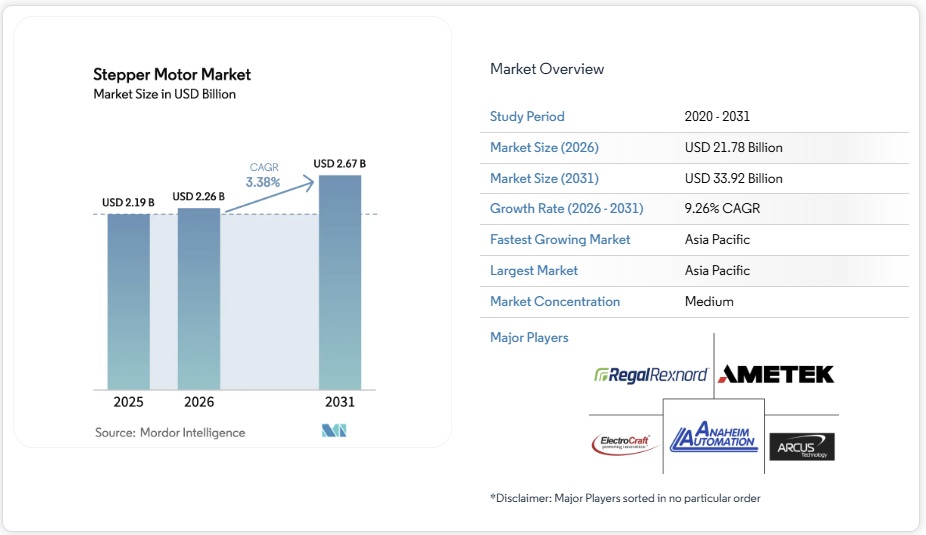
ステッピングモーター市場は、2025年の21億9,000万米ドルから2026年には22億6,000万米ドルに成長し、2026年から2031年にかけて年平均成長率3.38%で2031年には26億7,000万米ドルに達すると予測されています。ロボット、医療機器、半導体製造装置のメーカーが、サーボプラットフォームのシステムコストの高さを回避できる高精度なオープンループ位置決めのためにステッピングモーター技術を選択し続けているため、需要は安定しています。協働ロボットは組立セルで普及が進んでおり、予測可能なトルクと簡素化されたプログラミングを実現するコンパクトなNEMAフレームユニットの採用が加速しています。半導体、特にパッケージングおよびリソグラフィラインへの設備投資は、クリーンルーム環境で確実に動作するハイブリッドおよびリニアタイプの注文を支えています。成長は、ラボオートメーション、デスクトップ3Dプリンター、バッテリー製造ラインが、高い再現性を備えた低メンテナンスアクチュエータを求めていることにも起因しています。在庫調整の影響で2024年にはモーションコントロール業界全体が縮小したが、2025年の工場自動化への投資再開は、安定した購買サイクルへの回帰を示唆している。
セグメント分析
- ハイブリッド型ステッピングモーターは、トルク密度と1.8度のステップ分解能のバランスの良さから、2025年にはステッピングモーター市場の54.65%を占めると予測されています。また、年平均成長率(CAGR)3.95%で拡大し、永久磁石型や可変リラクタンス型を上回る成長が見込まれています。この優位性は、フレームサイズを大きくすることなく磁束密度を高める、より精密な磁気回路の開発に向けた継続的な研究開発投資につながっています。ベンダー各社は現在、I²R損失を低減し、低電流での動作を可能にする高充填率巻線を採用しており、発熱量の低減によりベアリング寿命を延ばしています。
- ハイブリッド型技術の改良は、IEC 60034-30-1規格への準拠に必要なエネルギー効率の向上にも貢献しています。ネオジム鉄ボロン磁石のブランクは、組み立て後のスキューを最小限に抑えるためにレーザー加工されており、フォトニクス試験ステージに不可欠なマイクロステップ直線性を向上させています。永久磁石式モーターは依然としてコスト重視の自動販売機に採用されており、一方、可変リラクタンス式モーターは、磁石の劣化が懸念される極低温環境下のポンプなど、ニッチな分野で需要を維持しています。ステッピングモーター市場全体としては、低価格サーボモーターとの性能差を縮めつつコスト優位性を維持するハイブリッド技術の改良を中心とした技術ロードマップの恩恵を受けています。
- ステッピングモーター市場レポートは、モータータイプ(ハイブリッド、永久磁石、可変リラクタンス)、駆動方式(オープンループ、クローズドループ)、用途(産業機器、ロボット・協働ロボット、医療・実験機器、コンピューティング/3Dプリンティングなど)、地域(北米、南米、欧州、アジア太平洋、中東、アフリカ)別に分類されています。市場予測は金額(米ドル)で示されています。
Stepper Motor Market Analysis
The stepper motor market is expected to grow from USD 2.19 billion in 2025 to USD 2.26 billion in 2026 and is forecast to reach USD 2.67 billion by 2031 at 3.38% CAGR over 2026-2031. Demand holds steady as manufacturers in robotics, medical devices, and semiconductor equipment continue choosing stepper technology for precise open-loop positioning that avoids the higher system cost of servo platforms. Collaborative robots are gaining traction in assembly cells and are accelerating the adoption of compact NEMA-frame units that deliver predictable torque and simplified programming.Semiconductor capital spending, particularly in packaging and lithography lines, sustains orders for hybrid and linear variants that operate reliably in clean-room environments. Growth also stems from laboratory automation, desktop 3-D printers, and battery-manufacturing lines seeking low-maintenance actuators with tight repeatability. While the overall motion-control sector contracted in 2024 because of inventory corrections, renewed factory-automation investment in 2025 signals a return to steady purchasing cycles.
Global Stepper Motor Market Trends and Insights
Growing adoption of robotics and collaborative automation
Manufacturing plants deploying collaborative robots favor stepper drives because predictable step increments allow intrinsic torque limiting that enhances human-machine safety. U.S. reshoring programs and European productivity upgrades are standardizing on modular motion platforms that accept low-voltage, two-phase hybrids with microstepping controllers. Encoder-equipped closed-loop models are now achieving near-servo smoothness, broadening the feasible working envelope for pick-and-place systems. Ethernet-based protocols integrate the motors into plant networks, enabling condition monitoring that minimizes unplanned downtime. As small-lot production dominates contract manufacturing, easy changeover and fast programming keep stepper solutions attractive for integrators.
Rising demand for precision motion control in medical devices
Surgical robots, hematology analyzers, and drug-delivery pumps require sub-micron accuracy within compact footprints, a specification matched by modern hybrid steppers coupled to high-resolution encoders. Designers select the motors for repeatable holding torque that maintains instrument position even when power is cut, a critical patient-safety safeguard. Quiet operation is delivered by damping algorithms that shift resonance away from audible frequencies, meeting hospital noise norms. FDA and CE rules highlight traceability, favoring vendors with ISO 13485 certificates and validated design-history files. Long replacement cycles in healthcare extend revenue visibility for component suppliers.
Performance limits versus servo / BLDC motors
Despite incremental gains, torque in stepper stacks declines sharply above 1,000 RPM, capping suitability in high-speed pick-and-place or conveyor drives. Price erosion in entry-level servos reduces the historical cost gap that once favored steppers for medium-precision work. Integrated servo packages now include automatic tuning and fieldbus options, simplifying commissioning and reducing the total installed cost delta. Marketers, therefore, emphasize use cases where positional holding torque at standstill outweighs dynamic requirements, such as valve actuation or microplate indexing.
Other drivers and restraints analyzed in the detailed report include:
- Expansion of 3-D printing and desktop manufacturing ecosystems
- Surge in semiconductor packaging-equipment investments
- Integrated smart-actuators cannibalizing discrete motors
For complete list of drivers and restraints, kindly check the Table Of Contents.
Segment Analysis
Hybrid variants commanded 54.65% stepper motor market share in 2025 due to their balance of torque density and 1.8-degree step resolution, and they are forecast to expand at a 3.95% CAGR, outpacing permanent-magnet and variable-reluctance formats. This dominance translates into sustained research and development allocations for finer magnetic circuits that raise flux density without enlarging frame size. Vendors now deploy high-fill-factor windings that shave I²R losses and allow operation at reduced current, extending bearing life through lower heat generation.
Hybrid improvements also underpin energy-efficiency upgrades needed to comply with IEC 60034-30-1 classes. Neodymium-iron-boron magnet blanks are laser-machined to minimize post-assembly skew, improving microstep linearity essential for photonics test stages. Permanent-magnet units still serve cost-sensitive vending machines, while variable-reluctance designs retain niches in extreme-temperature pumps where magnet decay is a concern. Overall, the stepper motor market benefits from a technology roadmap centered on hybrid refinements that close the performance gap with inexpensive servos without surrendering the cost advantage.
The Stepper Motor Market Report is Segmented by Motor Type (Hybrid, Permanent Magnet, and Variable Reluctance), Drive Technique (Open-Loop, and Closed-Loop), Application (Industrial Equipment, Robotics and Cobots, Medical and Laboratory Devices, Computing / 3-D Printing, and More), and Geography (North America, South America, Europe, Asia-Pacific, Middle East, and Africa). The Market Forecasts are Provided in Terms of Value (USD).
Geography Analysis
Asia-Pacific remained the 2025 revenue leader with a 35.74% share, anchored by Chinese component ecosystems that streamline magnet, shaft, and driver sourcing. Regional titans such as MOONS’ Electric leverage scale economies above 1 million units per year, supporting aggressive pricing that feeds global export channels. Japan complements volume with technology, patented closed-loop firmware, and high-vacuum designs that power the region’s semiconductor equipment exports. South Korea and Southeast Asia have emerged as contract-manufacturing hubs that integrate imported hybrids into finished printer and robot sub-assemblies, reinforcing intra-regional value chains.
North America, projected at a 3.76% CAGR, benefits from federal incentives that reimburse automation upgrades and onshore semiconductor fabs. U.S. integrators increasingly specify standardized NEMA frames over custom servos to shorten lead times during green-field EV battery-plant construction. Canadian facilities in life sciences and food packaging drive demand for wash-down IP65 variants, while Mexico supports automotive harness production lines using cost-optimized open-loop steppers.
Europe experiences steady gains under energy-efficiency directives such as Regulation 2019/1781 that push factories toward closed-loop retrofits. German OEMs exploit local precision-machining expertise to supply high-vacuum variants to the global wafer-tool sector. Meanwhile, emerging Middle-East and African economies begin specifying stepper drives in desalination, textile, and packaging projects, though volumes remain a fraction of mature regions. Altogether, geographic diversification shields the stepper motor market from isolated downturns and underscores a resilient multi-regional demand base.
List of Companies Covered in this Report:
- AMETEK, Inc.
- Anaheim Automation, Inc.
- Arcus Technology Inc.
- Changzhou Fulling Motor Co., Ltd.
- Changzhou Leili Intelligent Drive Systems Co., Ltd.
- ElectroCraft, Inc.
- Faulhaber Group
- JVL Industri Elektronik A/S
- Kollmorgen (Regal Rexnord Corp.)
- Lin Engineering, Inc.
- MinebeaMitsumi Inc.
- MOONS’ Electric Co., Ltd.
- Nanotec Electronic GmbH & Co. KG
- Nidec Servo Corporation
- Nippon Pulse America, Inc.
- Oriental Motor Co., Ltd.
- Parker-Hannifin Corp.
- Performance Motion Devices, Inc.
- Phytron GmbH
- Schneider Electric SE
- Sanyo Denki Co., Ltd.
- Sonceboz SA
- STMicroelectronics N.V.
- Tamagawa Seiki Co., Ltd.
- Texas Instruments Inc.
Additional Benefits:
- The market estimate (ME) sheet in Excel format
- 3 months of analyst support
Table of Contents
1 INTRODUCTION
1.1 Study Assumptions and Market Definition
1.2 Scope of the Study
2 RESEARCH METHODOLOGY
3 EXECUTIVE SUMMARY
4 MARKET LANDSCAPE
4.1 Market Overview
4.2 Market Drivers
4.2.1 Growing adoption of robotics and collaborative automation
4.2.2 Rising demand for precision motion control in medical devices
4.2.3 Expansion of 3-D printing and desktop manufacturing ecosystems
4.2.4 Surge in semiconductor packaging-equipment investments
4.2.5 Shift to energy-efficient closed-loop stepper solutions
4.2.6 Government incentives for localised motion-component production
4.3 Market Restraints
4.3.1 Performance limits versus servo / BLDC motors
4.3.2 Price pressure from low-cost Asian manufacturers
4.3.3 Integrated smart-actuators cannibalising discrete motors
4.3.4 Thermal-management challenges in compact designs
4.4 Industry Supply Chain Analysis
4.5 Regulatory Landscape
4.6 Technological Outlook
4.7 Porter’s Five Forces Analysis
4.7.1 Bargaining Power of Suppliers
4.7.2 Bargaining Power of Buyers
4.7.3 Threat of New Entrants
4.7.4 Threat of Substitutes
4.7.5 Intensity of Competitive Rivalry
4.8 Impact of Macroeconomic Factors
5 MARKET SIZE AND GROWTH FORECASTS (VALUE)
5.1 By Motor Type
5.1.1 Hybrid
5.1.2 Permanent Magnet
5.1.3 Variable Reluctance
5.2 By Drive Technique
5.2.1 Open-Loop
5.2.2 Closed-Loop
5.3 By Application
5.3.1 Industrial Equipment
5.3.2 Robotics and Cobots
5.3.3 Medical and Laboratory Devices
5.3.4 Computing / 3-D Printing
5.3.5 Other Applications
5.4 By Geography
5.4.1 North America
5.4.1.1 United States
5.4.1.2 Canada
5.4.1.3 Mexico
5.4.2 South America
5.4.2.1 Brazil
5.4.2.2 Argentina
5.4.2.3 Rest of South America
5.4.3 Europe
5.4.3.1 Germany
5.4.3.2 United Kingdom
5.4.3.3 France
5.4.3.4 Italy
5.4.3.5 Spain
5.4.3.6 Russia
5.4.3.7 Rest of Europe
5.4.4 Asia-Pacific
5.4.4.1 China
5.4.4.2 Japan
5.4.4.3 India
5.4.4.4 South Korea
5.4.4.5 South-East Asia
5.4.4.6 Rest of Asia-Pacific
5.4.5 Middle East and Africa
5.4.5.1 Middle East
5.4.5.1.1 Saudi Arabia
5.4.5.1.2 United Arab Emirates
5.4.5.1.3 Rest of Middle East
5.4.5.2 Africa
5.4.5.2.1 South Africa
5.4.5.2.2 Egypt
5.4.5.2.3 Rest of Africa
6 COMPETITIVE LANDSCAPE
6.1 Market Concentration
6.2 Strategic Moves
6.3 Market Share Analysis
6.4 Company Profiles (includes Global-level Overview, Market-level Overview, Core Segments, Financials as available, Strategic Information, Market Rank/Share for key companies, Products and Services, and Recent Developments)
6.4.1 AMETEK, Inc.
6.4.2 Anaheim Automation, Inc.
6.4.3 Arcus Technology Inc.
6.4.4 Changzhou Fulling Motor Co., Ltd.
6.4.5 Changzhou Leili Intelligent Drive Systems Co., Ltd.
6.4.6 ElectroCraft, Inc.
6.4.7 Faulhaber Group
6.4.8 JVL Industri Elektronik A/S
6.4.9 Kollmorgen (Regal Rexnord Corp.)
6.4.10 Lin Engineering, Inc.
6.4.11 MinebeaMitsumi Inc.
6.4.12 MOONS’ Electric Co., Ltd.
6.4.13 Nanotec Electronic GmbH & Co. KG
6.4.14 Nidec Servo Corporation
6.4.15 Nippon Pulse America, Inc.
6.4.16 Oriental Motor Co., Ltd.
6.4.17 Parker-Hannifin Corp.
6.4.18 Performance Motion Devices, Inc.
6.4.19 Phytron GmbH
6.4.20 Schneider Electric SE
6.4.21 Sanyo Denki Co., Ltd.
6.4.22 Sonceboz SA
6.4.23 STMicroelectronics N.V.
6.4.24 Tamagawa Seiki Co., Ltd.
6.4.25 Texas Instruments Inc.
7 MARKET OPPORTUNITIES AND FUTURE OUTLOOK
7.1 White-Space and Unmet-Need Assessment