
| 出版社 | MarketsandMarkets |
| 出版年月 | 2025年11月 |
EV Semiconductors Market – Global Forecast To 2032

EV用半導体市場 – テクノロジー(シリコンベース、ワイドバンドギャップ)、推進力、用途(バッテリー管理システム、パワートレイン、ADASなど)、コンポーネント(電源ICとモジュール、MCUとプロセッサ、センサーなど)、および地域別 – 2032年までの世界予測
EV用半導体市場は、2025年の240億9,000万米ドルから年平均成長率9.1%で成長し、2032年には574億8,000万米ドルに達すると予測されています。
市場の成長は、乗用車1台あたりの半導体搭載量の増加と、完全電動プラットフォームへの移行によって推進されています。EVは、安全機能と自動化機能のためにより多くのセンサーとコンピューティングを使用するため、ADASには、ICE車両よりも高い普及率で高性能MCU、レーダー、ビジョンチップが必要です。急速充電、サイクル寿命の延長、正確なセルモニタリングには、高精度アナログフロントエンド、パワーデバイス、機能安全プロセッサが必要なため、バッテリーエレクトロニクスはますます高度化しています。SiC、GaN、ハイブリッドSiC GaNインバータ、高度なパッケージングなどのワイドバンドギャップ技術は、効率を向上させ、発熱を低減し、コンパクトな高出力設計を可能にします。米国CHIPS法やEUチップ法などの政府の取り組みは、テキサス・インスツルメンツ、インフィニオン、STマイクロエレクトロニクスによる現地工場の拡張を促進しています。ソフトウェア定義の車両プラットフォームにより、メモリと処理能力の需要が増加し、OEM サプライヤーとの緊密な連携によりイノベーションが加速します。プレミアム BEV の 800V アーキテクチャにより、充電速度の高速化と走行距離の延長を実現する高度なパワー半導体の採用が促進されています。Audi A6 や Mercedes-Benz C クラスなどのモデルの 48V システムは、完全な高電圧 EV 設計に移行することなく、高い電気負荷に対応できる効率的なパワーデバイスの需要を維持しています。
本レポートは、EV用半導体市場を、技術(シリコンベース半導体、ワイドバンドギャップ半導体)、推進力(バッテリー電気自動車(BEV)およびプラグインハイブリッド電気自動車(PHEV)、アプリケーション(バッテリー管理システム、パワートレインシステム、ADAS、ボディ&シャーシ、インフォテインメント&コネクティビティ)、コンポーネントタイプ(パワーIC&モジュール、マイクロコントローラ&プロセッサ、ディスクリート、通信&インターフェースIC、センサーIC、ゲートドライバIC、メモリ&ストレージIC、その他の半導体)、および地域の観点から分析しています。また、EV用半導体市場における主要プレーヤーの競合状況と企業プロフィールも網羅しています。本調査には、主要市場プレーヤー、企業プロフィール、製品および事業内容に関する主要な考察、最近の動向、主要な市場戦略に関する詳細な競合分析が含まれています。
レポートを購入する主なメリット:
- 本レポートは、EV半導体市場とそのサブセグメントの収益数値の近似値に関する情報を提供し、市場リーダーや新規参入企業に役立ちます。
- 本レポートは、関係者が競争環境を理解し、ビジネスの位置付けを改善し、適切な市場開拓戦略を策定するための洞察を深めるのに役立ちます。
- 本レポートは、ステークホルダーが市場の動向を把握し、主要な市場牽引要因、制約要因、課題、そして機会に関する情報を提供する上で役立ちます。
- 本レポートは、ステークホルダーがEV用半導体市場の現状および将来の価格動向を理解する上でも役立ちます。
- このレポートは、テクノロジー、推進力、アプリケーション、コンポーネントの種類、地域に基づいたさまざまな市場動向に関する情報を提供し、市場リーダー/新規参入企業にも役立ちます。
このレポートでは、以下の点について詳しく説明します。
- 主な推進要因(EV の普及拡大、EV 1 台あたりの半導体含有量の高さ、チップ設計と統合における技術的進歩)、制約要因(長い認定サイクルと厳格な自動車信頼性基準、先端材料の高コスト、地政学的、貿易的、輸出管理上のリスク、断片化された基準と相互運用性の課題)、機会(ワイドバンドギャップ材料の成長、新興市場での拡大、Tier 1 および OEM とのパートナーシップ/共同開発)、課題(激しい競争とマージン圧力、サイバーセキュリティ、安全性、責任に関する懸念)の分析。
- 製品開発/イノベーション:EV半導体市場における今後の技術、研究開発活動、製品投入に関する詳細な洞察
- 市場開発:様々な地域における収益性の高い市場に関する包括的な情報
- 市場多様化:EV半導体市場における新製品・サービス、未開拓地域、最近の動向、投資に関する包括的な情報
- 競合評価:EV半導体市場における、インフィニオンテクノロジーズAG(ドイツ)、STマイクロエレクトロニクス(スイス)、NXPセミコンダクターズ(オランダ)、テキサスインスツルメンツインコーポレーテッド(米国)、ルネサスエレクトロニクス株式会社(日本)などの主要企業の市場シェア、成長戦略、サービス提供の詳細な評価
Report Description
The EV semiconductors market is projected to reach USD 57.48 billion in 2032, growing from USD 24.09 billion in 2025, at a CAGR of 9.1%. The market’s growth is driven by increasing semiconductor content per passenger car and the shift to fully electric platforms. EVs use more sensors and computing for safety and automation features, so ADAS requires high-performance MCUs, radar, and vision chips at higher penetration than ICE vehicles. Battery electronics are becoming more advanced because fast charging, longer cycle life, and precise cell monitoring need high-accuracy analog front ends, power devices, and functional safety processors. Wide-bandgap technologies, including SiC and GaN, hybrid SiC GaN inverters, and advanced packaging, improve efficiency, lower heat, and enable compact high-power designs. Government initiatives, such as the US CHIPS Act and the EU Chips Act, drive local fab expansion by Texas Instruments, Infineon, and STMicroelectronics. Software-defined vehicle platforms increase the demand for memory and processing, and tighter OEM supplier collaboration accelerates innovation. 800V architectures in premium BEVs are pushing the adoption of advanced power semiconductors for faster charging and a longer range. 48V systems in models like Audi A6 and Mercedes-Benz C Class sustain demand for efficient power devices to support high electrical load without moving to full high voltage EV designs.
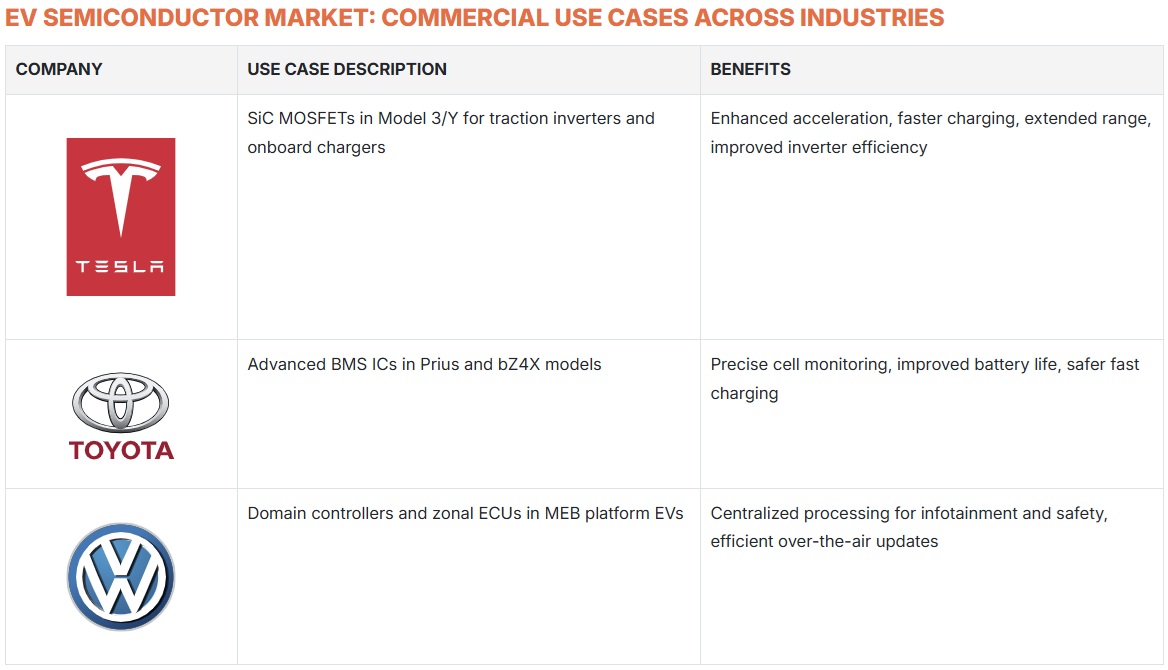
EV Semiconductors Market – commercial use cases across industries
The EV semiconductors market is dominated by major players, including Infineon Technologies AG (Germany), STMicroelectronics (Switzerland), NXP Semiconductors (Netherlands), Texas Instruments Incorporated (US), Renesas Electronics Corporation (Japan), and more. These companies are expanding their portfolios to strengthen their market position.
Research Coverage:
The report covers the EV semiconductors market in terms of Technology (Silicon-based Semiconductor, Wide-Bandgap Semiconductor), Propulsion [Battery Electric Vehicle (BEV) and Plug-In Hybrid Electric Vehicle (PHEV)], Application (Battery Management System, Powertrain System, ADAS, Body & Chassis, and Infotainment & Connectivity), Component Type (Power ICs & Modules, Microcontrollers & Processors, Discretes, Communication & Interface ICs, Sensor ICs, Gate Driver ICs, Memory & Storage ICs, Other Semiconductors), and Region. It covers the competitive landscape and company profiles of significant players in the EV semiconductors market. The study includes an in-depth competitive analysis of the key market players, their company profiles, key observations related to product and business offerings, recent developments, and key market strategies.
Key Benefits of Buying the Report:
- The report will help market leaders/new entrants with information on the closest approximations of revenue numbers for the EV semiconductors market and its subsegments.
- This report will help stakeholders understand the competitive landscape and gain more insights to position their businesses better and plan suitable go-to-market strategies.
- The report will also help stakeholders understand the market pulse and provides information on key market drivers, restraints, challenges, and opportunities.
- The report will also help stakeholders understand the EV semiconductors market’s current and future pricing trends.
- The report will also help market leaders/new entrants with information on various market trends based on technology, propulsion, application, component type, and Region.
The report provides insight into the following pointers:
- Analysis of key drivers (Rising EV adoption, high semiconductor content per EV, technological advancements in chip design and integration), restraints (Long qualification cycles and strict automotive reliability standards; high cost of advanced materials; and geopolitical, trade, and export control risks; fragmented standards and interoperability challenges), opportunities (Growth in wide-bandgap materials, expansion in emerging markets, tier-1 and OEM partnerships/co-development), and challenges (Intense competition and margin pressure; cybersecurity, safety, and liability concerns).
- Product Development/Innovation: Detailed insights into upcoming technologies, research & development activities, and product launches in the EV semiconductors market
- Market Development: Comprehensive information about lucrative markets across varied regions
- Market Diversification: Exhaustive information about new products and services, untapped geographies, recent developments, and investments in the EV semiconductors market
- Competitive Assessment: In-depth assessment of market share, growth strategies, and service offerings of leading players like Infineon Technologies AG (Germany), STMicroelectronics (Switzerland), NXP Semiconductors (Netherlands), Texas Instruments Incorporated (US), and Renesas Electronics Corporation (Japan), among others, in the EV semiconductors market