
| 出版社 | MarketsandMarkets |
| 出版年月 | 2025年10月 |
3D Cell Culture Market – Global Forecast to 2030

三次元細胞培養市場 – 製品(スキャフォールド[ハイドロゲル、固体スキャフォールド]、スキャフォールドフリー[低接着プレート、マイクロ流体、バイオプリント])、用途(がん、幹細胞研究、組織工学)、トレンド、エンドユーザー、地域別 – 2030年までの世界予測
世界の三次元細胞培養(3D細胞培養)市場は、2024年の11億8,000万米ドルから2030年には22億6,000万米ドルに達し、予測期間中は年平均成長率(CAGR)11.7%で成長すると予測されています。3D細胞培養の導入拡大や3D細胞培養研究への資金提供の増加といった要因が市場の成長を牽引しています。
本調査レポートは、三次元細胞培養(3D細胞培養)市場を製品別(スキャフォールドベース3D細胞培養、スキャフォールドフリー3D細胞培養、マイクロ流体ベース3D細胞培養、磁性およびバイオプリント3D細胞培養)、用途別(がんおよび幹細胞研究、創薬および毒性試験、組織工学および再生医療)、エンドユーザー別(製薬およびバイオテクノロジー企業、研究機関、化粧品業界、その他のエンドユーザー)、地域別(北米、欧州、アジア太平洋、ラテンアメリカ、中東、アフリカ)に分類しています。レポートは、3D細胞培養市場の成長に影響を与える推進要因、課題、機会、制約など、主要な要因に関する詳細な情報を網羅しています。主要業界プレーヤーの詳細な分析により、事業概要、サービスポートフォリオ、コラボレーション、パートナーシップ、拡張、契約、買収などの主要戦略、そして3D細胞培養市場に関連する最近の動向に関する洞察を提供しています。このレポートでは、3D 細胞培養市場のエコシステムにおけるトップ プレーヤーと今後の新興企業の競合分析を取り上げています。
本レポートは、三次元細胞培養(3D細胞培養)市場の成長に影響を与える主要な要因(促進要因、制約要因、課題、機会など)に関する詳細な情報を網羅しています。主要業界プレーヤーを徹底的に分析し、事業概要、ソリューション、サービス、主要戦略、新製品の発売、買収、3D細胞培養市場に関連する最近の動向に関する洞察を提供しています。本レポートは、3D細胞培養市場エコシステムにおける新興企業の競合分析も網羅しています。
本レポートは、三次元細胞培養(3D細胞培養)市場全体とそのサブセグメントの収益数値に最も近い概算値を提供することで、市場リーダー/新規参入企業を支援します。また、ステークホルダーが競争環境をより深く理解し、事業のポジショニングを改善し、適切な市場開拓戦略を策定するための洞察を深めるのに役立ちます。本レポートは、ステークホルダーが市場の動向を把握し、主要な市場牽引要因、制約要因、機会、課題に関する情報を提供することを可能にします。
The global 3D cell culture market is projected to reach USD 2.26 billion by 2030 from USD 1.18 billion in 2024, at a CAGR of 11.7% during the forecast period. Factors such as increased adoption of 3D cell culture and a rise in funding for 3D cell culture research drive market growth.
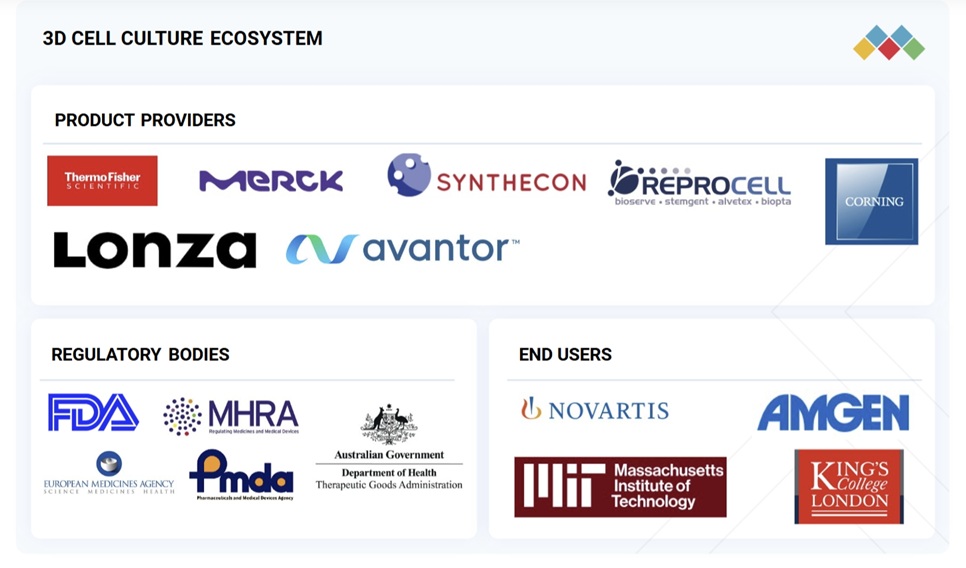
3D Cell Culture Market – Global Forecast to 2030 – ecosystem
The top players in the global 3D cell culture market are Thermo Fisher Scientific, Inc. (US), Merck KGaA (Germany), Corning Incorporated (US), Lonza (Switzerland), Tecan Trading AG (Switzerland), Avantor, REPROCELL Inc. (Japan), 3D Biotek LLC. (US), S-BIO, Vaupell Holdings Inc. (US), Advanced BioMatrix Inc. (US), UPM Biomedicals (Finland), SYNTHECON, INCORPORATED (US), Emulate, Inc. (US), CN Bio Innovations Ltd. (UK), Kirkstall Ltd. (UK), Lena Biosciences (US), TissUse GmbH (Germany), Cellendes GmbH (Germany), Greiner Bio-one International GmbH (Germany), AMSBIO (UK), MIMETAS B.V.(Netherlands), and Promocell GmbH (Germany).
Research Coverage
This research report categorizes the 3D cell culture market by product (scaffold-based 3D cell cultures, scaffold-free 3D cell cultures, microfluidics-based 3D cell cultures, and magnetic & bioprinted 3D cell cultures), application (cancer & stem cell research, drug discovery & toxicology testing, and tissue engineering & regenerative medicine), end user (pharmaceutical & biotechnology companies, research institutes, cosmetics industry, and other end users) and by region (North America, Europe, Asia Pacific, Latin America, Middle East, and Africa). The scope of the report covers detailed information regarding the major factors, such as drivers, challenges, opportunities, and restraints influencing the growth of the 3D cell culture market. A detailed analysis of the key industry players has been done to provide insights into their business overview, service portfolio, key strategies such as collaborations, partnerships, expansions, agreements, and acquisitions, and recent developments associated with the 3D cell culture market. This report covers a competitive analysis of top players and upcoming startups in the 3D cell culture market ecosystem.
The report’s scope covers detailed information regarding the primary factors, such as drivers, restraints, challenges, and opportunities, influencing the growth of the 3D cell culture market. A thorough analysis of the key industry players has been conducted to provide insights into their business overview, solutions, and services; key strategies; new product launches, acquisitions, and recent developments associated with the 3D cell culture market. This report covers the competitive analysis of upcoming startups in the 3D cell culture market ecosystem.
Key Benefits of Buying the Report:
The report will help market leaders/new entrants by providing them with the closest approximations of the revenue numbers for the overall 3D cell culture market and its subsegments. It will also help stakeholders better understand the competitive landscape and gain more insights to better position their business and make suitable go-to-market strategies. This report will enable stakeholders to understand the market’s pulse and provide them with information on the key market drivers, restraints, opportunities, and challenges.
The report provides insights into the following pointers:
- Analysis of key drivers (high focus on developing alternatives to animal testing, increasing adoption of personalized medicine, increased government support and funding, rising academia-research collaborations), restraints (high cost of implementing 3D cell culture technologies, lack of widely accepted or single standardization in 3D cell culture), opportunities (emergence of microfluidic based 3D cell culture), and challenges (lack of consistency in 3D cell culture products, high dependency on plastic waste disposals and consumables) influencing the growth of 3D cell culture market.
- Product Development/Innovation: Detailed insights on newly launched products of the 3D cell culture market
- Market Development: Comprehensive information about lucrative markets – the report analyses the 3D cell culture market across varied regions.
- Market Diversification: Exhaustive information about new services, untapped geographies, recent developments, and investments in the 3D cell culture market.
- Competitive Assessment: In-depth assessment of market shares, growth strategies, and service offerings of leading players such as Thermo Fisher Scientific Inc. (US), Merck KGaA (Germany), Corning Incorporated (US), Lonza (Switzerland), and Avantor Inc. (US), among others