
| 出版社 | Mordor Intelligence |
| 出版年月 | 2025年9月 |
Ghana Automobile – Market Share Analysis, Industry Trends & Statistics, Growth Forecasts (2025 – 2030)

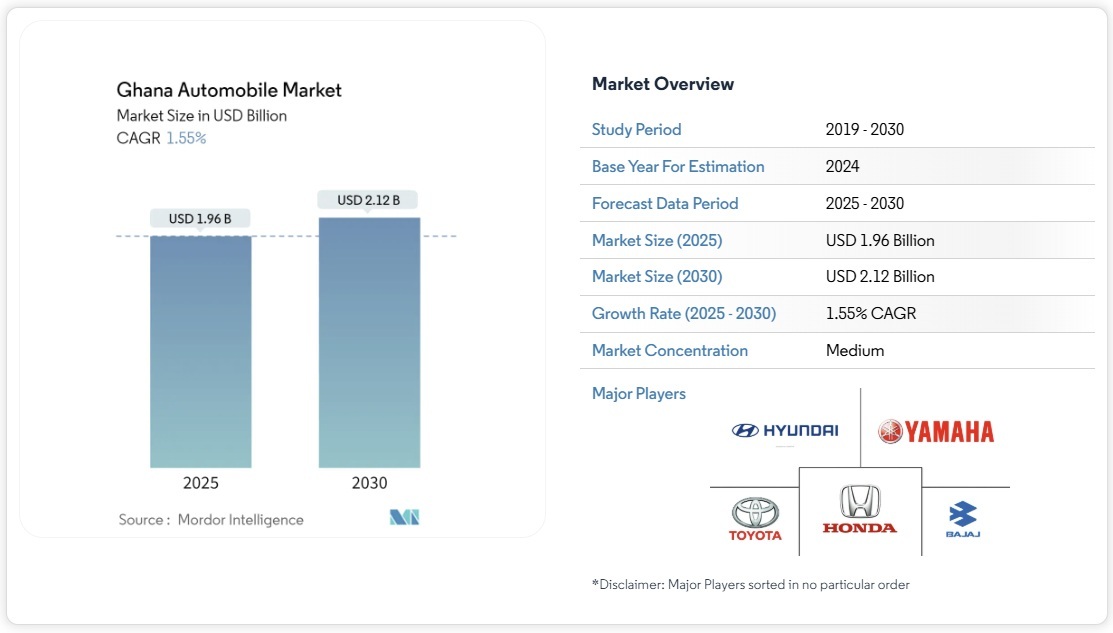
ガーナの自動車市場規模は、2025年には19億6,000万米ドルと推定され、予測期間(2025~2030年)中に1.55%のCAGRで成長し、2030年までに21億2,000万米ドルに達すると予想されています。
ガーナの自動車産業は、輸入中古車販売店と、新車販売を行う少数の販売代理店で構成されています。ガーナは年間約10万台の自動車を輸入しており、米国、日本、ドイツが主要な供給国です。ガーナは西アフリカ諸国の中で第3位の経済大国であり、2016年にカンタカ・グループが開始した「Made in Ghana」車の増加と、ガーナ自動車産業における熟練労働者の増加により、予測期間中に自動車産業の成長が見込まれています。
ガーナは、自動車メーカーによる西アフリカの同国への工場設立を促進するため、製造から10年以上経過した車両の輸入を禁止した。ガーナの自動車輸入の70%以上は中古車が占めている。この新法には、ガーナで自動車を製造または組立する自動車メーカーに対する輸入関税の免除も盛り込まれている。
The Ghana Automobile Market size is estimated at USD 1.96 billion in 2025, and is expected to reach USD 2.12 billion by 2030, at a CAGR of 1.55% during the forecast period (2025-2030).
The automotive industry in Ghana consists of retailers of imported used vehicles and a few distributors who retail newly manufactured vehicles. The country imports about 100,000 vehicles per year. The United States, Japan, and Germany are the country’s leading suppliers. Ghana is the third biggest economy among West African countries, and it is expected to experience growth in the automotive industry during the forecast period, owing to the increase in ‘Made in Ghana’ vehicles initiated by Kantaka Group in 2016 and the increasing skilled workforce in the Ghanaian automotive industry.
Ghana Automobile – Market Share Analysis, Industry Trends & Statistics, Growth Forecasts
Ghana has prohibited the import of vehicles older than ten years in an effort to encourage automakers to establish factories in the West African country. Used vehicles account for more than 70% of vehicle imports in Ghana. The new legislation also includes import-duty exemptions for automakers that manufacture or assemble vehicles in the country.
According to Bloomberg, Volkswagen, Nissan, Toyota, Suzuki, and Renault are among the companies that are considered a significant presence in Ghana. The country hopes to become a car manufacturing hub for West Africa, a region with a population of over 380 million people. Carmakers who enter the country must consider offering car loan services. Car loans are now uncommon in Africa, prompting many people to purchase used vehicles instead.
In the short term, considering Ghana’s present fiscal constraints, the government has devised plans to introduce 1,000 electric buses, along with the necessary charging and maintenance infrastructure, for both intra-city (40%) and intercity (60%) transportation services. By 2050, Ghana aims to have 32%, equivalent to 12,027 electric public buses, operational nationwide.
According to the International Trade Administration, this initiative involves the assembly of 500 complete built-unit (CBU) electric buses and 500 semi-knocked-down (SKD) buses in collaboration with local assemblers, fostering a productive partnership on Ghanaian soil.
Ghana Automobile Industry Overview
The Ghanaian automobile market is moderately fragmented, with a few players such as Toyota Motors, Nissan Motors, Suzuki Corporation, Hyundai Motors, Yamaha Motors, Bajaj Auto, and Hero Motorcycles, among others. Several players in the market are introducing various business strategies to gain a competitive advantage, which are expected to enhance the target market during the forecast period.
- October 2023: Ashok Leyland announced the completion of its maiden locally assembled Phoneix trucks at Rana Motors assembling plant in Accra. The company aims to take advantage of the government’s Automotive Manufacturing Development policy to ramp up its assembling activity in Ghana.
- April 2023: Ghana’s Jospong Group, a major conglomerate in the country, announced its collaboration with the US-based ZeroNox, which specializes in the electrification of commercial vehicles, to launch a massive electrification project involving 1,000 rubbish trucks. Under the signed joint venture agreement, 1,000 rubbish trucks from Zoomlion, a subsidiary of Jospong, would be retrofitted with ZeroNox’s latest EV platform and LFP batteries.