
| 出版社 | Mordor Intelligence |
| 出版年月 | 2025年7月 |
Bicycle – Market Share Analysis, Industry Trends & Statistics, Growth Forecasts (2025 – 2030)

自転車市場レポートは、製品タイプ(ロード/シティ、マウンテン/オールテレーン、ハイブリッド、E-自転車、その他)、デザイン(通常および折りたたみ)、エンドユーザー(男性、女性、子供)、流通チャネル(オフライン小売店およびオンライン小売店)、および地域(北米、ヨーロッパ、アジア太平洋、南米、中東およびアフリカ)別にセグメント化されています。
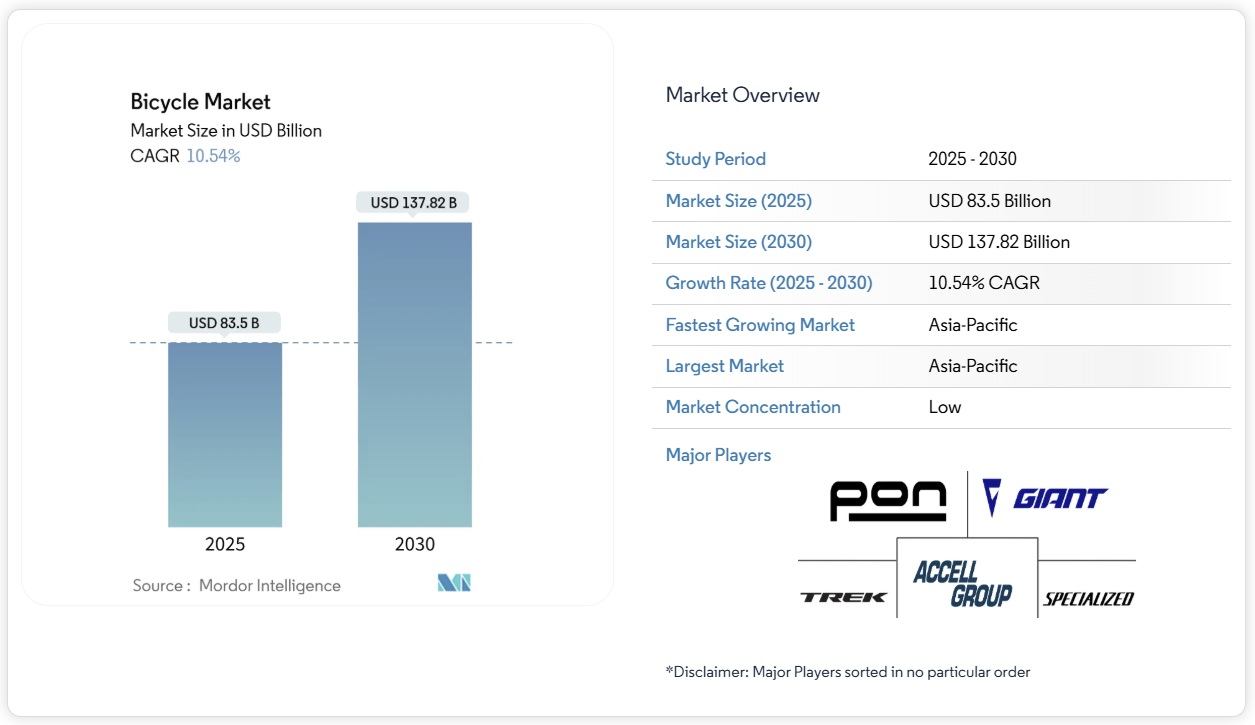
自転車市場規模は2025年に835億米ドルと推定され、2030年には1,378億2,000万米ドルに達すると予測されています。予測期間(2025~2030年)中、年平均成長率(CAGR)は10.54%です。都市部では渋滞税の導入が進み、雇用主は健康増進プログラムに自転車利用のインセンティブを組み込むなど、自転車の持続的な需要を促進しています。この需要は、既に予測を上回る大規模なインフラ投資と、炭素排出量削減を目的とした厳格な気候変動対策によってさらに高まっています。さらに、バッテリー安全技術の継続的な進歩は、安全性への懸念に対応することで、潜在的な消費者基盤を拡大しています。消費者直販ブランドの台頭と、ソフトウェアを活用したフリートサービスの統合は、小売業界のあり方を再定義し、業務効率を最適化し、顧客のアクセス性を向上させています。燃料価格の高騰は、自転車の自動車に対するコスト優位性をさらに高め、より経済的に実現可能な選択肢となっています。全体として、自転車市場は、有利な規制の枠組み、技術の進歩、そして持続可能かつアクティブなモビリティソリューションへの都市生活の移行に支えられ、成長を続けています。
2024年には、アジア太平洋地域が世界市場の48.11%を占め、主要な収益貢献者としての地位を確固たるものにしました。この地域は、いくつかの要因に牽引され、2030年まで13.33%という高い年平均成長率(CAGR)を達成すると予測されています。中国では、電動自転車の普及、バッテリーリサイクルの義務化、そして持続可能な交通手段としての二輪車の利用を積極的に奨励する都市交通政策により、自転車市場が大きな成長を遂げています。一方、日本は認証制度を欧州基準に戦略的に整合させることで、輸出手続きの簡素化と国内ブランドの国際競争力強化を図っています。
Bicycle Market Analysis
The bicycle market size is estimated at USD 83.50 billion in 2025, and is expected to reach USD 137.82 billion by 2030, at a CAGR of 10.54% during the forecast period (2025-2030). Urban centers are increasingly implementing congestion charges, while employers are incorporating bicycle incentives into wellness programs, driving sustained demand for bicycles. This demand is further reinforced by significant government investments in infrastructure, which have already exceeded projections, alongside stricter climate policies aimed at reducing carbon emissions. Additionally, ongoing advancements in battery safety technology are expanding the potential consumer base by addressing safety concerns. The emergence of direct-to-consumer brands and the integration of software-enabled fleet services are redefining the retail landscape, optimizing operational efficiencies, and enhancing customer accessibility. Rising fuel prices are further amplifying the cost advantage of bicycles over motorized vehicles, making them a more economically viable option. Overall, the bicycle market continues to experience growth, supported by favorable regulatory frameworks, technological progress, and a shift in urban lifestyles toward sustainable and active mobility solutions.
Bicycle – Market Share Analysis, Industry Trends & Statistics, Growth Forecasts (2025 – 2030)
List of Companies Covered in this Report:
- Accell Group NV
- Trek Bicycle Corporation
- Pon Holdings BV
- Giant Manufacturing Co. Ltd
- Specialized Bicycle Components Inc.
- Shimano Inc.
- Scott Sports SA
- Merida Industry Co. Ltd
- Stryder Cycle Private Limited
- Cycles Devinci inc.
- Pending System GmbH & Co. KG
- Brompton Bicycle Ltd
- Decathlon SA
- Rad Power Bikes Inc.
- Riese and Muller GmbH
- Bulls Bikes GmbH
- Yadea Group Holdings Ltd
- Canyon Bicycles GmbH
- Hero Cycles Limited
- Ribble Cycles
Segment Analysis
E-bicycles held 51.25% of the bicycle market in 2024, and the segment is forecast to post a 12.76% CAGR to 2030. The bicycle market size for e-bicycles is therefore on track to more than double within the decade, propelled by safety certifications such as UL 2849 that boost consumer trust. Batteries are now removable and airline-compliant, widening use cases. Meanwhile, conventional road and city bikes preserve large sales volumes, sustaining economies of scale for component suppliers.
Technology convergence defines competitive edges: integrated navigation, theft-tracking, and predictive maintenance enrich the rider experience and push premium price points. Asia-Pacific producers benefit from cost-efficient capacity, while European assemblers leverage proximity to capture premium niches. Battery recycling mandates in China set a template other regions may follow, adding after-sales service revenue for compliant brands. Market entry remains open for software-native firms bundling bikes with fleet analytics, providing asset-light access to mobility budgets.
In 2024, regular frames continue to dominate the bicycle market, accounting for a substantial 85.78% market share. This dominance highlights the strong appeal of mass-produced geometries, cost-effective pricing, and seamless compatibility with existing infrastructure, which collectively make regular frames a preferred choice among consumers. On the other hand, folding designs are projected to experience a robust growth trajectory, registering an impressive 11.43% CAGR through 2030. This growth rate, which is double that of the overall bicycle market, is primarily driven by the rising demand for compact and space-efficient solutions, particularly in response to challenges such as limited urban housing space and the growing need for efficient last-mile connectivity with rail networks.
Material advances in magnesium hinges and quick-release clamps now limit weight premiums, and warranty parity with regular bikes removes past hesitations. In the bicycle industry, corporations also favor foldables for employee fleets because units store safely under desks and in small lockers. European policy supporting combined rail-bike commutes, notably in Germany and the Netherlands, gives folding models regulatory tailwinds. Yet the bulk of annual volume will still come from regular bikes until folding retail prices close the gap.
The Bicycle Market Report is Segmented by Product Type (Road/City, Mountain/All-Terrain, Hybrid, E-Bicycle, and Others), Design (Regular and Folding), End-User (Men, Women, and Children), Distribution Channel (Offline Retail Stores and Online Retail Stores), and Geography ((North America, Europe, Asia-Pacific, South America, and Middle East and Africa). The Market Forecasts are Provided in Terms of Value (USD).