
| 出版社 | MarketsandMarkets |
| 出版年月 | 2025年10月 |
Network Automation Market – Global Forecast to 2030

ネットワーク自動化市場 – ネットワーク自動化の種類(オーケストレーション自動化、プロビジョニング自動化、スクリプト駆動型ネットワーク自動化、インテリジェントネットワーク自動化、IBN自動化、ネットワークセキュリティ自動化) – 2030年までの世界予測
世界のネットワーク自動化市場は、2025年の78億8,000万米ドルから2030年には123億8,000万米ドルに拡大し、予測期間中の年平均成長率(CAGR)は9.4%と予測されています。
世界のネットワーク自動化市場は、マルチクラウドの導入、ハイブリッドITインフラストラクチャ、IoTの普及、エッジコンピューティングに起因するネットワークの複雑性の増大などの要因に牽引され、自動化管理への強いニーズが生まれています。SDN、NFV、インテントベースネットワーキングの普及は、大規模なポリシー適用とプログラマビリティを必要とするため、この傾向をさらに加速させています。サイバーセキュリティの脅威の増大と厳格なコンプライアンス要件により、企業は監視、パッチ適用、ガバナンスの自動化を迫られています。さらに、5Gおよびエッジネットワークの展開により、手動で管理できない分散型の低遅延環境が創出される一方で、AI、ML、アナリティクス、ゼロタッチプロビジョニングの進歩により、予測的かつ自己修復的で回復力の高いネットワークが実現しています。しかし、市場は、初期投資コストの高さ、レガシーシステムとの統合における課題、熟練した専門家の不足、自動化システムにおける潜在的なセキュリティ脆弱性、ベンダーロックインにつながる可能性のある相互運用性の問題といった制約に直面しています。これらの推進要因と制約が、業界全体におけるネットワーク自動化の導入と進化に影響を与えています。
本市場レポートは、ネットワーク自動化市場を様々なセグメントにわたって網羅しています。提供内容、ネットワーク自動化の種類、ネットワークの種類、エンドユーザー、地域に基づいて、様々なセグメントの市場規模と成長ポテンシャルを推定しました。主要市場参加者の徹底的な競合分析、各社の事業情報、製品提供に関する重要な考察、現在のトレンド、そして重要な市場戦略を網羅しています。
ネットワーク自動化業界全体とそのサブセグメントにおける最も正確な収益予測に関する情報を含む本調査は、市場リーダー企業と新規参入企業の両方にとって有益です。ステークホルダーは、本レポートによって競争環境への理解を深め、自社のポジショニングを向上させ、効果的な市場開拓戦略を策定できるようになります。本調査は、主要な市場推進要因、制約、機会、課題に関する洞察を提供し、業界関係者が業界の動向を把握する上で役立ちます。
Report Description
The global network automation market is expected to grow from USD 7.88 billion in 2025 to USD 12.38 billion by 2030, at a compound annual growth rate (CAGR) of 9.4% during the forecast period. The global network automation market is driven by factors such as rising network complexity resulting from multi-cloud adoption, hybrid IT infrastructures, IoT proliferation, and edge computing, creating a strong need for automated management. The widespread deployment of SDN, NFV, and intent-based networking further accelerates this trend, as these technologies require large-scale policy enforcement and programmability. Growing cybersecurity threats and stringent compliance requirements are pushing enterprises to automate monitoring, patching, and governance. Additionally, the rollouts of 5G and edge networks are creating distributed, low-latency environments that cannot be managed manually, while advancements in AI, ML, analytics, and zero-touch provisioning enable predictive, self-healing, and highly resilient networks. However, the market faces restraints such as high initial investment costs, challenges in integrating with legacy systems, a shortage of skilled professionals, potential security vulnerabilities in automated systems, and interoperability issues that may lead to vendor lock-in. These drivers and restraints are shaping the adoption and evolution of network automation across industries.
Some of the significant network automation vendors are Cisco (US), IBM (US), HPE (US), Huawei (China), VMware (US), Arista Networks (US), Nokia (Finland), Ericsson (Sweden), Extreme Networks (US), and Fujitsu (Japan).
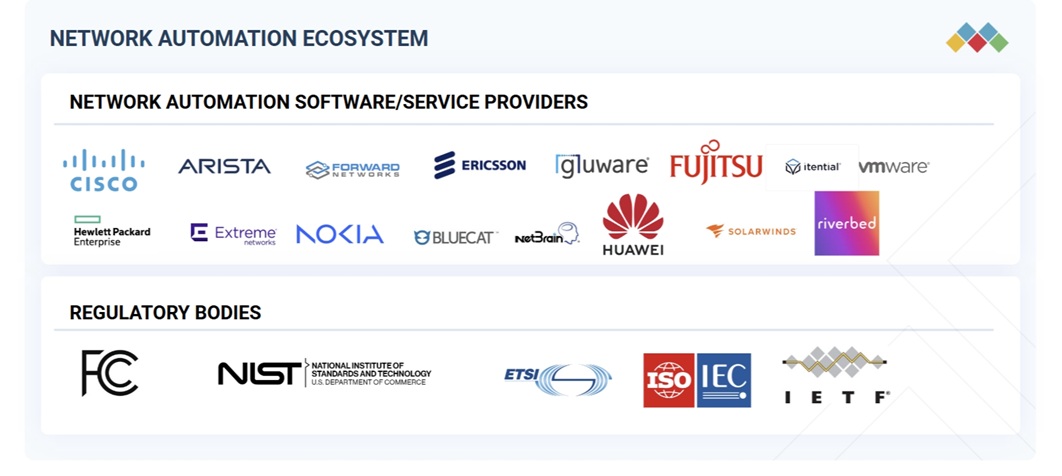
Network Automation Market – Global Forecast to 2030 – ecosystem
Research coverage:
The market report covered the network automation market across segments. We estimated the market size and growth potential for various segments based on offering, network automation type, network type, end-user, and region. It contains a thorough competition analysis of the major market participants, information about their businesses, essential observations about their product offerings, current trends, and critical market strategies.
Reasons to buy this report:
With information on the most accurate revenue estimates for the whole network automation industry and its subsegments, the research will benefit market leaders and recent newcomers. Stakeholders will benefit from this report’s enhanced understanding of the competitive environment, which will enable them to better position their companies and develop effective go-to-market strategies. The research provides insights into the primary market drivers, constraints, opportunities, and challenges, enabling players to grasp the industry’s pulse.
The report provides insights into the following pointers:
Analysis of key drivers (Rising network complexity & scale, need for operational efficiency & cost reduction, and security & compliance requirements), restraints (High initial investment & integration challenges, and lack of skilled workforce), opportunities (Integration of AI and ML in network automation to drive autonomous networks, 5G & edge computing expansion, and cloud-native & multi-vendor interoperability), and challenges (Security risks of automated networks, and vendor lock-in & interoperability issues).
- Product Development/Innovation: Comprehensive analysis of emerging technologies, R&D initiatives, and service and product introductions in the network automation market.
- Market Development: In-depth details regarding profitable markets: the paper examines the global network automation market.
- Market Diversification: Comprehensive details regarding recent advancements, investments, unexplored regions, new goods and services, and the network automation market.
- Competitive Assessment: Thorough analysis of the market shares, expansion plans, platforms, and service portfolios of the top competitors in the network automation industry, such as Cisco (US), IBM (US), HPE (US), Huawei (China), VMware (US), Arista Networks (US), Nokia (Finland), Ericsson (Sweden), Extreme Networks (US), Fujitsu (Japan), NetBrain Technologies (US), Gluware (US), SolarWinds (US), Riverbed (US), Forward Networks (US), Palo Alto Networks (US), Aviz Networks (US), Itential (US), BackBox (US), NetYCE (Netherlands), Kentik (US), Anuta Networks (US), Versa Networks (US), Infoblox (US), Auvik Networks (Canada), Arrcus (US), BlueCat (Canada), and Stardust Systems (US).