
| 出版社 | MarketsandMarkets |
| 出版年月 | 2025年10月 |
Managed Network Services Market – Global Forecast To 2030

マネージドネットワークサービス市場 – タイプ(マネージド LAN、マネージド Wi-Fi、マネージド WAN、マネージド VPN、ネットワーク監視、マネージド NFV、マネージド ネットワーク セキュリティ)、業種(BFSI、IT および通信、製造)、地域別 – 2030 年までの世界予測
マネージドネットワークサービス市場は、予測期間中に年平均成長率7.3%で成長し、2025年には1,207.4億米ドル、2030年には1,720.4億米ドルに達すると予測されています。企業は、グローバルな接続性、ハイブリッドワーク、クラウド変革といった複雑な課題を乗り越えるために、マネージドネットワークサービスへの関心を高めています。プロバイダーがパフォーマンス管理、セキュリティ、自動化を統合した包括的なソリューションを提供することで、市場は勢いを増しています。
業界を横断したデジタルエコシステムの台頭により、信頼できるパートナーによって管理される、拡張性に優れた常時接続ネットワークへの需要が高まっています。柔軟なサービスモデルと成果に基づく価格設定を提供するプロバイダーの導入は拡大しています。マネージドネットワークサービスは、アジャイル運用の重要な推進力となり、接続性、クラウド統合、サイバーセキュリティを統合したサービスエクスペリエンスを実現します。重点は、インテリジェントで予測的かつ適応的なネットワーク管理へと移行していくでしょう。
マネージドネットワークサービスは、導入を遅らせ、運用を複雑化する様々な制約と課題に直面しています。オンプレミスのレガシーインフラをクラウドネイティブのSD-WANおよびSASEアーキテクチャと統合・近代化することは、技術的にもコスト的にも困難です。また、マルチクラウドやエッジ環境への導入は、一貫性のある可視性、サービス品質、ポリシー適用を困難にする断片化をもたらします。管轄区域をまたぐセキュリティとデータプライバシーのコンプライアンスは、法的および運用上のオーバーヘッドを増加させ、テレメトリデータの増加は監視、分析、ストレージに負担をかけます。
市場調査では、さまざまなセグメントにわたるマネージド ネットワーク サービスの市場規模をカバーしています。この調査は、使用シナリオ(さらに拡張されたモバイルブロードバンド(FEMBB)、非常に信頼性が高く低遅延の通信(ERLLC)、長距離高移動度通信(LDHMC)、超大規模マシン型通信(UMMTC)、極低電力通信(ELPC))、エンタープライズアプリケーション(ホログラフィック通信、触覚/触覚インターネット、完全自動運転、インダストリー5.0、バイオナノモノのインターネット、その他のエンタープライズアプリケーション(深海観光および宇宙旅行))、通信インフラストラクチャ(セルラー、ブロードバンド、固定)、垂直(消費者およびエンタープライズ(製造、ヘルスケアおよびライフサイエンス、自動車、メディアおよびエンターテイメント、航空宇宙および防衛、その他のエンタープライズ[小売およびeコマース、エネルギーおよび公共事業、教育]))、および地域(北米、ヨーロッパ、アジア太平洋、中東およびアフリカ、ラテンアメリカ)など、さまざまなセグメントにわたって市場規模と成長の可能性を推定することを目的としています。この調査には、主要な市場プレーヤーの詳細な競合分析、その企業プロファイル、製品およびビジネス提供に関する主要な観察、最近の動向、および市場戦略が含まれています。
本レポートは、市場リーダーと新規参入企業にとって、世界のマネージドネットワークサービス市場の収益数値とサブセグメントに関する近似値に関する情報を提供するのに役立ちます。また、ステークホルダーが競争環境を理解し、自社のポジショニングを改善し、適切な市場開拓戦略を策定するための洞察を深めるのに役立ちます。さらに、本レポートは、市場の動向に関する洞察に加え、主要な市場牽引要因、制約要因、課題、そして機会に関する情報も提供します。
Report Description
The managed network services market is estimated to be USD 120.74 billion in 2025 to USD 172.04 billion by 2030, at a CAGR of 7.3%, during the forecast period. Enterprises are increasingly turning to managed network services as they navigate the complexity of global connectivity, hybrid work, and cloud transformation. The market is gaining traction as providers deliver comprehensive solutions that integrate performance management, security, and automation.
The rise of digital ecosystems across industries has pushed demand for scalable, always-on networks managed by trusted partners. Providers offering flexible service models and outcome-based pricing are witnessing growing adoption. Managed network services will emerge as key drivers of agile operations, bridging connectivity, cloud integration, and cybersecurity into a unified service experience. The emphasis will shift toward intelligent, predictive, and adaptive network management.
The major players in the managed network services market are Cisco (US), AT&T (US), Verizon (US), NTT Data (Japan), Deutsche Telekom (Germany), Huawei (China), Orange (France), Vodafone (UK), Ericsson (Sweden), Telefonica (Spain), Singtel (Singapore), Telstra (Australia), Lumen Technologies (US), Fujitsu (Japan), Tata Communications (India), Colt Technology Services (UK), Nokia (Finland), GTT Communications (US), Sify Technologies (India), DXC Technology (US), Wipro (India), Comarch (Poland), Commscope (US), Alkira (US), Kentik (US), flexiWAN (Israel), Bigleaf Networks (US), Graphiant (US), Oman Data Park (Oman), Kubus (UK), EIL Global (Australia), Systal Technology Solutions (Scotland), and MetTel (US). These players have adopted various growth strategies, such as partnerships, agreements, and collaborations, product launches, product enhancements, and acquisitions, to expand their footprint in the managed network services market.
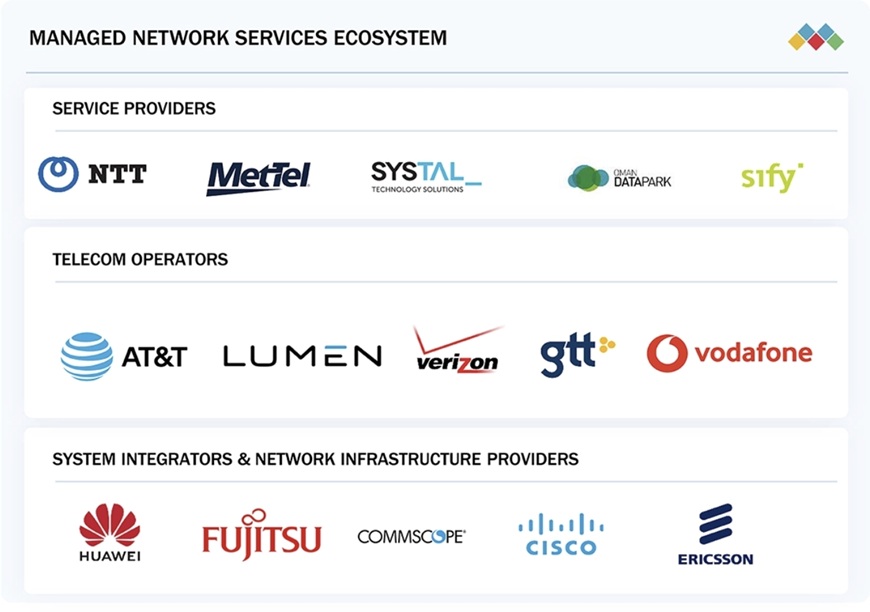
Managed Network Services Market – Global Forecast To 2030 – ecosystem
Research Coverage
The market study covers the managed network services market size across different segments. It aims at estimating the market size and the growth potential across various segments, including Usage Scenario (Further-enhanced Mobile Broadband (FEMBB), Extremely Reliable And Low-latency Communications (ERLLC), Long-distance and High-mobility Communications (LDHMC), Ultra-massive Machine Type Communications (UMMTC), Extremely Low-power Communications (ELPC)), Enterprise Application (Holographic Communications, Tactile/Haptic Internet, Fully Automated Driving, Industry 5.0, Internet Of Bio-Nano-Things, Other Enterprise Applications (Deep-sea Sightseeing and Space Travel)), Communication Infrastructure (Cellular, Broaband, Fixed), Vertical (Consumer and Enterprise (Manufacturing, Healthcare & Life Sciences, Automotive, Media & Entertainment, Aerospace & Defense, Other Enterprises [Retail & Ecommerce, Energy & Utilities, Education])), and Region (North America, Europe, Asia Pacific, Middle East & Africa, and Latin America). The study includes an in-depth competitive analysis of the leading market players, their company profiles, key observations related to product and business offerings, recent developments, and market strategies.
Key Benefits of Buying the Report
The report will help market leaders and new entrants with information on the closest approximations of the global managed network services market’s revenue numbers and subsegments. It will also help stakeholders understand the competitive landscape and gain more insights to position their businesses better and plan suitable go-to-market strategies. Moreover, the report will provide stakeholders with insights into the market’s pulse, as well as information on key market drivers, restraints, challenges, and opportunities.
The report provides insights into the following points:
- Analysis of key drivers (technological advancements, deliver extreme performance and highly advanced use cases, growing metaverse traction), restraints (high initial cost, limited spectrum availability, regulatory and standardization challenges, terahertz (THz) frequency challenges and energy efficiency concerns), opportunities (transformative applications, global connectivity, detailed sensing and high-precision positioning technologies offered by 6g networks), and challenges (security and privacy, ethical and social implications, environmental concerns) influencing the growth of the managed network services market
- Product Development/Innovation: Detailed insights into upcoming technologies, research & development activities, and new product & service launches in the managed network services market
- Market Development: Comprehensive information about lucrative markets and analyzes the managed network services market across various regions
- Market Diversification: Exhaustive information about new products & services, untapped geographies, recent developments, and investments in the managed network services market
- Competitive Assessment: In-depth assessment of market shares, growth strategies, and service offerings of leading players, such as Cisco (US), AT&T (US), Verizon (US), NTT Data (Japan), Deutsche Telekom (Germany), Huawei (China), Orange (France), Vodafone (UK), Ericsson (Sweden), Telefonica (Spain), Singtel (Singapore), Telstra (Australia), Lumen Technologies (US), Fujitsu (Japan), Tata Communications (India), Colt Technology Services (UK), Nokia (Finland), GTT Communications (US), Sify Technologies (India), DXC Technology (US), Wipro (India), Comarch (Poland), Commscope (US), Alkira (US), Kentik (US), flexiWAN (Israel), Bigleaf Networks (US), Graphiant (US), Oman Data Park (Oman), Kubus (UK), EIL Global (Australia), Systal Technology Solutions (Scotland), and MetTel (US)