
| 出版社 | MarketsandMarkets |
| 出版年月 | 2025年8月 |
E-fuels Market – Global Forecast To 2030

本レポートは、合成燃料(e-fuel)市場を規模、用途、燃料の種類別に定義、解説、予測しています。また、市場の詳細な定性・定量分析も提供しています。主要な市場牽引要因、制約要因、機会、課題について包括的な分析を提供しています。さらに、市場の様々な重要な側面を網羅しており、競争環境、市場ダイナミクス、市場規模予測、そしてe-fuel市場の将来動向などを分析しています。
合成燃料(e-fuel)市場は、特に直接的な電化が困難な分野において、脱炭素化と持続可能なエネルギーソリューションへの世界的な移行によって牽引されています。気候変動、炭素排出、化石燃料への依存に対する懸念が高まる中、e-fuelは、再生可能水素と回収されたCO₂を利用して既存のインフラと互換性のある合成燃料を生成することで、カーボンニュートラルな代替手段を提供します。従来のエンジンや燃料システムとの互換性が確保されているため、航空、船舶、重量輸送、化学など、排出削減が困難な分野に最適です。各国が野心的なネットゼロ目標を設定するにつれ、拡張性の高い低炭素液体燃料およびガス燃料の需要が急速に高まっています。政府の支援政策、炭素価格設定、そしてグリーン燃料の義務化は、この分野への投資とイノベーションを加速させています。Power-to-Liquidプロセス、炭素回収、グリーン水素製造における技術進歩は、効率性とコスト実現可能性を向上させています。エネルギー安全保障に関する懸念と企業の持続可能性目標の高まりに伴い、e-fuel はクリーンで循環的なエネルギー システムへの世界的な移行における重要な柱として浮上しています。
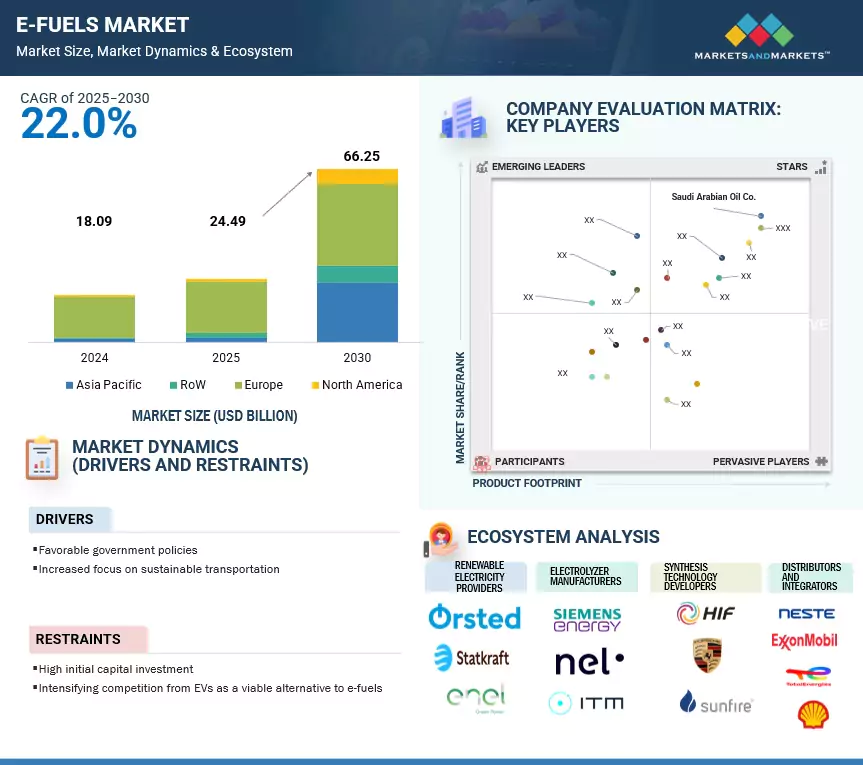
合成燃料(e-fuel)市場は、2025年の244億9,000万米ドルから2030年には662億5,000万米ドルに達すると予測されており、予測期間中は年平均成長率(CAGR)22.0%で成長します。e-fuel市場は、航空、海運、大型輸送など、直接的な電動化が困難な分野における脱炭素化への世界的な取り組みによって牽引されています。炭素規制の強化、再生可能燃料の義務化、そして政府の優遇措置が、e-fuelの導入を加速させています。グリーン水素、二酸化炭素回収、Power-to-Liquidsプロセスにおける技術進歩は、効率性と拡張性を向上させます。e-fuelは既存の燃料インフラと統合できるため、魅力的な移行ソリューションとなります。エネルギー安全保障への懸念の高まりと企業の持続可能性への取り組みも、世界中で低炭素合成燃料の需要をさらに押し上げています。
The e-fuels market is estimated to reach USD 66.25 billion by 2030 from USD 24.49 billion in 2025, at a CAGR of 22.0% during the forecast period. The e-fuels market is driven by the global push for decarbonization in sectors where direct electrification is challenging, such as aviation, maritime, and heavy transport. Rising carbon regulations, renewable fuel mandates, and government incentives are accelerating adoption. Technological advancements in green hydrogen, carbon capture, and Power-to-Liquid processes enhance efficiency and scalability. The ability of e-fuels to integrate with existing fuel infrastructure makes them an attractive transitional solution. Increasing energy security concerns and corporate sustainability commitments also further propel demand for low-carbon, synthetic fuels worldwide.
e-fuels-market-new
The e-fuels market is dominated by a few major players that have a wide regional presence. The leading players in the e-fuels market are Saudi Arabian Oil Co. (Saudi Arabia), AUDI AG (Germany), Repsol (Spain), Sunfire SE (Germany), Electrochaea GmbH (Germany), Uniper SE (Germany), Ørsted A/S (Denmark), Yara (Norway), Perstorp (Germany), HIF Global (US), INFINIUM (US), among others.
Study Coverage:
The report defines, describes, and forecasts the e-fuel market by size, application, and fuel type. It also offers a detailed qualitative and quantitative analysis of the market. The report provides a comprehensive review of the major market drivers, restraints, opportunities, and challenges. It also covers various important aspects of the market. These include an analysis of the competitive landscape, market dynamics, market estimates in terms of value, and future trends in the e-fuels market.
Key Benefits of Buying the Report
- The e-fuels market is driven by the global shift toward decarbonization and sustainable energy solutions, particularly in sectors where direct electrification is challenging. With increasing concerns over climate change, carbon emissions, and fossil fuel dependency, e-fuels offer a carbon-neutral alternative by utilizing renewable hydrogen and captured CO₂ to create synthetic fuels compatible with existing infrastructure. Their drop-in compatibility with conventional engines and fuel systems makes them ideal for hard-to-abate sectors such as aviation, shipping, heavy transport, and chemicals. As nations set ambitious net-zero targets, the demand for scalable, low-carbon liquid and gaseous fuels is rapidly growing. Supportive government policies, carbon pricing, and green fuel mandates are accelerating investment and innovation in the space. Technological advancements in Power-to-Liquid processes, carbon capture, and green hydrogen production are improving efficiency and cost viability. With growing energy security concerns and corporate sustainability goals, e-fuels are emerging as a key pillar in the global transition toward clean, circular energy systems.
- Product Development/Innovation: The e-fuels market is advancing through product innovations focused on enhancing production efficiency, scalability, and environmental performance. Companies are developing advanced Power-to-Liquid (PtL) and Power-to-Gas (PtG) technologies that enable efficient conversion of renewable electricity, water, and captured CO₂ into high-quality synthetic fuels. Innovations in electrolyzer technology, carbon capture systems, and reactor design are significantly improving energy conversion rates and reducing production costs. Modular and scalable e-fuel production units enable decentralized fuel generation, which is ideal for remote or off-grid applications. Integration with digital platforms supports process optimization, real-time emissions tracking, and energy flow monitoring. Furthermore, breakthroughs in catalyst development and synthetic fuel refining are improving fuel purity and engine compatibility. Research into direct air capture, co-electrolysis, and new feedstock pathways is expanding the versatility of e-fuel production. These innovations are not only accelerating commercialization but also enhancing the viability of e-fuels as a cornerstone of sustainable, net-zero energy systems.
- Market Development: In October 2024, Saudi Arabian Oil Co., a global integrated energy and chemicals company, and ENOWA, NEOM’s energy and water company, signed a joint development agreement to construct and establish a first-of-its-kind synthetic electro fuel (e-fuel) demonstration plant. It aims to demonstrate technical feasibility and commercial viability by producing 35 barrels per day of low-carbon, synthetic gasoline from renewable-based hydrogen and captured carbon dioxide (CO2).
- Market Diversification: In May 2025, Uniper and thyssenkrupp Uhde partnered to develop a large-scale ammonia cracker plant in Gelsenkirchen, Germany, capable of converting 28 tons/day of ammonia into hydrogen. This demonstration project supports global hydrogen trade and the hydrogen import terminal in Wilhelmshaven, enabling ammonia to be an e-fuel carrier.
- Competitive Assessment: Assessment of rankings of some of the key players, including of Saudi Arabian Oil Co. (Saudi Arabia), AUDI AG (Germany), Repsol (Spain), Sunfire SE (Germany), Electrochaea GmbH (Germany), Uniper SE (Germany), Ørsted A/S (Denmark), Yara (Norway), Perstorp (Germany), HIF Global (US), INFINIUM (US), INERATEC GmbH (Germany), Liquid Wind (Sweden), Norsk e-fuel (Norway), Nordic Electrofuel (Norway), European Energy (Denmark) among others.