
| 出版社 | MarketsandMarkets |
| 出版年月 | 2025年10月 |
Automated Material Handling Equipment Market – Global Forecast To 2030

自動マテハン (AMHE) 市場 – 製品(産業用ロボット、自律移動ロボット、無人搬送車、自動倉庫・リトリーバルシステム(ASRS)、クレーン、コンベア・仕分けシステム、WMS)地域別 – 2030年までの世界予測
世界の自動マテリアルハンドリング機器 (AMHE) 市場は、年平均成長率8.9%で、2025年の333億9,000万米ドルから2030年には512億2,000万米ドルに拡大すると予測されています。
企業が生産性の向上、ダウンタイムの削減、熟練労働者の不足への対応を目指す中、製造工場や流通ネットワークにおけるロボット工学と自動化への依存度の高まりが、主要な成長原動力として浮上しています。無人搬送車(AGV)、産業用ロボット、高度なコンベアシステムは、生産ワークフローの合理化、継続的な運用の実現、材料フローの精度確保のために広く導入されています。自動車、半導体、ヘルスケアなどの業界では、AMHE(自動マテリアルハンドリング機器)が、大規模で複雑な生産サイクルをサポートしながら、厳しい品質要件を満たす上で重要な役割を果たしています。市場はさらに、人工知能、マシンビジョン、IoT対応プラットフォームの統合によって支えられており、運用の可視性、予知保全、システム適応性が向上しています。モジュール式でスケーラブルなシステム設計への投資は、企業が需要の変動に迅速に対応することを可能にする一方で、エネルギー効率の高いデジタルソリューションの採用は環境への影響の軽減にも役立っています。産業界が事業運営において回復力、柔軟性、持続可能性を優先する中、AMHE は次世代のサプライ チェーンとスマート ファクトリー エコシステムを実現する重要な役割を担うようになり、世界市場における持続的な成長を確実にしています。
本レポートでは、自動マテリアルハンドリング機器 (AMHE) 市場を製品タイプ、業界、地域に基づいてセグメント化しています。製品タイプセグメントには、産業用ロボット、無人搬送車(AGV)、自動倉庫・リトリーバルシステム(ASRS)、クレーン、コンベア・仕分けシステム、倉庫管理システム(WMS)が含まれます。業界セグメントでは、自動車、化学、航空、半導体・エレクトロニクス、Eコマース、食品・飲料、ヘルスケア、金属・重機、3PL、その他の産業(製紙、印刷、繊維、衣料)にセグメント化されています。地域分析は、北米、欧州、アジア太平洋、その他の地域(RoW)を対象としています。
本レポートは、市場全体および各サブセグメントの収益数値の近似値に関する情報を提供し、この市場のリーダー企業および新規参入企業にとって役立ちます。また、本レポートは、ステークホルダーが競争環境を理解し、事業のポジショニングを改善し、適切な市場開拓戦略を策定するための洞察を深めるのに役立ちます。さらに、本レポートは、ステークホルダーが自動マテリアルハンドリング機器市場の動向を理解するのに役立ち、主要な市場牽引要因、制約要因、課題、そして機会に関する情報を提供します。
レポートを購入する主なメリット
主な推進要因(AMHEの導入を促進するeコマース業界の急速な拡大、流通センターにおけるリアルタイム在庫管理システムの需要の高まり、倉庫の効率的なスペース利用の重要性の高まり、自動化された資材搬送システムの需要を促進するマスカスタマイゼーションの導入の増加、倉庫自動化の需要によるモバイルロボットスタートアップの台頭、リーン生産方式とジャストインタイム(JIT)方式の需要、AMHEにおけるクラウドベースソリューションの導入の増加)、制約要因(データセキュリティとサイバー脅威のリスク、導入および切り替えコストの高さ、発展途上国におけるインフラの互換性の問題、熟練労働者の不足)、機会(WMSへのビデオAI技術の組み込み、東南アジアにおけるイントラロジスティクス分野の急成長、効率的なラストマイル配送ソリューションの需要の高まり、スマートファクトリーとインダストリー4.0の導入拡大によるAMHEの需要の促進、注文のカスタマイズとパーソナライゼーションの増加、ヘルスケア分野における自動化された資材搬送ソリューションの需要の増加)、課題(AMHEにおけるデータ統合とシステム互換性の課題の克服、機器のダウンタイムによる生産および収益の損失の軽減、小規模な自動化された資材搬送機器市場の成長に影響を与えているのは、倉庫などの大型施設の自動化です。
- 製品開発/イノベーション:自動マテリアルハンドリング機器 (AMHE) 市場における今後の技術、研究開発活動、新製品投入に関する詳細な洞察。
- 市場開発:有望な市場に関する包括的な情報 ― 本レポートでは、様々な地域における自動マテリアルハンドリング機器市場を分析しています。
- 市場多様化:自動マテリアルハンドリング機器 (AMHE) 市場における新製品/サービス、未開拓地域、最近の動向、投資に関する包括的な情報。
- 競合評価:ダイフク株式会社(日本)、KION GROUP AG(ドイツ)、SSI SCHAEFER(ドイツ)、豊田自動織機株式会社(日本)、ハネウェル・インターナショナル株式会社(米国)などの主要企業の市場シェア、成長戦略、サービス提供に関する詳細な評価。
Report Description
With a CAGR of 8.9%, the global automated material handling equipment (AMHE) market is projected to expand from USD 33.39 billion in 2025 to USD 51.22 billion by 2030. Increasing reliance on robotics and automation in manufacturing plants and distribution networks is emerging as a primary growth driver, as organizations look to enhance productivity, reduce downtime, and address skilled labor shortages. Automated guided vehicles, industrial robots, and advanced conveyor systems are being widely deployed to streamline production workflows, enable continuous operations, and ensure precision in material flow. In industries such as automotive, semiconductors, and healthcare, AMHE is playing a critical role in meeting stringent quality requirements while supporting large scale, complex production cycles. The market is further supported by the integration of artificial intelligence, machine vision, and IoT-enabled platforms, which are improving operational visibility, predictive maintenance, and system adaptability. Investments in modular and scalable system designs are also enabling businesses to respond quickly to fluctuations in demand, while the adoption of energy efficient and digitalized solutions is helping reduce environmental impact. As industries prioritize resilience, flexibility, and sustainability in their operations, AMHE is increasingly positioned as a key enabler of next generation supply chain and smart factory ecosystems, ensuring sustained growth across global markets.
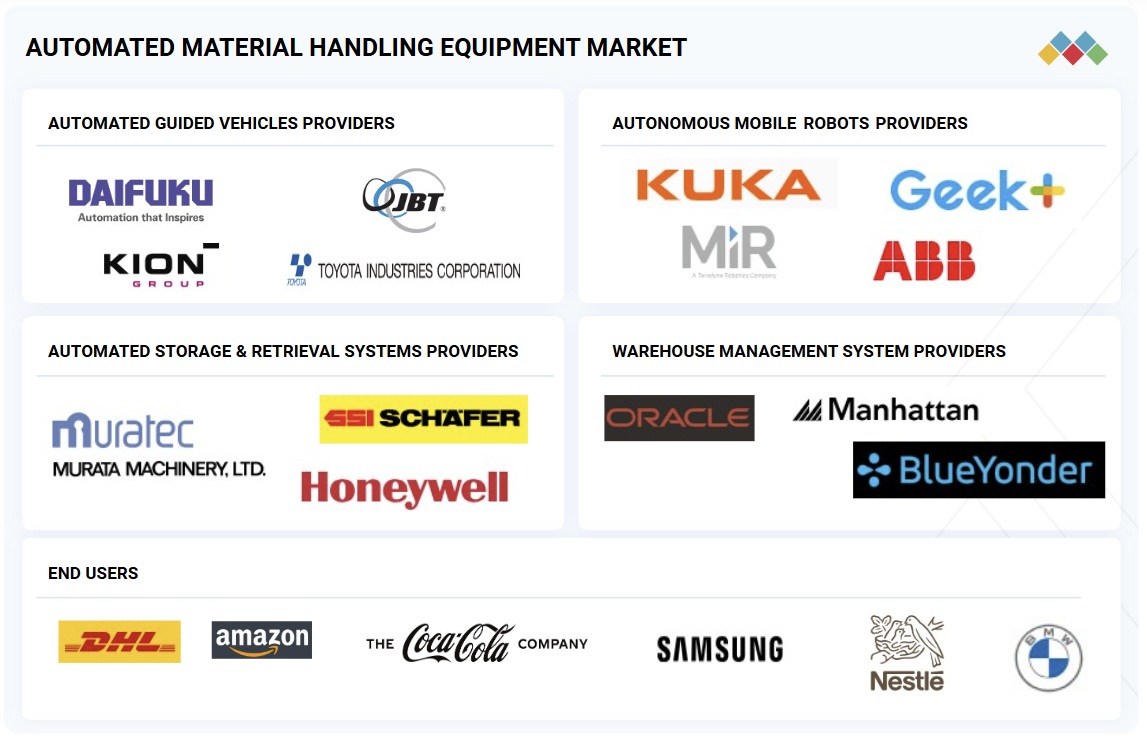
Automated Material Handling Equipment Market – Global Forecast To 2030 – ecosystem
Major players profiled in this report are as follows: Daifuku Co., Ltd. (Japan), KION GROUP AG (Germany), SSI SCHAEFER (Germany), Toyota Industries Corporation (Japan), Honeywell International Inc. (US), Hyster-Yale Materials Handling, Inc., (US), Jungheinrich AG (Germany), Hanwha Robotics CO.LTD. (South Korea), JBT (US), KUKA AG (Germany), BEUMER Group (Germany), KNAPP AG (Austria), MURATA MACHINERY, LTD. (Japan), TGW Logistics (Austria), Manhattan Associates (US), Oracle (US), Addverb Technologies Limited (India), Snap-on AutoCrib (US), AVANCON SA (Switzerland), Ferretto SpA (Italy), Grabit (US), inVia Robotics, Inc. (US), Locus Robotics (US), MEIDENSHA CORPORATION (Japan), Mobile Industrial Robots (Denmark) and Westfalia Technologies, Inc. (US).These leading companies possess a wide portfolio of products, establishing a prominent presence in established as well as emerging markets.
Research Coverage
In this report, the automated material handling equipment market has been segmented based on product type, industry, and region. The product type segment includes Industrial Robots, Automated Guided Vehicles (AGVs), Automated Storage & Retrieval Systems (ASRS), Cranes, Conveyors & Sortation Systems and Warehouse Management System (WMS). Based on industries, the market is segmented into Automotive, Chemicals, Aviation, Semiconductor & Electronics, E-commerce, Food & Beverages, Healthcare, Metal & Heavy Machinery, 3PL and Other Industries (Paper, Printing, Textile, Clothing). The regional analysis covers North America, Europe, Asia Pacific, and Rest of the World (RoW).
Reasons to buy the report
The report will help the leaders/new entrants in this market with information on the closest approximations of the revenue numbers for the overall market and the sub-segments. This report will help stakeholders understand the competitive landscape and gain more insights to position their businesses better and plan suitable go-to-market strategies. The report also helps stakeholders understand the automated material handling equipment market’s pulse and provides information on key market drivers, restraints, challenges, and opportunities.
Key Benefits of Buying the Report
Analysis of key drivers (rapid expansion of e-commerce industry driving AMHE adoption, mounting demand for real-time inventory management systems in distribution centers, rising emphasis on efficient space utilization in warehouses, growing adoption of mass customization driving demand for automated material handling systems, rise of mobile robotics startups driven by demand for warehouse automation, demand for lean manufacturing and just-in-time (JIT) practices, rising adoption of cloud-based solutions in AMHE), restraints (risks of data security and cyber threats, high installation and switching costs, issues with infrastructure compatibility in developing countries, shortage of skilled workforce), opportunities (embedding video AI technology into WMS, rapidly growing intralogistics sector in Southeast Asia, rising need for efficient last-mile delivery solutions, Expanding adoption of smart factories and Industry 4.0 fueling AMHE demand, growing order customization and personalization, rising demand for automated material handling solutions in the healthcare sector), and challenges (overcoming data integration and system compatibility challenges in AMHE, mitigating production and revenue losses from equipment downtime, extended ROI timelines for small-scale warehouses) influencing the growth of the automated material handling equipment market.
- Product Development/Innovation: Detailed insights on upcoming technologies, research and development activities, and new product launches in the automated material handling equipment market.
- Market Development: Comprehensive information about lucrative markets – the report analyses the automated material handling equipment market across varied regions.
- Market Diversification: Exhaustive information about new products/services, untapped geographies, recent developments, and investments in the automated material handling equipment market.
- Competitive Assessment: In-depth assessment of market shares, growth strategies, and service offerings of leading players like Daifuku Co., Ltd. (Japan), KION GROUP AG (Germany), SSI SCHAEFER (Germany), Toyota Industries Corporation (Japan), Honeywell International Inc. (US). and others.