
Connectivity Data Hub: H2 2025
| 出版 | Kaleido Intelligence |
| 出版年月 | 2026年01月 |
| ページ数 | 60 |
| 価格 | 記載以外のライセンスについてはお問合せください |
| ベーシックライセンス | GBP 7,000 |
| 種別 | 英文調査報告書 |
| 商品番号 | SMR-12512 |

KaleidoのConnectivity Data Hubは、企業がコネクティビティ市場の現状と将来の規模を正確に測定することを可能にします。このツールは、セルラーIoT市場全体、あるいはeSIM、セルラー衛星通信、プライベートネットワークといった特定のセグメント、あるいはIoTにおける特定の主要垂直市場における成長の動向を調査することに関心のある企業にとって、貴重な洞察を提供します。
コネクティビティ分野に関する非常に堅牢なデータを提供するこのデータハブは、世界60以上の市場を網羅しており、クライアントが市場参入の優先順位を決定し、世界中の成長パターンを把握するのに役立ちます。
Kaleidoの2025年コネクティビティデータアップデートは、主要IoTセグメント全体の成長ポテンシャルを評価しています。主要テクノロジーと垂直セクターにおける継続的な経済的な逆風に加え、企業インタビュー、製品デモ、アンケート調査を通じて収集された豊富な一次調査も考慮しています。このデータベースは、当社が過去に取得した市場データに基づいて構築されており、対象となるすべてのサブセクターの機会を明確に定量化することで、お客様が過去の成長曲線と5年間の予測予測を併せて確認できるようにしています。
セルラーIoTの主要産業分野は2025年に世界接続数22億に達する
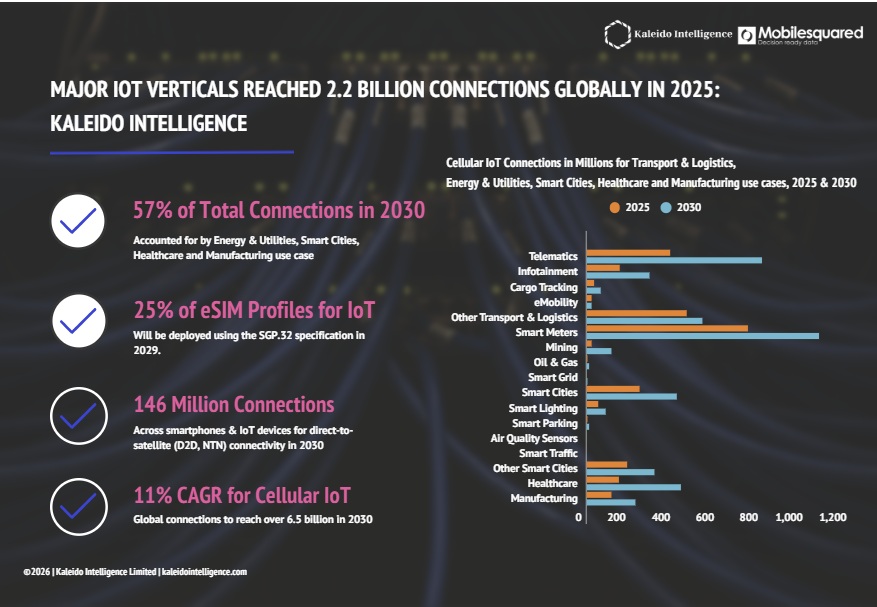
2026年1月22日、ロンドン – IoTおよびコネクティビティの専門企業であるKaleido Intelligenceの最新調査によると、運輸・物流、エネルギー・公益事業、スマートシティ、ヘルスケア、製造業などの主要なIoT分野におけるセルラー接続数は、2025年に22億に達しました。これは接続数で市場全体の55%に相当します。Kaleidoは、2030年までにこれらの分野における接続数は39億に達し、世界全体の57%を占めると予測しています。
Kaleidoの最新のConnectivity Data Hubは、セルラーIoT向けの非常に詳細な履歴・予測データベースであり、eSIM IoT仕様(SGP.31/32)の実装が2027年から増加すると予測しています。認証プラットフォームとeSIMの完全な商用化は、2025年に主にテスト用に少量出荷された後、今年中に開始されます。2029年までに、IoTユースケース向けに有効化されたeSIMの約4分の1が、SGP.32 eSIMと関連アーキテクチャによってサポートされるようになります。また、この新仕様は、IoT市場における有効化されたeSIMの数が2028年には10億枚を超える市場へと押し上げると予想されます。
ダイレクト・ツー・セル(未改造の携帯電話機器への衛星接続)を利用するスマートフォンおよび IoT 加入者は、2025 年の 2,000 万人から 2030 年までに 146 万人に増加する見込みです。ただし、衛星接続のニーズは一時的なものであり、通信料金も高額であるため、通信事業者の潜在的な収益は大幅に制限されることになります。
Research Highlights
- New data for all metrics based on Kaleido’s ongoing industry surveys, interviews, briefings and analysis. Includes:
- Connections according to
- Cellular IoT
- Cellular 5G
- eSIM/iSIM, broken down by SGP.02, SGP.32 and SGP.22 (M2M, IoT and Consumer GSMA eUICC profile specifications). including:
- Active connections, installed base, shipments, operator billed revenues and remote sim provisioning revenues
- Splits for eSIM and iSIM growth
- Cellular LPWAN, including:
- NB-IoT and LTE-M Connections
- Domestic, inbound roaming and outbound roaming connections
- Connectivity ARPU and revenues according to technology and routing
- Mobile Fraud & Security, including:
- Threads, detection levels and revenue losses
- Splits according to threat type
- Private Networks, including:
- Private Network sites, split by LTE and 5G technology
- Private LTE and 5G Capex and Opex
- Splits according to Transport, Energy & Utilities, Manufacturing, Industrial, Smart Cities & Other Segments
- Cellular connections by industry, focusing on connections and revenues across the following vertical splits:
- Automotive, Transport & Logistics
- Energy, Utilities & Mining
- Healthcare
- Manufacturing
- Others
- Over 60 country market data projections, alongside historical data
- Connections according to
Report Overview
istorical & Market Forecast Connectivity Database: eSIM, LPWAN, Direct-to-Satellite, Private LTE & 5G, Mobile Security & Fraud, Transportation, Energy & Utilities, Smart Cities, Manufacturing & Healthcare
Kaleido’s Connectivity Data Hub allows companies to accurately measure the current and future size of the connectivity market. This tool provides valuable insights for those interested in examining the overall cellular IoT market or specific segments such as eSIM, cellular-satellite communications, private networks or how growth will develop within specific key verticals within IoT.
Delivering highly robust data on the connectivity sector, the Data Hub covers over 60 markets worldwide, allowing clients to help prioritise market entry and understand growth patterns around the world.
Kaleido’s 2025 connectivity data update evaluates the potential for growth across key IoT segments, bearing in mind ongoing economic headwinds on key technologies and vertical sectors in addition to a wealth of primary research gathered through company interviews, product demos and surveys. The database builds on our previous market data, clearly quantifying the opportunity for all sub-sectors covered, to enable clients to view historical curves alongside 5-year forecast projections.
Key metrics tracked through the Data Hub include:
- Total Cellular M2M Connections
- Total 5G Cellular M2M Connections
- IoT, Consumer & M2M eSIM, including:
- Total Active eSIM & iSIM Connection Installed Base
- Total eSIM & iSIM Shipments
- Total eSIM & iSIM Shipment Sales Value
- Total eSIM & iSIM Operator Billed Revenues
- Total eSIM & iSIM RSP Management Revenue
- Mobile Fraud & Security Threat & Losses for SMS, Voice, Subscriber Fraud, Denial of Service and Others, including:
- Total Security & Fraud Events per Annum
- Total Detected Security & Fraud Events per Annum
- Total Annual Operator Revenue Loss Resulting from Security/Fraud Events
- Private Networks by industry vertical, including:
-
- Private LTE & 5G Network Sites Deployed
- Total Private LTE and 5G Networks, Split by Vertical
- Total Private LTE and 5G Network Capex
- Total Private LTE and 5G Network Opex
- Cellular LPWAN forecasts, including:
- Total NB-IoT connections
- Total LTE-M connections
- Connections according to domestic, inbound roaming and outbound roaming deployments
- Connectivity ARPUs and revenues
- Vertical splits, including connections and revenues for:
- Transportation & logistics
- Energy & utilities
- Healthcare
- Manufacturing
- Smart cities
- Direct-to-satellite connectivity and revenues across:
- Smartphones
- IoT devices, including NB-IoT and 5G Connections
All Consumer Roaming data metrics are split by 7 global regions and 60+ country markets, with a data range from 2016 to 2030.
Clients can compare growth curves by market, or by channel, delivering clear viewpoints to make the best business decisions.
Members will be able to access the research directly.
New customers can purchase the Connectivity Data Hub as a one-off product or subscribe to 12-month access; the latter includes all-new metrics and updates throughout the year.
Please contact us to learn more about pricing options.
Historical, current and forecast consumer roaming market projections are provided for the following global markets:
| Latin America & Caribbean | Europe & Central Asia | East Asia & Pacific | Middle East & North Africa |
| Argentina | Austria | Australia | Algeria |
| Brazil | Belgium | China | Bahrain |
| Chile | Czech Republic | Hong Kong SAR, China | Djibouti |
| Colombia | Denmark | Indonesia | Egypt, Arab Rep. |
| Ecuador | France | Japan | Iran, Islamic Rep. |
| Mexico | Germany | Korea, Rep. | Iraq |
| Peru | Greece | Malaysia | Israel |
| Uruguay | Hungary | New Zealand | Jordan |
| North America | Ireland | Philippines | Kuwait |
| Canada | Italy | Singapore | Lebanon |
| United States | Netherlands | Taiwan, China | Libya |
| South Asia | Poland | Thailand | Malta |
| Bangladesh | Portugal | Vietnam | Morocco |
| India | Russian Federation | Sub-Saharan Africa | Oman |
| Pakistan | Spain | Kenya | Qatar |
| Sri Lanka | Sweden | Nigeria | Saudi Arabia |
| Turkey | South Africa | Syrian Arab Republic | |
| United Kingdom | Tanzania | Tunisia | |
| Uganda | United Arab Emirates | ||
| Zimbabwe | Global |
[PRESS RELEASE]
Cellular IoT’s Top Verticals Reached 2.2 Billion Global Connections in 2025
Transport & Logistics, Energy & Utilities, Smart Cities, Healthcare and Manufacturing Use Cases Made up 55% of the IoT Market in 2025.
January 22nd 2026, London – New research from IoT and connectivity experts Kaleido Intelligence has found that major IoT verticals, including Transport & Logistics, Energy & Utilities, Smart Cities, Healthcare and Manufacturing, reached 2.2 billion cellular connections in 2025. This represents 55% of the total market in terms of connection volume. Kaleido forecasts that, by 2030, these verticals will account for 3.9 billion connections, equivalent to 57% of the global total.
Beneath this expansion lies a critical challenge: the verticals driving IoT adoption demand unprecedented flexibility in connectivity. Regulatory mandates and enterprise needs, such as security, asset visibility and policy requirements, are driving adaptation among connectivity service providers, with eSIM, distributed infrastructure and device context understanding forming essential tools for operations.
Connectivity Data Hub- H2 2025 – PRESS RELEASE
eSIM IoT Specification to Dominate from 2029
Kaleido’s latest Connectivity Data Hub, a highly granular historical and forecast database for cellular IoT, predicts that implementation of the eSIM IoT specification (SGP.31/32) will ramp up from 2027. Full commercialisation of certified platforms and eSIMs will commence this year, following deliveries of small volumes largely for testing during 2025. By 2029, nearly a quarter of all eSIMs activated for IoT use cases will be supported by SGP.32 eSIMs and associated architecture. Meanwhile, the new specification will help drive the market to over 1 billion activated eSIMs within IoT in 2028.
Research author Steffen Sorrell commented: “Interest in deploying the new eSIM specification is undeniable, but the industry must ensure that in-field use of enabled devices is not undermined by a lack of industry collaboration in terms of interoperability between solution components and platforms.”
Direct-to-Cell Connections to Reach 146 Million in 2030
Direct-to-cell (satellite connectivity to unmodified cellular devices) will reach 146 smartphone and IoT subscribers by 2030, up from 20 million in 2025. The transient nature of the need for satellite connectivity in conjunction with high airtime pricing will, however, severely constrain potential operator revenues.
目次はEメールでお送りいたします。「お問い合わせ」よりお申し付けください。