
| 出版社 | Inkwood Research |
| 出版年月 | 2025年11月 |
GLOBAL UAV BATTERY MARKET FORECAST 2025-2032

世界の無人航空機(UAV)用バッテリー市場(技術別:リチウムベース、ニッケルベース、燃料電池、ナトリウムイオン)、市場コンポーネント別:セル、エンクロージャ、コネクタ、市場販売時点別:OEM、アフターマーケット、市場プラットフォーム別:消費者、商業、政府および法執行機関、軍事
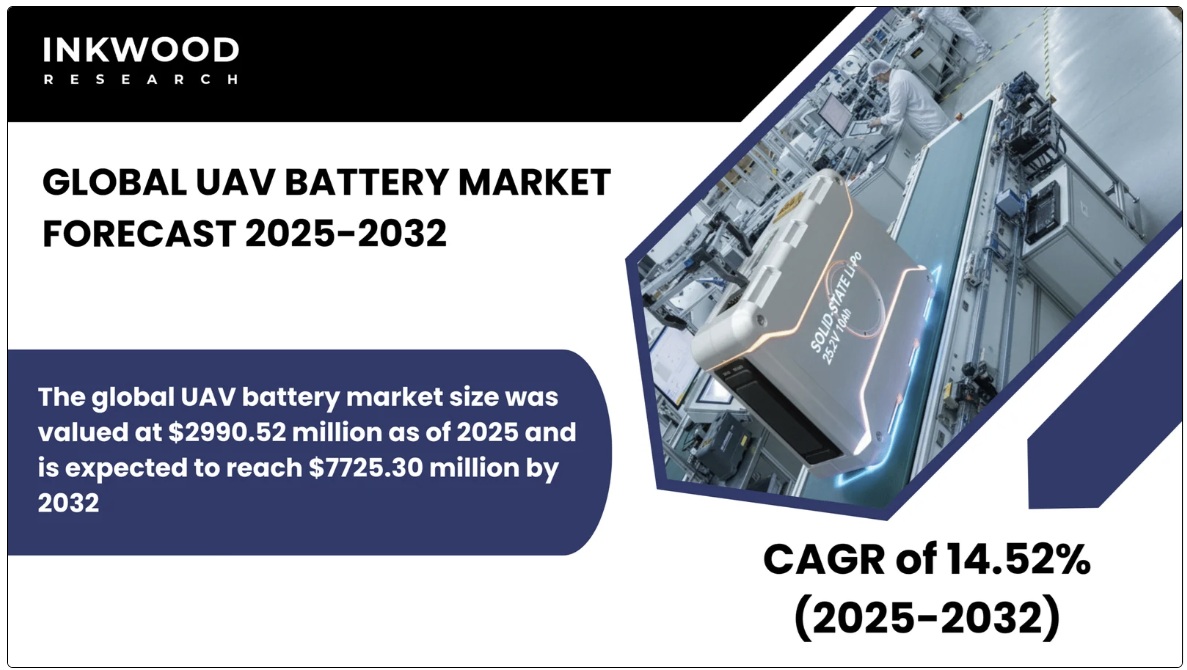
世界の無人航空機(UAV)用バッテリー市場規模は、2025年時点で2億9,052万ドルと評価されており、2032年には7億7,2530万ドルに達すると予測されています。予測期間2025~2032年は年平均成長率14.52%で成長します。本調査の基準年は2024年、予測期間は2025~2032年です。
本市場調査では、無人航空機(UAV)用バッテリー市場への危機の影響を定性的および定量的に分析しています。 世界の無人航空機(UAV)用バッテリー市場は、国防費の増加、商用ドローン用途の拡大、バッテリー化学の画期的な進歩に牽引され、爆発的な成長を遂げています。リチウムベースの技術が市場を席巻する一方、新興の燃料電池システムは飛行持続時間の延長を約束しています。 しかし、熱管理の課題とエネルギー密度の限界が、長期ミッションの制約となっています。バッテリーメーカーと UAV メーカー間の戦略的パートナーシップにより、軍事、商業、消費者の各分野にわたってカスタマイズされた電源ソリューションが加速しています。
世界の無人航空機(UAV)用バッテリー市場の主要企業は次のとおりです。
- Tadiran Batteries
- Eagle-Picher Technologies
- Epsilor
- HES Energy Systems
- Intelligent Energy
これらの企業の一部が採用している主な戦略は次のとおりです。
- Plug Powerは2024年3月、SK E&Sとの戦略的提携を発表しました。この提携は、長時間飛行が可能なUAV向けに特別に設計された水素燃料電池システムの開発を目的としています。この協業では、Plug Powerの燃料電池に関する専門知識とSK E&Sの水素製造能力を融合し、従来のバッテリーの限界を超えてドローンの飛行時間を延長する統合型電源ソリューションを実現します。
- インテリジェント・エナジーは2024年9月、商用および防衛用無人航空機の航続時間を延長する軽量水素発電モジュール「IE-SOAR燃料電池システム」を発売しました。この製品は、従来のリチウム電池では対応できない、数時間に及ぶミッションを必要とする戦術偵察プラットフォームを対象としています。
- エプシロールは、防衛関連企業向けリチウムポリマー電池の生産能力増強のため、2024年6月にUAV用バッテリー製造施設を拡張しました。この拡張は、自律監視作戦を支える信頼性の高い電力システムに対する軍事需要の高まりに対応しています。
- HESエナジーシステムズは、2024年1月に欧州の大手防衛関連企業と提携契約を締結し、次世代戦術無人航空機(UAV)プログラム向けにカスタマイズされた燃料電池ソリューションを提供しています。この提携は、軍事運用要件に最適化された水素貯蔵および電力供給システムの開発に重点を置いています。
GLOBAL UAV BATTERY MARKET OVERVIEW
The global UAV battery market size was valued at $2990.52 million as of 2025 and is expected to reach $7725.30 million by 2032, growing at a CAGR of 14.52% during the forecast period 2025-2032. The base year considered for the study is 2024, and the forecast period is between 2025 and 2032. The market study has also analyzed the crisis impact on the UAV battery market qualitatively as well as quantitatively.
The global UAV battery market is witnessing explosive growth driven by rising defense expenditures, expanding commercial drone applications, and breakthrough advancements in battery chemistry. Lithium-based technologies dominate the landscape while emerging fuel cell systems promise extended flight endurance.
However, thermal management challenges and limited energy density continue to constrain long-duration missions. Strategic partnerships between battery manufacturers and UAV producers are accelerating customized power solutions across military, commercial, and consumer segments.
UAV batteries represent the critical power source enabling unmanned aerial vehicles to execute missions across defense, commercial, and consumer applications. These rechargeable energy storage systems convert chemical energy into electrical power, propelling rotors or propellers while simultaneously operating onboard electronics, sensors, and communication systems. Battery technology directly impacts flight duration, payload capacity, and operational range.
Consequently, the performance characteristics of UAV power systems determine mission feasibility across surveillance operations, delivery services, agricultural monitoring, and tactical reconnaissance. Modern UAV batteries leverage advanced chemistries, including lithium-ion, lithium-polymer, fuel cells, and emerging solid-state architectures to optimize energy density while minimizing weight constraints inherent in aerial platforms.
The UAV battery market continues to expand rapidly as unmanned systems proliferate across defense and commercial sectors worldwide. Growing military investments in autonomous reconnaissance platforms drive substantial demand for high-performance power solutions.
Meanwhile, commercial applications such as package delivery, precision agriculture, and infrastructure inspection fuel the adoption of battery-powered drones. Technological breakthroughs in battery chemistry enhance energy density and cycle life, enabling longer flight times and more ambitious mission profiles. Furthermore, supportive government regulations opening civil airspace to UAV operations create new market opportunities for battery suppliers.
GLOBAL UAV BATTERY MARKET FORECAST 2025-2032
GROWTH ENABLERS
Key enablers of the global UAV battery market growth:
- Increasing commercial applications, such as delivery services, agriculture, and surveillance, are boosting UAV battery demand
- Technological advancements in battery chemistry are improving energy density and cycle life of UAV batteries
- Government support and regulatory approvals for UAV operations in civil airspace are expanding market opportunities
- Rising defense expenditures and demand for unmanned systems for border security and reconnaissance are fueling market growth
- Rising defense expenditures worldwide significantly accelerate UAV battery market expansion as militaries modernize aerial reconnaissance capabilities. Nations increasingly deploy unmanned systems for border patrol, intelligence gathering, and tactical surveillance missions where conventional aircraft prove costly or risky. These defense applications demand batteries delivering extended endurance, rapid recharge capabilities, and reliable performance under extreme environmental conditions.
- Moreover, geopolitical tensions drive procurement of long-range UAV platforms requiring advanced power systems capable of supporting multi-hour missions. Military specifications often push battery manufacturers toward innovative chemistries and thermal management solutions.
- Defense contracts typically involve substantial order volumes and premium pricing, making this segment particularly attractive for battery suppliers. Additionally, military UAV programs frequently accelerate technology development that eventually benefits commercial applications through knowledge transfer and economies of scale in manufacturing processes.
GROWTH RESTRAINTS
Key growth restraining factors of the global UAV battery market:
- Limited flight time and energy storage capacity of current battery technologies constrain long-endurance UAV operations
- High cost of advanced battery materials and production limits mass adoption in cost-sensitive applications
- Thermal management and safety issues associated with high-energy batteries pose challenges for manufacturers
- Slow development of battery recycling infrastructure increases environmental and supply chain risks
- Thermal management and safety issues present substantial obstacles for UAV battery manufacturers pursuing higher energy densities. Lithium-based batteries generate significant heat during charging and discharging cycles, particularly under high-power flight conditions. Excessive temperatures can trigger thermal runaway events leading to fires or explosions, creating catastrophic mission failures and regulatory scrutiny.
- Consequently, battery designers must integrate sophisticated cooling systems, adding weight and complexity to power modules. Aviation authorities impose stringent safety certifications requiring extensive testing under extreme conditions before approving batteries for commercial operations.
Additionally, lithium battery transportation faces strict regulations limiting shipping options and increasing logistics costs. These safety concerns particularly impact high-capacity batteries needed for long-endurance missions. Manufacturers must balance energy density improvements against thermal stability, often compromising performance to meet safety standards. Furthermore, incidents involving battery failures damage industry reputation and slow adoption rates among risk-averse operators in commercial and government sectors
KEY MARKET TRENDS
Global Flow Battery Industry | Top Trends
- Solid-state battery technology represents a transformative shift in UAV power systems by replacing liquid electrolytes with solid ceramic or polymer materials. This architectural change eliminates flammability risks associated with conventional lithium-ion batteries while enabling higher energy densities through advanced electrode materials. Solid-state designs operate safely across wider temperature ranges, making them ideal for military UAVs operating in extreme climates. Several aerospace companies have initiated partnerships with solid-state battery developers to validate these systems for aviation applications.
- Hybrid power systems integrating hydrogen fuel cells with lithium batteries unlock unprecedented flight endurance for UAV platforms. Fuel cells generate continuous electrical power through hydrogen oxidation while batteries provide peak power during takeoff and maneuvering. This combination allows tactical UAVs to achieve mission durations exceeding conventional battery-only systems by factors of three to five. Defense contractors actively develop hybrid architectures for long-range surveillance platforms requiring extended loiter capabilities.
- Collaborative relationships between drone producers and battery manufacturers intensify as operators demand application-specific power systems optimized for distinct mission profiles. Commercial delivery drones require rapid-charging batteries supporting multiple daily flights, whereas agricultural UAVs prioritize extended endurance for large-area coverage. These divergent requirements drive co-development initiatives where battery suppliers engineer custom cell configurations, thermal management systems, and battery management electronics tailored to specific airframe designs.
- Advanced materials, including graphene-enhanced electrodes and lithium-sulfur chemistry, promise substantial performance improvements over conventional battery technologies. Graphene’s exceptional electrical conductivity and mechanical strength enable faster charging rates and longer cycle life when incorporated into battery electrodes. Meanwhile, lithium-sulfur batteries theoretically deliver energy densities double that of lithium-ion systems at significantly lower material costs.
REPORT SYNOPSIS
| REPORT SCOPE | DETAILS |
|---|---|
| Market Forecast Years | 2025-2032 |
| Base Year | 2024 |
| Market Historical Years | 2018-2022 |
| Forecast Units | Revenue ($ Million) |
| Segments Analyzed | Technology, Component, Point of Sale, and Platform |
| Geographies Analyzed | North America, Europe, Asia-Pacific, Rest of World |
| Companies Analyzed | Tadiran Batteries, Eagle-Picher Technologies, Epsilor, HES Energy Systems, Intelligent Energy, Inventus Power, Plug Power, RRC Power Solutions, Shenzhen Grepow Battery, Sion Power |
Inkwood Researchでは世界の下記地域・国別の市場調査レポートも出版しています。各レポートの詳細についてはお問合せください。
| GLOBAL UAV BATTERY MARKET FORECAST 2025-2032 | 世界の無人航空機(UAV)用バッテリー市場予測 2025-2032年 | Single User License (USD) |
| INDIA UAV BATTERY MARKET FORECAST 2025-2032 | インドの無人航空機(UAV)用バッテリー市場予測 2025-2032年 | USD 1,100 |
| NORTH AMERICA UAV BATTERY MARKET FORECAST 2025-2032 | 北米の無人航空機(UAV)用バッテリー市場予測 2025-2032年 | USD 1,600 |
| SAUDI ARABIA UAV BATTERY MARKET FORECAST 2025-2032 | サウジアラビアの無人航空機(UAV)用バッテリー市場予測 2025-2032年 | USD 1,100 |
| ASIA-PACIFIC UAV BATTERY MARKET FORECAST 2025-2032 | アジア太平洋地域の無人航空機(UAV)用バッテリー市場予測 2025-2032年 | USD 1,600 |
| CHINA UAV BATTERY MARKET FORECAST 2025-2032 | 中国の無人航空機(UAV)用バッテリー市場予測 2025-2032年 | USD 1,100 |
| EUROPE UAV BATTERY MARKET FORECAST 2025-2032 | 欧州の無人航空機(UAV)用バッテリー市場予測 2025-2032年 | USD 1,600 |