
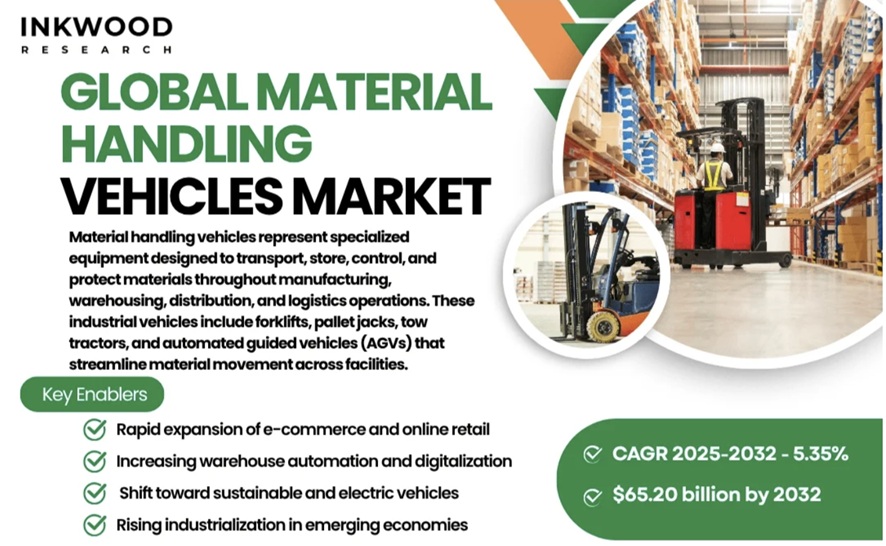
GLOBAL MATERIAL HANDLING VEHICLES MARKET FORECAST 2025-2032
世界のマテリアルハンドリング車両市場:車両タイプ別(フォークリフト、パレットジャッキ、牽引トラクター、無人搬送車(AGV))、用途別(製造、サードパーティロジスティクス(3PL)、電子商取引、一般商品、食品・飲料、その他の用途)、動力源別(電気、内燃機関、水素燃料電池、ハイブリッド)、所有形態別(リース、購入、レンタル、中古機器)
Global Material Handling Vehicles Market by Vehicle Type (Forklifts, Pallet Jacks, Tow Tractors, Automated Guided Vehicles (AGVs)) Market by Application (Manufacturing, Third-Party Logistics (3PL), E-Commerce, General Merchandise, Food & Beverage, Other Applications) Market by Power Source (Electric, Internal Combustion Engine, Hydrogen Fuel Cells, Hybrid) Market by Ownership Model (Lease, Purchasing, Renting, Used Equipment)
| 出版 | Inkwood Research |
| 出版年月 | 2025年10月 |
| ページ数 | 315 |
| 価格 | 記載以外のライセンスについてはお問合せください |
| シングルユーザ | USD 2,900 |
| 種別 | 英文調査報告書 |
| 商品番号 | SMR-9785 |

世界のマテリアルハンドリング車両市場規模は2025年から2032年の予測期間中は年平均成長率(CAGR)11.62%で成長し、2032年までに328億2,308万米ドルに達するとInkwood Researchでは予測しています。調査の基準年は2024年、予測期間は2025年から2032年です。
Inkwood Research(インクウッドリサーチ)「世界のマテリアルハンドリング車両市場:車両タイプ別(フォークリフト、パレットジャッキ、牽引トラクター、無人搬送車(AGV))、用途別(製造、サードパーティロジスティクス(3PL)、電子商取引、一般商品、食品・飲料、その他の用途)、動力源別(電気、内燃機関、水素燃料電池、ハイブリッド)、所有形態別(リース、購入、レンタル、中古機器) – Global Material Handling Vehicles Market by Vehicle Type (Forklifts, Pallet Jacks, Tow Tractors, Automated Guided Vehicles (AGVs)) Market by Application (Manufacturing, Third-Party Logistics (3PL), E-Commerce, General Merchandise, Food & Beverage, Other Applications) Market by Power Source (Electric, Internal Combustion Engine, Hydrogen Fuel Cells, Hybrid) Market by Ownership Model (Lease, Purchasing, Renting, Used Equipment)」は世界のマテリアルハンドリング市場を調査し、主要セグメント別に分析・予測を行っています。
調査対象セグメント
- 車両タイプ
- フォークリフト
- ハンドリフト(パレットジャッキ)
- 牽引車
- 無人搬送車(AGV)
- 用途
- 製造業
- 耐久財
- 非耐久財
- 3PL(サード・パーティー・ロジスティクス)
- eコマース
- 雑貨
- 食品&飲料
- その他の用途
- 製造業
- 電源
- 電導
- リチウムイオン電池
- 鉛蓄電池
- 内燃機関エンジン(ICE)
- 水素燃料電池
- ハイブリッド
- 電導
- 所有形態
- リース
- 購入
- レンタル
- 中古
- 地域
- 北米
- 米国
- カナダ
- 欧州
- 英国
- ドイツ
- フランス
- イタリア
- スペイン
- ポーランド
- ベルギー
- その他の欧州
- アジア太平洋地域
- 中国
- インド
- 日本
- オーストラリア&ニュージーランド
- 韓国
- タイ
- インドネシア
- ベトナム
- その他のアジア太平洋地域
- その他の地域(RoW)
- ラテンアメリカ
- 中東&アフリカ
- 北米
マテリアルハンドリング(マテハン)車両とは、製造、倉庫保管、配送、物流業務全体を通じて、資材の輸送、保管、管理、保護を目的とした特殊機器を指します。これらの産業用車両には、フォークリフト、パレットジャッキ、牽引トラクター、施設内の資材移動を効率化する無人搬送車(AGV)などがあります。
現代のマテリアルハンドリング(マテハン)機器は、自動化、IoT接続、電動パワートレインといった先進技術を統合し、運用効率を向上させています。企業がスマート倉庫技術を導入し、サプライチェーン業務を最適化する中で、機械・設備市場は大きな変革を遂げています。マテリアルハンドリングソリューションは、世界中のeコマース倉庫の自動化、製造工場、配送センター、サードパーティロジスティクス施設において重要な機能を果たしています。
世界のマテリアルハンドリング(マテハン)車両市場の主な成長促進要因
- 電子商取引とオンライン小売の急速な拡大
- 倉庫の自動化とデジタル化の発展
- 持続可能な自動車と電気自動車への移行
- 新興国における工業化の発展
Inkwood Researchでは世界の下記地域・国別の市場調査レポートも出版しています。各レポートの詳細についてはお問合せください。
| タイトル | Single User Price (USD) | |
| GLOBAL MATERIAL HANDLING VEHICLES MARKET FORECAST 2025-2032 | 世界のマテリアルハンドリング車両 2025-2032年 | USD 2,900 |
| ASIA-PACIFIC MATERIAL HANDLING VEHICLES MARKET FORECAST 2025-2032 | アジア太平洋地域のマテリアルハンドリング車両市場予測 2025-2032年 | USD 1,600 |
| EUROPE MATERIAL HANDLING VEHICLES MARKET FORECAST 2025-2032 | 欧州のマテリアルハンドリング車両市場予測 2025-2032年 | USD 1,600 |
| GERMANY MATERIAL HANDLING VEHICLES MARKET FORECAST 2025-2032 | ドイツのマテリアルハンドリング車両市場予測 2025-2032年 | USD 1,100 |
| INDIA MATERIAL HANDLING VEHICLES MARKET FORECAST 2025-2032 | インドのマテリアルハンドリング車両市場予測 2025-2032年 | USD 1,100 |
| JAPAN MATERIAL HANDLING VEHICLES MARKET FORECAST 2025-2032 | 日本のマテリアルハンドリング車両市場予測 2025-2032年 | USD 1,100 |
| NORTH AMERICA MATERIAL HANDLING VEHICLES MARKET FORECAST 2025-2032 | 北米のマテリアルハンドリング車両市場予測 2025-2032年 | USD 1,600 |
| SAUDI ARABIA MATERIAL HANDLING VEHICLES MARKET FORECAST 2025-2032 | サウジアラビアのマテリアルハンドリング車両市場予測 2025-2032年 | USD 1,100 |
KEY FINDINGS
The global material handling vehicles market size is expected to reach $32,823.08 million by 2032, growing at a CAGR of 11.62% during the forecast period 2025-2032. The base year considered for the study is 2024, and the forecast period is between 2025 and 2032. The market study has also analyzed the crisis impact on the material handling vehicles market qualitatively as well as quantitatively.
Material handling vehicles represent specialized equipment designed to transport, store, control, and protect materials throughout manufacturing, warehousing, distribution, and logistics operations. These industrial vehicles include forklifts, pallet jacks, tow tractors, and automated guided vehicles (AGVs) that streamline material movement across facilities.
Modern material handling equipment integrates advanced technologies such as automation, IoT connectivity, and electric powertrains to enhance operational efficiency. The machinery & equipment market has witnessed a substantial transformation as companies adopt smart warehouse technologies to optimize supply chain operations. Material handling solutions serve critical functions in e-commerce warehouse automation, manufacturing plants, distribution centers, and third-party logistics facilities worldwide.
E-commerce expansion drives unprecedented demand for material handling vehicles across global supply chain networks. Warehouse automation solutions have become essential as online retailers scale operations to meet consumer expectations for rapid delivery. Labor shortages in developed economies push businesses toward automated warehouse vehicles and autonomous forklifts. Additionally, emerging markets witness rising industrialization, creating substantial opportunities for material handling equipment manufacturers to expand their footprint globally.
MARKET INSIGHTS
Key enablers of the global material handling vehicles market growth:
- Rapid expansion of e-commerce and online retail
- Increasing warehouse automation and digitalization
- Shift toward sustainable and electric vehicles
- Rising industrialization in emerging economies
- Emerging economies across Asia-Pacific, Latin America, and parts of Africa are experiencing accelerated industrial growth. Manufacturing sectors in countries like India, Vietnam, Indonesia, and Thailand are expanding rapidly as global companies diversify supply chains.
- Consequently, demand for material handling trucks and industrial material handling systems surges in these regions. Governments implement favorable policies to attract foreign investment in manufacturing infrastructure. Furthermore, urbanization drives the construction of modern warehousing facilities equipped with advanced material handling solutions.
- Infrastructure development projects create substantial demand for heavy-duty material handling equipment in construction and industrial sectors. Local companies increasingly adopt international standards for warehouse operations, necessitating investments in quality material transport vehicles.
- However, the logistics automation market in emerging economies still faces challenges related to skilled operator availability. Despite these hurdles, rising disposable incomes and growing consumer markets make these regions attractive for material handling equipment manufacturers seeking long-term growth opportunities.
Key growth restraining factors of the global material handling vehicles market:
- High initial investment and maintenance costs
- Lack of skilled operators for advanced systems
- Limited infrastructure in developing countries
- Safety concerns and strict regulatory compliance
- Safety remains paramount in material handling operations as workplace accidents can result in severe injuries and costly litigation. Regulatory bodies worldwide enforce stringent standards for equipment design, operator training, and workplace protocols. Compliance with OSHA regulations in the United States and similar standards globally requires significant investments in safety features.
- Additionally, companies must implement comprehensive training programs to ensure operators handle material handling vehicles properly. Liability concerns prompt businesses to invest heavily in safety technologies like collision avoidance systems and operator monitoring.
- Regulatory compliance extends beyond operational safety to environmental standards, particularly for internal combustion engine vehicles. Emission regulations vary across regions, creating complexity for material handling equipment manufacturers serving global markets.
- Furthermore, certifications and periodic inspections add to operational costs for end-users. Insurance premiums rise when companies fail to maintain adequate safety records. Nevertheless, these regulations drive innovation as manufacturers develop safer, more compliant electric warehouse vehicles and smart warehouse technologies with enhanced safety features.
Global Material Handling Vehicles Industry | Top Trends
- Autonomous forklifts and self-guided pallet trucks transform warehouse operations by reducing labor dependency and increasing productivity. Companies deploy automated guided vehicles (AGVs) equipped with sensors, cameras, and AI algorithms for navigation without human intervention. These autonomous systems optimize route planning, minimize collision risks, and operate continuously without breaks. Major logistics providers invest heavily in autonomous fleet deployment to address persistent labor shortages. Consequently, the warehouse robots market experiences exponential growth as technology maturation reduces implementation costs.
- Smart warehouse technologies leverage IoT sensors and AI analytics to optimize material handling operations through real-time data collection. Fleet management systems monitor vehicle performance, battery levels, operator behavior, and maintenance requirements continuously. Predictive analytics identify potential equipment failures before they occur, reducing downtime and repair costs significantly. Additionally, AI algorithms optimize task allocation across vehicle fleets based on workload distribution and priority levels. Companies achieve substantial efficiency gains through data-driven decision-making enabled by connected material handling equipment.
- Electric material handling equipment adoption accelerates as companies prioritize sustainability and operational cost reduction. However, battery charging downtime affects productivity in high-intensity operations requiring 24/7 equipment availability. Battery swapping technology addresses this challenge by enabling rapid battery replacement in minutes rather than hours. Fast charging infrastructure development supports Li-ion powered forklifts and pallet trucks with significantly reduced charging times. Consequently, businesses eliminate productivity losses associated with traditional charging methods while maintaining continuous operations.
- Collaborative robots, or cobots, work alongside human operators to enhance productivity without replacing the workforce entirely. These robots handle repetitive tasks such as material transport and palletizing while humans focus on complex operations. Safety features enable cobots to operate in shared spaces without protective barriers, unlike traditional industrial robots. Moreover, intuitive programming interfaces allow rapid deployment and reconfiguration as operational needs change.
REPORT SYNOPSIS
| REPORT SCOPE | DETAILS |
|---|---|
| Market Forecast Years | 2025-2032 |
| Base Year | 2024 |
| Market Historical Years | 2018-2023 |
| Forecast Units | Revenue ($ Million) |
| Segments Analyzed | Vehicle Type, Application, Power Source, and Ownership Model |
| Country Analyzed | North America, Europe, Asia-Pacific, Rest of World |
| Companies Analyzed | Anhui Heli Co Ltd, BlueBotics, Clark Material Handling Company, Crown Equipment Corporation, Doosan Industrial Vehicle, EP Equipment, FlexQube AB, Hangcha Group Co Ltd, Hyster-Yale Materials Handling Inc, Jungheinrich AG, KION Group AG, Komatsu Ltd, Mitsubishi Logisnext Co Ltd, Seegrid Corporation, Toyota Industries Corporation |
SEGMENTATION ANALYSIS
Market Segmentation – Vehicle Type, Application, Power Source, and Ownership Model
Market by Vehicle Type:
- Forklifts
- Forklifts dominate the material handling vehicles market as versatile workhorses capable of lifting, transporting, and stacking materials efficiently. These industrial trucks feature hydraulic lifting mechanisms, operator platforms, and various attachment options for diverse applications. Forklifts operate in warehouses, manufacturing plants, shipping yards, and construction sites worldwide. Different classes accommodate varying load capacities, power sources, and operational environments. Counterbalance forklifts, reach trucks, and order pickers serve specialized functions within material handling operations.
- Electric forklifts gain market share as companies transition from internal combustion models to reduce emissions and operating costs. Li-ion battery technology offers faster charging, longer lifespan, and maintenance-free operation compared to traditional lead acid batteries. Furthermore, automation integration transforms forklifts into semi-autonomous or fully autonomous vehicles. Load capacity segmentation ranges from compact units handling below 5 tons to heavy-duty equipment exceeding 36 tons for industrial applications.
- Demand drivers include e-commerce growth, warehouse expansion, and manufacturing activity increases globally. Product innovations focus on operator comfort, safety enhancements, and telematics integration for fleet management. Additionally, rental and leasing models enable businesses to access modern equipment without substantial capital expenditures. The forklifts market represents the largest segment within material handling vehicles, supporting overall market growth through continuous technological advancement and expanding application scope.
- Pallet Jacks
- Tow Tractors
- Automated Guided Vehicles (AGVs)
Market by Application:
- Manufacturing
- Durable
- Non-Durable
- Third-Party Logistics (3PL)
- E-Commerce
- General Merchandise
- Food & Beverage
- Other Applications
Market by Power Source:
- Electric
- Li-Ion
- Lead Acid
- Internal Combustion Engine
- Hydrogen Fuel Cells
- Hybrid
Market by Ownership Model:
- Lease
- Purchasing
- Renting
- Used Equipment
REGIONAL ANALYSIS
Geographical Study Based on Four Major Regions:
North America: The United States and Canada
- The United States material handling vehicles market leads North America due to extensive e-commerce infrastructure, advanced manufacturing capabilities, and high automation adoption rates. Major retailers and logistics providers operate vast distribution networks requiring sophisticated material handling equipment throughout the country.
- Labor cost pressures and persistent workforce shortages accelerate investments in automated warehouse vehicles and autonomous systems. Moreover, stringent safety regulations drive demand for modern equipment with advanced safety features and operator assistance technologies. Environmental policies encourage electric material handling equipment adoption, particularly in California and other progressive states implementing emissions reduction mandates.
- Canada’s material handling vehicles market benefits from robust manufacturing sectors, natural resource industries, and growing e-commerce penetration. The country’s vast geography creates unique logistics challenges requiring efficient material transport vehicles across distribution networks. Cold storage and food processing industries represent significant market segments demanding specialized equipment for harsh operating environments.
- Furthermore, trade relationships with the United States integrate Canadian operations into North American supply chains. Government infrastructure investments and industrial development initiatives support market expansion, particularly in Ontario, Quebec, and British Columbia regions experiencing economic growth.
Europe: The United Kingdom, Germany, France, Italy, Spain, Poland, Belgium, and Rest of Europe
Asia-Pacific: China, India, Japan, Australia & New Zealand, South Korea, Thailand, Indonesia, Vietnam, and Rest of Asia-Pacific
Rest of World: Latin America, the Middle East & Africa
Our market research reports offer an in-depth analysis of individual country-level market size and growth statistics. We cover the segmentation analysis, key growth factors, and macro-economic trends within the material handling vehicles market, providing detailed insights into –
- India Material Handling Vehicles Market
- Germany Material Handling Vehicles Market
- Saudi Arabia Material Handling Vehicles Market
- Japan Material Handling Vehicles Market
COMPETITIVE INSIGHTS
The major players in the global material handling vehicles market are:
- Toyota Industries Corporation
- Kion Group AG
- Jungheinrich AG
- Crown Equipment Corporation
- Hyster-Yale Materials Handling Inc
Key Strategies Adopted by Some of These Companies:
- Toyota Industries Corporation introduced its advanced automated forklift series with enhanced AI navigation capabilities in March 2024, targeting the growing warehouse automation market and addressing labor shortage concerns in logistics operations.
- Kion Group AG partnered with Microsoft Azure in July 2024 to develop cloud-based fleet management solutions, enabling real-time monitoring and predictive maintenance across global material handling operations.
- Jungheinrich AG expanded its manufacturing facility in India during October 2023, increasing production capacity by 40% to serve the rapidly growing Asia-Pacific logistics automation market with locally manufactured electric warehouse vehicles.
- Crown Equipment Corporation acquired a leading AGV technology company in January 2024, strengthening its autonomous vehicle portfolio and accelerating development of next-generation smart warehouse technologies for distribution center automation.
We Offer 10% Free Customization and 3 Months Analyst Support
Frequently Asked Questions (FAQs):
Q1: What is the projected market size for material handling vehicles by 2032?
The global material handling vehicles market is expected to reach $32,823.08 million by 2032. This growth reflects increasing warehouse automation adoption, e-commerce expansion, and the shift toward electric material handling equipment across industries worldwide.
Q2: Which power source segment shows the fastest growth in material handling vehicles?
Electric material handling equipment demonstrates the fastest growth, driven by sustainability initiatives and lower operating costs. Li-ion battery technology advances make electric warehouse vehicles increasingly attractive compared to internal combustion alternatives.
Q3: How does e-commerce growth impact material handling vehicles demand?
E-commerce expansion significantly drives material handling vehicles adoption as online retailers require sophisticated distribution center automation. Automated guided vehicles (AGVs) and warehouse robots market growth directly correlates with increasing order volumes and rapid delivery expectations.
Table of Contents
1. RESEARCH SCOPE & METHODOLOGY
1.1. STUDY OBJECTIVES
1.2. METHODOLOGY
1.3. ASSUMPTIONS & LIMITATIONS
2. EXECUTIVE SUMMARY
2.1. MARKET SIZE & FORECAST
2.2. MARKET OVERVIEW
2.3. SCOPE OF STUDY
2.4. CRISIS SCENARIO ANALYSIS
2.5. MAJOR MARKET FINDINGS
2.5.1. THE MARKET IS EXPERIENCING STRONG DEMAND DUE TO THE INCREASING NEED FOR AUTOMATED SOLUTIONS IN WAREHOUSING AND LOGISTICS
2.5.2. E-COMMERCE EXPANSION IS SIGNIFICANTLY BOOSTING THE ADOPTION OF MATERIAL HANDLING VEHICLES ACROSS DISTRIBUTION CENTERS WORLDWIDE
2.5.3. THE MARKET IS SEEING GROWTH IN ELECTRIC AND HYBRID VEHICLES AS COMPANIES PRIORITIZE SUSTAINABILITY AND LOWER OPERATING COSTS
2.5.4. RISING LABOR SHORTAGES IN DEVELOPED REGIONS ARE DRIVING INVESTMENTS IN HIGHLY AUTOMATED AND ROBOTIC MATERIAL HANDLING SYSTEMS
3. MARKET DYNAMICS
3.1. KEY DRIVERS
3.1.1. RAPID EXPANSION OF E-COMMERCE AND ONLINE RETAIL
3.1.2. INCREASING WAREHOUSE AUTOMATION AND DIGITALIZATION
3.1.3. SHIFT TOWARD SUSTAINABLE AND ELECTRIC VEHICLES
3.1.4. RISING INDUSTRIALIZATION IN EMERGING ECONOMIES
3.2. KEY RESTRAINTS
3.2.1. HIGH INITIAL INVESTMENT AND MAINTENANCE COSTS
3.2.2. LACK OF SKILLED OPERATORS FOR ADVANCED SYSTEMS
3.2.3. LIMITED INFRASTRUCTURE IN DEVELOPING COUNTRIES
3.2.4. SAFETY CONCERNS AND STRICT REGULATORY COMPLIANCE
4. KEY ANALYTICS
4.1. KEY MARKET TRENDS
4.1.1. ADOPTION OF AUTONOMOUS AND SEMI-AUTONOMOUS VEHICLES
4.1.2. INTEGRATION OF IOT AND AI FOR SMART FLEET MANAGEMENT
4.1.3. GROWING DEMAND FOR BATTERY SWAPPING AND FAST CHARGING SYSTEMS
4.1.4. INCREASED FOCUS ON COLLABORATIVE ROBOTS FOR MATERIAL HANDLING
4.2. PORTER’S FIVE FORCES ANALYSIS
4.2.1. BUYERS POWER
4.2.2. SUPPLIERS POWER
4.2.3. SUBSTITUTION
4.2.4. NEW ENTRANTS
4.2.5. INDUSTRY RIVALRY
4.3. GROWTH PROSPECT MAPPING
4.3.1. GROWTH PROSPECT MAPPING FOR NORTH AMERICA
4.3.2. GROWTH PROSPECT MAPPING FOR EUROPE
4.3.3. GROWTH PROSPECT MAPPING FOR ASIA-PACIFIC
4.3.4. GROWTH PROSPECT MAPPING FOR REST OF WORLD
4.4. MARKET MATURITY ANALYSIS
4.5. MARKET CONCENTRATION ANALYSIS
4.6. VALUE CHAIN ANALYSIS
4.6.1. RAW MATERIAL AND COMPONENT SUPPLIERS
4.6.2. SUBSYSTEM AND COMPONENT MANUFACTURERS
4.6.3. ORIGINAL EQUIPMENT MANUFACTURERS (OEMS)
4.6.4. SYSTEM INTEGRATORS AND SOLUTION PROVIDERS
4.6.5. DISTRIBUTION AND SALES CHANNELS
4.6.6. END-USERS AND APPLICATION INDUSTRIES
4.6.7. AFTERMARKET SERVICES AND SUPPORT PROVIDERS
4.7. KEY BUYING CRITERIA
4.7.1. RELIABILITY AND DURABILITY OF EQUIPMENT
4.7.2. LOAD CAPACITY AND PERFORMANCE SPECIFICATIONS
4.7.3. AUTOMATION AND TECHNOLOGY INTEGRATION
4.7.4. ENERGY EFFICIENCY AND POWER CONSUMPTION
4.7.5. AFTER-SALES SERVICE AND SUPPORT
4.7.6. EASE OF OPERATION AND OPERATOR TRAINING
4.7.7. FLEXIBILITY AND CUSTOMIZATION OPTIONS
4.7.8. SAFETY AND REGULATORY COMPLIANCE
4.7.9. VENDOR REPUTATION AND CUSTOMER REFERENCES
4.8. REGULATORY FRAMEWORK
5. MATERIAL HANDLING VEHICLES MARKET BY VEHICLE TYPE
5.1. FORKLIFTS
5.1.1. BY LOAD CAPACITY
5.1.1.1. BELOW 5 TONS
5.1.1.2. 5-10 TONS
5.1.1.3. 11-36 TONS
5.1.1.4. ABOVE 36 TONS
5.1.2. BY CLASS
5.1.2.1. CLASS 1
5.1.2.2. CLASS 2
5.1.2.3. CLASS 3
5.1.2.4. CLASS 4/5
5.2. PALLET JACKS
5.3. TOW TRACTORS
5.4. AUTOMATED GUIDED VEHICLES (AGVS)
6. MATERIAL HANDLING VEHICLES MARKET BY APPLICATION
6.1. MANUFACTURING
6.1.1. DURABLE
6.1.2. NON-DURABLE
6.2. THIRD-PARTY LOGISTICS (3PL)
6.3. E-COMMERCE
6.4. GENERAL MERCHANDISE
6.5. FOOD & BEVERAGE
6.6. OTHER APPLICATIONS
7. MATERIAL HANDLING VEHICLES MARKET BY POWER SOURCE
7.1. ELECTRIC
7.1.1. LI-ION
7.1.2. LEAD ACID
7.2. INTERNAL COMBUSTION ENGINE
7.3. HYDROGEN FUEL CELLS
7.4. HYBRID
8. MATERIAL HANDLING VEHICLES MARKET BY OWNERSHIP MODEL
8.1. LEASE
8.2. PURCHASING
8.3. RENTING
8.4. USED EQUIPMENT
9. GEOGRAPHICAL ANALYSIS
9.1. NORTH AMERICA
9.1.1. MARKET SIZE & ESTIMATES
9.1.2. NORTH AMERICA MARKET DRIVERS
9.1.3. NORTH AMERICA MARKET CHALLENGES
9.1.4. KEY PLAYERS IN NORTH AMERICA MATERIAL HANDLING VEHICLES MARKET
9.1.5. COUNTRY ANALYSIS
9.1.5.1. UNITED STATES
9.1.5.1.1. UNITED STATES MARKET SIZE & OPPORTUNITIES
9.1.5.2. CANADA
9.1.5.2.1. CANADA MARKET SIZE & OPPORTUNITIES
9.2. EUROPE
9.2.1. MARKET SIZE & ESTIMATES
9.2.2. EUROPE MARKET DRIVERS
9.2.3. EUROPE MATERIAL HANDLING VEHICLES MARKET CHALLENGES
9.2.4. KEY PLAYERS IN EUROPE MATERIAL HANDLING VEHICLES MARKET
9.2.5. COUNTRY ANALYSIS
9.2.5.1. GERMANY
9.2.5.1.1. GERMANY MARKET SIZE & OPPORTUNITIES
9.2.5.2. UNITED KINGDOM
9.2.5.2.1. UNITED KINGDOM MARKET SIZE & OPPORTUNITIES
9.2.5.3. FRANCE
9.2.5.3.1. FRANCE MARKET SIZE & OPPORTUNITIES
9.2.5.4. ITALY
9.2.5.4.1. ITALY MARKET SIZE & OPPORTUNITIES
9.2.5.5. SPAIN
9.2.5.5.1. SPAIN MARKET SIZE & OPPORTUNITIES
9.2.5.6. BELGIUM
9.2.5.6.1. BELGIUM MARKET SIZE & OPPORTUNITIES
9.2.5.7. POLAND
9.2.5.7.1. POLAND MARKET SIZE & OPPORTUNITIES
9.2.5.8. REST OF EUROPE
9.2.5.8.1. REST OF EUROPE MARKET SIZE & OPPORTUNITIES
9.3. ASIA-PACIFIC
9.3.1. MARKET SIZE & ESTIMATES
9.3.2. ASIA-PACIFIC MARKET DRIVERS
9.3.3. ASIA-PACIFIC MARKET CHALLENGES
9.3.4. KEY PLAYERS IN ASIA-PACIFIC MATERIAL HANDLING VEHICLES MARKET
9.3.5. COUNTRY ANALYSIS
9.3.5.1. CHINA
9.3.5.1.1. CHINA MARKET SIZE & OPPORTUNITIES
9.3.5.2. INDIA
9.3.5.2.1. INDIA MARKET SIZE & OPPORTUNITIES
9.3.5.3. JAPAN
9.3.5.3.1. JAPAN MARKET SIZE & OPPORTUNITIES
9.3.5.4. AUSTRALIA & NEW ZEALAND
9.3.5.4.1. AUSTRALIA & NEW ZEALAND MARKET SIZE & OPPORTUNITIES
9.3.5.5. SOUTH KOREA
9.3.5.5.1. SOUTH KOREA MARKET SIZE & OPPORTUNITIES
9.3.5.6. THAILAND
9.3.5.6.1. THAILAND MARKET SIZE & OPPORTUNITIES
9.3.5.7. INDONESIA
9.3.5.7.1. INDONESIA MARKET SIZE & OPPORTUNITIES
9.3.5.8. VIETNAM
9.3.5.8.1. VIETNAM MARKET SIZE & OPPORTUNITIES
9.3.5.9. REST OF ASIA-PACIFIC
9.3.5.9.1. REST OF ASIA-PACIFIC MARKET SIZE & OPPORTUNITIES
9.4. REST OF WORLD
9.4.1. MARKET SIZE & ESTIMATES
9.4.2. REST OF WORLD MARKET DRIVERS
9.4.3. REST OF WORLD MARKET CHALLENGES
9.4.4. KEY PLAYERS IN REST OF WORLD MATERIAL HANDLING VEHICLES MARKET
9.4.5. REGIONAL ANALYSIS
9.4.5.1. LATIN AMERICA
9.4.5.1.1. LATIN AMERICA MARKET SIZE & OPPORTUNITIES
9.4.5.2. MIDDLE EAST & AFRICA
9.4.5.2.1. MIDDLE EAST & AFRICA MARKET SIZE & OPPORTUNITIES
10. COMPETITIVE LANDSCAPE
10.1. KEY STRATEGIC DEVELOPMENTS
10.1.1. MERGERS & ACQUISITIONS
10.1.2. PRODUCT LAUNCHES & DEVELOPMENTS
10.1.3. PARTNERSHIPS & AGREEMENTS
10.1.4. BUSINESS EXPANSIONS & DIVESTITURES
10.2. COMPANY PROFILES
10.2.1. ANHUI HELI CO LTD
10.2.1.1. COMPANY OVERVIEW
10.2.1.2. PRODUCTS
10.2.1.3. STRENGTHS & CHALLENGES
10.2.2. BLUEBOTICS
10.2.2.1. COMPANY OVERVIEW
10.2.2.2. PRODUCTS
10.2.2.3. STRENGTHS & CHALLENGES
10.2.3. CLARK MATERIAL HANDLING COMPANY
10.2.3.1. COMPANY OVERVIEW
10.2.3.2. PRODUCTS
10.2.3.3. STRENGTHS & CHALLENGES
10.2.4. CROWN EQUIPMENT CORPORATION
10.2.4.1. COMPANY OVERVIEW
10.2.4.2. PRODUCTS
10.2.4.3. STRENGTHS & CHALLENGES
10.2.5. DOOSAN INDUSTRIAL VEHICLE
10.2.5.1. COMPANY OVERVIEW
10.2.5.2. PRODUCTS
10.2.5.3. STRENGTHS & CHALLENGES
10.2.6. EP EQUIPMENT
10.2.6.1. COMPANY OVERVIEW
10.2.6.2. PRODUCTS
10.2.6.3. STRENGTHS & CHALLENGES
10.2.7. FLEXQUBE AB
10.2.7.1. COMPANY OVERVIEW
10.2.7.2. PRODUCTS
10.2.7.3. STRENGTHS & CHALLENGES
10.2.8. HANGCHA GROUP CO LTD
10.2.8.1. COMPANY OVERVIEW
10.2.8.2. PRODUCTS
10.2.8.3. STRENGTHS & CHALLENGES
10.2.9. HYSTER-YALE MATERIALS HANDLING INC
10.2.9.1. COMPANY OVERVIEW
10.2.9.2. PRODUCTS
10.2.9.3. STRENGTHS & CHALLENGES
10.2.10. JUNGHEINRICH AG
10.2.10.1. COMPANY OVERVIEW
10.2.10.2. PRODUCTS
10.2.10.3. STRENGTHS & CHALLENGES
10.2.11. KION GROUP AG
10.2.11.1. COMPANY OVERVIEW
10.2.11.2. PRODUCTS
10.2.11.3. STRENGTHS & CHALLENGES
10.2.12. KOMATSU LTD
10.2.12.1. COMPANY OVERVIEW
10.2.12.2. PRODUCTS
10.2.12.3. STRENGTHS & CHALLENGES
10.2.13. MITSUBISHI LOGISNEXT CO LTD
10.2.13.1. COMPANY OVERVIEW
10.2.13.2. PRODUCTS
10.2.13.3. STRENGTHS & CHALLENGES
10.2.14. SEEGRID CORPORATION
10.2.14.1. COMPANY OVERVIEW
10.2.14.2. PRODUCTS
10.2.14.3. STRENGTHS & CHALLENGES
10.2.15. TOYOTA INDUSTRIES CORPORATION
10.2.15.1. COMPANY OVERVIEW
10.2.15.2. PRODUCTS
10.2.15.3. STRENGTHS & CHALLENGES
LIST OF TABLES
TABLE 1: MARKET SNAPSHOT – MATERIAL HANDLING VEHICLES
TABLE 2: MARKET BY VEHICLE TYPE, HISTORICAL YEARS, 2018-2023 (IN $ MILLION)
TABLE 3: MARKET BY VEHICLE TYPE, FORECAST YEARS, 2025-2032 (IN $ MILLION)
TABLE 4: FORKLIFTS MARKET, BY REGION, HISTORICAL YEARS, 2018-2023 (IN $ MILLION)
TABLE 5: FORKLIFTS MARKET, BY REGION, FORECAST YEARS, 2025-2032 (IN $ MILLION)
TABLE 6: MATERIAL HANDLING VEHICLES MARKET, BY FORKLIFTS, HISTORICAL YEARS, 2018-2023 (IN $ MILLION)
TABLE 7: MATERIAL HANDLING VEHICLES MARKET, BY FORKLIFTS, FORECAST YEARS, 2025-2032 (IN $ MILLION)
TABLE 8: MARKET BY LOAD CAPACITY, HISTORICAL YEARS, 2018-2023 (IN $ MILLION)
TABLE 9: MARKET BY LOAD CAPACITY, FORECAST YEARS, 2025-2032 (IN $ MILLION)
TABLE 10: BELOW 5 TONS MARKET, BY REGION, HISTORICAL YEARS, 2018-2023 (IN $ MILLION)
TABLE 11: BELOW 5 TONS MARKET, BY REGION, FORECAST YEARS, 2025-2032 (IN $ MILLION)
TABLE 12: 5-10 TONS MARKET, BY REGION, HISTORICAL YEARS, 2018-2023 (IN $ MILLION)
TABLE 13: 5-10 TONS MARKET, BY REGION, FORECAST YEARS, 2025-2032 (IN $ MILLION)
TABLE 14: 11-36 TONS MARKET, BY REGION, HISTORICAL YEARS, 2018-2023 (IN $ MILLION)
TABLE 15: 11-36 TONS MARKET, BY REGION, FORECAST YEARS, 2025-2032 (IN $ MILLION)
TABLE 16: ABOVE 36 TONS MARKET, BY REGION, HISTORICAL YEARS, 2018-2023 (IN $ MILLION)
TABLE 17: ABOVE 36 TONS MARKET, BY REGION, FORECAST YEARS, 2025-2032 (IN $ MILLION)
TABLE 18: MATERIAL HANDLING VEHICLES MARKET, BY CLASS, HISTORICAL YEARS, 2018-2023 (IN $ MILLION)
TABLE 19: MATERIAL HANDLING VEHICLES MARKET, BY CLASS, FORECAST YEARS, 2025-2032 (IN $ MILLION)
TABLE 20: CLASS 1 MARKET, BY REGION, HISTORICAL YEARS, 2018-2023 (IN $ MILLION)
TABLE 21: CLASS 1 MARKET, BY REGION, FORECAST YEARS, 2025-2032 (IN $ MILLION)
TABLE 22: CLASS 2 MARKET, BY REGION, HISTORICAL YEARS, 2018-2023 (IN $ MILLION)
TABLE 23: CLASS 2 MARKET, BY REGION, FORECAST YEARS, 2025-2032 (IN $ MILLION)
TABLE 24: CLASS 3 MARKET, BY REGION, HISTORICAL YEARS, 2018-2023 (IN $ MILLION)
TABLE 25: CLASS 3 MARKET, BY REGION, FORECAST YEARS, 2025-2032 (IN $ MILLION)
TABLE 26: CLASS 4/5 MARKET, BY REGION, HISTORICAL YEARS, 2018-2023 (IN $ MILLION)
TABLE 27: CLASS 4/5 MARKET, BY REGION, FORECAST YEARS, 2025-2032 (IN $ MILLION)
TABLE 28: PALLET JACKS MARKET, BY REGION, HISTORICAL YEARS, 2018-2023 (IN $ MILLION)
TABLE 29: PALLET JACKS MARKET, BY REGION, FORECAST YEARS, 2025-2032 (IN $ MILLION)
TABLE 30: TOW TRACTORS MARKET, BY REGION, HISTORICAL YEARS, 2018-2023 (IN $ MILLION)
TABLE 31: TOW TRACTORS MARKET, BY REGION, FORECAST YEARS, 2025-2032 (IN $ MILLION)
TABLE 32: AUTOMATED GUIDED VEHICLES (AGVS) MARKET, BY REGION, HISTORICAL YEARS, 2018-2023 (IN $ MILLION)
TABLE 33: AUTOMATED GUIDED VEHICLES (AGVS) MARKET, BY REGION, FORECAST YEARS, 2025-2032 (IN $ MILLION)
TABLE 34: MARKET BY APPLICATION, HISTORICAL YEARS, 2018-2023 (IN $ MILLION)
TABLE 35: MARKET BY APPLICATION, FORECAST YEARS, 2025-2032 (IN $ MILLION)
TABLE 36: MANUFACTURING MARKET, BY REGION, HISTORICAL YEARS, 2018-2023 (IN $ MILLION)
TABLE 37: MANUFACTURING MARKET, BY REGION, FORECAST YEARS, 2025-2032 (IN $ MILLION)
TABLE 38: MATERIAL HANDLING VEHICLES MARKET, BY MANUFACTURING, HISTORICAL YEARS, 2018-2023 (IN $ MILLION)
TABLE 39: MATERIAL HANDLING VEHICLES MARKET, BY MANUFACTURING, FORECAST YEARS, 2025-2032 (IN $ MILLION)
TABLE 40: DURABLE MARKET, BY REGION, HISTORICAL YEARS, 2018-2023 (IN $ MILLION)
TABLE 41: DURABLE MARKET, BY REGION, FORECAST YEARS, 2025-2032 (IN $ MILLION)
TABLE 42: NON-DURABLE MARKET, BY REGION, HISTORICAL YEARS, 2018-2023 (IN $ MILLION)
TABLE 43: NON-DURABLE MARKET, BY REGION, FORECAST YEARS, 2025-2032 (IN $ MILLION)
TABLE 44: THIRD-PARTY LOGISTICS (3PL) MARKET, BY REGION, HISTORICAL YEARS, 2018-2023 (IN $ MILLION)
TABLE 45: THIRD-PARTY LOGISTICS (3PL) MARKET, BY REGION, FORECAST YEARS, 2025-2032 (IN $ MILLION)
TABLE 46: E-COMMERCE MARKET, BY REGION, HISTORICAL YEARS, 2018-2023 (IN $ MILLION)
TABLE 47: E-COMMERCE MARKET, BY REGION, FORECAST YEARS, 2025-2032 (IN $ MILLION)
TABLE 48: GENERAL MERCHANDISE MARKET, BY REGION, HISTORICAL YEARS, 2018-2023 (IN $ MILLION)
TABLE 49: GENERAL MERCHANDISE MARKET, BY REGION, FORECAST YEARS, 2025-2032 (IN $ MILLION)
TABLE 50: FOOD & BEVERAGE MARKET, BY REGION, HISTORICAL YEARS, 2018-2023 (IN $ MILLION)
TABLE 51: FOOD & BEVERAGE MARKET, BY REGION, FORECAST YEARS, 2025-2032 (IN $ MILLION)
TABLE 52: OTHER APPLICATIONS MARKET, BY REGION, HISTORICAL YEARS, 2018-2023 (IN $ MILLION)
TABLE 53: OTHER APPLICATIONS MARKET, BY REGION, FORECAST YEARS, 2025-2032 (IN $ MILLION)
TABLE 54: MARKET BY POWER SOURCE, BY REGION, HISTORICAL YEARS, 2018-2023 (IN $ MILLION)
TABLE 55: MARKET BY POWER SOURCE, BY REGION, FORECAST YEARS, 2025-2032 (IN $ MILLION)
TABLE 56: ELECTRIC MARKET, BY REGION, HISTORICAL YEARS, 2018-2023 (IN $ MILLION)
TABLE 57: ELECTRIC MARKET, BY REGION, FORECAST YEARS, 2025-2032 (IN $ MILLION)
TABLE 58: MATERIAL HANDLING VEHICLES MARKET, BY ELECTRIC, HISTORICAL YEARS, 2018-2023 (IN $ MILLION)
TABLE 59: MATERIAL HANDLING VEHICLES MARKET, BY ELECTRIC, FORECAST YEARS, 2025-2032 (IN $ MILLION)
TABLE 60: LI-ION MARKET, BY REGION, HISTORICAL YEARS, 2018-2023 (IN $ MILLION)
TABLE 61: LI-ION MARKET, BY REGION, FORECAST YEARS, 2025-2032 (IN $ MILLION)
TABLE 62: LEAD ACID MARKET, BY REGION, HISTORICAL YEARS, 2018-2023 (IN $ MILLION)
TABLE 63: LEAD ACID MARKET, BY REGION, FORECAST YEARS, 2025-2032 (IN $ MILLION)
TABLE 64: INTERNAL COMBUSTION ENGINE MARKET, BY REGION, HISTORICAL YEARS, 2018-2023 (IN $ MILLION)
TABLE 65: INTERNAL COMBUSTION ENGINE MARKET, BY REGION, FORECAST YEARS, 2025-2032 (IN $ MILLION)
TABLE 66: HYDROGEN FUEL CELLS MARKET, BY REGION, HISTORICAL YEARS, 2018-2023 (IN $ MILLION)
TABLE 67: HYDROGEN FUEL CELLS MARKET, BY REGION, FORECAST YEARS, 2025-2032 (IN $ MILLION)
TABLE 68: HYBRID MARKET, BY REGION, HISTORICAL YEARS, 2018-2023 (IN $ MILLION)
TABLE 69: HYBRID MARKET, BY REGION, FORECAST YEARS, 2025-2032 (IN $ MILLION)
TABLE 70: MARKET BY OWNERSHIP MODEL, HISTORICAL YEARS, 2018-2023 (IN $ MILLION)
TABLE 71: MARKET BY OWNERSHIP MODEL, FORECAST YEARS, 2025-2032 (IN $ MILLION)
TABLE 72: LEASE MARKET, BY REGION, HISTORICAL YEARS, 2018-2023 (IN $ MILLION)
TABLE 73: LEASE MARKET, BY REGION, FORECAST YEARS, 2025-2032 (IN $ MILLION)
TABLE 74: PURCHASING MARKET, BY REGION, HISTORICAL YEARS, 2018-2023 (IN $ MILLION)
TABLE 75: PURCHASING MARKET, BY REGION, FORECAST YEARS, 2025-2032 (IN $ MILLION)
TABLE 76: RENTING MARKET, BY REGION, HISTORICAL YEARS, 2018-2023 (IN $ MILLION)
TABLE 77: RENTING MARKET, BY REGION, FORECAST YEARS, 2025-2032 (IN $ MILLION)
TABLE 78: USED EQUIPMENT MARKET, BY REGION, HISTORICAL YEARS, 2018-2023 (IN $ MILLION)
TABLE 79: USED EQUIPMENT MARKET, BY REGION, FORECAST YEARS, 2025-2032 (IN $ MILLION)
TABLE 80: MARKET BY GEOGRAPHICAL ANALYSIS, HISTORICAL YEARS, 2018-2023 (IN $ MILLION)
TABLE 81: MARKET BY GEOGRAPHICAL ANALYSIS, FORECAST YEARS, 2025-2032 (IN $ MILLION)
TABLE 82: NORTH AMERICA MARKET, COUNTRY ANALYSIS, HISTORICAL YEARS, 2018-2023 (IN $ MILLION)
TABLE 83: NORTH AMERICA MARKET, COUNTRY ANALYSIS, FORECAST YEARS, 2025-2032 (IN $ MILLION)
TABLE 84: KEY PLAYERS OPERATING IN THE NORTH AMERICAN MARKET
TABLE 85: EUROPE MARKET, COUNTRY ANALYSIS, HISTORICAL YEARS, 2018-2023 (IN $ MILLION)
TABLE 86: EUROPE MARKET, COUNTRY ANALYSIS, FORECAST YEARS, 2025-2032 (IN $ MILLION)
TABLE 87: KEY PLAYERS OPERATING IN THE EUROPEAN MARKET
TABLE 88: ASIA-PACIFIC MARKET, COUNTRY ANALYSIS, HISTORICAL YEARS, 2018-2023 (IN $ MILLION)
TABLE 89: ASIA-PACIFIC MARKET, COUNTRY ANALYSIS, FORECAST YEARS, 2025-2032 (IN $ MILLION)
TABLE 90: KEY PLAYERS OPERATING IN THE ASIA-PACIFIC MARKET
TABLE 91: REST OF WORLD MARKET, REGIONAL ANALYSIS, HISTORICAL YEARS, 2018-2023 (IN $ MILLION)
TABLE 92: REST OF WORLD MARKET, REGIONAL ANALYSIS, FORECAST YEARS, 2025-2032 (IN $ MILLION)
TABLE 93: LIST OF MERGERS & ACQUISITIONS
TABLE 94: LIST OF PRODUCT LAUNCHES & DEVELOPMENTS
TABLE 95: LIST OF PARTNERSHIPS & AGREEMENTS
TABLE 96: LIST OF BUSINESS EXPANSIONS & DIVESTITURES
LIST OF FIGURES
FIGURE 1: KEY MARKET TRENDS
FIGURE 2: PORTER’S FIVE FORCES ANALYSIS
FIGURE 3: GROWTH PROSPECT MAPPING FOR NORTH AMERICA
FIGURE 4: GROWTH PROSPECT MAPPING FOR EUROPE
FIGURE 5: GROWTH PROSPECT MAPPING FOR ASIA-PACIFIC
FIGURE 6: GROWTH PROSPECT MAPPING FOR REST OF WORLD
FIGURE 7: MARKET MATURITY ANALYSIS
FIGURE 8: MARKET CONCENTRATION ANALYSIS
FIGURE 9: VALUE CHAIN ANALYSIS
FIGURE 10: KEY BUYING CRITERIA
FIGURE 11: SEGMENT GROWTH POTENTIAL, BY VEHICLE TYPE, IN 2024
FIGURE 12: FORKLIFTS MARKET SIZE, 2025-2032 (IN $ MILLION)
FIGURE 13: SEGMENT GROWTH POTENTIAL, BY FORKLIFTS, IN 2024
FIGURE 14: LOAD CAPACITY MARKET SIZE, 2025-2032 (IN $ MILLION)
FIGURE 15: SEGMENT GROWTH POTENTIAL, BY LOAD CAPACITY, IN 2024
FIGURE 16: BELOW 5 TONS MARKET SIZE, 2025-2032 (IN $ MILLION)
FIGURE 17: 5-10 TONS MARKET SIZE, 2025-2032 (IN $ MILLION)
FIGURE 18: 11-36 TONS MARKET SIZE, 2025-2032 (IN $ MILLION)
FIGURE 19: ABOVE 36 TONS MARKET SIZE, 2025-2032 (IN $ MILLION)
FIGURE 20: SEGMENT GROWTH POTENTIAL, BY CLASS, IN 2024
FIGURE 21: CLASS 1 MARKET SIZE, 2025-2032 (IN $ MILLION)
FIGURE 22: CLASS 2 MARKET SIZE, 2025-2032 (IN $ MILLION)
FIGURE 23: CLASS 3 MARKET SIZE, 2025-2032 (IN $ MILLION)
FIGURE 24: CLASS 4/5 MARKET SIZE, 2025-2032 (IN $ MILLION)
FIGURE 25: PALLET JACKS MARKET SIZE, 2025-2032 (IN $ MILLION)
FIGURE 26: TOW TRACTORS MARKET SIZE, 2025-2032 (IN $ MILLION)
FIGURE 27: AUTOMATED GUIDED VEHICLES (AGVS) MARKET SIZE, 2025-2032 (IN $ MILLION)
FIGURE 28: SEGMENT GROWTH POTENTIAL, BY APPLICATION, IN 2024
FIGURE 29: MANUFACTURING MARKET SIZE, 2025-2032 (IN $ MILLION)
FIGURE 30: SEGMENT GROWTH POTENTIAL, BY MANUFACTURING, IN 2024
FIGURE 31: DURABLE MARKET SIZE, 2025-2032 (IN $ MILLION)
FIGURE 32: NON-DURABLE MARKET SIZE, 2025-2032 (IN $ MILLION)
FIGURE 33: THIRD-PARTY LOGISTICS MARKET SIZE, 2025-2032 (IN $ MILLION)
FIGURE 34: E-COMMERCE MARKET SIZE, 2025-2032 (IN $ MILLION)
FIGURE 35: GENERAL MERCHANDISE MARKET SIZE, 2025-2032 (IN $ MILLION)
FIGURE 36: FOOD & BEVERAGE MARKET SIZE, 2025-2032 (IN $ MILLION)
FIGURE 37: OTHER APPLICATIONS MARKET SIZE, 2025-2032 (IN $ MILLION)
FIGURE 38: SEGMENT GROWTH POTENTIAL, BY POWER SOURCE, IN 2024
FIGURE 39: ELECTRIC MARKET SIZE, 2025-2032 (IN $ MILLION)
FIGURE 40: SEGMENT GROWTH POTENTIAL, BY ELECTRIC, IN 2024
FIGURE 41: LI-ION MARKET SIZE, 2025-2032 (IN $ MILLION)
FIGURE 42: LEAD ACID MARKET SIZE, 2025-2032 (IN $ MILLION)
FIGURE 43: INTERNAL COMBUSTION ENGINE MARKET SIZE, 2025-2032 (IN $ MILLION)
FIGURE 44: HYDROGEN FUEL CELLS MARKET SIZE, 2025-2032 (IN $ MILLION)
FIGURE 45: HYBRID MARKET SIZE, 2025-2032 (IN $ MILLION)
FIGURE 46: SEGMENT GROWTH POTENTIAL, BY OWNERSHIP MODEL, IN 2024
FIGURE 47: LEASE MARKET SIZE, 2025-2032 (IN $ MILLION)
FIGURE 48: PURCHASING MARKET SIZE, 2025-2032 (IN $ MILLION)
FIGURE 49: RENTING MARKET SIZE, 2025-2032 (IN $ MILLION)
FIGURE 50: USED EQUIPMENT MARKET SIZE, 2025-2032 (IN $ MILLION)
FIGURE 51: NORTH AMERICA MATERIAL HANDLING VEHICLES MARKET, COUNTRY OUTLOOK, 2024 & 2032 (IN %)
FIGURE 52: UNITED STATES MARKET SIZE, 2025-2032 (IN $ MILLION)
FIGURE 53: CANADA MARKET SIZE, 2025-2032 (IN $ MILLION)
FIGURE 54: EUROPE MATERIAL HANDLING VEHICLES MARKET, COUNTRY OUTLOOK, 2024 & 2032 (IN %)
FIGURE 55: GERMANY MARKET SIZE, 2025-2032 (IN $ MILLION)
FIGURE 56: UNITED KINGDOM MARKET SIZE, 2025-2032 (IN $ MILLION)
FIGURE 57: FRANCE MARKET SIZE, 2025-2032 (IN $ MILLION)
FIGURE 58: ITALY MARKET SIZE, 2025-2032 (IN $ MILLION)
FIGURE 59: SPAIN MARKET SIZE, 2025-2032 (IN $ MILLION)
FIGURE 60: BELGIUM MARKET SIZE, 2025-2032 (IN $ MILLION)
FIGURE 61: POLAND MARKET SIZE, 2025-2032 (IN $ MILLION)
FIGURE 62: REST OF EUROPE MARKET, 2025-2032 (IN $ MILLION)
FIGURE 63: ASIA-PACIFIC MATERIAL HANDLING VEHICLES MARKET, COUNTRY OUTLOOK, 2024 & 2032 (IN %)
FIGURE 64: CHINA MARKET SIZE, 2025-2032 (IN $ MILLION)
FIGURE 65: INDIA MARKET SIZE, 2025-2032 (IN $ MILLION)
FIGURE 66: JAPAN MARKET SIZE, 2025-2032 (IN $ MILLION)
FIGURE 67: AUSTRALIA & NEW ZEALAND MARKET SIZE, 2025-2032 (IN $ MILLION)
FIGURE 68: SOUTH KOREA MARKET SIZE, 2025-2032 (IN $ MILLION)
FIGURE 69: THAILAND MARKET SIZE, 2025-2032 (IN $ MILLION)
FIGURE 70: INDONESIA MARKET SIZE, 2025-2032 (IN $ MILLION)
FIGURE 71: VIETNAM MARKET SIZE, 2025-2032 (IN $ MILLION)
FIGURE 72: REST OF ASIA-PACIFIC MARKET SIZE, 2025-2032 (IN $ MILLION)
FIGURE 73: REST OF WORLD MATERIAL HANDLING VEHICLES MARKET, REGIONAL OUTLOOK, 2024 & 2032 (IN %)
FIGURE 74: LATIN AMERICA MARKET SIZE, 2025-2032 (IN $ MILLION)
FIGURE 75: MIDDLE EAST & AFRICA MARKET SIZE, 2025-2032 (IN $ MILLION)