
Electric Vehicle Charging Station Market Size, Share, Trends and Forecast by Charging Station Type, Vehicle Type, Installation Type, Charging Level, Connector Type, Application, and Region, 2026-2034
電気自動車充電ステーション市場規模、シェア、動向、予測:充電ステーションタイプ、車両タイプ、設置タイプ、充電レベル、コネクタタイプ、用途、地域別、2026-2034年
| 出版 | IMARC Group |
| 出版年月 | 2026年03月 |
| ページ数 | 145 |
| 価格 | 記載以外のライセンスについてはお問合せください |
| シングルユーザ | USD 3,999 |
| 種別 | 英文調査報告書 |
| 商品番号 | SMR-15276 |

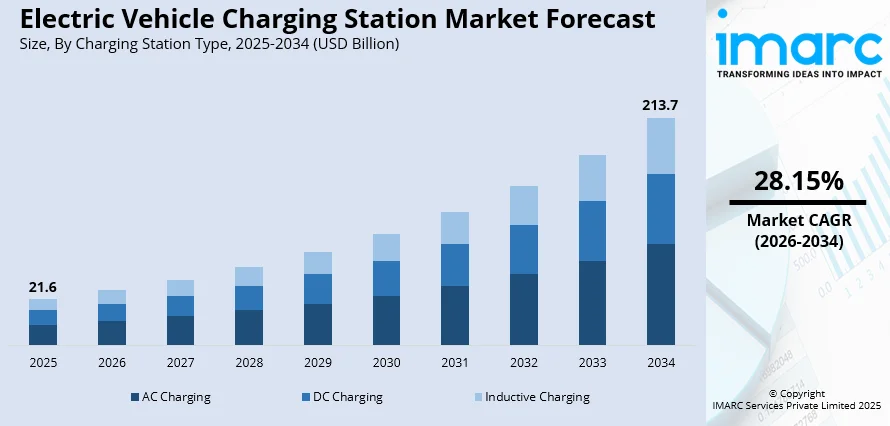
世界の電気自動車充電ステーション市場規模は、2025年に216億米ドルと評価されました。IMARCグループは、今後、市場規模は2034年までに2,137億米ドルに達し、2026年から2034年にかけて28.15%の年平均成長率(CAGR)で成長すると予測しています。現在、アジア太平洋地域が市場を牽引しており、2025年には54.5%以上の市場シェアを獲得しています。この地域は、強力な政府による景気刺激策、電気自動車(EV)の急速な成長、大規模なインフラ投資、都市化、そして主要なEV製造拠点の立地により、充電ネットワークの継続的な拡大を牽引しており、市場をリードしています。
世界的に、電気自動車(EV)充電ステーション業界を牽引する最も影響力のある要因は、政府の政策と気候変動対策、そして環境の持続可能性の整合性です。多くの国が、温室効果ガスの排出削減と電動モビリティへの移行を支援するため、政策、補助金、減税措置などを実施しています。こうした取り組みには、国家レベルのEV目標の採用、充電ポイント設置への資金提供、ゼロエミッション車の法制化などが含まれます。さらに、世界的な気候協定はクリーン輸送イニシアチブにおける国際協力を促進し、インフラ整備をさらに加速させています。現在、都市設計には住宅、事業所、公共交通機関にEV充電ポイントが組み込まれることが多くなっています。例えば、2023年2月には、L-Chargeがアムステルダムで世界初のモバイル型超高速オフグリッドEV充電サービスを導入しました。アプリを介したオンデマンド充電を可能にし、クリーン燃料を燃焼させる移動式ステーションでインフラのギャップを埋めています。さらに、世界的な脱炭素化への移行は、電力網をクリーンエネルギー源に対応させるよう促し、EVインフラの整備を補完しています。輸送は最も多くのCO2を排出する分野であるため、世界的な政策の調和は、電気自動車充電ステーションの設置を促進するための持続的かつ協調的な取り組みを世界的に保証します。
Report Overview
The global electric vehicle charging station market size was valued at USD 21.6 Billion in 2025. Looking forward, IMARC Group estimates the market to reach USD 213.7 Billion by 2034, exhibiting a CAGR of 28.15% from 2026-2034. Asia Pacific currently dominates the market, holding a market share of over 54.5% in 2025. The region leads the market based on robust government stimulus, fast growth of electric vehicles (EVs), massive infrastructure spending on a large scale, urbanization, and the location of key EV manufacturing bases fueling ongoing expansion of charging networks in the region.
Globally, the most influential factor in driving the electric vehicle (EV) charging station industry is the co-alignment of government policies and climate objectives as well as sustainability in the environment. Many countries have implemented policy, subsidy, and tax-break initiatives to help cut greenhouse gas emissions and assist the shift toward electric mobility. Such initiatives cover national EV target adoption, funding for the provision of charging points, and legislating zero-emission vehicles. Moreover, global climate pacts have promoted transnational cooperation in clean transport initiatives, further spurring infrastructure development. Urban design now often includes EV charging points in residential properties, business locations, and public transport systems. For example, in February 2023, L-Charge introduced the world’s first mobile, extremely fast, off-grid EV charging service in Amsterdam, facilitating on-demand charging via an app to fill infrastructural gaps with clean fuel-burning, movable stations. Furthermore, the worldwide transition towards decarbonization is also driving electricity grids to be ready for clean energy sources, complementing the development of EV infrastructure. Since transportation is among the highest emitters, global policy harmonization guarantees a sustained and coordinated effort in favor of electric vehicle charging station installation globally.
In the United States, one of the most influential drivers of the market is the strenuous focus on infrastructure investment alongside long-term planning for cities with a market share of 88.70% in 2024. Federal and state governments are making large investments in creating a vast and inclusive EV charging network with access in both urban and rural communities. For instance, In January 2025, Brooklyn-based Itselectric revealed plans to grow New York City’s curbside EV chargers from 1,400 in 2024 to 10,000 by 2030, filling key urban charging infrastructure gaps. Moreover, such investments enable Level 2 and DC fast charger installations along major highways, public places, neighborhoods, and underserved communities. Municipal governments are adding EV-friendly zoning regulations and building codes requiring the incorporation of charging stations into new developments. Concurrently, utility providers and local governments are working together to enhance power grids and introduce smart charging systems. Integrating EV infrastructure into urban transport planning not only supports cleaner mobility but also local economies and job generation. This integrated approach is making the U.S. a developing and strategically planned market for the deployment of EV charging stations.
Electric Vehicle Charging Station Market Trends:
Rising adoption of electric vehicles (EVs)
The rising demand for EV charging stations due to the increasing adoption of EVs among the masses across the globe is contributing to the electric vehicle charging station market growth. According to the International Energy Agency (IEA), in 2023, sales of electric cars were 3.5 Million more as compared to the previous year, recording a growth of 35% annually. In 2024, the revenue in the electric vehicle market is projected to reach a staggering US$ 623.3 Billion worldwide. Moreover, the unit sales of the electric vehicle market are anticipated to reach 17.07 million vehicles units by 2028. In addition, there is a rising concern about environmental sustainability and the need to reduce greenhouse gas (GHG) emissions. Additionally, various key market players are extensively investing in the development of electric vehicle charging stations. For instance, in October 2022, Octopus Energy Generation made its first investment in the UK EV charging infrastructure. It is planning to invest up to GBP 110 Million in a Manchester-based EV public charging network Be. EV on behalf of its Sky fund (ORI SCSp) to scale and install new charge points across the United Kingdom. The agreement will contribute to the expansion of Be.EV’s 150-strong public charge point network, with Be.EV committing to adding 1,000 more charge points across the North of England and beyond. Such initiatives are anticipated to create a positive electric vehicle charging station market outlook.
Advancements in Battery Technology
Various manufacturers are rapidly advancing their battery technologies in the EV sector. In line with this, they are working on technologies such as wireless charging and autonomous charging robots, which may make vehicle charging convenient. For instance, Siemens AG launched a new high-power charger, Sicharge D. It features scalable, high charging power of up to 300 kW. The charging station also supports voltages between 150 and 1,000 volts and charging currents of up to 1,000. Moreover, the integration of higher-voltage Level 2 chargers and rapid DC fast chargers that provide quicker charge times and enhance the overall EV ownership experience is also contributing to market growth. Apart from this, various power companies are increasingly investing in developing the public charging infrastructure to cater to the escalating need for faster and more affordable charging solutions. For instance, in October 2022, Ather Energy announced the installation of the 580th public fast charging point, the Ather Grid, across 56 cities in India. As the company expands its national footprint, Ather Energy plans to install 820 more grids, bringing the total to 1400 by the end of FY23. Ather Grids are strategically installed across markets, with 60% of current installations in tier-II and tier-III cities.
Favorable Government Initiatives
The government authorities of several countries are encouraging the adoption of cleaner and more sustainable transportation solutions, which is offering a positive market outlook. They are implementing stringent rules and regulations to combat air pollution and reduce carbon emissions in the environment across the globe. According to the United Nations World Meteorological Organization (WMO), total carbon dioxide emissions were calculated to reach 41.6 Billion Tons in 2024. Moreover, concerned government bodies worldwide are also introducing various schemes and initiatives to encourage buyers to choose electric vehicles over conventional vehicles. For instance, the Japanese government aims to transform all the new cars sold in the country into electric or hybrid vehicles by 2050. Similarly, the California ZEV program, which aims to have 1.5 million electric vehicles on the road by 2025, is one such initiative. India, China, the United Kingdom, South Korea, France, Germany, Norway, and the Netherlands are some of the countries offering various incentives for people looking to purchase an electric vehicle. Apart from this, the concerned regulatory bodies and authorities are incentivizing the deployment of EV charging infrastructure through grants, subsidies, and tax benefits, which is further bolstering the growth of the market. Additionally, municipalities in several countries are implementing zero-emission targets to achieve sustainability goals.
Electric Vehicle Charging Station Market Report Scope:
| Report Features | Details |
|---|---|
| Base Year of the Analysis | 2025 |
| Historical Period | 2020-2025 |
| Forecast Period | 2026-2034 |
| Units | Billion USD |
| Scope of the Report | Exploration of Historical Trends and Market Outlook, Industry Catalysts and Challenges, Segment-Wise Historical and Future Market Assessment:
|
| Charging Station Types Covered | AC Charging, DC Charging, Inductive Charging |
| Vehicle Types Covered | Battery Electric Vehicle (BEV), Plug-in Hybrid Electric Vehicle (PHEV), Hybrid Electric Vehicle (HEV) |
| Installation Types Covered | Portable Charger, Fixed Charger |
| Charging Levels Covered | Level 1, Level 2, Level 3 |
| Connector Types Covered | Combines Charging Station (CCS), CHAdeMO, Normal Charging, Tesla Supercharger, Type-2 (IEC 621196), Others |
| Applications Covered | Residential, Commercial |
| Regions Covered | Asia Pacific, Europe, North America, Latin America, Middle East and Africa |
| Countries Covered | United States, Canada, Germany, France, United Kingdom, Italy, Spain, Russia, China, Japan, India, South Korea, Australia, Indonesia, Brazil, Mexico |
| Companies Covered | ABB E-mobility, Alfen N.V., Blink Charging Co., Bosch Automotive Service Solutions LLC., bp pulse, ChargePoint, Inc, Eaton Corporation plc, Efacec, Evbox, EVgo Services LLC, Schneider Electric, Tesla, Inc., etc. |
| Customization Scope | 10% Free Customization |
| Post-Sale Analyst Support | 10-12 Weeks |
| Delivery Format | PDF and Excel through Email (We can also provide the editable version of the report in PPT/Word format on special request) |
Electric Vehicle Charging Station Industry Segmentation:
IMARC Group provides an analysis of the key trends in each segment of the global electric vehicle charging station market, along with forecast at the global, regional, and country levels from 2026-2034. The market has been categorized based on charging station type, vehicle type, installation type, charging level, connector type, and application.
Analysis by Charging Station Type:
- AC Charging
- DC Charging
- Inductive Charging
In 2025, AC Charging leads the world electric vehicle charging station market forecast with a strong share of 88.1%. This is due to extensive use of alternating current (AC) chargers in both residential and commercial areas. AC chargers are cheaper to install and operate compared to DC fast chargers, and hence they are the preferred solution for home installations, offices, and public charging stations. These chargers are generally slower but sufficient for overnight charging or extended stops, providing a balance between cost and charging time. The growing use of electric vehicles, along with government incentives and encouragement of EV infrastructure, has helped fuel the ongoing expansion of AC charging stations. As the demand for electric vehicles on the road increases, so will the need for AC charging stations, particularly in inner cities where the ability to charge conveniently and at a low cost is vital for EV owners.
Analysis by Vehicle Type:
- Battery Electric Vehicle (BEV)
- Plug-in Hybrid Electric Vehicle (PHEV)
- Hybrid Electric Vehicle (HEV)
The Battery Electric Vehicle (BEV) category maintains the highest market share of 78.8% in the EV market in 2025. BEVs are plug-in vehicles powered solely by rechargeable batteries, providing zero-emission transportation. Their success is due to the increased demand for green cars and the drive to decarbonize the transport industry. With technological improvements in battery technology, charging stations, and car ranges, BEVs are increasingly becoming the practical everyday choice. Governments across the world have also launched supportive regulations and incentives for the use of BEVs, including tax rebates, EV purchase rebates, and investment in EV infrastructure. Also, leading auto makers are turning to BEVs, replacing ICE vehicles, further solidifying the expansion of the BEV segment. As the EV market matures on a global scale, the BEV segment will maintain its leading position with its environmental advantages and rising affordability for consumers.
Analysis by Installation Type:
- Portable Charger
- Fixed Charger
Fixed Chargers lead the installation type in the electric vehicle charging station market by 93.2% in 2025. Fixed chargers are installed at home, business, and public places permanently and give a steady and trustworthy charging facility. Fixed chargers give a more long-term solution than mobile charging units, which are portable but not so trustworthy for daily use. Fixed chargers are best suited for both domestic and public charging requirements since they provide stable power and an effortless experience to the users. With the rise in electric vehicle adoption on roads, demand for fixed charging infrastructure keeps increasing. Fixed chargers are also easier and cheaper to maintain, thus becoming a desired choice for extensive infrastructure development. Both private and public sector investment in EV infrastructure is picking up, especially in urban cities, where fixed chargers are pivotal in delivering convenient charging solutions for making accessible services available to serve the expanding demand of EV users.
Analysis by Charging Level:
- Level 1
- Level 2
- Level 3
Level 2 charging level holds 69.7% electric vehicle charging station market value in 2025. They run on a 240V supply and provide a quicker charging process compared to Level 1 chargers, which use household power outlets. Level 2 chargers suit home use since they offer a full charge overnight, generally taking 4 to 8 hours based on the size of the vehicle’s battery. They are also extensively employed in public and commercial charging points, where they provide a satisfactory cost and charging speed combination. The high market penetration of Level 2 chargers is attributed to their extensive availability and affordability. As the adoption of electric vehicles is on the rise, the requirement for Level 2 chargers will keep growing, especially in places where fast charging facilities (Level 3) have not been made available. This will propel the installation of Level 2 chargers in residential and public infrastructure, catalyzing additional EV adoption.
Analysis by Connector Type:
- Combines Charging Station (CCS)
- CHAdeMO
- Normal Charging
- Tesla Supercharger
- Type-2 (IEC 621196)
- Others
The CHAdeMO connector type has a 30.3% market share in 2025. CHAdeMO is one of the most common DC fast charging standards, used notably in Japan and for cars such as the Nissan Leaf. It facilitates quick charging, tending to slash charging time immensely in comparison to AC chargers or Level 1 chargers. CHAdeMO’s sustained popularity is due in part to its early adoption among large Chinese and Japanese automakers and because it has been used to give EVs fast, convenient charging in residential as well as public stations. Nevertheless, with other fast-charging standards such as CCS (Combined Charging System) gaining popularity around the world, CHAdeMO’s market share will be threatened. Nevertheless, CHAdeMO remains significant as a charging standard where it has significant Japanese automaker influence. It is still an important component of the worldwide fast-charging network and will probably remain a primary charging solution for some EV models in the near future.
Analysis by Application:
- Residential
- Commercial
In 2025, the Residential segment dominates the application category, with 61.1% of the electric vehicle charging station market. Residential charging is the most prevalent type of EV charging because many EV users find it more convenient to charge their cars at home. Through home chargers, customers simply need to plug in their cars overnight and drive off in the morning with a fully charged battery. This level of convenience renders residential charging highly appealing to EV users who are not interested in depending on public charging points. Increased traffic from the rising population of electric vehicles, together with the support provided by governments to help home charge installation costs, should drive subsequent expansion within the market segment. The increase in the population of EVs is making charging solution demands from domestic residents keep rising, mainly because urban and suburban populations are gradually becoming proponents of using electric cars as well as deploying supporting technology at their homes for home charging.
Regional Analysis:
- North America
o United States
o Canada
- Asia Pacific
o China
o Japan
o India
o South Korea
o Australia
o Indonesia
o Others
- Europe
o Germany
o France
o United Kingdom
o Italy
o Spain
o Russia
o Others
- Latin America
o Brazil
o Mexico
o Others
- Middle East and Africa
In 2025, the Asia-Pacific region has the largest market share of the EV charging station market, at 54.5%. This is mainly due to the speedy adoption of electric vehicles in the countries of China, Japan, and South Korea, which are leading the world in the EV movement. Regional government policies are highly conducive to the adoption of EVs, with subsidies, tax breaks, and investment in charging infrastructure being primary growth drivers. China, the world’s biggest EV market, has invested heavily in the development of its charging infrastructure, which further fuels the growth of electric vehicles. The Asia-Pacific region also houses some of the biggest EV manufacturers, adding to the high demand for charging stations. As the market keeps expanding, more expansion of EV charging infrastructure is anticipated, with growing investments from both public and private sectors to cater to the increasing number of electric vehicles on the road.
Key Regional Takeaways:
North America Electric Vehicle Charging Station Market Analysis
In 2025, the North America electric vehicle (EV) charging station market maintains its steady growth, fueled by expanding EV adoption and consistent government support for clean transportation. The region is seeing more investments in charging infrastructure in urban, suburban, and highway networks to make EV charging more convenient and accessible for consumers. Public and private sectors are working actively to increase the coverage of both Level 2 and DC fast-charging stations, with a specific focus on fixed installations in residential and commercial locations. Level 2 chargers continue to be dominant because of their cost versus charging speed balance, catering to daily commuting requirements. Residential installations are also increasing at a fast pace as more EV owners find home charging convenient. North America’s emphasis on decreasing carbon footprints and embracing clean energy solutions is also driving the evolution of high-end EV infrastructure. Therefore, the continent is becoming an integral player in the growth of the world’s EV charging station market.
United States Electric Vehicle Charging Station Market Analysis
The United States electric vehicle (EV) charging station market is fueled mainly by the increasing usage of electric vehicles, driven by higher environmental concerns and government subsidies. In line with the International Energy Agency (IEA), the United States registered 10% of new EVs registered worldwide in 2023. Additionally, it is estimated through industry reports that, by the year 2030, 26.4 Million EVs will be operating on American highways, representing 10% of all vehicles on the road. This has massively increased demand for accessible and easy-to-use charging infrastructure. State and federal policies, like tax credits, grants, and plans to invest in infrastructure, are further driving this transformation. Also, improved charging technology, such as fast-charging technology, is becoming increasingly simpler and faster to recharge EVs, making them more desirable for consumers. Increasing public-private partnerships and investments from major auto companies and energy providers are also building out infrastructure throughout urban and rural settings. In addition, the presence of Level 3 DC fast chargers and the emergence of new technologies, including wireless charging, are making it easier to own EVs. Combined, these trends are driving the high growth of the electric vehicle charging station market in the United States, keeping charging infrastructure up with EV sales.
Asia Pacific Electric Vehicle Charging Station Market Analysis
The market for electric vehicle (EV) charging stations in the Asia Pacific region is growing as a result of rising urbanization and a mounting demand for environmentally friendly means of transportation in high-density areas. According to estimates by reports, in the year 2024, 52.9% of the Asia population resided in urban cities, translating to 2,545,230,547 people. With increasing urbanization, the need for cleaner means of mobility is on the increase, compelling governments and companies to give top priority to the rollout of EV charging infrastructure. Coupled with speedy innovations in smart grid technology and integrating charging points with mobile applications for convenient accessibility, user experience and adoption are also being fueled by EV. The growing array of affordable electric cars has further increased the demand for a robust charging network. In addition, robust government policies and incentives, especially in emerging economies like India, are reducing the barriers to EV adoption, while high investments in grid infrastructure are making charging stations more accessible in both urban and rural regions.
Europe Electric Vehicle Charging Station Market Analysis
The European Union electric vehicle (EV) charging station market is growing rapidly, driven by the region’s high level of commitment to sustainability and decarbonization objectives as part of the European Union’s Green Deal and its ambitious greenhouse gas emission reduction targets by 2030. GHG emissions in the European Union fell by 2.6% in Q2 2024 compared to the same quarter in 2023, according to reports. The EU regulatory support, such as strict emission standards for vehicles and EV purchase incentives, is further driving the mass adoption of electric vehicles in European nations.
Consequently, there is a growing demand for a widespread and affordable EV charging network to support the rising number of EVs on the roads. Government investment in the development of charging networks, coupled with private sector participation, is essential to this process. Technological innovation in quick-charging technologies, including ultra-fast chargers and intelligent charging systems, further improves convenience and shortens charging time, drawing more customers into adopting electric vehicles. Apart from this, the increasing trend of awareness regarding environmental concerns, as well as favorable incentives like subsidies, grants, and tax incentives, is also fueling demand for EVs and their charging points, making the European market one of the most vibrant in the globe.
Latin America Electric Vehicle Charging Station Market Analysis
The Latin American market for electric vehicle (EV) charging stations is significantly contributing to the rise in environmental awareness and government policies that favor environmentally friendly transportation. The implementation of various government initiatives like tax reductions and subsidies to popularize the use of electric vehicles. For example, there were 52,000 new EV registrations in Brazil in 2023, showing a rise of 181.1% from the preceding year. As urbanization increases and pollution concerns rise, the demand for cleaner alternatives to traditional vehicles is boosting the need for EV charging infrastructure. Furthermore, urban planning initiatives are increasingly incorporating EV infrastructure in new developments, making charging stations more accessible. Increased supply of electric buses and commercial vehicles, especially in nations like Brazil and Mexico, is also stimulating the need for a widespread charging network to facilitate fleet changes.
Middle East and Africa Electric Vehicle Charging Station Market Analysis
The Middle East and Africa electric vehicle (EV) charging station market is heavily impacted by increasing investments in green technology as well as the growth of renewable energy infrastructure. The Middle East market for renewable energy will grow at a CAGR of 13.53% between 2024 and 2032, the IMARC Group report states. Since governments of nations in the region are looking to diversify the sources of energy and move away from oil, there is increased emphasis on the electrification of the transport sector. The growing availability of affordable EV models is also driving consumer uptake, while government efforts to cut fuel usage and air pollution are driving demand for charging stations. Moreover, the growing presence of international automakers and energy firms in the region is also driving the growth of strong charging networks to cater to the growing demand for electric vehicles.
Competitive Landscape:
The competitive environment in the electric vehicle (EV) charging station industry is one of fast technology evolution and increasing infrastructure. Competitors are shifting attention to maximizing charging efficiency, increasing coverage, and providing simple-to-use digital interfaces. Advances in charging technology, particularly in Level 2 and DC fast charging, have led to the deployment of more efficient and convenient stations across urban, residential, and highway settings. Strategic collaborations among technology providers, utility companies, and infrastructure investors are facilitating large-scale implementation. Most participants are also converging smart charging solutions that facilitate remote management, scheduling, and energy optimization. The focus on sustainability and renewable energy integration is also creating the need for solar-powered and grid-responsive systems. There is also an increasing trend toward modular and scalable station designs that can be configured for varied environments. As the demand rises, the market continues to be active, with stakeholders continually refining their products to aid in the rapid adoption of electric cars.
The report provides a comprehensive analysis of the competitive landscape in the electric vehicle charging station market with detailed profiles of all major companies, including:
- ABB E-mobility
- Alfen N.V.
- Blink Charging Co.
- Bosch Automotive Service Solutions LLC.
- bp pulse
- ChargePoint, Inc
- Eaton Corporation plc
- Efacec
- Evbox
- EVgo Services LLC
- Schneider Electric
- Tesla, Inc.
Key Questions Answered in This Report
- How big is the electric vehicle charging station market?
- What is the future outlook of electric vehicle charging station market?
- What are the key factors driving the electric vehicle charging station market?
- Which region accounts for the largest electric vehicle charging station market share?
- Which are the leading companies in the global electric vehicle charging station market?
Table of Contents
1 Preface
2 Scope and Methodology
2.1 Objectives of the Study
2.2 Stakeholders
2.3 Data Sources
2.3.1 Primary Sources
2.3.2 Secondary Sources
2.4 Market Estimation
2.4.1 Bottom-Up Approach
2.4.2 Top-Down Approach
2.5 Forecasting Methodology
3 Executive Summary
4 Introduction
4.1 Overview
4.2 Key Industry Trends
5 Global Electric Vehicle Charging Station Market
5.1 Market Overview
5.2 Market Performance
5.3 Impact of COVID-19
5.4 Market Forecast
6 Market Breakup by Charging Station Type
6.1 AC Charging
6.1.1 Market Trends
6.1.2 Market Forecast
6.2 DC Charging
6.2.1 Market Trends
6.2.2 Market Forecast
6.3 Inductive Charging
6.3.1 Market Trends
6.3.2 Market Forecast
7 Market Breakup by Vehicle Type
7.1 Battery Electric Vehicle (BEV)
7.1.1 Market Trends
7.1.2 Market Forecast
7.2 Plug-in Hybrid Electric Vehicle (PHEV)
7.2.1 Market Trends
7.2.2 Market Forecast
7.3 Hybrid Electric Vehicle (HEV)
7.3.1 Market Trends
7.3.2 Market Forecast
8 Market Breakup by Installation Type
8.1 Portable Charger
8.1.1 Market Trends
8.1.2 Market Forecast
8.2 Fixed Charger
8.2.1 Market Trends
8.2.2 Market Forecast
9 Market Breakup by Charging Level
9.1 Level 1
9.1.1 Market Trends
9.1.2 Market Forecast
9.2 Level 2
9.2.1 Market Trends
9.2.2 Market Forecast
9.3 Level 3
9.3.1 Market Trends
9.3.2 Market Forecast
10 Market Breakup by Connector Type
10.1 Combines Charging Station (CCS)
10.1.1 Market Trends
10.1.2 Market Forecast
10.2 CHAdeMO
10.2.1 Market Trends
10.2.2 Market Forecast
10.3 Normal Charging
10.3.1 Market Trends
10.3.2 Market Forecast
10.4 Tesla Supercharger
10.4.1 Market Trends
10.4.2 Market Forecast
10.5 Type-2 (IEC 621196)
10.5.1 Market Trends
10.5.2 Market Forecast
10.6 Others
10.6.1 Market Trends
10.6.2 Market Forecast
11 Market Breakup by Application
11.1 Residential
11.1.1 Market Trends
11.1.2 Market Forecast
11.2 Commercial
11.2.1 Market Trends
11.2.2 Market Forecast
12 Market Breakup by Region
12.1 North America
12.1.1 United States
12.1.1.1 Market Trends
12.1.1.2 Market Forecast
12.1.2 Canada
12.1.2.1 Market Trends
12.1.2.2 Market Forecast
12.2 Asia-Pacific
12.2.1 China
12.2.1.1 Market Trends
12.2.1.2 Market Forecast
12.2.2 Japan
12.2.2.1 Market Trends
12.2.2.2 Market Forecast
12.2.3 India
12.2.3.1 Market Trends
12.2.3.2 Market Forecast
12.2.4 South Korea
12.2.4.1 Market Trends
12.2.4.2 Market Forecast
12.2.5 Australia
12.2.5.1 Market Trends
12.2.5.2 Market Forecast
12.2.6 Indonesia
12.2.6.1 Market Trends
12.2.6.2 Market Forecast
12.2.7 Others
12.2.7.1 Market Trends
12.2.7.2 Market Forecast
12.3 Europe
12.3.1 Germany
12.3.1.1 Market Trends
12.3.1.2 Market Forecast
12.3.2 France
12.3.2.1 Market Trends
12.3.2.2 Market Forecast
12.3.3 United Kingdom
12.3.3.1 Market Trends
12.3.3.2 Market Forecast
12.3.4 Italy
12.3.4.1 Market Trends
12.3.4.2 Market Forecast
12.3.5 Spain
12.3.5.1 Market Trends
12.3.5.2 Market Forecast
12.3.6 Russia
12.3.6.1 Market Trends
12.3.6.2 Market Forecast
12.3.7 Others
12.3.7.1 Market Trends
12.3.7.2 Market Forecast
12.4 Latin America
12.4.1 Brazil
12.4.1.1 Market Trends
12.4.1.2 Market Forecast
12.4.2 Mexico
12.4.2.1 Market Trends
12.4.2.2 Market Forecast
12.4.3 Others
12.4.3.1 Market Trends
12.4.3.2 Market Forecast
12.5 Middle East and Africa
12.5.1 Market Trends
12.5.2 Market Breakup by Country
12.5.3 Market Forecast
13 SWOT Analysis
13.1 Overview
13.2 Strengths
13.3 Weaknesses
13.4 Opportunities
13.5 Threats
14 Value Chain Analysis
15 Porters Five Forces Analysis
15.1 Overview
15.2 Bargaining Power of Buyers
15.3 Bargaining Power of Suppliers
15.4 Degree of Competition
15.5 Threat of New Entrants
15.6 Threat of Substitutes
16 Price Analysis
17 Competitive Landscape
17.1 Market Structure
17.2 Key Players
17.3 Profiles of Key Players
17.3.1 ABB E-mobility
17.3.1.1 Company Overview
17.3.1.2 Product Portfolio
17.3.1.3 Financials
17.3.1.4 SWOT Analysis
17.3.2 Alfen N.V.
17.3.2.1 Company Overview
17.3.2.2 Product Portfolio
17.3.2.3 Financials
17.3.2.4 SWOT Analysis
17.3.3 Blink Charging Co.
17.3.3.1 Company Overview
17.3.3.2 Product Portfolio
17.3.3.3 Financials
17.3.4 Bosch Automotive Service Solutions LLC.
17.3.4.1 Company Overview
17.3.4.2 Product Portfolio
17.3.4.3 Financials
17.3.4.4 SWOT Analysis
17.3.5 bp pulse
17.3.5.1 Company Overview
17.3.5.2 Product Portfolio
17.3.5.3 Financials
17.3.5.4 SWOT Analysis
17.3.6 ChargePoint, Inc
17.3.6.1 Company Overview
17.3.6.2 Product Portfolio
17.3.7 Eaton Corporation plc
17.3.7.1 Company Overview
17.3.7.2 Product Portfolio
17.3.7.3 Financials
17.3.7.4 SWOT Analysis
17.3.8 Efacec
17.3.8.1 Company Overview
17.3.8.2 Product Portfolio
17.3.9 Evbox
17.3.9.1 Company Overview
17.3.9.2 Product Portfolio
17.3.9.3 Financials
17.3.9.4 SWOT Analysis
17.3.10 EVgo Services LLC
17.3.10.1 Company Overview
17.3.10.2 Product Portfolio
17.3.11 Schneider Electric
17.3.11.1 Company Overview
17.3.11.2 Product Portfolio
17.3.11.3 Financials
17.3.11.4 SWOT Analysis
17.3.12 Tesla, Inc.
17.3.12.1 Company Overview
17.3.12.2 Product Portfolio
17.3.12.3 Financials
17.3.12.4 SWOT Analysis
List of Tables
Table 1: Global: Electric Vehicle Charging Station Market: Key Industry Highlights, 2025 & 2034
Table 2: Global: Electric Vehicle Charging Station Market Forecast: Breakup by Charging Station Type (in Million USD), 2026-2034
Table 3: Global: Electric Vehicle Charging Station Market Forecast: Breakup by Vehicle Type (in Million USD), 2026-2034
Table 4: Global: Electric Vehicle Charging Station Market Forecast: Breakup by Installation Type (in Million USD), 2026-2034
Table 5: Global: Electric Vehicle Charging Station Market Forecast: Breakup by Charging Level (in Million USD), 2026-2034
Table 6: Global: Electric Vehicle Charging Station Market Forecast: Breakup by Connector Type (in Million USD), 2026-2034
Table 7: Global: Electric Vehicle Charging Station Market Forecast: Breakup by Application (in Million USD), 2026-2034
Table 8: Global: Electric Vehicle Charging Station Market Forecast: Breakup by Region (in Million USD), 2026-2034
Table 9: Global: Electric Vehicle Charging Station Market: Competitive Structure
Table 10: Global: Electric Vehicle Charging Station Market: Key Players
List of Figures
Figure 1: Global: Electric Vehicle Charging Station Market: Major Drivers and Challenges
Figure 2: Global: Electric Vehicle Charging Station Market: Sales Value (in Billion USD), 2020-2025
Figure 3: Global: Electric Vehicle Charging Station Market Forecast: Sales Value (in Billion USD), 2026-2034
Figure 4: Global: Electric Vehicle Charging Station Market: Breakup by Charging Station Type (in %), 2025
Figure 5: Global: Electric Vehicle Charging Station Market: Breakup by Vehicle Type (in %), 2025
Figure 6: Global: Electric Vehicle Charging Station Market: Breakup by Installation Type (in %), 2025
Figure 7: Global: Electric Vehicle Charging Station Market: Breakup by Charging Level (in %), 2025
Figure 8: Global: Electric Vehicle Charging Station Market: Breakup by Connector Type (in %), 2025
Figure 9: Global: Electric Vehicle Charging Station Market: Breakup by Application (in %), 2025
Figure 10: Global: Electric Vehicle Charging Station Market: Breakup by Region (in %), 2025
Figure 11: Global: Electric Vehicle Charging Station (AC Charging) Market: Sales Value (in Million USD), 2020 & 2025
Figure 12: Global: Electric Vehicle Charging Station (AC Charging) Market Forecast: Sales Value (in Million USD), 2026-2034
Figure 13: Global: Electric Vehicle Charging Station (DC Charging) Market: Sales Value (in Million USD), 2020 & 2025
Figure 14: Global: Electric Vehicle Charging Station (DC Charging) Market Forecast: Sales Value (in Million USD), 2026-2034
Figure 15: Global: Electric Vehicle Charging Station (Inductive Charging) Market: Sales Value (in Million USD), 2020 & 2025
Figure 16: Global: Electric Vehicle Charging Station (Inductive Charging) Market Forecast: Sales Value (in Million USD), 2026-2034
Figure 17: Global: Electric Vehicle Charging Station (Battery Electric Vehicle (BEV)) Market: Sales Value (in Million USD), 2020 & 2025
Figure 18: Global: Electric Vehicle Charging Station (Battery Electric Vehicle (BEV)) Market Forecast: Sales Value (in Million USD), 2026-2034
Figure 19: Global: Electric Vehicle Charging Station (Plug-in Hybrid Electric Vehicle (PHEV)) Market: Sales Value (in Million USD), 2020 & 2025
Figure 20: Global: Electric Vehicle Charging Station (Plug-in Hybrid Electric Vehicle (PHEV)) Market Forecast: Sales Value (in Million USD), 2026-2034
Figure 21: Global: Electric Vehicle Charging Station (Hybrid Electric Vehicle (HEV)) Market: Sales Value (in Million USD), 2020 & 2025
Figure 22: Global: Electric Vehicle Charging Station (Hybrid Electric Vehicle (HEV)) Market Forecast: Sales Value (in Million USD), 2026-2034
Figure 23: Global: Electric Vehicle Charging Station (Portable Charger) Market: Sales Value (in Million USD), 2020 & 2025
Figure 24: Global: Electric Vehicle Charging Station (Portable Charger) Market Forecast: Sales Value (in Million USD), 2026-2034
Figure 25: Global: Electric Vehicle Charging Station (Fixed Charger) Market: Sales Value (in Million USD), 2020 & 2025
Figure 26: Global: Electric Vehicle Charging Station (Fixed Charger) Market Forecast: Sales Value (in Million USD), 2026-2034
Figure 27: Global: Electric Vehicle Charging Station (Level 1) Market: Sales Value (in Million USD), 2020 & 2025
Figure 28: Global: Electric Vehicle Charging Station (Level 1) Market Forecast: Sales Value (in Million USD), 2026-2034
Figure 29: Global: Electric Vehicle Charging Station (Level 2) Market: Sales Value (in Million USD), 2020 & 2025
Figure 30: Global: Electric Vehicle Charging Station (Level 2) Market Forecast: Sales Value (in Million USD), 2026-2034
Figure 31: Global: Electric Vehicle Charging Station (Level 3) Market: Sales Value (in Million USD), 2020 & 2025
Figure 32: Global: Electric Vehicle Charging Station (Level 3) Market Forecast: Sales Value (in Million USD), 2026-2034
Figure 33: Global: Electric Vehicle Charging Station (Combines Charging Station (CCS)) Market: Sales Value (in Million USD), 2020 & 2025
Figure 34: Global: Electric Vehicle Charging Station (Combines Charging Station (CCS)) Market Forecast: Sales Value (in Million USD), 2026-2034
Figure 35: Global: Electric Vehicle Charging Station (CHAdeMO) Market: Sales Value (in Million USD), 2020 & 2025
Figure 36: Global: Electric Vehicle Charging Station (CHAdeMO) Market Forecast: Sales Value (in Million USD), 2026-2034
Figure 37: Global: Electric Vehicle Charging Station (Normal Charging) Market: Sales Value (in Million USD), 2020 & 2025
Figure 38: Global: Electric Vehicle Charging Station (Normal Charging) Market Forecast: Sales Value (in Million USD), 2026-2034
Figure 39: Global: Electric Vehicle Charging Station (Tesla Supercharger) Market: Sales Value (in Million USD), 2020 & 2025
Figure 40: Global: Electric Vehicle Charging Station (Tesla Supercharger) Market Forecast: Sales Value (in Million USD), 2026-2034
Figure 41: Global: Electric Vehicle Charging Station (Type-2 (IEC 621196)) Market: Sales Value (in Million USD), 2020 & 2025
Figure 42: Global: Electric Vehicle Charging Station (Type-2 (IEC 621196)) Market Forecast: Sales Value (in Million USD), 2026-2034
Figure 43: Global: Electric Vehicle Charging Station (Other Connector Types) Market: Sales Value (in Million USD), 2020 & 2025
Figure 44: Global: Electric Vehicle Charging Station (Other Connector Types) Market Forecast: Sales Value (in Million USD), 2026-2034
Figure 45: Global: Electric Vehicle Charging Station (Residential) Market: Sales Value (in Million USD), 2020 & 2025
Figure 46: Global: Electric Vehicle Charging Station (Residential) Market Forecast: Sales Value (in Million USD), 2026-2034
Figure 47: Global: Electric Vehicle Charging Station (Commercial) Market: Sales Value (in Million USD), 2020 & 2025
Figure 48: Global: Electric Vehicle Charging Station (Commercial) Market Forecast: Sales Value (in Million USD), 2026-2034
Figure 49: North America: Electric Vehicle Charging Station Market: Sales Value (in Million USD), 2020 & 2025
Figure 50: North America: Electric Vehicle Charging Station Market Forecast: Sales Value (in Million USD), 2026-2034
Figure 51: United States: Electric Vehicle Charging Station Market: Sales Value (in Million USD), 2020 & 2025
Figure 52: United States: Electric Vehicle Charging Station Market Forecast: Sales Value (in Million USD), 2026-2034
Figure 53: Canada: Electric Vehicle Charging Station Market: Sales Value (in Million USD), 2020 & 2025
Figure 54: Canada: Electric Vehicle Charging Station Market Forecast: Sales Value (in Million USD), 2026-2034
Figure 55: Asia-Pacific: Electric Vehicle Charging Station Market: Sales Value (in Million USD), 2020 & 2025
Figure 56: Asia-Pacific: Electric Vehicle Charging Station Market Forecast: Sales Value (in Million USD), 2026-2034
Figure 57: China: Electric Vehicle Charging Station Market: Sales Value (in Million USD), 2020 & 2025
Figure 58: China: Electric Vehicle Charging Station Market Forecast: Sales Value (in Million USD), 2026-2034
Figure 59: Japan: Electric Vehicle Charging Station Market: Sales Value (in Million USD), 2020 & 2025
Figure 60: Japan: Electric Vehicle Charging Station Market Forecast: Sales Value (in Million USD), 2026-2034
Figure 61: India: Electric Vehicle Charging Station Market: Sales Value (in Million USD), 2020 & 2025
Figure 62: India: Electric Vehicle Charging Station Market Forecast: Sales Value (in Million USD), 2026-2034
Figure 63: South Korea: Electric Vehicle Charging Station Market: Sales Value (in Million USD), 2020 & 2025
Figure 64: South Korea: Electric Vehicle Charging Station Market Forecast: Sales Value (in Million USD), 2026-2034
Figure 65: Australia: Electric Vehicle Charging Station Market: Sales Value (in Million USD), 2020 & 2025
Figure 66: Australia: Electric Vehicle Charging Station Market Forecast: Sales Value (in Million USD), 2026-2034
Figure 67: Indonesia: Electric Vehicle Charging Station Market: Sales Value (in Million USD), 2020 & 2025
Figure 68: Indonesia: Electric Vehicle Charging Station Market Forecast: Sales Value (in Million USD), 2026-2034
Figure 69: Others: Electric Vehicle Charging Station Market: Sales Value (in Million USD), 2020 & 2025
Figure 70: Others: Electric Vehicle Charging Station Market Forecast: Sales Value (in Million USD), 2026-2034
Figure 71: Europe: Electric Vehicle Charging Station Market: Sales Value (in Million USD), 2020 & 2025
Figure 72: Europe: Electric Vehicle Charging Station Market Forecast: Sales Value (in Million USD), 2026-2034
Figure 73: Germany: Electric Vehicle Charging Station Market: Sales Value (in Million USD), 2020 & 2025
Figure 74: Germany: Electric Vehicle Charging Station Market Forecast: Sales Value (in Million USD), 2026-2034
Figure 75: France: Electric Vehicle Charging Station Market: Sales Value (in Million USD), 2020 & 2025
Figure 76: France: Electric Vehicle Charging Station Market Forecast: Sales Value (in Million USD), 2026-2034
Figure 77: United Kingdom: Electric Vehicle Charging Station Market: Sales Value (in Million USD), 2020 & 2025
Figure 78: United Kingdom: Electric Vehicle Charging Station Market Forecast: Sales Value (in Million USD), 2026-2034
Figure 79: Italy: Electric Vehicle Charging Station Market: Sales Value (in Million USD), 2020 & 2025
Figure 80: Italy: Electric Vehicle Charging Station Market Forecast: Sales Value (in Million USD), 2026-2034
Figure 81: Spain: Electric Vehicle Charging Station Market: Sales Value (in Million USD), 2020 & 2025
Figure 82: Spain: Electric Vehicle Charging Station Market Forecast: Sales Value (in Million USD), 2026-2034
Figure 83: Russia: Electric Vehicle Charging Station Market: Sales Value (in Million USD), 2020 & 2025
Figure 84: Russia: Electric Vehicle Charging Station Market Forecast: Sales Value (in Million USD), 2026-2034
Figure 85: Others: Electric Vehicle Charging Station Market: Sales Value (in Million USD), 2020 & 2025
Figure 86: Others: Electric Vehicle Charging Station Market Forecast: Sales Value (in Million USD), 2026-2034
Figure 87: Latin America: Electric Vehicle Charging Station Market: Sales Value (in Million USD), 2020 & 2025
Figure 88: Latin America: Electric Vehicle Charging Station Market Forecast: Sales Value (in Million USD), 2026-2034
Figure 89: Brazil: Electric Vehicle Charging Station Market: Sales Value (in Million USD), 2020 & 2025
Figure 90: Brazil: Electric Vehicle Charging Station Market Forecast: Sales Value (in Million USD), 2026-2034
Figure 91: Mexico: Electric Vehicle Charging Station Market: Sales Value (in Million USD), 2020 & 2025
Figure 92: Mexico: Electric Vehicle Charging Station Market Forecast: Sales Value (in Million USD), 2026-2034
Figure 93: Others: Electric Vehicle Charging Station Market: Sales Value (in Million USD), 2020 & 2025
Figure 94: Others: Electric Vehicle Charging Station Market Forecast: Sales Value (in Million USD), 2026-2034
Figure 95: Middle East and Africa: Electric Vehicle Charging Station Market: Sales Value (in Million USD), 2020 & 2025
Figure 96: Middle East and Africa: Electric Vehicle Charging Station Market: Breakup by Country (in %), 2025
Figure 97: Middle East and Africa: Electric Vehicle Charging Station Market Forecast: Sales Value (in Million USD), 2026-2034
Figure 98: Global: Electric Vehicle Charging Station Industry: SWOT Analysis
Figure 99: Global: Electric Vehicle Charging Station Industry: Value Chain Analysis
Figure 100: Global: Electric Vehicle Charging Station Industry: Porter’s Five Forces Analysis