
Construction Chemicals Market Size, Share, Trends, and Forecast by Type, Application, and Region 2026-2034
建設用化学薬品市場規模、シェア、トレンド、予測、タイプ別、用途別、地域別 2026-2034年
| 出版 | IMARC Group |
| 出版年月 | 2026年02月 |
| ページ数 | 147 |
| 価格 | 記載以外のライセンスについてはお問合せください |
| シングルユーザ | USD 3,999 |
| 種別 | 英文調査報告書 |
| 商品番号 | SMR-13866 |

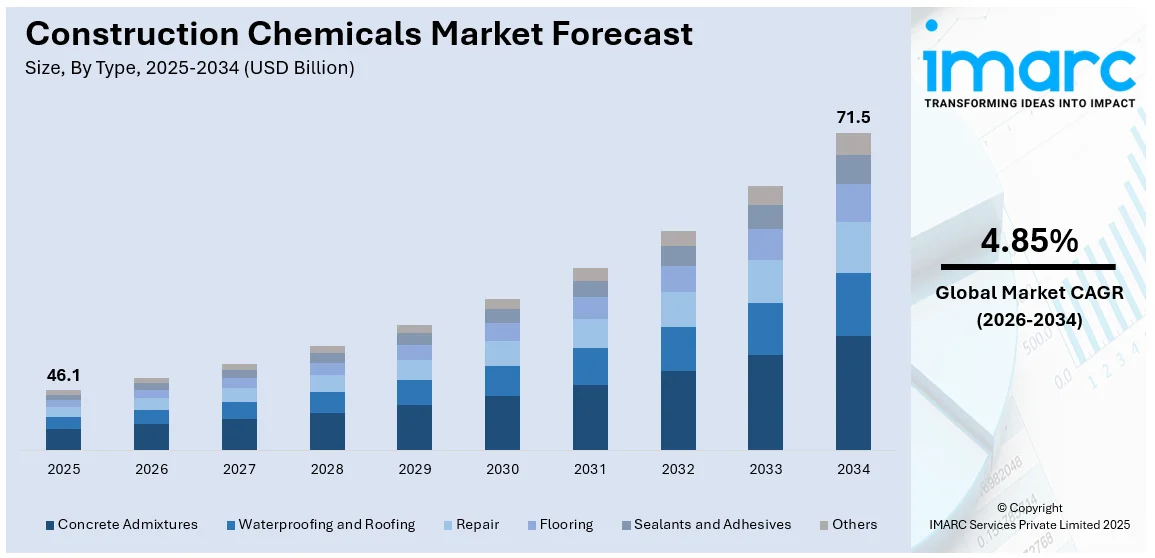
世界の建設用化学薬品市場規模は、2025年に461億米ドルと評価されました。今後、IMARCグループは、市場が2034年までに715億米ドルに達し、2026年から2034年の間に4.85%のCAGRを示すと予測しています。アジア太平洋地域は現在、市場を支配しており、2025年には52.0%を超える大きな市場シェアを占めています。その優位性は、人口増加の増加、インフラ開発の需要の増加、急速な都市化と工業化、政府の取り組みの実施、スマートシティと住宅への大規模投資によって推進されています。
世界的な都市化の進展とインフラ整備は、建設用化学薬品市場を牽引する主要な要因です。農村部から都市部への移行は、住宅団地、高速道路、橋梁、鉄道などのインフラ整備に多額の支出が必要となるため、重要な役割を果たしています。業界調査によると、米国の都市人口は2023年に0.74916%増加すると予想されています。構造物の寿命と機能性を向上させるためには、この拡大に高度な建設技術が不可欠です。防水剤、シーラント、コンクリート混和剤などの建設化学薬品は、これらのプロジェクトの持続可能性と品質を向上させるため、不可欠な存在となっています。
Report Overview
The global construction chemicals market size was valued at USD 46.1 Billion in 2025. Looking forward, IMARC Group estimates the market to reach USD 71.5 Billion by 2034, exhibiting a CAGR of 4.85% during 2026-2034. Asia-Pacific currently dominates the market, holding a significant market share of over 52.0% in 2025 . Its dominance is driven by the rising population growth, increasing demand for infrastructure development, rapid urbanization and industrialization, imposition of government initiatives and large-scale investments in smart cities and residential housing.
The increasing urbanization and infrastructure developments across the globe are major factors driving the market for construction chemicals. The transition from rural to urban living is playing a crucial role as this requires significant expenditures for building infrastructure like residential complexes, highways, bridges, and railroads. As per industry studies, the United States’ urban population grew by 0.74916% in the year 2023. In order to improve the longevity and functionality of structures, this expansion needs sophisticated construction techniques. Construction chemicals, such as waterproofing agents, sealants, and concrete admixtures, are essential because they enhance the sustainability and quality of these projects.
United States is among the leading market disrupters due to boosted construction of residential and commercial units, an increased efficiency of technology concerning construction materials, and a rising trend of projects involving retrofitting and renovation in the United States. As reported by the Joint Center for Housing Studies of Harvard University Leading Indicator of Remodeling Activity (LIRA), the two years of 2022 and 2023 in the U.S., home remodeling hit over $400 billion. Homeowners shelled out around $463 billion on renovations in the first quarter of 2024, and more than half (52%) of American homeowners are planning to do some sort of renovation in their homes. These growing renovation activities have led to a rising demand for construction chemicals across the United States.
CONSTRUCTION CHEMICALS MARKET TRENDS:
Growth in Construction Industry
Due to increased urbanization, industrialization, and population growth, the construction sector is majorly impacted on a global scale. The World Bank expects that by 2050, urban populations will be risen by 68%, needing the construction of infrastructure for homes, businesses, and industries. The demand for construction chemicals, which are essential to improve the performance, durability, and efficiency of building materials, is being directly driven by this trend. Large-scale investments in housing and infrastructure improvements in emerging economies like China and India further speed up this rise. For example, China’s Belt and Road Initiative and India’s Smart Cities Mission are quickening construction activity, which is driving up demand for modern construction chemicals.
Widespread Adoption of Ready-Mix Concrete (RMC)
The adoption of ready-mix concrete (RMC) is transforming construction practices, with contractors increasingly favoring its use for projects such as roads, bridges, tunnels, and dams. This trend is particularly strong in urban centers where time and space constraints demand efficient solutions. Additionally, the versatility of RMC to adapt to various construction conditions ensures its widespread application, driving the demand for related construction chemicals such as admixtures and bonding agents.
Rising Repair and Refurbishment Activities
The need for specialist construction chemicals that are created by rising investments in aged infrastructure repair and refurbishment projects are driving the growth of this market. Through the Federal Highway Administration’s (FHWA) Bridge Investment Program, the Biden-Harris Administration has allotted more than USD 5 billion as part of its Investing in America program to finance the rehabilitation, repair, and replacement of 13 nationally significant bridges spread over 16 states. These efforts try to improve freight transport routes, boost economic activity, and increase connectivity. Aside from this, the necessity to update, modernize, and repair outdated infrastructure in order to maintain safety, effectiveness, and resilience in the face of increased urbanization and climatic problems is reflected in this significant expenditure. In a similar vein, European countries are concentrating on renovating ancient structures, which calls for the application of construction chemicals that offer durability while maintaining visual integrity. Products like epoxy adhesives and waterproofing membranes are witnessing heightened demand in these applications, addressing both structural and functional requirements.
Favorable Government Policies
The market for construction chemicals is growing because a significant part of government programs has been devoted to urbanization and infrastructure development. As an example, in India, the government has dedicated 3.3% of GDP to the infrastructure sector in the budget for 2024, where a major focus is placed on logistics and transportation. Roads and highways attract the biggest share of this spend, while railroads and public transportation in cities account for the next. All these expenditure focus on constructing strong, efficient, and eco-friendly infrastructures that result in higher demands for innovative construction chemicals. Legislation supporting green construction practice is also expediting the launch of novel and environmental-friendly chemical solutions. These programs make for a booming industry based on the encouragement of a strong and effective material application. In this respect, these initiatives are creating durable and high-performance material marketplaces, which inculcate stringent environmental and performance characteristics. Such alignment with priorities of the government is imperative because construction chemicals play important roles in modern infrastructure construction.
Construction Chemicals Market Report Scope:
| Report Features | Details |
|---|---|
| Base Year of the Analysis | 2025 |
| Historical Period | 2020-2025 |
| Forecast Period | 2026-2034 |
| Units | Billion USD |
| Scope of the Report | Exploration of Historical Trends and Market Outlook, Industry Catalysts and Challenges, Segment-Wise Historical and Future Market Assessment:
|
| Types Coverage | Concrete Admixtures, Waterproofing and Roofing, Repair, Flooring, Sealants and Adhesives, Others |
| Applications Coverage | Residential, Non- Residential |
| Region Covered | Asia Pacific, Europe, North America, Latin America, Middle East and Africa |
| Countries Covered | United States, Canada, Germany, France, United Kingdom, Italy, Spain, Russia, China, Japan, India, South Korea, Australia, Indonesia, Brazil, Mexico |
| Companies Covered | 3M Company, ACC Limited (Holcim Group), Arkema S.A., BASF SE, Conmix Ltd, Dow Inc., Evonik Industries AG (RAG-Stiftung), GCP Applied Technologie Inc. (Standard Industries Inc.), Mapei S.P.A, Nouryon Holding B.V., Pidilite Industries Limited, RPM International Inc., Sika AG |
| Customization Scope | 10% Free Customization |
| Post-Sale Analyst Support | 10-12 Weeks |
| Delivery Format | PDF and Excel through Email (We can also provide the editable version of the report in PPT/Word format on special request) |
CONSTRUCTION CHEMICALS INDUSTRY SEGMENTATION:
IMARC Group provides an analysis of the key trends in each segment of the global construction chemicals market, along with forecasts at the global, country and regional levels from 2026-2034. The market has been categorized based on type, application, and region.
Analysis by Type:
- Concrete Admixtures
- Waterproofing and Roofing
- Repair
- Flooring
o Sealants and Adhesives
- Others
Concrete admixtures stand as the largest component in 2025, holding around 49.3% of the market. Due to their extensive use in improving the performance of concrete in a variety of building projects, concrete admixtures account for the biggest market share in the construction chemicals industry. These admixtures, which include retarders, accelerators, plasticizers, and superplasticizers, raise workability, strength, and durability, making them necessary for contemporary infrastructure. Their ability to lower water content, speed up setting, and offer resilience to external factors fits well with the rising need for environmentally friendly and economically viable building solutions. Concrete admixtures are becoming increasingly popular as infrastructure projects and urbanization spread around the world, solidifying their market dominance.
Analysis by Application:
Access the comprehensive market breakdown Request Sample
- Residential
- Non-Residential
Non-residential leads the market with around 62.0% of market share in 2025. Commercial, industrial, and institutional buildings, such as offices, factories, schools, hospitals, bridges, and airports are examples of products in the non-residential segment of the construction chemicals market. This segment represents substantial demand for specialty chemicals, including the cement admixtures, sealants, adhesives, protective coatings, and water-proofing chemicals that influence durability, performance, and aesthetic appeal, lowering maintenance costs. The major influences for non-residential construction are urbanization, industrialization, and the governmental investments in the infrastructure developments. The increase in other sectors such as logistics, retail, and healthcare stimulates the demand for more sophisticated construction products.
Regional Analysis:
- North America United States Canada
o United States
o Canada
o Asia-Pacific China Japan India South Korea Australia Indonesia Others
- China
- Japan
- India
- South Korea
- Australia
- Indonesia
o Others
o Europe Germany France United Kingdom Italy Spain Russia Others
- Germany
- France
o United Kingdom
- Italy
- Spain
- Russia
o Others
o Latin America Brazil Mexico Others
- Brazil
- Mexico
o Others
o Middle East and Africa
o United States
o Canada
o China
o Japan
o India
o South Korea
o Australia
o Indonesia
o Others
o Germany
o France
o United Kingdom
o Italy
o Spain
o Russia
o Others
o Brazil
o Mexico
o Others
In 2025, Asia-Pacific accounted for the largest market share of over 52.0%. Due to fast urbanization, population expansion, and considerable infrastructure development in nations like China, India, and Southeast Asia, the Asia Pacific region leads the market for construction chemicals. On top of that, government programs related to industrialization and smart cities have sped up building, increasing demand for cutting-edge chemicals like adhesives, waterproofing agents, and concrete admixtures. Furthermore, the region’s cost-effective labor and manufacturing, along with growing expenses in residential and commercial building, are adding to its market leadership.
KEY REGIONAL TAKEAWAYS:
NORTH AMERICA CONSTRUCTION CHEMICALS MARKET ANALYSIS
The market for construction chemicals in North America is growing rapidly due to the requirement for upgradation of obsolete infrastructure and renewed focus on sustainable construction methods. Advanced construction chemicals, such as sealants, repair mortars, and coatings, are also in high demand because of the region’s robust regulatory framework supporting the use of green and energy-efficient building materials. Market expansion is also supplemented by growing investments in commercial building and renovation projects, especially in the US and Canada.
UNITED STATES CONSTRUCTION CHEMICALS MARKET ANALYSIS
The United States holds 80.30% of the market share. The construction chemicals market in the US is anticipated to increase significantly due to ongoing infrastructure development and a growing demand for durable and eco-friendly building materials. With a focus on important projects including roads, bridges, and public transportation systems, the Infrastructure Investment and Jobs Act (IIJA) has set aside USD 1.2 trillion for infrastructure investments. High-performance construction chemicals, specifically concrete admixtures and waterproofing solutions, increase the longevity and efficiency of infrastructure projects and are hence in demand in such projects. Furthermore, maintenance and repair of old infrastructure have also emerged as a prime reason for the growth in the market. According to the American Society of Civil Engineers (ASCE), the U.S. needs to invest USD 7.4 Trillion by 2033 to address critical infrastructure needs across 11 key areas, including highways, bridges, rail, transit, drinking water, stormwater, wastewater, electricity, airports, seaports, and inland waterways. This made the call for repair chemicals such as epoxy-based resins, bonding agents as critical points in restoring old structures back on track.”.
ASIA PACIFIC CONSTRUCTION CHEMICALS MARKET ANALYSIS
The Asia-Pacific region alone accounts for the highest market share in the world with the largest revenue for construction chemicals. Among them are roads, airports, bridges, and apartment complexes that are driven by fast-paced urbanization, rapid population growth, and development of economies of nations like China, India, and Southeast Asia. About 4.3 billion people, or 60% of the world’s population, live in the Asia-Pacific area, according to the United Nations Population Fund (UNFPA). TThe two most populous countries in the world, China and India, are located in this area, and their combined population significantly increases the need for housing projects, urbanization, and infrastructure development. Aside from extensive requirements for building projects, these population needs drive the growth of this construction chemical market to fill the regional shifts in their demand for building materials that are durable, effective, economical, and most importantly safe to the health of an environment. The growing middle class, along with increasing disposable income, is further driving demand for quality housing and commercial spaces.
EUROPE CONSTRUCTION CHEMICALS MARKET ANALYSIS
Sustainability and regulatory compliance are major factors in the European construction chemicals market. Low-VOC materials, green cement, and energy-efficient chemicals are becoming ever more common due to the European Union’s Green Deal and more stringent environmental regulations. The European economy depends heavily on the building industry. With almost 3 million businesses and 18 million direct employees, the construction industry contributes around 9% of the EU’s GDP. Investments in urban housing developments and public transit are important market drivers in nations like the UK, France, and Germany. In addition, Europe’s pledge to reach net-zero emissions by 2050 encourages more residential, commercial, and industrial projects to use sustainable building chemicals.
LATIN AMERICA CONSTRUCTION CHEMICALS MARKET ANALYSIS
The expansion of residential projects and the construction of infrastructure are majorly impacting the market’s strong growth in Latin America. Concrete admixtures, sealants, and flooring solutions are in high demand because of notable countries like Brazil, Mexico, and Chile giving priority to urban housing developments, transportation, and logistics. Additionally, by 2030, the Latin America and the Caribbean (LAC) region would need to invest more than USD 2.2 trillion on vital areas including electricity, transportation, telecommunications, and water and sanitation, according to the Development Bank of Latin America (CAF). This significant investment is necessary to sustain and grow the infrastructure needed to achieve the Sustainable Development Goals (SDGs). In particular, 41% of this sum will go toward repairing and replacing old assets that are reaching the end of their lives, while 59% will go toward building new infrastructure to meet expanding needs. These challenging goals demonstrate the increasing need for refined construction chemicals, which have become essential for improving the sustainability, efficiency, and longevity of both new and old infrastructure projects.
MIDDLE EAST AND AFRICA CONSTRUCTION CHEMICALS MARKET ANALYSIS
The Middle East & Africa (MEA) market is undergoing a transformative construction boom, particularly in the Kingdom of Saudi Arabia (KSA) and the United Arab Emirates (U.A.E.), driven by visionary national agendas and large-scale development projects. Gulf Cooperation Council (GCC) countries, such as the UAE, Saudi Arabia, and Qatar, are investing heavily in modern urban centers, luxury residential projects, and world-class infrastructure, including stadiums and airports. The region’s harsh climate creates a strong demand for waterproofing chemicals, thermal insulation materials, and corrosion inhibitors. In Africa, increasing investments in affordable housing and transportation projects, supported by international funding, are boosting market growth. The MEA region also benefits from its focus on diversification away from oil, with governments prioritizing sustainable urban development and green building certifications.
COMPETITIVE LANDSCAPE:
Leading companies in the market are actively pursuing strategic initiatives to strengthen their market positions and expand their global footprints. These initiatives include acquiring complementary businesses to enhance product portfolios and entering high-growth regions. Moreover, they are investing in new production facilities and enhancing manufacturing capabilities to cater to diverse construction projects globally. Besides this, companies are also leveraging research and development (R&D) to introduce innovative and sustainable solutions, aligning with the rising focus on green building practices. Apart from this, strategic partnerships and acquisitions are being pursued to strengthen market presence and tap into emerging regions with high growth potential.
KEY QUESTIONS ANSWERED IN THIS REPORT
- What is construction chemicals?
- How big is the construction chemicals market?
- What is the expected growth rate of the global construction chemicals market during 2026-2034?
- What are the key factors driving the global construction chemicals market?
- What is the leading segment of the global construction chemicals market based on the type?
- What is the leading segment of the global construction chemicals market based on the application?
- What are the key regions in the global construction chemicals market?
- Who are the key players/companies in the global construction chemicals market?
Table of Contents
1 Preface
2 Scope and Methodology
2.1 Objectives of the Study
2.2 Stakeholders
2.3 Data Sources
2.3.1 Primary Sources
2.3.2 Secondary Sources
2.4 Market Estimation
2.4.1 Bottom-Up Approach
2.4.2 Top-Down Approach
2.5 Forecasting Methodology
3 Executive Summary
4 Introduction
4.1 Overview
4.2 Key Industry Trends
5 Global Construction Chemicals Market
5.1 Market Overview
5.2 Market Performance
5.3 Impact of COVID-19
5.4 Market Forecast
6 Market Breakup by Type
6.1 Concrete Admixtures
6.1.1 Market Trends
6.1.2 Market Forecast
6.2 Waterproofing and Roofing
6.2.1 Market Trends
6.2.2 Market Forecast
6.3 Repair
6.3.1 Market Trends
6.3.2 Market Forecast
6.4 Flooring
6.4.1 Market Trends
6.4.2 Market Forecast
6.5 Sealants and Adhesives
6.5.1 Market Trends
6.5.2 Market Forecast
6.6 Others
6.6.1 Market Trends
6.6.2 Market Forecast
7 Market Breakup by Application
7.1 Residential
7.1.1 Market Trends
7.1.2 Market Forecast
7.2 Non-Residential
7.2.1 Market Trends
7.2.2 Market Forecast
8 Market Breakup by Region
8.1 North America
8.1.1 United States
8.1.1.1 Market Trends
8.1.1.2 Market Forecast
8.1.2 Canada
8.1.2.1 Market Trends
8.1.2.2 Market Forecast
8.2 Asia-Pacific
8.2.1 China
8.2.1.1 Market Trends
8.2.1.2 Market Forecast
8.2.2 Japan
8.2.2.1 Market Trends
8.2.2.2 Market Forecast
8.2.3 India
8.2.3.1 Market Trends
8.2.3.2 Market Forecast
8.2.4 South Korea
8.2.4.1 Market Trends
8.2.4.2 Market Forecast
8.2.5 Australia
8.2.5.1 Market Trends
8.2.5.2 Market Forecast
8.2.6 Indonesia
8.2.6.1 Market Trends
8.2.6.2 Market Forecast
8.2.7 Others
8.2.7.1 Market Trends
8.2.7.2 Market Forecast
8.3 Europe
8.3.1 Germany
8.3.1.1 Market Trends
8.3.1.2 Market Forecast
8.3.2 France
8.3.2.1 Market Trends
8.3.2.2 Market Forecast
8.3.3 United Kingdom
8.3.3.1 Market Trends
8.3.3.2 Market Forecast
8.3.4 Italy
8.3.4.1 Market Trends
8.3.4.2 Market Forecast
8.3.5 Spain
8.3.5.1 Market Trends
8.3.5.2 Market Forecast
8.3.6 Russia
8.3.6.1 Market Trends
8.3.6.2 Market Forecast
8.3.7 Others
8.3.7.1 Market Trends
8.3.7.2 Market Forecast
8.4 Latin America
8.4.1 Brazil
8.4.1.1 Market Trends
8.4.1.2 Market Forecast
8.4.2 Mexico
8.4.2.1 Market Trends
8.4.2.2 Market Forecast
8.4.3 Others
8.4.3.1 Market Trends
8.4.3.2 Market Forecast
8.5 Middle East and Africa
8.5.1 Market Trends
8.5.2 Market Breakup by Country
8.5.3 Market Forecast
9 SWOT Analysis
9.1 Overview
9.2 Strengths
9.3 Weaknesses
9.4 Opportunities
9.5 Threats
10 Value Chain Analysis
11 Porters Five Forces Analysis
11.1 Overview
11.2 Bargaining Power of Buyers
11.3 Bargaining Power of Suppliers
11.4 Degree of Competition
11.5 Threat of New Entrants
11.6 Threat of Substitutes
12 Price Analysis
13 Competitive Landscape
13.1 Market Structure
13.2 Key Players
13.3 Profiles of Key Players
13.3.1 3M Company
13.3.1.1 Company Overview
13.3.1.2 Product Portfolio
13.3.1.3 Financials
13.3.1.4 SWOT Analysis
13.3.2 ACC Limited (Holcim Group)
13.3.2.1 Company Overview
13.3.2.2 Product Portfolio
13.3.2.3 Financials
13.3.3 Arkema S.A.
13.3.3.1 Company Overview
13.3.3.2 Product Portfolio
13.3.3.3 Financials
13.3.3.4 SWOT Analysis
13.3.4 BASF SE
13.3.4.1 Company Overview
13.3.4.2 Product Portfolio
13.3.4.3 Financials
13.3.4.4 SWOT Analysis
13.3.5 Conmix Ltd
13.3.5.1 Company Overview
13.3.5.2 Product Portfolio
13.3.6 Dow Inc.
13.3.6.1 Company Overview
13.3.6.2 Product Portfolio
13.3.6.3 Financials
13.3.7 Evonik Industries AG (RAG-Stiftung)
13.3.7.1 Company Overview
13.3.7.2 Product Portfolio
13.3.7.3 Financials
13.3.8 GCP Applied Technologie Inc. (Standard Industries Inc.)
13.3.8.1 Company Overview
13.3.8.2 Product Portfolio
13.3.8.3 Financials
13.3.9 Mapei S.p.A
13.3.9.1 Company Overview
13.3.9.2 Product Portfolio
13.3.10 Nouryon Holding B.V.
13.3.10.1 Company Overview
13.3.10.2 Product Portfolio
13.3.11 Pidilite Industries Limited
13.3.11.1 Company Overview
13.3.11.2 Product Portfolio
13.3.11.3 Financials
13.3.12 RPM International Inc.
13.3.12.1 Company Overview
13.3.12.2 Product Portfolio
13.3.12.3 Financials
13.3.12.4 SWOT Analysis
13.3.13 Sika AG
13.3.13.1 Company Overview
13.3.13.2 Product Portfolio
13.3.13.3 Financials
List of Tables
Table 1: Global: Construction Chemicals Market: Key Industry Highlights, 2025 and 2034
Table 2: Global: Construction Chemicals Market Forecast: Breakup by Type (in Million USD), 2026-2034
Table 3: Global: Construction Chemicals Market Forecast: Breakup by Application (in Million USD), 2026-2034
Table 4: Global: Construction Chemicals Market Forecast: Breakup by Region (in Million USD), 2026-2034
Table 5: Global: Construction Chemicals Market: Competitive Structure
Table 6: Global: Construction Chemicals Market: Key Players
List of Figures
Figure 1: Global: Construction Chemicals Market: Major Drivers and Challenges
Figure 2: Global: Construction Chemicals Market: Sales Value (in Billion USD), 2020-2025
Figure 3: Global: Construction Chemicals Market Forecast: Sales Value (in Billion USD), 2026-2034
Figure 4: Global: Construction Chemicals Market: Breakup by Type (in %), 2025
Figure 5: Global: Construction Chemicals Market: Breakup by Application (in %), 2025
Figure 6: Global: Construction Chemicals Market: Breakup by Region (in %), 2025
Figure 7: Global: Construction Chemicals (Concrete Admixtures) Market: Sales Value (in Million USD), 2020 & 2025
Figure 8: Global: Construction Chemicals (Concrete Admixtures) Market Forecast: Sales Value (in Million USD), 2026-2034
Figure 9: Global: Construction Chemicals (Waterproofing and Roofing) Market: Sales Value (in Million USD), 2020 & 2025
Figure 10: Global: Construction Chemicals (Waterproofing and Roofing) Market Forecast: Sales Value (in Million USD), 2026-2034
Figure 11: Global: Construction Chemicals (Repair) Market: Sales Value (in Million USD), 2020 & 2025
Figure 12: Global: Construction Chemicals (Repair) Market Forecast: Sales Value (in Million USD), 2026-2034
Figure 13: Global: Construction Chemicals (Flooring) Market: Sales Value (in Million USD), 2020 & 2025
Figure 14: Global: Construction Chemicals (Flooring) Market Forecast: Sales Value (in Million USD), 2026-2034
Figure 15: Global: Construction Chemicals (Sealants and Adhesives) Market: Sales Value (in Million USD), 2020 & 2025
Figure 16: Global: Construction Chemicals (Sealants and Adhesives) Market Forecast: Sales Value (in Million USD), 2026-2034
Figure 17: Global: Construction Chemicals (Other Types) Market: Sales Value (in Million USD), 2020 & 2025
Figure 18: Global: Construction Chemicals (Other Types) Market Forecast: Sales Value (in Million USD), 2026-2034
Figure 19: Global: Construction Chemicals (Residential) Market: Sales Value (in Million USD), 2020 & 2025
Figure 20: Global: Construction Chemicals (Residential) Market Forecast: Sales Value (in Million USD), 2026-2034
Figure 21: Global: Construction Chemicals (Non-Residential) Market: Sales Value (in Million USD), 2020 & 2025
Figure 22: Global: Construction Chemicals (Non-Residential) Market Forecast: Sales Value (in Million USD), 2026-2034
Figure 23: North America: Construction Chemicals Market: Sales Value (in Million USD), 2020 & 2025
Figure 24: North America: Construction Chemicals Market Forecast: Sales Value (in Million USD), 2026-2034
Figure 25: United States: Construction Chemicals Market: Sales Value (in Million USD), 2020 & 2025
Figure 26: United States: Construction Chemicals Market Forecast: Sales Value (in Million USD), 2026-2034
Figure 27: Canada: Construction Chemicals Market: Sales Value (in Million USD), 2020 & 2025
Figure 28: Canada: Construction Chemicals Market Forecast: Sales Value (in Million USD), 2026-2034
Figure 29: Asia-Pacific: Construction Chemicals Market: Sales Value (in Million USD), 2020 & 2025
Figure 30: Asia-Pacific: Construction Chemicals Market Forecast: Sales Value (in Million USD), 2026-2034
Figure 31: China: Construction Chemicals Market: Sales Value (in Million USD), 2020 & 2025
Figure 32: China: Construction Chemicals Market Forecast: Sales Value (in Million USD), 2026-2034
Figure 33: Japan: Construction Chemicals Market: Sales Value (in Million USD), 2020 & 2025
Figure 34: Japan: Construction Chemicals Market Forecast: Sales Value (in Million USD), 2026-2034
Figure 35: India: Construction Chemicals Market: Sales Value (in Million USD), 2020 & 2025
Figure 36: India: Construction Chemicals Market Forecast: Sales Value (in Million USD), 2026-2034
Figure 37: South Korea: Construction Chemicals Market: Sales Value (in Million USD), 2020 & 2025
Figure 38: South Korea: Construction Chemicals Market Forecast: Sales Value (in Million USD), 2026-2034
Figure 39: Australia: Construction Chemicals Market: Sales Value (in Million USD), 2020 & 2025
Figure 40: Australia: Construction Chemicals Market Forecast: Sales Value (in Million USD), 2026-2034
Figure 41: Indonesia: Construction Chemicals Market: Sales Value (in Million USD), 2020 & 2025
Figure 42: Indonesia: Construction Chemicals Market Forecast: Sales Value (in Million USD), 2026-2034
Figure 43: Others: Construction Chemicals Market: Sales Value (in Million USD), 2020 & 2025
Figure 44: Others: Construction Chemicals Market Forecast: Sales Value (in Million USD), 2026-2034
Figure 45: Europe: Construction Chemicals Market: Sales Value (in Million USD), 2020 & 2025
Figure 46: Europe: Construction Chemicals Market Forecast: Sales Value (in Million USD), 2026-2034
Figure 47: Germany: Construction Chemicals Market: Sales Value (in Million USD), 2020 & 2025
Figure 48: Germany: Construction Chemicals Market Forecast: Sales Value (in Million USD), 2026-2034
Figure 49: France: Construction Chemicals Market: Sales Value (in Million USD), 2020 & 2025
Figure 50: France: Construction Chemicals Market Forecast: Sales Value (in Million USD), 2026-2034
Figure 51: United Kingdom: Construction Chemicals Market: Sales Value (in Million USD), 2020 & 2025
Figure 52: United Kingdom: Construction Chemicals Market Forecast: Sales Value (in Million USD), 2026-2034
Figure 53: Italy: Construction Chemicals Market: Sales Value (in Million USD), 2020 & 2025
Figure 54: Italy: Construction Chemicals Market Forecast: Sales Value (in Million USD), 2026-2034
Figure 55: Spain: Construction Chemicals Market: Sales Value (in Million USD), 2020 & 2025
Figure 56: Spain: Construction Chemicals Market Forecast: Sales Value (in Million USD), 2026-2034
Figure 57: Russia: Construction Chemicals Market: Sales Value (in Million USD), 2020 & 2025
Figure 58: Russia: Construction Chemicals Market Forecast: Sales Value (in Million USD), 2026-2034
Figure 59: Others: Construction Chemicals Market: Sales Value (in Million USD), 2020 & 2025
Figure 60: Others: Construction Chemicals Market Forecast: Sales Value (in Million USD), 2026-2034
Figure 61: Latin America: Construction Chemicals Market: Sales Value (in Million USD), 2020 & 2025
Figure 62: Latin America: Construction Chemicals Market Forecast: Sales Value (in Million USD), 2026-2034
Figure 63: Brazil: Construction Chemicals Market: Sales Value (in Million USD), 2020 & 2025
Figure 64: Brazil: Construction Chemicals Market Forecast: Sales Value (in Million USD), 2026-2034
Figure 65: Mexico: Construction Chemicals Market: Sales Value (in Million USD), 2020 & 2025
Figure 66: Mexico: Construction Chemicals Market Forecast: Sales Value (in Million USD), 2026-2034
Figure 67: Others: Construction Chemicals Market: Sales Value (in Million USD), 2020 & 2025
Figure 68: Others: Construction Chemicals Market Forecast: Sales Value (in Million USD), 2026-2034
Figure 69: Middle East and Africa: Construction Chemicals Market: Sales Value (in Million USD), 2020 & 2025
Figure 70: Middle East and Africa: Construction Chemicals Market: Breakup by Country (in %), 2025
Figure 71: Middle East and Africa: Construction Chemicals Market Forecast: Sales Value (in Million USD), 2026-2034
Figure 72: Global: Construction Chemicals Industry: SWOT Analysis
Figure 73: Global: Construction Chemicals Industry: Value Chain Analysis
Figure 74: Global: Construction Chemicals Industry: Porter’s Five Forces Analysis