
| 出版社 | Grand View Research |
| 出版年月 | 2025年8月 |
Virtualized Radio Access Network Market Size, Share & Trends Analysis Report

世界の仮想化無線アクセスネットワーク(vRAN)市場規模は、2024 年に 166 億 1,000 万米ドルに達すると推定され、2025 年から 2033 年にかけて 19.5% の CAGR で成長し、2033 年には 797 億 1,000 万米ドルに達すると予測されています。仮想化無線アクセス ネットワーク (vRAN) 市場は、柔軟性、拡張性、およびコスト効率に優れたモバイル ネットワーク インフラストラクチャに対する需要の高まりによって推進されています。
データトラフィックの増加、5Gネットワークの世界的な展開、そしてネットワークの高密度化の必要性から、通信事業者は仮想化アーキテクチャの採用を加速させています。5Gネットワークの世界的な展開は、仮想化無線アクセスネットワーク(vRAN)市場の成長を牽引する重要な要因となっています。通信事業者は、既存のインフラをアップグレードし、より高い帯域幅とより低いレイテンシを実現しています。これにより、柔軟で拡張性の高い導入オプションを備えたvRANの採用が拡大しています。スモールセルと分散ユニットによるネットワークの高密度化も、vRANによってより効率的にサポートされます。vRANはハードウェアとソフトウェアを分離し、集中管理を可能にするためです。この傾向は、データ使用量の増加と周波数効率が極めて重要な都市部で特に顕著です。
人工知能(AI)と機械学習(ML)は、予測分析、リアルタイム最適化、自動障害検出を実現するために、vRANシステムへの統合がますます進んでいます。これらの技術は、増大するデータ量の管理、サービス品質の向上、そしてネットワーク運用における人的介入の削減において、通信事業者を支援します。AI搭載のRANインテリジェントコントローラ(RIC)は、vRANエコシステムの主要コンポーネントとなりつつあり、よりスマートで自己最適化されたネットワークを実現します。この傾向は、高密度トラフィック環境における運用効率の向上とダウンタイムの最小化を目指す通信事業者にとって特に有益です。
Virtualized Radio Access Network (vRAN) Market Summary
The global virtualized radio access network market size was estimated at USD 16.61 billion in 2024 and is projected to reach USD 79.71 billion by 2033, growing at a CAGR of 19.5% from 2025 to 2033. The virtualized radio access network (vRAN) market is being driven by the growing demand for flexible, scalable, and cost-efficient mobile network infrastructure.
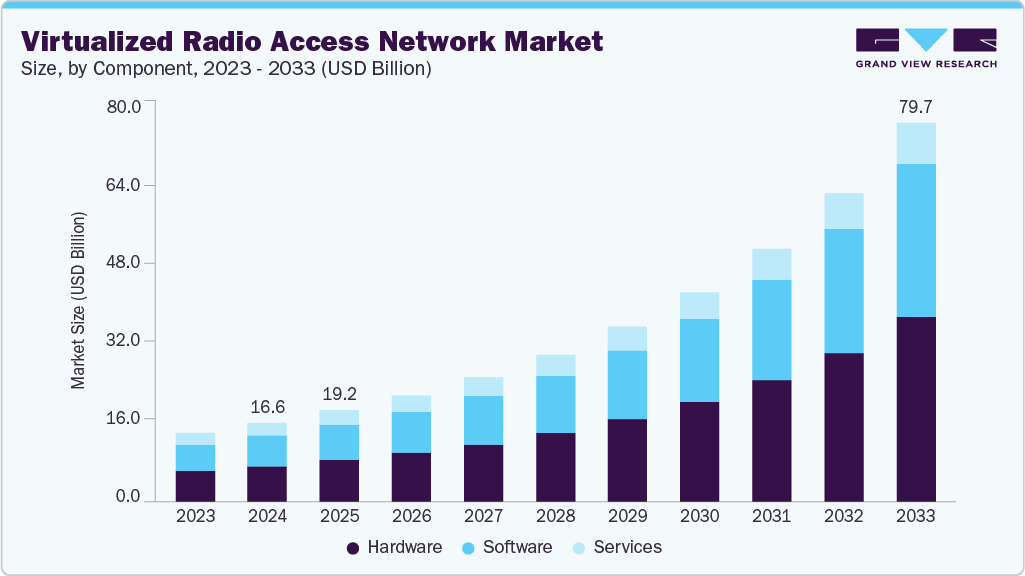
virtualized-radio-access-network-market-size
Increased data traffic, the global rollout of 5G networks, and the need for network densification have led operators to adopt virtualized architectures. The global deployment of 5G networks has become a key driver for the growth of the vRAN market. Telecom providers are upgrading their current infrastructure to enable higher bandwidth and lower latency, which increases the adoption of vRAN due to its flexible and scalable deployment options. Network densification through small cells and distributed units is also more efficiently supported by vRAN, as it separates hardware from software and allows for centralized control. This trend is especially noticeable in urban areas, where high data usage and spectrum efficiency are critical.
Artificial Intelligence (AI) and Machine Learning (ML) are increasingly being integrated into vRAN systems to enable predictive analytics, real-time optimization, and automated fault detection. These technologies assist operators in managing growing data volumes, enhancing quality of service, and reducing human intervention in network operations. AI-powered RAN Intelligent Controllers (RICs) are becoming key components of the vRAN ecosystem, allowing for smarter, self-optimizing networks. This trend is especially advantageous for telecom providers aiming to improve operational efficiency and minimize downtime in high-density traffic environments.
Virtualized Radio Access Network Market Report Scope
| Report Attribute | Details |
| Market size value in 2025 | USD 19.21 billion |
| Revenue forecast in 2033 | USD 79.71 billion |
| Growth rate | CAGR of 19.5% from 2025 to 2033 |
| Base year for estimation | 2024 |
| Historical data | 2021 – 2023 |
| Forecast period | 2025 – 2033 |
| Quantitative units | Revenue in USD million and CAGR from 2025 to 2033 |
| Report coverage | Revenue forecast, company ranking, competitive landscape, growth factors, and trends |
| Segments covered | Component, deployment type, network type, end use, region |
| Regional scope | North America; Europe; Asia Pacific; Latin America; Middle East & Africa |
| Country scope | U.S.; Canada; Mexico; Germany; UK; France; China; Japan; India; South Korea; Australia; Brazil; KSA; UAE; South Africa |
| Key companies profiled | Samsung; Mavenir; Intel Corporation; NEC Corporation; Parallel Wireless; Nokia Corporation; Capgemini; Ericsson; VMware; Cisco Systems, Inc. |
| Customization scope | Free report customization (equivalent up to 8 analysts working days) with purchase. Addition or alteration to country, regional & segment scope. |