
| 出版社 | Berg Insight |
| 出版年月 | 2025年10月 |
Smart Homes and Home Automation – 12th Edition

欧州と北米におけるホームオートメーションシステムの出荷数とサービス料金の収益は、2024年の877億ユーロから2029年には1,439億ユーロに達し、年平均成長率は10.4%での成長になると Berg Insightでは予測しています。
Berg Insight(ベルグインサイト)「スマートホームとホームオートメーション 第12版 – Smart Homes and Home Automation – 12th Edition」は欧州と北米のスマートホーム市場最新動向を調査・分析し、また5年予測も提供しています。
主な掲載内容と特長
- 主要企業のエグゼクティブ30名とのインタビューを基にした洞察
- スマートホームとホームオートメーションのエコシステムを360度俯瞰
- 主要垂直市場セグメントにおける業界動向のサマリー
- 欧州と北米におけるスマートホームシステムの採用に関する統計データ
- 2029年までの市場予測
- 産業プレイヤにおける最新構想
- 市場主要ベンダの最新企業情報
主な掲載内容
- スマートホームとホームオートメーション
- ネットワークと通信技術
- 概観
- スマートホームネットワーク技術と規格
- スマートホームハブとインテグレーションサービス
- スマートホームプラットフォームとホワイトラベルソリューションプロバイダ
- ポイントソリューションプロバイダ
- 市場概観
- セキュリティとアクセス制御システムベンダ
- エネルギー管理と温度調節システムベンダ
- 視聴覚とエンターテインメントシステムベンダ
- 照明と窓制御システムベンダ
- 灌漑管理と水管理システムベンダ
- ホームアプライアンスベンダ
- サービスロボットベンダ
- 家全体のシステム(ホールホームシステム)ベンダとサービス提供会社
- 市場概観
- 市場セグメントと市場開拓戦略
- ホールホームシステムベンダ
- サービス提供会社
- 市場予測とまとめ
- 欧州
- 収益
- 出荷数
- インストールベース
- 北米
- 収益
- 出荷数
- インストールベース
- 人気のあるスマートホーム製品カテゴリ
- 市場動向と分析
- 欧州
Report Overview
Smart Homes and Home Automation is the twelfth consecutive report from Berg Insight analysing the latest developments and trends on the smart home markets in Europe and North America. This strategic research report provides you with 240 pages of unique business intelligence including 5-year industry forecasts and expert commentary on which to base your business decisions.
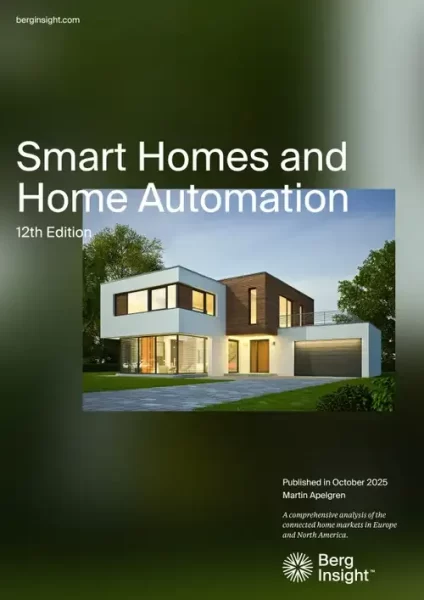
Smart Homes and Home Automation – 12th Edition
How should the mobile industry address the vast business opportunity in connected smart homes? Berg Insight estimates that revenues from home automation system shipments and service fees in Europe and North America will grow at a compound annual growth rate of 10.4 percent from € 87.7 billion in 2024 to € 143.9 billion in 2029. Get a 360-degree perspective on the rapid evolution of the home automation market in this comprehensive 240-page strategy report.
Highlights from the report:
- Insights from 30 executive interviews with market leading companies.
- 360-degree overview of the smart homes & home automation ecosystem.
- Summary of industry trends in key vertical market segments.
- Statistical data on adoption of smart home systems in Europe and North America.
- New market forecasts lasting until 2029.
- Detailed reviews of the latest initiatives launched by industry players.
- Updated profiles of the key vendors on this market.
139 million homes in Europe and North America were smart at the end of 2024
Smart home and home automation systems include a wide range of solutions for controlling, monitoring and automating functions in the home. Berg Insight’s definition of a smart home system is one that is accessible from remote and includes a smartphone app or a web portal user interface. Devices that can only be controlled and automated locally, through switches, timers, sensors and remote controls, are thus not included in the scope of this study. Smart home systems can be grouped into seven primary categories: security and access control systems; energy management and climate control systems; audio-visual and entertainment systems; lighting and window control systems; home appliances; service robotics and irrigation and water management systems.
A point solution will in many cases constitute a consumer’s first smart home purchase. The most popular point solutions to date, in terms of sold units, include smart thermostats, smart light bulbs, smart plugs, connected security cameras, voice-controlled smart speakers and floor cleaning robots. These products are marketed by incumbent OEMs such as Signify, Resideo, Danfoss, Belkin, Chamberlain, Schlage, Assa Abloy and iRobot and newer entrants such as Ecobee, Sonos, Arlo, Nuki, Mysa, IKEA, Wyze Labs and SharkNinja. In the whole-home system market, traditional home automation vendors such as Crestron Electronics, Control4, Savant Systems, eQ-3, Shelly, Somfy and Loxone are facing new competition as companies from adjacent industries have entered the market. Communications and security service providers such as Verisure, ADT, Vivint, Comcast, SimpliSafe and Telus have established themselves among the largest whole-home solution vendors in North America and Europe by combining home security services with smart home features.
The North American smart home market continues to grow. The installed base of smart home systems reached 305.8 million at the end of 2024. An estimated 64.4 million of these were multifunction or whole-home systems whereas 241.4 million were point solutions designed for one specific function. As some homes have more than one smart system in use, the installed base totalled an estimated 66.7 million smart homes at the end of the year. This corresponds to 44.8 percent of all households, placing North America as the most advanced smart home market in the world. Between 2024 and 2029, the number of households that adopt smart home systems is forecasted to grow at a compound annual growth rate (CAGR) of 6.4 percent, resulting in 90.9 million smart homes at the end of the forecast period. Market revenues reached US$_52.4 billion (€ 48.4 billion) in 2024. The market is expected to grow at a CAGR of 9.3 percent between 2024 and 2029, reaching US$_81.8 billion (€ 75.6 billion) in yearly revenues at the end of the forecast period.
The European market for smart home systems is still behind the North American market in terms of market penetration and maturity. However, the market has now grown to become almost as large as the North American market. At the end of 2024, there were a total of 240.1 million smart home systems in use in the EU27+3 countries. Around 46.4 million of these systems were multifunction or whole-home systems whereas 193.7 million were point solutions. This corresponds to around 72.8 million smart homes when overlaps are taken into account, meaning that 30.7 percent of all households in Europe were smart at the end of the year. The number of European households to adopt smart home systems is forecasted to grow at a compound annual growth rate (CAGR) of 7.2 percent during the next five years, resulting in 102.8 million smart homes by 2029. Market revenues reached € 39.3 billion (US$ 42.5 billion) in 2024. The market is forecasted to grow at a CAGR of 11.7 percent between 2024 and 2029 to reach € 68.3 billion (US$ 73.9 billion) at the end of the forecast period.
The outlook for the smart home market in the coming years is positive. Connectivity adds several benefits to the most commonly used products and systems in the home, including home security systems, door locks, indoor climate control devices, lights, irrigation systems, home appliances and entertainment solutions. The ability to view information and manage various settings of the home remotely enables energy and cost savings, enhances security and safety, and provides convenience for homeowners. In several product categories, connectivity is now becoming a standard feature and consumers are increasingly expecting new products to be smart and connected.