
| 出版社 | MarketsandMarkets |
| 出版年月 | 2025年10月 |
AI Orchestration Market – Global Forecast To 2030

AIオーケストレーション市場 – サービス(エージェント オーケストレーション プラットフォーム、モデル サービング ツール、エージェント ビルダー、データ オーケストレーション プラットフォーム)、導入モデル(SaaS、エアギャップ)、用途(ITSM、マーケティング自動化、フィールド サービス) – 2030 年までの世界予測
世界のAIオーケストレーション市場規模は、2025年の110.2億米ドルから2030年には302.3億米ドルに拡大し、年平均成長率(CAGR)は22.3%になると予測されています。この成長を牽引しているのは、アプリケーション全体にわたる統合ガバナンス層へのニーズの高まりです。組織は、ITおよびビジネスワークフロー全体に一元的に適用される承認、リネージ追跡、ポリシー適用を求めています。規制当局からの圧力も市場拡大を後押ししており、銀行、医療、公共部門におけるコンプライアンスフレームワークの強化により、エビデンス、ロールアウェアな承認、ロールバック制御を組み込んだ監査対応オーケストレーション層への需要が高まっています。
これらの要因により、AIオーケストレーションは、アシスタント、ワークフロー、そして透明な制御を備えたレガシーシステムを橋渡しする、企業の自動化戦略の中核レイヤーへと変貌を遂げつつあります。企業がカスタマーサービス、IT運用、セキュリティ、財務、サプライチェーンといったユースケースにまたがるオーケストレーションアクションを拡大する中で、迅速な価値実現とガバナンス、ポータブルなポリシー、そして測定可能なROIを兼ね備えたベンダーが、導入をリードすると予想されます。価格体系の複雑さと機能間の予算配分は、企業レベルでの取り組みを阻害しています。さらに、意図しないライトバックが発生する可能性がAIオーケストレーションツールの自律性を制約し、市場全体の拡大を阻害する可能性があります。
本調査レポートでは、AIオーケストレーション市場を、サービス、オーケストレーションアーキテクチャ、導入モデル、アプリケーション、エンドユーザー別に分類しています。サービスセグメントは、AIオーケストレーションソフトウェアとAIオーケストレーションサービスに分かれています。ソフトウェアセグメントはさらに、エージェントオーケストレーションプラットフォーム、エージェントビルダーツール、ワークフローオーケストレーションプラットフォーム、データオーケストレーションプラットフォーム、モデルサービングプラットフォーム、インフラストラクチャオーケストレーションプラットフォームに分かれています。サービスセグメントは、マネージドサービスとプロフェッショナルサービス(トレーニングとコンサルティング、システム統合と実装、サポートと保守)で構成されています。オーケストレーションアーキテクチャセグメントには、集中型オーケストレーション、分散型オーケストレーション、分散型オーケストレーション、ハイブリッドオーケストレーションが含まれます。導入モデルセグメントは、シングルテナントSaaS、マルチテナントSaaS、カスタマーマネージドクラウド、オンプレミスおよびエアギャップ導入を網羅しています。
アプリケーションセグメントは、顧客サービス自動化、営業・収益自動化、マーケティング自動化、ITサービス管理、セキュリティ運用、財務・調達自動化、サプライチェーン自動化、人事・従業員サービスデスク、エンタープライズナレッジサーチ、ソフトウェアエンジニアリング・コーディング自動化、フィールドサービス・資産運用、その他のアプリケーション(法務・契約ライフサイクル、リスク・内部監査、研究・ラボワークフロー)をカバーしています。エンドユーザーセグメントは、BFSI、小売・CPG、プロフェッショナルサービスプロバイダー、ヘルスケア・ライフサイエンス、通信、ソフトウェア・テクノロジープロバイダー、メディア・エンターテインメント、物流・運輸、政府・防衛、自動車、エネルギー・公益事業、製造、その他の企業(教育、旅行・ホスピタリティ、建設・不動産)に分かれています。AIオーケストレーション市場の地域分析は、北米、ヨーロッパ、アジア太平洋、中東・アフリカ(MEA)、ラテンアメリカをカバーしています。
本レポートは、AIオーケストレーション市場の成長に影響を与える主要な要因(促進要因、制約要因、課題、機会など)に関する詳細な情報を網羅しています。主要業界プレーヤーの詳細な分析を実施し、事業概要、ソリューション、サービスに加え、主要戦略、契約、パートナーシップ、合意、新製品・新サービスの発売、合併・買収、AIオーケストレーション市場に関連する最近の動向に関する洞察を提供しています。本レポートは、AIオーケストレーション市場エコシステムにおける新興スタートアップ企業の競合分析も網羅しています。
本レポートは、市場リーダーと新規参入企業に対し、AIオーケストレーション市場全体とそのサブセグメントの収益数値に関する近似値を提供します。これにより、関係者は競争環境を理解し、自社のポジショニングを改善し、適切な市場開拓戦略を策定するための洞察を深めることができます。また、市場の動向を把握し、主要な市場牽引要因、制約要因、課題、そして機会に関する情報も提供します。
Report Description
The global AI orchestration market size is projected to grow from USD 11.02 billion in 2025 to USD 30.23 billion by 2030, at a CAGR of 22.3%. Growth is being driven by the increasing need for a unified governance layer across applications, as organizations seek centralized approvals, lineage tracking, and policy enforcement that apply uniformly across IT and business workflows. Regulatory pressure is also adding momentum, with compliance frameworks in banking, healthcare, and the public sector driving buyers toward audit-ready orchestration layers that incorporate evidence, role-aware approvals, and rollback controls.
These factors are turning AI orchestration into the central layer of enterprise automation strategies, bridging assistants, workflows, and legacy systems with transparent controls. Vendors that can combine fast time-to-value with governance, portable policies, and measurable ROI are expected to lead adoption as enterprises expand orchestrated actions across customer service, IT operations, security, finance, and supply chain use cases. The intricate nature of pricing structures and the division of budgets across functions are impeding enterprise-level commitments. Additionally, the potential for unintentional write-backs is constraining the autonomy of AI orchestration tools, which could hinder overall market expansion.
The report includes the study and in-depth company profiles of key players offering AI orchestration software and services. The major players in the AI orchestration market include IBM (US), AWS (US), Salesforce (US), Adobe (US), Microsoft (US), SAP (Germany), Google (US), Coforge (India), ServiceNow (US), UiPath (US), NVIDIA (US), LivePerson (US), Genesys (US), Palantir (US), Kore.ai (US), Altair (US), Yellow.ai (US), Glean (US), Digital.ai (US), Workato (US), Appian (US), Solace (Canada), Jitterbit (US), SnapLogic (US), Aisera (US), OneReach.ai (US), Domino Data Labs (US), Anyscale (US), Forethought.ai (US), Vue.ai (US), Rafay Systems (US), Spacelift.io (US), Airia (US), Dagster Labs (US), Humanitec (Germany), Tonkean (US), Akka.io (US), SparkBeyond (US), Union.ai (US), Orkes (US), Teneo.ai (Sweden), Orby AI (US), Multimodal.dev (US), and Hopsworks (Sweden).
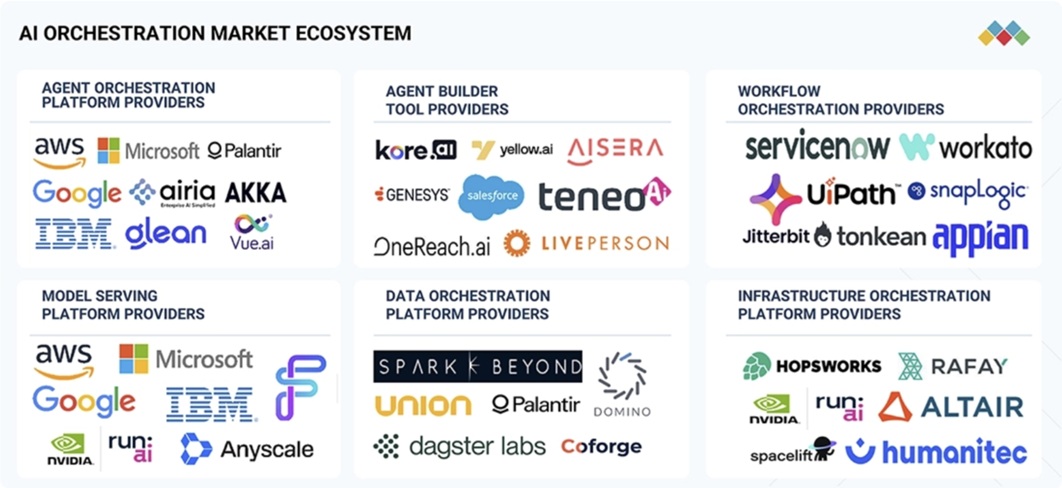
AI Orchestration Market – Global Forecast To 2030 – ecosystem
Key Benefits of Buying the Report
The report will provide market leaders and new entrants with information on the closest approximations of the revenue numbers for the overall AI orchestration market and its subsegments. It would help stakeholders understand the competitive landscape and gain more insights to better position their business and plan suitable go-to-market strategies. It also helps stakeholders understand the pulse of the market and provides them with information on key market drivers, restraints, challenges, and opportunities.
The report provides insights into the following pointers:
Analysis of key drivers (enterprise shift from reactive chat to governed, outcome-linked automation; AI orchestration reducing cost-to-serve and time-to-resolution by executing system actions; need for a common governance layer across apps to centralize approvals, lineage, and policy enforcement; stringent focus on regulatory compliance pushing buyers toward governed AI orchestration), restraints (pricing complexity and cross-function budget splits stalling enterprise-wide commitments; risk of unintended write-backs limiting autonomy and efficiency of AI orchestration tools), opportunities (demand for sovereign and air-gapped AI orchestration in public sector and regulated industries; replacement of overlapping RPA, iPaaS, and workflow stacks with AI orchestration suites; prebuilt template libraries and certified action packs accelerating ROI cycles for mid-market), and challenges (enterprise app sprawl across multi-cloud environments causing vendor lock-in concerns; end-to-end observability across multi-agent orchestration remains complex)
- Product Development/Innovation: Detailed insights into upcoming technologies, research & development activities, and new product & service launches in the AI orchestration market
- Market Development: Comprehensive information about lucrative markets – analysis of the AI orchestration market across varied regions
- Market Diversification: Exhaustive information about new products & services, untapped geographies, recent developments, and investments in the AI orchestration market
Competitive Assessment: In-depth assessment of market shares, growth strategies and service offerings of IBM (US), AWS (US), Salesforce (US), Adobe (US), Microsoft (US), SAP (Germany), Google (US), Coforge (India), ServiceNow (US), UiPath (US), NVIDIA (US), LivePerson (US), Genesys (US), Palantir (US), Kore.ai (US), Altair (US), Yellow.ai (US), Glean (US), Digital.ai (US), Workato (US), Appian (US), Solace (Canada), Jitterbit (US), SnapLogic (US), Aisera (US), OneReach.ai (US), Domino Data Labs (US), Anyscale (US), Forethought.ai (US), Vue.ai (US), Rafay Systems (US), Spacelift.io (US), Airia (US), Dagster Labs (US), Humanitec (Germany), Tonkean (US), Akka.io (US), SparkBeyond (US), Union.ai (US), Orkes (US), Teneo.ai (Sweden), Orby AI (US), Multimodal.dev (US), and Hopsworks (Sweden), among others, in the AI orchestration market. The report also helps stakeholders understand the pulse of the AI orchestration market and provides them with information on key market drivers, restraints, challenges, and opportunities.