
| 出版社 | IMARC Group |
| 出版年月 | 2025年9月 |
Eye Tracking Market Size, Share, Trends and Forecast

アイトラッキング市場規模、シェア、トレンド、予測:タイプ、コンポーネント、場所、用途、地域別、2025-2033年
世界のアイトラッキング市場規模は、2024年には13億9,450万米ドルと評価されました。IMARCグループは、今後、市場規模は2033年までに94億7,625万米ドルに達し、2025年から2033年にかけて22.54%の年平均成長率(CAGR)で成長すると予測しています。北米は現在、市場を支配しており、2024年には49.8%を超える大きなシェアを占めると予測されています。これは、研究イニシアチブの増加とスマートセンサーの普及によるものです。
世界のアイトラッキング市場は、ゲームやバーチャルリアリティアプリケーションにおけるユーザーエクスペリエンスの向上に対する需要の高まりなど、いくつかの主要な要因によって牽引されています。さらに、障がい者支援技術の進歩も、アイトラッキングソリューションの採用拡大を促進しています。市場調査や広告における消費者行動分析のためのアイトラッキングの利用増加も顕著です。さらに、製品開発におけるユーザー中心設計への重点化や、患者のモニタリングやリハビリテーションのためのヘルスケア分野へのアイトラッキングの導入が市場拡大に貢献しており、様々な分野におけるアイトラッキングの汎用性を浮き彫りにしています。
米国は、目覚ましい技術進歩と様々な業界での幅広い導入を特徴とする、世界のアイトラッキング(視線計測)市場において極めて重要な役割を果たしています。米国は研究開発のリーダーであり、ゲーム、バーチャルリアリティ、ユーザーエクスペリエンス研究のための視線追跡アプリケーションにおける革新を促進しています。例えば、2024年には、米国コーネル大学の研究者が、バーチャルリアリティヘッドセット向けにソナーベースの視線追跡システムを発表しました。このシステムは、カメラベースのシステムと比較して大幅に消費電力を抑えます。さらに、ヘルスケア分野では、患者の評価やリハビリテーションに視線追跡を活用するケースが増えており、診断能力の向上に役立っています。米国には大手テクノロジー企業や新興企業が数多く存在し、新たなアプリケーションの開拓や既存技術の改良を継続的に進めているため、市場の成長がさらに加速しています。これにより、視線追跡分野における主要プレーヤーとしての米国の地位は確固たるものとなっています。
Report Overview
The global eye tracking market size was valued at USD 1,394.50 Million in 2024. Looking forward, IMARC Group estimates the market to reach USD 9,476.25 Million by 2033, exhibiting a CAGR of 22.54% during 2025-2033. North America currently dominates the market, holding a significant market share of over 49.8% in 2024, driven by an increasing number of research initiatives and widespread deployment of smart sensors.
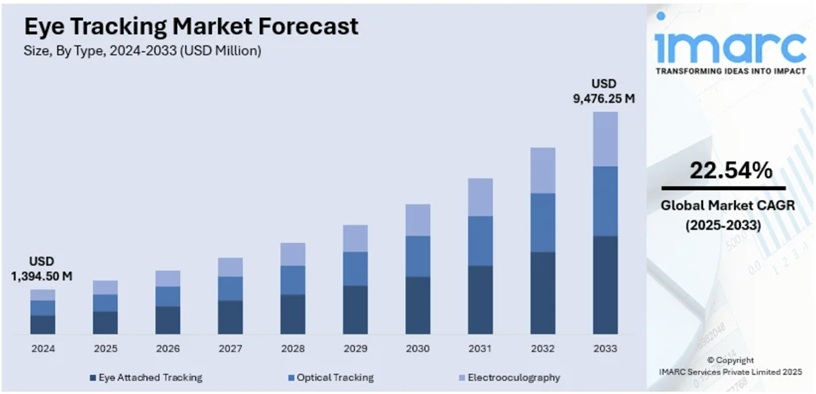
Eye Tracking Market
The global eye tracking market is driven by several key factors, including the rising demand for enhanced user experiences in gaming and virtual reality applications. Additionally, advancements in assistive technologies for individuals with disabilities are fostering greater adoption of eye tracking solutions. The increasing use of eye tracking in market research and advertising to analyze consumer behavior is also significant. Furthermore, the growing emphasis on user-centered design in product development and the integration of eye tracking in healthcare for patient monitoring and rehabilitation are contributing to market expansion, highlighting its versatility across various sectors.
The United States plays a pivotal role in the global eye tracking market, characterized by significant technological advancements and widespread adoption across various industries. The country is a leader in research and development, fostering innovations in eye tracking applications for gaming, virtual reality, and user experience research. For instance, in 2024, researchers at Cornell University, U.S., introduced sonar-based eye tracking system for virtual reality headsets. This system utilizes significantly lower power in comparison to camera-based ones. Additionally, the healthcare sector increasingly utilizes eye tracking for patient assessment and rehabilitation, enhancing diagnostic capabilities. The presence of major technology firms and startups in the U.S. further accelerates market growth, as they continuously explore new applications and improve existing technologies, solidifying the nation’s position as a key player in the eye tracking landscape.
Eye Tracking Market Trends:
Integration with Virtual and Augmented Reality
Eye tracking technology is increasingly being integrated with virtual reality (VR) and augmented reality (AR) platforms to enhance user experience and interaction. This integration allows for more immersive and responsive environments in gaming, training, and simulation applications, thereby positively influencing the eye tracking market outlook. For instance, eye-tracking enables foveated rendering in VR, which focuses processing power on the user’s direct line of sight, significantly improving graphical performance and reducing latency. According to a report by the International Data Corporation (IDC), global spending on AR/VR was estimated to reach USD 160 Billion by 2023, indicating a substantial market for eye-tracking technology within these platforms. This growth is driven by the expanding use of VR/AR in sectors such as healthcare for surgical training, retail for virtual try-ons, and in education for interactive learning experiences.
Advancements in Healthcare Applications
Eye tracking technology is gaining traction in healthcare for diagnostic and therapeutic applications. It is used in assessing neurological conditions, tracking cognitive development, and aiding in the rehabilitation of patients with brain injuries. For example, eye-tracking can help detect early signs of Alzheimer’s disease by analyzing eye movement patterns. The National Institutes of Health (NIH) highlights that eye-tracking has become a valuable tool in understanding visual attention and cognitive functions in patients with autism spectrum disorders (ASD), where approximately 1 in 36 children in the U.S. are diagnosed annually, thus generating a favorable eye tracking market revenue. This technology enables healthcare providers to offer more personalized treatment plans and improve patient outcomes. As the prevalence of neurological disorders increases globally, the eye tracking demand in healthcare is projected to rise, offering significant opportunities for innovation and development in this field.
Expansion in Consumer Electronics
The consumer electronics market is witnessing a surge in the incorporation of eye-tracking technology, particularly in devices such as smartphones, tablets, and laptops. Eye-tracking enhances user interaction by enabling hands-free control, improving accessibility for individuals with disabilities, and providing new ways for content consumption. For instance, features like gaze-based scrolling and eye-controlled navigation are becoming more common. The National Telecommunications and Information Administration reports a 3% increase in mobile broadband usage in the U.S. from 2021 to 2023, underscoring the integration of advanced interfaces. This trend is further bolstered by the growing interest in smart home devices and wearables, where eye-tracking can play a crucial role in creating more intuitive and user-friendly interfaces. With the growing consumer demand for smarter and more responsive devices, there has been a favorable eye tracking industry outlook that indicates that eye-tracking technology is set to become a standard feature in the next generation of consumer electronics.
Eye Tracking Market Report Scope:
| Report Features | Details |
|---|---|
| Base Year of the Analysis | 2024 |
| Historical Period | 2019-2024 |
| Forecast Period | 2025-2033 |
| Units | Million USD |
| Scope of the Report | Exploration of Historical and Forecast Trends, Industry Catalysts and Challenges, Segment-Wise Historical and Future Market Assessment:
|
| Types Covered | Eye Attached Tracking, Optical Tracking, Electrooculography |
| Components Covered | Hardware, Software |
| Locations Covered | Remote, Mobile |
| Applications Covered | Healthcare, Retail, Research, Automotive, Consumer Electronics, Others |
| Regions Covered | Asia Pacific, Europe, North America, Latin America, Middle East and Africa |
| Countries Covered | United States, Canada, Germany, France, United Kingdom, Italy, Spain, Russia, China, Japan, India, South Korea, Australia, Indonesia, Brazil, Mexico |
| Companies Covered | Ergoneers GmbH, Eyegaze Inc., EyeTech Digital Systems Inc., EyeTracking Inc., Gazepoint Research Inc., iMotions A/S, Mirametrix Inc., Seeing Machines, Smart Eye AB, SR Research Ltd., Tobii AB, etc. |
| Customization Scope | 10% Free Customization |
| Post-Sale Analyst Support | 10-12 Weeks |
| Delivery Format | PDF and Excel through Email (We can also provide the editable version of the report in PPT/Word format on special request) |