
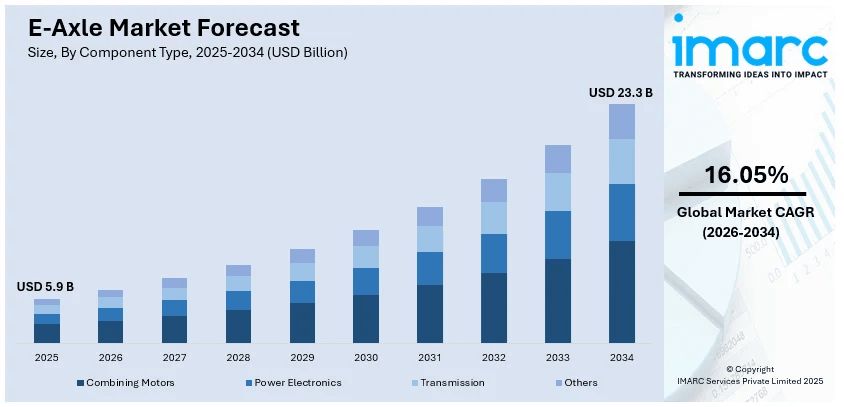
E-Axle Market Report by Component Type (Combining Motors, Power Electronics, Transmission, and Others), Vehicle Type (ICE Vehicles, Electric Vehicle), Drive Type (Forward Wheel Drive, Rear Wheel Drive, All Wheel Drive), and Region 2026-2034
E-Axle(イーアクスル)市場レポート : コンポーネントタイプ(モーター、パワーエレクトロニクス、トランスミッションなどの組み合わせ)、車両タイプ(ICE車両、電気自動車)、駆動タイプ(前輪駆動、後輪駆動、全輪駆動)、および地域 2026-2034年
| 出版 | IMARC Group |
| 出版年月 | 2026年02月 |
| ページ数 | 141 |
| 価格 | 記載以外のライセンスについてはお問合せください |
| シングルユーザ | USD 3,999 |
| 種別 | 英文調査報告書 |
| 商品番号 | SMR-13654 |

世界のE-Axle(イーアクスル)市場規模は2025年に59億米ドルに達しました。IMARCグループは、今後、市場規模が2034年までに233億米ドルに達し、2026年から2034年にかけて16.05%の年平均成長率(CAGR)で成長すると予測しています。市場は、電気自動車(EV)の需要の高まり、車両排気ガスによる大気汚染の発生を防ぐための厳格な排出規制、そして車両の機能性と持続可能性を向上させるための継続的な技術進歩に牽引され、着実な成長を遂げています。
E-Axle市場分析:
- 市場の成長と規模:世界的E-Axle(イーアクスル)市場は、電動モビリティへの世界的なシフトにより、堅調な成長を遂げています。
- 主要な市場牽引要因:世界的な厳格な排出ガス規制の施行が主な要因であり、自動車メーカーは電気自動車(EV)とeアクスル技術への投資を迫られています。
- 技術の進歩:パワーエレクトロニクス、バッテリー技術、電動モーター設計における継続的なイノベーションにより、eアクスルの効率、性能、そして費用対効果が向上しています。統合型eアクスルソリューションは、よりコンパクトで効率的になり、様々な車種の特定のニーズに合わせてカスタマイズされています。
- 業界における応用:E-Axle(イーアクスル)は、乗用車、商用車、既存の内燃機関(ICE)車両の改造など、幅広い車両に採用されています。eアクスルは、電気自動車やハイブリッド車の牽引力、安定性、そして効率性の向上に不可欠です。
- 主要市場動向:自動車メーカーとeアクスルメーカーの提携は、イノベーションと現地生産を促進しています。内燃機関(ICE)車へのeアクスルの後付けや、小型で手頃な価格のEVの開発は、注目すべきトレンドです。
- 地域別動向:EVの急速な普及を背景に、アジア太平洋地域が市場を支配しています。しかし、自動車排ガス削減への関心の高まりを受け、北米は急成長市場として台頭しています。
- 競争環境:主要企業は、研究開発への投資、グローバルプレゼンスの拡大、そしてeアクスル生産における持続可能性への注力に注力しています。自動車メーカーとの協業や戦略的パートナーシップは、市場シェアを確保するための一般的な戦略です。
- 課題と機会:課題としては、進化する規制や需要に対応するための継続的なイノベーションの必要性が挙げられます。しかしながら、四輪駆動構成などへのeアクスルの適用拡大や、特に新興市場におけるEV普及のためのインフラ整備の課題への対応といった機会が、これらの課題を克服すると予測されています。
Report Overview
The global E-axle market size reached USD 5.9 Billion in 2025. Looking forward, IMARC Group expects the market to reach USD 23.3 Billion by 2034, exhibiting a growth rate (CAGR) of 16.05% during 2026-2034. The market is experiencing steady growth driven by the heightened demand for electric vehicles (EVs), stringent emission regulations to prevent the occurrence of air pollution by vehicular exhausts, and continuous technological advancements to enhance the functionality and sustainability of vehicles.
E-Axle Market Analysis:
- Market Growth and Size: The global e-axle market is experiencing robust growth on account of the global shift towards electric mobility.
- Major Market Drivers: Key factors include the implementation of stringent emission regulations worldwide, which are compelling automakers to invest in electric vehicles (EVs) and e-axle technology.
- Technological Advancements: Ongoing innovations in power electronics, battery technology, and electric motor design are improving e-axle efficiency, performance, and cost-effectiveness. Integrated e-axle solutions are becoming more compact, efficient, and tailored for meeting the specific needs of various vehicle types.
- Industry Applications: E-axles find applications in a wide range of vehicles, including passenger cars, commercial vehicles, and retrofitting of existing internal combustion engine (ICE) vehicles. They are crucial for enhancing traction, stability, and efficiency in electric and hybrid vehicles.
- Key Market Trends: Partnerships between automakers and e-axle manufacturers are fostering innovation and local production. Retrofitting e-axles in ICE vehicles and developing smaller, affordable EVs are notable trends.
- Geographical Trends: Asia Pacific dominates the market, driven by the rapid adoption of EVs. However, North America is emerging as a fast-growing market on account of the rising focus on reducing the emissions of vehicular exhausts.
- Competitive Landscape: Key players are investing in research and development, expanding their global presence, and focusing on sustainability in e-axle production. Collaboration with automakers and strategic partnerships are common strategies to secure market share.
- Challenges and Opportunities: Challenges include the need for continuous innovation to meet evolving regulations and demands. Nonetheless, opportunities for expanding e-axle applications, such as in all-wheel drive configurations, and addressing infrastructure challenges for EV adoption, particularly in emerging markets, are projected to overcome these challenges.
E-Axle Market Trends:
Rising demand for EVs
The increasing demand for EVs as a sustainable mode of transportation is impelling the market growth. Moreover, there is a notable shift in user preferences and a global commitment to reduce carbon emissions. EVs are emerging as a pivotal solution to address these concerns. As a result, automakers are accelerating their efforts to produce a wider range of EVs, from compact cars to commercial trucks. E-axles are integral to the success of EVs as they offer a integrated solution for electric power trains. These systems combine the electric motor, power electronics, and gearbox into a single unit, optimizing efficiency and space utilization. This integration enhances the overall performance and range of EVs. Furthermore, governments worldwide are providing incentives and subsidies to promote EV adoption, further catalyzing the demand for e-axles.
Stringent emission regulations
Strict emission policies and regulations are driving the adoption of e-axle in various cars. Governments and international bodies are imposing increasingly stringent standards to combat air pollution and reduce greenhouse gas emissions. These regulations necessitate a transition from traditional internal combustion engine (ICE) vehicles to electric and hybrid alternatives. E-axles play a crucial role in helping automakers meet these demanding emission targets. By integrating the electric motor, power electronics, and transmission into a single unit, e-axles maximize energy efficiency and minimize emissions in EVs. This technology ensures that EVs not only comply with emission regulations but also deliver superior performance and range compared to their ICE counterparts. The automotive industry recognizes the importance of staying compliant with emission standards to avoid penalties and maintain a positive public image. Consequently, automakers are investing heavily in electric and hybrid vehicle development, which is fueling the demand for advanced e-axle solutions.
Technological advancements and innovation
Continuous technological advancements are propelling the growth of the market. Moreover, significant innovations in power electronics, battery technology, and electric motor design are revolutionizing the capabilities of e-axle systems. One key area of innovation is in power electronics. Advanced semiconductor technologies are leading to the development of more efficient and compact inverters and converters. These components are essential for managing the flow of electricity between the battery and the electric motor, optimizing energy usage, and minimizing losses. As a result, e-axles can deliver improved overall efficiency, translating to greater range and performance for EVs. Battery technology is another critical aspect of e-axle advancements. Lithium-ion (Li-ion) batteries continue to evolve, with increased energy density and faster charging capabilities. These improvements enable e-axles to harness and store energy more effectively, further enhancing the performance of EVs. Additionally, innovations in electric motor design are leading to the production of smaller, lighter, and more powerful motors. This has a direct impact on the compactness and efficiency of e-axle, making it an attractive choice for automakers looking to optimize their electric powertrains.
E-Axle Industry Segmentation:
IMARC Group provides an analysis of the key trends in each segment of the market, along with forecasts at the global, regional, and country levels for 2026-2034. Our report has categorized the market based on component type, vehicle type, and drive type.
Breakup by Component Type:
- Combining Motors
- Power Electronics
- Transmission
- Others
Transmission accounts for the majority of the market share
The report has provided a detailed breakup and analysis of the market based on the component type. This includes combining motors, power electronics, transmission, and others. According to the report, transmission represented the largest segment.
E-axle systems integrate the transmission component, making it an integral part of the overall setup. The transmission within an e-axle system is responsible for efficiently transferring power from the electric motor to the wheels of the vehicle. With the increasing demand for electric vehicles (EVs) and the need for seamless power distribution, the transmission component is crucial. Manufacturers are constantly innovating to enhance transmission efficiency, durability, and performance.
The motor component within e-axle systems plays a pivotal role in generating the necessary torque and power for EVs. It is responsible for converting electrical energy into mechanical energy to drive the wheels. Technological advancements in electric motor design are leading to the development of more compact, efficient, and powerful motors, improving the overall performance of electric vehicles.
Power electronics are the control units that manage the flow of electricity between the battery and the electric motor in e-axle systems. They ensure efficient power conversion and distribution, optimizing energy usage and vehicle performance. Moreover, power electronics play a critical role in maximizing the efficiency of electric powertrains.
Breakup by Vehicle Type:
- ICE Vehicles
o Passenger Vehicle
o Commercial Vehicle
- Electric Vehicle
ICE vehicles hold the largest share in the industry
A detailed breakup and analysis of the market based on the vehicle type have also been provided in the report. This includes ICE vehicles (passenger vehicle and commercial vehicle) and electric vehicle. According to the report, ICE vehicles accounted for the largest market share.
The internal combustion engine (ICE) systems are increasingly being adopted in ICE vehicles as automakers seek to improve fuel efficiency, reduce emissions, and meet stringent environmental regulations. E-axles provide a cost-effective solution for hybridization, allowing ICE vehicles to benefit from electric assistance during acceleration and low-speed operation. This technology helps traditional vehicles reduce their carbon footprint while maintaining the familiarity of combustion engines.
The adoption of electric vehicles (EVs) is driving the demand for e-axles. With the global push for cleaner and more sustainable transportation, EVs are gaining immense popularity. E-axle systems in EVs are integral components that house the electric motor, power electronics, and transmission, providing a compact and efficient solution for electric powertrains.
Breakup by Drive Type:
- Forward Wheel Drive
- Rear Wheel Drive
- All Wheel Drive
Forward wheel drive represents the leading market segment
The report has provided a detailed breakup and analysis of the market based on the drive type. This includes forward wheel drive, rear wheel drive, and all wheel drive. According to the report, forward wheel drive represented the largest segment.
Forward-wheel drive (FWD) vehicles represent the largest segment in the market. FWD configurations are popular in many passenger cars and compact vehicles due to their space-efficient design and generally lower manufacturing costs. E-axle systems designed for FWD vehicles are positioned at the front of the vehicle, housing the electric motor, power electronics, and transmission. These systems enhance traction, stability, and efficiency, making them well-suited for everyday commuting and urban driving. As fuel efficiency and emissions regulations become increasingly stringent, the demand for e-axles in FWD vehicles is expected to remain robust, catering to a broad user base.
The rear-wheel drive (RWD) segment represents a niche in e-axle systems. RWD configurations are commonly found in sports cars, luxury vehicles, and some larger sedans and sports utility vehicles (SUVs). E-axles designed for RWD vehicles are typically positioned at the rear, optimizing weight distribution and providing better handling characteristics. While RWD e-axles cater to a specific set of enthusiasts and premium vehicle segments, they are gaining traction as automakers introduce electric versions of traditional RWD models. The demand for e-axles in RWD vehicles is expected to increase as electric performance and luxury vehicles continue to expand their presence.
The all-wheel drive (AWD) segment is another significant section in e-axle systems. AWD configurations are favored for their ability to provide power to all four wheels, enhancing traction and stability in various driving conditions, including adverse weather and off-road situations. E-axles designed for AWD vehicles are versatile and cater to a wide range of vehicle types, including SUVs, crossovers, and performance cars. As individuals seek vehicles that offer both electric propulsion and AWD capabilities, e-axles that support AWD configurations are becoming increasingly popular. This segment is expected to become popular as automakers expand their AWD electric vehicle offerings to meet demands for versatility and safety.
Breakup by Region:
- North America
o United States
o Canada
- Asia-Pacific
o China
o Japan
o India
o South Korea
o Australia
o Indonesia
o Others
- Europe
o Germany
o France
o United Kingdom
o Italy
o Spain
o Russia
o Others
- Latin America
o Brazil
o Mexico
o Others
- Middle East and Africa
Asia Pacific leads the market, accounting for the largest e-axle market share
The market research report has also provided a comprehensive analysis of all the major regional markets, which include North America (the United States and Canada); Asia Pacific (China, Japan, India, South Korea, Australia, Indonesia, and others); Europe (Germany, France, the United Kingdom, Italy, Spain, Russia, and others); Latin America (Brazil, Mexico, and others); and the Middle East and Africa. According to the report, Asia Pacific accounted for the largest market share.
The Asia Pacific e-axle market is driven by the increasing adoption of electric vehicles (EVs). The region is witnessing a rise in partnerships and collaborations between automakers and e-axle manufacturers, fostering innovation and local production. Stringent emissions regulations in China and other countries are encouraging automakers to invest in EVs and e-axle technology.
North America maintains a strong presence due to the growing trend of retrofitting e-axles in existing ICE vehicles. Environmental awareness and government incentives to reduce carbon emissions are propelling the growth of the market.
Europe stands as another key region in the market, owing to the increasing implementation of stricter emissions regulations and preferences for cleaner transportation. Investments in charging infrastructure and supportive government policies are bolstering the market growth.
Latin America exhibits a growing potential, fueled by the rising shift towards electric mobility, primarily in countries like Brazil and Mexico. Environmental concerns and the need to reduce urban pollution are driving the adoption of electric vehicles and e-axle technology.
The Middle East and Africa region is experiencing growth on account of the rising sales of EVs.
E-Axle Market Report Scope:
| Report Features | Details |
|---|---|
| Base Year of the Analysis | 2025 |
| Historical Period | 2020-2025 |
| Forecast Period | 2026-2034 |
| Units | Billion USD |
| Scope of the Report | Exploration of Historical Trends and Market Outlook, Industry Catalysts and Challenges, Segment-Wise Historical and Future Market Assessment:
|
| Component Types Covered | Combining Motors, Power Electronics, Transmission, Others |
| Vehicle Types Covered |
|
| Drive Types Covered | Forward Wheel Drive, Rear Wheel Drive, All Wheel Drive |
| Regions Covered | Asia Pacific, Europe, North America, Latin America, Middle East and Africa |
| Countries Covered | United States, Canada, Germany, France, United Kingdom, Italy, Spain, Russia, China, Japan, India, South Korea, Australia, Indonesia, Brazil, Mexico |
| Companies Covered | Aisin Corporation, BRIST Axle Systems S.r.l., Dana Limited, Linamar Corporation, Nidec Corporation, Robert Bosch GmbH, Schaeffler Group USA Inc., SEG Automotive, Valeo, ZF Friedrichshafen AG, etc. |
| Customization Scope | 10% Free Customization |
| Post-Sale Analyst Support | 10-12 Weeks |
| Delivery Format | PDF and Excel through Email (We can also provide the editable version of the report in PPT/Word format on special request) |
Leading Key Players in the E-Axle Industry:
The key players in the e-axle market are actively engaged in several strategic initiatives to maintain their competitive edge. These initiatives include research and development (R&D) efforts focused on advancing e-axle technology, such as optimizing power electronics, improving motor efficiency, and enhancing integration capabilities. Additionally, these players are expanding their global footprint by establishing partnerships and collaborations with automakers to supply e-axle systems for a wide range of electric and hybrid vehicles. Moreover, they are investing in manufacturing facilities to meet the growing demand for e-axles and reduce production costs. Key players are also prioritizing sustainability by developing eco-friendly materials and processes for e-axle production, aligning with the focus on reducing environmental impact.
The market research report has provided a comprehensive analysis of the competitive landscape. Detailed profiles of all major companies have also been provided. Some of the key players in the market include:
- Aisin Corporation
- BRIST Axle Systems S.r.l.
- Dana Limited
- Linamar Corporation
- Nidec Corporation
- Robert Bosch GmbH
- Schaeffler Group USA Inc.
- SEG Automotive
- Valeo
- ZF Friedrichshafen AG
Key Questions Answered in This Report
- What was the size of the global E-axle market in 2025?
- What is the expected growth rate of the global E-axle market during 2026-2034?
- What are the key factors driving the global E-axle market?
- What has been the impact of COVID-19 on the global E-axle market?
- What is the breakup of the global E-axle market based on the component type?
- What is the breakup of the global E-axle market based on the vehicle type?
- What is the breakup of the global E-axle market based on the drive type?
- What are the key regions in the global E-axle market?
- Who are the key players/companies in the global E-axle market?
Table of Contents
1 Preface
2 Scope and Methodology
2.1 Objectives of the Study
2.2 Stakeholders
2.3 Data Sources
2.3.1 Primary Sources
2.3.2 Secondary Sources
2.4 Market Estimation
2.4.1 Bottom-Up Approach
2.4.2 Top-Down Approach
2.5 Forecasting Methodology
3 Executive Summary
4 Introduction
4.1 Overview
4.2 Key Industry Trends
5 Global E-Axle Market
5.1 Market Overview
5.2 Market Performance
5.3 Impact of COVID-19
5.4 Market Forecast
6 Market Breakup by Component Type
6.1 Combining Motors
6.1.1 Market Trends
6.1.2 Market Forecast
6.2 Power Electronics
6.2.1 Market Trends
6.2.2 Market Forecast
6.3 Transmission
6.3.1 Market Trends
6.3.2 Market Forecast
6.4 Others
6.4.1 Market Trends
6.4.2 Market Forecast
7 Market Breakup by Vehicle Type
7.1 ICE Vehicles
7.1.1 Market Trends
7.1.2 Key Segments
7.1.2.1 Passenger Vehicle
7.1.2.2 Commercial Vehicle
7.1.3 Market Forecast
7.2 Electric Vehicle
7.2.1 Market Trends
7.2.2 Market Forecast
8 Market Breakup by Drive Type
8.1 Forward Wheel Drive
8.1.1 Market Trends
8.1.2 Market Forecast
8.2 Rear Wheel Drive
8.2.1 Market Trends
8.2.2 Market Forecast
8.3 All Wheel Drive
8.3.1 Market Trends
8.3.2 Market Forecast
9 Market Breakup by Region
9.1 North America
9.1.1 United States
9.1.1.1 Market Trends
9.1.1.2 Market Forecast
9.1.2 Canada
9.1.2.1 Market Trends
9.1.2.2 Market Forecast
9.2 Asia-Pacific
9.2.1 China
9.2.1.1 Market Trends
9.2.1.2 Market Forecast
9.2.2 Japan
9.2.2.1 Market Trends
9.2.2.2 Market Forecast
9.2.3 India
9.2.3.1 Market Trends
9.2.3.2 Market Forecast
9.2.4 South Korea
9.2.4.1 Market Trends
9.2.4.2 Market Forecast
9.2.5 Australia
9.2.5.1 Market Trends
9.2.5.2 Market Forecast
9.2.6 Indonesia
9.2.6.1 Market Trends
9.2.6.2 Market Forecast
9.2.7 Others
9.2.7.1 Market Trends
9.2.7.2 Market Forecast
9.3 Europe
9.3.1 Germany
9.3.1.1 Market Trends
9.3.1.2 Market Forecast
9.3.2 France
9.3.2.1 Market Trends
9.3.2.2 Market Forecast
9.3.3 United Kingdom
9.3.3.1 Market Trends
9.3.3.2 Market Forecast
9.3.4 Italy
9.3.4.1 Market Trends
9.3.4.2 Market Forecast
9.3.5 Spain
9.3.5.1 Market Trends
9.3.5.2 Market Forecast
9.3.6 Russia
9.3.6.1 Market Trends
9.3.6.2 Market Forecast
9.3.7 Others
9.3.7.1 Market Trends
9.3.7.2 Market Forecast
9.4 Latin America
9.4.1 Brazil
9.4.1.1 Market Trends
9.4.1.2 Market Forecast
9.4.2 Mexico
9.4.2.1 Market Trends
9.4.2.2 Market Forecast
9.4.3 Others
9.4.3.1 Market Trends
9.4.3.2 Market Forecast
9.5 Middle East and Africa
9.5.1 Market Trends
9.5.2 Market Breakup by Country
9.5.3 Market Forecast
10 SWOT Analysis
10.1 Overview
10.2 Strengths
10.3 Weaknesses
10.4 Opportunities
10.5 Threats
11 Value Chain Analysis
12 Porters Five Forces Analysis
12.1 Overview
12.2 Bargaining Power of Buyers
12.3 Bargaining Power of Suppliers
12.4 Degree of Competition
12.5 Threat of New Entrants
12.6 Threat of Substitutes
13 Price Analysis
14 Competitive Landscape
14.1 Market Structure
14.2 Key Players
14.3 Profiles of Key Players
14.3.1 Aisin Corporation
14.3.1.1 Company Overview
14.3.1.2 Product Portfolio
14.3.1.3 Financials
14.3.1.4 SWOT Analysis
14.3.2 BRIST Axle Systems S.r.l.
14.3.2.1 Company Overview
14.3.2.2 Product Portfolio
14.3.2.3 Financials
14.3.2.4 SWOT Analysis
14.3.3 Dana Limited
14.3.3.1 Company Overview
14.3.3.2 Product Portfolio
14.3.3.3 Financials
14.3.3.4 SWOT Analysis
14.3.4 Linamar Corporation
14.3.4.1 Company Overview
14.3.4.2 Product Portfolio
14.3.4.3 Financials
14.3.4.4 SWOT Analysis
14.3.5 Nidec Corporation
14.3.5.1 Company Overview
14.3.5.2 Product Portfolio
14.3.5.3 Financials
14.3.5.4 SWOT Analysis
14.3.6 Robert Bosch GmbH
14.3.6.1 Company Overview
14.3.6.2 Product Portfolio
14.3.6.3 Financials
14.3.7 Schaeffler Group USA Inc.
14.3.7.1 Company Overview
14.3.7.2 Product Portfolio
14.3.7.3 Financials
14.3.8 SEG Automotive
14.3.8.1 Company Overview
14.3.8.2 Product Portfolio
14.3.8.3 Financials
14.3.8.4 SWOT Analysis
14.3.9 Valeo
14.3.9.1 Company Overview
14.3.9.2 Product Portfolio
14.3.9.3 Financials
14.3.9.4 SWOT Analysis
14.3.10 ZF Friedrichshafen AG
14.3.10.1 Company Overview
14.3.10.2 Product Portfolio
14.3.10.3 Financials
14.3.10.4 SWOT Analysis
List of Tables
Table 1: Global: E-Axle Market: Key Industry Highlights, 2025 & 2034
Table 2: Global: E-Axle Market Forecast: Breakup by Component Type (in Million USD), 2026-2034
Table 3: Global: E-Axle Market Forecast: Breakup by Vehicle Type (in Million USD), 2026-2034
Table 4: Global: E-Axle Market Forecast: Breakup by Drive Type (in Million USD), 2026-2034
Table 5: Global: E-Axle Market Forecast: Breakup by Region (in Million USD), 2026-2034
Table 6: Global: E-Axle Market: Competitive Structure
Table 7: Global: E-Axle Market: Key Players
List of Figures
Figure 1: Global: E-Axle Market: Major Drivers and Challenges
Figure 2: Global: E-Axle Market: Sales Value (in Billion USD), 2020-2025
Figure 3: Global: E-Axle Market Forecast: Sales Value (in Billion USD), 2026-2034
Figure 4: Global: E-Axle Market: Breakup by Component Type (in %), 2025
Figure 5: Global: E-Axle Market: Breakup by Vehicle Type (in %), 2025
Figure 6: Global: E-Axle Market: Breakup by Drive Type (in %), 2025
Figure 7: Global: E-Axle Market: Breakup by Region (in %), 2025
Figure 8: Global: E-Axle (Combining Motors) Market: Sales Value (in Million USD), 2020 & 2025
Figure 9: Global: E-Axle (Combining Motors) Market Forecast: Sales Value (in Million USD), 2026-2034
Figure 10: Global: E-Axle (Power Electronics) Market: Sales Value (in Million USD), 2020 & 2025
Figure 11: Global: E-Axle (Power Electronics) Market Forecast: Sales Value (in Million USD), 2026-2034
Figure 12: Global: E-Axle (Transmission) Market: Sales Value (in Million USD), 2020 & 2025
Figure 13: Global: E-Axle (Transmission) Market Forecast: Sales Value (in Million USD), 2026-2034
Figure 14: Global: E-Axle (Other Component Types) Market: Sales Value (in Million USD), 2020 & 2025
Figure 15: Global: E-Axle (Other Component Types) Market Forecast: Sales Value (in Million USD), 2026-2034
Figure 16: Global: E-Axle (ICE Vehicles) Market: Sales Value (in Million USD), 2020 & 2025
Figure 17: Global: E-Axle (ICE Vehicles) Market Forecast: Sales Value (in Million USD), 2026-2034
Figure 18: Global: E-Axle (Electric Vehicle) Market: Sales Value (in Million USD), 2020 & 2025
Figure 19: Global: E-Axle (Electric Vehicle) Market Forecast: Sales Value (in Million USD), 2026-2034
Figure 20: Global: E-Axle (Forward Wheel Drive) Market: Sales Value (in Million USD), 2020 & 2025
Figure 21: Global: E-Axle (Forward Wheel Drive) Market Forecast: Sales Value (in Million USD), 2026-2034
Figure 22: Global: E-Axle (Rear Wheel Drive) Market: Sales Value (in Million USD), 2020 & 2025
Figure 23: Global: E-Axle (Rear Wheel Drive) Market Forecast: Sales Value (in Million USD), 2026-2034
Figure 24: Global: E-Axle (All Wheel Drive) Market: Sales Value (in Million USD), 2020 & 2025
Figure 25: Global: E-Axle (All Wheel Drive) Market Forecast: Sales Value (in Million USD), 2026-2034
Figure 26: North America: E-Axle Market: Sales Value (in Million USD), 2020 & 2025
Figure 27: North America: E-Axle Market Forecast: Sales Value (in Million USD), 2026-2034
Figure 28: United States: E-Axle Market: Sales Value (in Million USD), 2020 & 2025
Figure 29: United States: E-Axle Market Forecast: Sales Value (in Million USD), 2026-2034
Figure 30: Canada: E-Axle Market: Sales Value (in Million USD), 2020 & 2025
Figure 31: Canada: E-Axle Market Forecast: Sales Value (in Million USD), 2026-2034
Figure 32: Asia-Pacific: E-Axle Market: Sales Value (in Million USD), 2020 & 2025
Figure 33: Asia-Pacific: E-Axle Market Forecast: Sales Value (in Million USD), 2026-2034
Figure 34: China: E-Axle Market: Sales Value (in Million USD), 2020 & 2025
Figure 35: China: E-Axle Market Forecast: Sales Value (in Million USD), 2026-2034
Figure 36: Japan: E-Axle Market: Sales Value (in Million USD), 2020 & 2025
Figure 37: Japan: E-Axle Market Forecast: Sales Value (in Million USD), 2026-2034
Figure 38: India: E-Axle Market: Sales Value (in Million USD), 2020 & 2025
Figure 39: India: E-Axle Market Forecast: Sales Value (in Million USD), 2026-2034
Figure 40: South Korea: E-Axle Market: Sales Value (in Million USD), 2020 & 2025
Figure 41: South Korea: E-Axle Market Forecast: Sales Value (in Million USD), 2026-2034
Figure 42: Australia: E-Axle Market: Sales Value (in Million USD), 2020 & 2025
Figure 43: Australia: E-Axle Market Forecast: Sales Value (in Million USD), 2026-2034
Figure 44: Indonesia: E-Axle Market: Sales Value (in Million USD), 2020 & 2025
Figure 45: Indonesia: E-Axle Market Forecast: Sales Value (in Million USD), 2026-2034
Figure 46: Others: E-Axle Market: Sales Value (in Million USD), 2020 & 2025
Figure 47: Others: E-Axle Market Forecast: Sales Value (in Million USD), 2026-2034
Figure 48: Europe: E-Axle Market: Sales Value (in Million USD), 2020 & 2025
Figure 49: Europe: E-Axle Market Forecast: Sales Value (in Million USD), 2026-2034
Figure 50: Germany: E-Axle Market: Sales Value (in Million USD), 2020 & 2025
Figure 51: Germany: E-Axle Market Forecast: Sales Value (in Million USD), 2026-2034
Figure 52: France: E-Axle Market: Sales Value (in Million USD), 2020 & 2025
Figure 53: France: E-Axle Market Forecast: Sales Value (in Million USD), 2026-2034
Figure 54: United Kingdom: E-Axle Market: Sales Value (in Million USD), 2020 & 2025
Figure 55: United Kingdom: E-Axle Market Forecast: Sales Value (in Million USD), 2026-2034
Figure 56: Italy: E-Axle Market: Sales Value (in Million USD), 2020 & 2025
Figure 57: Italy: E-Axle Market Forecast: Sales Value (in Million USD), 2026-2034
Figure 58: Spain: E-Axle Market: Sales Value (in Million USD), 2020 & 2025
Figure 59: Spain: E-Axle Market Forecast: Sales Value (in Million USD), 2026-2034
Figure 60: Russia: E-Axle Market: Sales Value (in Million USD), 2020 & 2025
Figure 61: Russia: E-Axle Market Forecast: Sales Value (in Million USD), 2026-2034
Figure 62: Others: E-Axle Market: Sales Value (in Million USD), 2020 & 2025
Figure 63: Others: E-Axle Market Forecast: Sales Value (in Million USD), 2026-2034
Figure 64: Latin America: E-Axle Market: Sales Value (in Million USD), 2020 & 2025
Figure 65: Latin America: E-Axle Market Forecast: Sales Value (in Million USD), 2026-2034
Figure 66: Brazil: E-Axle Market: Sales Value (in Million USD), 2020 & 2025
Figure 67: Brazil: E-Axle Market Forecast: Sales Value (in Million USD), 2026-2034
Figure 68: Mexico: E-Axle Market: Sales Value (in Million USD), 2020 & 2025
Figure 69: Mexico: E-Axle Market Forecast: Sales Value (in Million USD), 2026-2034
Figure 70: Others: E-Axle Market: Sales Value (in Million USD), 2020 & 2025
Figure 71: Others: E-Axle Market Forecast: Sales Value (in Million USD), 2026-2034
Figure 72: Middle East and Africa: E-Axle Market: Sales Value (in Million USD), 2020 & 2025
Figure 73: Middle East and Africa: E-Axle Market: Breakup by Country (in %), 2025
Figure 74: Middle East and Africa: E-Axle Market Forecast: Sales Value (in Million USD), 2026-2034
Figure 75: Global: E-Axle Industry: SWOT Analysis
Figure 76: Global: E-Axle Industry: Value Chain Analysis
Figure 77: Global: E-Axle Industry: Porter’s Five Forces Analysis