Private 5G Market

プライベート5G市場 2026-2030年:機会、課題、戦略、予測

Private 5G Market: 2026 - 2030 - Opportunities, Challenges, Strategies & Forecasts


出版 SNS Telecom & IT
出版年月 2026年06月
ページ数 755
図表数 130
価格 記載以外のライセンスについてはお問合せください
種別 英文調査報告書
商品番号 SMR-9095


SEMABIZ - otoiawase8

SNS Telecom & IT(SNSテレコム&IT)「プライベート5G市場 2026-2030年:機会、課題、戦略、予測  –  Private 5G Market: 2026 – 2030 – Opportunities, Challenges, Strategies & Forecasts」はプライベート5Gネットワ​​ーク市場を詳細に調査した結果を提供します。バリューチェーン、市場成長促進要因、普及の障壁、基盤技術、運用・ビジネスモデル、垂直産業、応用シナリオ、重要動向、将来ロードマップ、標準化、周波数帯の可用性と割り当て、規制環境、ケーススタディ、エコシステムプレーヤーのプロファイル、戦略など、プライベート5G市場の広範な調査・分析結果を掲載しています。また、2026年から2030年までの世界および地域別の市場規模予測も示しています。予測は、3つのインフラサブマーケット、16の垂直産業、5つの地域市場を対象としています。
予測対象セグメント

  • インフラストラクチャのサブマーケット
    • 5G NR RAN(無線アクセスネットワーク)
      • 基地局RU(無線ユニット)
      • DU/CU(分散型および集中型ベースバンドユニット)
    • 5GC(5Gコア)
      • UPF(ユーザープレーン機能)
      • 制御プレーン機能
    • 5Gトランスポート(フロントホール、ミッドホール、バックホール)
      • 光ファイバーおよび有線
      • マイクロ波
      • 衛星通信
    • セルサイズ
      • スモールセル
        • 屋内
        • 屋外
      • マクロセル
    • 周波数範囲
      • サブ6GHz
      • mmWave(ミリ波)
    • エンドユーザー市場
      • 垂直産業
        • 農業
        • 航空
        • 放送
        • 建設
        • 教育
        • 林業
        • 医療
        • 製造
        • 軍事
        • 鉱業
        • 石油・ガス
        • 港湾・海上輸送
        • 公共安全
        • 鉄道
        • 公益事業
        • 倉庫・その他
      • オフィス、ビル、公共施設
  • 地域市場
    • 北米
    • アジア太平洋地域
    • 欧州
    • 中東・アフリカ
    • 中南米

主な掲載内容

  • プライベートクラウド5Gネットワーク概観
  • プライベート5Gのシステムアーキテクチャと技術
  • 主要垂直産業と用途
  • 周波数の有効性、割り当て、用途
  • 標準化、法規制、協働構想
  • プライベート5Gネットワークのケーススタディ
  • 調査対象のエコシステムプレイヤ

データベース(Excel)

Private 5G Market: 2026 – 2030

Synopsis

Private cellular networks largely remained a fringe solution in the 2G and 3G eras, although GSM-R networks for railway communications are still operational ahead of a planned transition to 5G-based FRMCS (Future Railway Mobile Communication System). The early 2010s saw the first installations of private LTE networks – including Rio Tinto’s private LTE network for its Western Australia mining operations, Tampnet’s offshore 4G infrastructure and iNET’s 700 MHz network in the Permian Basin  marking the beginning of what has since grown into a well-established but niche segment of the wider wireless infrastructure sector. However, private 5G networks or NPNs (Non-Public Networks) based on 3GPP-defined 5G specifications are increasingly replacing LTE across many verticals, with a market potential far exceeding that of previous technology generations. There continues to be a steady rise in production-grade deployments by household names and industrial giants such as ADNOC, AirbusArcelorMittal, BASF, Bayer, Belden, BHP, BMW, Boliden, BP, Cargill, Celanese, Chevron, CIMPOR, COSCO Shipping, CPF (Charoen Pokphand Foods), Denka, Dot Foods, DP World, Duracell, Equinor, EMSTEEL, Etihad, Flex, Ford, Foxconn, Gerdau, Google, Hancock Prospecting, Hitachi Rail, Home Depot, Hutchison Ports, Hyundai, Intel, Inventec, Jaguar Land Rover, John Deere, LG Electronics, LS Electric, Lufthansa, LyondellBasell, Meijer, Moeve (Cepsa), Nestlé, Newmont, Nucor, OKI Electric, Outokumpu, Pegatron, PETRONAS, POSCO, Repsol, Ricoh, Robert Bosch, Salzgitter, Snam, Subaru, Takeda, Tesla, Toyota, Trinity Industries, Usiminas, Volkswagen, Walmart, WEG, Whirlpool, Xerox, Xiaomi Auto and ZF.

Compared to LTE technology, private 5G networks – also referred to as 5G MPNs (Mobile Private Networks), 5G campus networks, P5G, local 5G or e-Um 5G systems, depending on geography – can address far more demanding performance requirements in terms of throughput, latency, reliability, availability and connection density. In particular, 5G’s URLLC (Ultra-Reliable, Low-Latency Communications) and mMTC (Massive Machine-Type Communications) capabilities, along with a future-proof transition path to 6G networks in the 2030s, have positioned it as a viable alternative to physically wired connections for industrial-grade communications between machines, robots and control systems. Furthermore, despite its relatively higher cost of ownership, 5G’s wider coverage radius per radio node, scalability, determinism, security features and mobility support have stirred strong interest in its potential as a replacement for interference-prone unlicensed wireless technologies in IIoT (Industrial IoT) environments, where the number of connected sensors and other endpoints is expected to increase significantly over the coming years.

China remains the most mature national market supported by state-funded directives aimed at accelerating the adoption of 5G connectivity in industrial settings such as factories, warehouses, mines, power plants, substations, oil and gas facilities and ports. Although most private 5G networks in China typically comprise dozens of RAN (Radio Access Network) nodes, the largest networks can reach up to 2,500 dedicated radios supported by on-premises or edge cloud-based core network functions depending on specific latency, reliability and security requirements. The country’s large installed base of private 5G networks is a significant factor in driving domestic demand for specialized non-handset terminals, including cost-efficient RedCap (Reduced Capability) devices for video surveillance and IoT sensor use cases. A key focus of new deployments is on 5G-Advanced features such as DetNet (Deterministic Networking) enhancements for real-time coordination of multiple automated processes and pre-standards implementations of 6G era technologies, including ISAC (Integrated Sensing & Communications) – a capability that is also a priority for the U.S. military. Chinese mobile operators and vendors have also expanded beyond their domestic market in pursuit of private 5G business opportunities in manufacturing, mining, ports and other sectors abroad, from Thailand, Indonesia, Morocco and South Africa to as far afield as Peru.

In contrast to China’s state-directed approach, private 5G adoption in the United States, Canada, Germany, United Kingdom, France, Spain, Italy, Japan, South Korea, Taiwan, Australia, New Zealand, Brazil and other countries is largely driven by enterprise-led investment as part of industrial intelligence, automation, physical AI and mission-critical communications initiatives. Globally, private 5G networks are progressively being implemented to support use cases as diverse as wirelessly connected machinery for the rapid reconfiguration of production lines, distributed PLC (Programmable Logic Controller) environments, AGVs (Automated Guided Vehicles) and AMRs (Autonomous Mobile Robots) for intralogistics, semi-humanoid and quadruped robots for complex industrial tasks, connected workers with mobile and paperless workflows, AR (Augmented Reality)-assisted guidance and troubleshooting, machine vision-based quality control, wireless software flashing of manufactured vehicles, remote-controlled cranes, unmanned mining equipment, digital twin models of complex industrial systems, virtual visits for parents to see their infants in NICUs (Neonatal Intensive Care Units), live broadcast production in locations not easily accessible by traditional solutions, operations-critical communications during major sporting events, precision agriculture and livestock farming, communications between drones and operational systems, ATO (Automatic Train Operation), video analytics for railway crossing and station platform safety, remote visual inspections of aircraft engine parts, real-time collaboration for flight line maintenance, VR (Virtual Reality)-based training, autonomous and remote operations at military bases and missile field communications. 

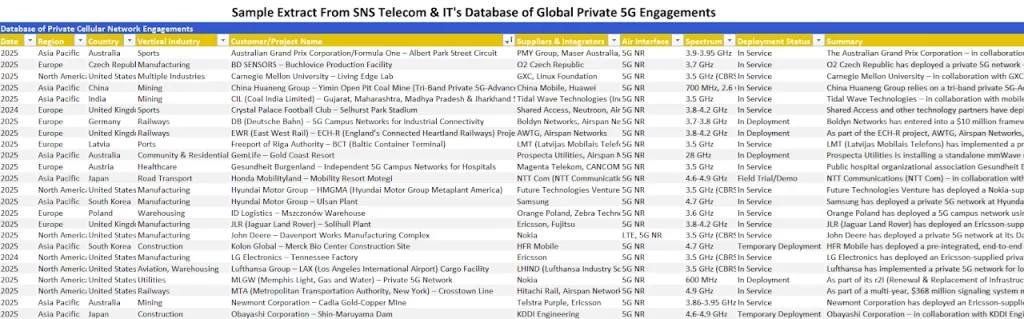
Private Cellular Network Data Sample

With UE (User Equipment)-related challenges, end user conservatism and other teething problems continuing to wane, early adopters are affirming their faith in the long-term potential of private 5G by investing in networks built in collaboration with specialist integrators, through traditional mobile operators or independently via direct procurement from 5G equipment suppliers – made possible by the availability of shared and licensed spectrum options in many national markets. As SNS Telecom & IT has highlighted over the last two years, a growing number of private 5G installations have progressed to a stage where practical and tangible benefits – particularly efficiency gains, cost savings and safety – are becoming increasingly evident. Notable examples, featuring new additions this year, include but are not limited to:

Although many networks referenced above have been built using 5G equipment supplied by traditional wireless infrastructure players  from incumbents Ericsson, Nokia, Huawei and ZTE to the likes of Samsung and NEC  alternative suppliers of RAN, mobile core and transport network equipment are continuing to gain traction in the private 5G market. Of particular note is the fact that smaller vendors have recently begun securing multi-site private 5G contracts spanning dozens of facilities across multiple geographies, encroaching on territory that until recently had been the preserve of wireless infrastructure giants. Noteworthy examples include Celona, Globalstar’s XCOM RAN business unit, Airspan NetworksDell Technologies, Firecell/Accelleran, GXC (Motive Companies), Moso Networks/Sercomm, Ataya, Mavenir, Baicells, Telrad Networks, BLiNQ Networks, Ceragon Networks, JMA Wireless, Microamp Solutions, Visban, Abside Networks, SEMPRE, Eridan Communications, AmpliTech, Battelle, ODC (Open RAN Development Company), Skylark Wireless, ANDREW (Amphenol), Alpha Wireless, Ubiik, Ciena, Canoga Perkins, Fibrolan, Aviat, Star Solutions/BTI Wireless, EdgeNectar, Expeto, Druid Software, HPE (Hewlett Packard Enterprise), Cisco Systems, RADTONICS, Pente Networks, Blue Arcus, Axyom.Core, A5G Networks, Bloxtel, Oracle, Enea, Parallel Wireless, Radisys, Wilson Connectivity, Nextivity, LG Electronics, Samji Electronics, SOLiD, EUCAST, EasyCell, HFR Mobile, Qucell (Accuver), WNC (Wistron NeWeb Corporation), Askey Computer, Saviah Technologies, QCT (Quanta Cloud Technology), G REIGNS, Pegatron, Alpha Networks, CloudRAN.AI, IPLOOK, Sunwave Communications, Comba Telecom, AsiaInfo Technologies, AI-LINK, LITEON, SynaXG, VHT (Viettel High Tech), FLARE SYSTEMS, Hytec Inter, ISL Networks, Rakuten Symphony, ELUON, NextEPC (COONTEC), Siemens, Obvios, Katela Networks, Eviden, Kontron, Teltronic, YateBTS, BubbleRAN, Amarisoft, CampusGenius, Riedel Communications, GuardStack/Blackned, Cumucore, Apeiroon, SendBuffer, Atika Technologies, IS-Wireless, Effnet, Node-H, SRS (Software Radio Systems), Benetel, AttoCore, cellXica, JET Connectivity, Neutral Wireless, Wireless Excellence, Antevia Networks, ASOCS, ASELSAN, i2i Systems, PROTEI, Iskra Technologies, Trópico, Niral Networks, Tidal Wave and Lekha Wireless.

Network infrastructure investment requires significant upfront capital and is expected to remain in service for many years before a refresh is warranted — for instance, many of Australia’s private LTE deployments in the mining sector are only now being replaced by standalone 5G networks after nearly a decade in operation, a transition made possible by the introduction of AWLs (Area-Wide Licences) in suitable mid-band spectrum. By contrast, UE or device procurement follows a more gradual trajectory, with endpoints for new use cases added incrementally over the network’s lifecycle. The private cellular device ecosystem shares one trait with the infrastructure segment  it is equally diverse with many OEMs and suppliers, from smartphone, tablet, laptop and specialized handset vendors such as Apple, Samsung, Zebra Technologies, Bittium, HMD, CROSSCALL, Ascom, Cybertel, TELOXHytera, Sonim (NEXA), Siyata, Purism, Cyrus Technology, RugGear, i.safe MOBILE, Getac and Panasonic Connect to suppliers of IoT modules, routers and other form factors such as Semtech, Telit Cinterion, Quectel, Sunsea, Fibocom, Lierda, Cavli Wireless, Cradlepoint (Ericsson), Digi International, Teltonika Networks, Inseego, BEC Technologies, MultiTech, Peplink, HMS Networks, Aviat, Moxa, Belden, InHand Networks, Lantronix, RAD, Eurotech, Westermo, Advantech, AMIT Wireless, ADLINK Technology, Sercomm, Robustel, Four-Faith, Hongdian, PUSR, Microhard, Horizon, Dejero, Global Telecom, Airgain, Celerway, INSYS icom, Kontron, Funkwerk, Siemens, Icomera, GE Vernova, Itron, Phoenix Contact, Milesight, Rajant, Sony, Haivision, LiveU, Teradek and TVU Networks. New devices and feature enhancements tailored for private 5G networks continue to enter the market. To cite a few recent examples, Nokia has partnered with HMD to develop a tactical smartphone for defense and public safety users, Siemens has enhanced its 5G routers with edge runtime capabilities, and Japan’s Sumitomo Electric has launched an mmWave terminal for local 5G networks that integrates proprietary AI image compression algorithms, enabling high-definition camera footage to be transmitted with an 80% reduction in data volume.

Private 5G Market Forecast

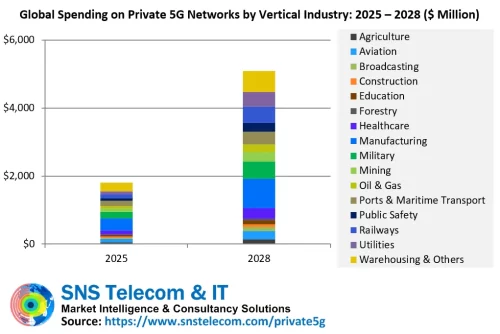
SNS Telecom & IT projects that annual investments in private 5G networks for vertical industries will grow at a CAGR of approximately 34% between 2026 and 2029, eventually surpassing $6.6 billion by the end of 2029. A substantial proportion of this growth will be led by highly localized 5G networks for workforce connectivity, automation and AI applications in enterprise campuses and industrial facilities. The adoption of physical AI is particularly pronounced, with many industrial giants relying on private 5G-connected AGVs, AMRs, drones, cranes, forklifts, mining vehicles, quadruped robots and even semi-humanoid systems for tasks such as the autonomous transportation of loads ranging from raw materials and parts to assembled vehicles and heavy steel slabs, remote-controlled dozing in mining operations, high-bay inventory counting, visual inspections for predictive maintenance, unmanned security patrols and dual-arm object manipulation. It is worth noting that robot manufacturers such as Boston Dynamics and AgiBot recommend private 5G networks as the preferred connectivity medium for their products in industrial settings.

In addition to multi-site private 5G deployments at existing brownfield facilities, organizations are increasingly incorporating on-premises 5G connectivity into the building plans of greenfield projects. Examples of new facilities with private 5G networks integrated from the outset include GDC’s (Georgia Department of Corrections) new state prison campus, Hybar’s Osceola steel mill, Hyundai‘s HMGMA (Hyundai Motor Group Metaplant America), Hitachi Rail’s Hagerstown factoryLos Angeles Chargers’ El Segundo training facility, Formula 1’s Las Vegas complex, Cleveland Clinic’s Mentor Hospital, CHI’s (Children’s Health Ireland) New Children’s Hospital, Port of Aberdeen’s South Harbour, ArcelorMittal’s Mardyck electrical steel plant, Takeda’s Lessines warehouse, NEC’s Kakegawa plant, Pegatron’s Batam smart factory, PATTA’s low-carbon Renwu factoryJacto’s Paulópolis production facility, Peru’s Port of Chancay and Shandong Yongsheng Rubber’s Nador tire manufacturing plant.

Alongside enterprise and industrial deployments, mission-critical communications is a distinct but equally important growth pillar for private 5G adoption among defense forces, public safety agencies, railways, utilities and critical infrastructure operators. In the defense sector, armed forces around the world are actively investing in both rapidly deployable 5G systems for tactical communications and mission-critical networks at permanent military bases and training fields. The U.S. military, for instance, has multiple deployments across the continental United States and overseas, including operational networks for the Indo-Pacific and Africa Commands. Additionally, sub-1 GHz wide area critical communications networks for public safety, railway and utility communications are gradually transitioning from LTE, GSM-R and other legacy narrowband technologies to standalone 5G systems as 5G-Advanced – 5G’s next evolutionary phase – reaches commercial maturityAmong other features for mission-critical networks, the 3GPP’s Release 18, 19 and 20 specifications for 5G-Advanced systems add support for lower 5G NR channel bandwidths in dedicated spectrum, new operating bands and specific enhancements for FRMCS and MCX (Mission-Critical PTT, Video & Data) service implementations.

The “Private 5G Market: 2026 – 2030 – Opportunities, Challenges, Strategies & Forecasts” report presents an in-depth assessment of the private 5G network market, including the value chain, market drivers, barriers to uptake, enabling technologies, operational and business models, vertical industries, application scenarios, key trends, future roadmap, standardization, spectrum availability and allocation, regulatory landscape, case studies, ecosystem player profiles and strategies. The report also presents global and regional market size forecasts from 2026 to 2030, as well as historical data from 2023 to 2025. The forecasts and historical data cover two network types, three infrastructure submarkets, four spectrum licensing  models, 13 frequency bands, 16 vertical industries and five regional markets.

The report is accompanied by an Excel datasheet suite covering all quantitative forecasts and historical data, as well as an extensive database of over 9,300 global private cellular engagements – including more than 4,600 private 5G installations – as of Q2 2026. Also included is a spectrum tracking database covering over 400 spectrum access routes in the sub-1 GHz, mid-band and mmWave ranges, with associated frequencies and bandwidth availability for both local and wide area private networks on a per-country basis.

Pricing

The report is available for the following price:

  • Single User License: USD 2,500
  • Company Wide License: USD 3,500

Summary of Private 5G Engagements

Below is a summary of existing and planned private 5G engagements across 16 vertical sectors:

Key Findings

The report has the following key findings:

Topics Covered

The report covers the following topics:

  • Introduction to private 5G networks
  • Value chain and ecosystem structure
  • Market drivers and challenges
  • System architecture and key elements of private 5G networks
  • Operational and business models, network size, geographic reach and other practical aspects of private 5G networks
  • Physical AI, industrial automation, critical communications broadband evolution and other themes shaping the adoption of private 5G networks
  • Enabling technologies and concepts, including 3GPP-defined URLLC, TSC, DetNet, MCX, SNPN and PNI-NPN, NR-U, RedCap/eRedCap, cellular IoT, high-precision positioning, ISAC, NTN access, IAB, network slicing, edge computing and network automation capabilities
  • Key trends such as the emergence of new classes of specialized private network operators, shared and local area spectrum licensing, private NaaS (Network-as-a-Service) offerings, IT/OT convergence, unified neutral host-private 5G solutions, Open RAN, vRAN and AI-RAN, agentic AI-driven network operations, rapidly deployable 5G systems for temporary coverage, satellite backhaul integration, direct-to-device connectivity, 5G-Advanced feature adoption and the incorporation of private 5G networks into the building plans of greenfield facilities
  • Analysis of vertical industries and application scenarios such as autonomous transport systems, collaborative mobile robots, reconfigurable wireless production lines, untethered AR/VR/MR, high-definition video transmission, machine vision, digital twins, predictive maintenance and mission-critical communications between personnel, drones, vehicles and operational systems
  • Future roadmap of private 5G networks
  • Review of private 5G network installations worldwide, including 150 case studies spanning 16 verticals
  • Private cellular engagement database tracking more than 4,600 private 5G installations in over 90 countries
  • Spectrum availability, allocation and usage across the global, regional and national domains
  • Spectrum tracking database covering more than 400 spectrum access routes for private 5G networks on a per-country basis
  • Standardization, regulatory and collaborative initiatives
  • Profiles and strategies of more than 1,900 ecosystem players
  • Strategic recommendations for 5G equipment and enabling technology suppliers, system integrators, private network specialists, mobile operators and end user organizations
  • Market analysis and forecasts from 2026 to 2030, with historical data from 2023 to 2025

Forecast Segmentation

Market forecasts are provided for each of the following submarkets and their subcategories:

  • Network Types
    • Wide Area Networks
    • Campus/Local Area Networks
  • Infrastructure Submarkets
    • 5G NR RAN (Radio Access Network)
      • Base Station RUs (Radio Units)
      • DUs/CUs (Distributed & Centralized Baseband Units)
    • 5GC (5G Core)
      • UPF (User Plane Function)
      • Control Plane Functions
    • 5G Transport (Fronthaul, Midhaul & Backhaul)
      • Fiber & Wireline
      • Microwave
      • Satellite Communications
  • Cell Sizes
    • Small Cells
      • Indoor
      • Outdoor
    • Macrocells
  • Spectrum Licensing Models
    • Mobile Operator-Owned Spectrum
    • Wide Area Licensed Spectrum
    • Shared & Local Area Licensed Spectrum
    • Unlicensed Spectrum
  • Frequency Bands
    • 410/450 MHz
    • 600 MHz
    • 700 MHz
    • 800 MHz
    • 900 MHz
    • 1.4-1.9 GHz
    • 2.1-2.6 GHz
    • 3.5 GHz CBRS
    • 3.3-3.8 GHz
    • 3.8-4.2 GHz
    • 4.4-4.9 GHz
    • 26/28 GHz
    • Other Bands
  • End User Markets
    • Vertical Industries
      • Agriculture
      • Aviation
      • Broadcasting
      • Construction
      • Education
      • Forestry
      • Healthcare
      • Manufacturing
      • Military
      • Mining
      • Oil & Gas
      • Ports & Maritime Transport
      • Public Safety
      • Railways
      • Utilities
      • Warehousing & Others
    • Offices, Buildings & Public Venues
  • Regional Markets
    • North America
    • Asia Pacific
    • Europe
    • Middle East & Africa
    • Latin & Central America

Table of Contents

1 Chapter 1: Introduction

1.1 Executive Summary
1.2 Topics Covered
1.3 Forecast Segmentation
1.4 Key Findings
1.5 Summary of Private 5G Engagements
1.6 Methodology
1.7 Target Audience

2 Chapter 2: An Overview of Private 5G Networks

2.1 An Introduction to the 3GPP-Defined 5G Standard
2.1.1 What is 5G?
2.1.2 5G Service Profiles
2.1.2.1 eMBB (Enhanced Mobile Broadband)
2.1.2.2 URLLC (Ultra-Reliable, Low-Latency Communications)
2.1.2.3 mMTC/mIoT (Massive Machine-Type Communications/Internet of Things)
2.1.3 5G-Advanced & the Evolution to 6G
2.1.4 The Significance of Vertical Industries in the 5G Era
2.2 Why Utilize 5G for Private Wireless Networks?
2.2.1 Performance, Mobility, Reliability & Security Characteristics
2.2.2 Ability to Address Both Wide Area & Localized Coverage Needs
2.2.3 Variety of Frequency Bands, Bandwidth Flexibility & Spectral Efficiency
2.2.4 Interworking With Public Mobile Networks & Non-3GPP Technologies
2.2.5 3GPP Support for Industrial-Grade & Mission-Critical Applications
2.2.6 Future-Proof Transition Path Towards 6G Networks
2.2.7 Thriving Ecosystem of Chipsets, Devices & Network Equipment
2.2.8 Economic Viability of Deployment & Operational Costs
2.3 Themes Influencing the Adoption of Private 5G Networks
2.3.1 Critical Communications Broadband Evolution
2.3.2 Industrial Automation & Physical AI Adoption
2.3.3 Bridging the OT & IT Divide in Industrial Settings
2.3.4 Horizontally-Oriented Enterprise Connectivity Initiatives
2.3.5 Neutral Hosting, Smart Cities, Community Broadband & Other Themes
2.4 Practical Aspects of Private 5G Networks
2.4.1 5G Technology Deployment Modes
2.4.1.1 NSA (Non-Standalone) 5G
2.4.1.2 SA (Standalone) 5G
2.4.2 Spectrum Options
2.4.2.1 National Spectrum for Specific Applications
2.4.2.1.1 Defense & PPDR (Public Protection & Disaster Relief)
2.4.2.1.2 Utilities & Critical Infrastructure Industries
2.4.2.1.3 Aviation, Maritime & Railway Communications
2.4.2.1.4 Other Segments
2.4.2.2 Local Area Licensed Spectrum
2.4.2.2.1 Local Area Licenses for Enterprises & Vertical Users
2.4.2.2.2 Local Leasing of Public Mobile Operator Frequencies
2.4.2.2.3 ASA (Authorized Shared Access) & Light Licensing
2.4.2.3 Unlicensed Spectrum
2.4.2.3.1 Designated License-Exempt Bands
2.4.2.3.2 Opportunistic Unlicensed Access
2.4.3 Network Size & Geographic Reach
2.4.3.1 Wide Area Private Cellular Networks
2.4.3.2 Medium-Scale Local Area Networks
2.4.3.3 On-Premises Campus Networks
2.4.4 Operational Scenarios
2.4.4.1 Isolated NPNs (Non-Public Networks)
2.4.4.2 Public Mobile Operator-Integrated NPNs
2.4.4.2.1 Dedicated Mobile Operator RAN Coverage
2.4.4.2.2 Shared RAN With On-Premise Core
2.4.4.2.3 Shared RAN & Control Plane
2.4.4.2.4 NPNs Hosted By Public Networks
2.4.4.3 Virtual Sliced Private Networks
2.4.4.4 Hybrid Public-Private Networks
2.4.4.5 Shared Core Private Networks
2.4.4.6 Secure MVNO (Mobile Virtual Network Operator) Arrangements
2.4.4.7 Other Approaches
2.4.5 Business Models
2.4.5.1 Fully Independent Private Networks
2.4.5.2 Service Provider-Managed Private Networks
2.4.5.3 Hybrid Ownership, Management & Control
2.4.5.4 Private NaaS (Network-as-a-Service)
2.4.5.5 Other Business Models
2.5 Value Chain of Private 5G Networks
2.5.1 Enabling Technology Providers
2.5.2 Terminal Equipment Suppliers
2.5.3 RAN, Core & Transport Infrastructure Vendors
2.5.4 Pure-Play Private 5G Network Operators
2.5.5 In-Building Neutral Hosts
2.5.6 National Mobile Operators
2.5.7 Satellite Operators & Other Service Providers
2.5.8 Spectrum Access Administrators
2.5.9 Critical Communications, Industrial OT & IT System Integrators
2.5.10 Cybersecurity & Network Orchestration Specialists
2.5.11 Test/Measurement, Application Software & Other Ecosystem Players
2.5.12 End User Organizations
2.6 Market Drivers
2.6.1 Limited Wireless Coverage in Indoor, Industrial & Remote Environments
2.6.2 Availability of Shared & Licensed Spectrum for Private Networks
2.6.3 Growing Demand for High-Bandwidth & Low-Latency Applications
2.6.4 Endorsement From the Industrial & Critical Communications Sectors
2.6.5 Guaranteed Connectivity & QoS (Quality-of-Service) Control
2.6.6 Greater Levels of Network Security & Data Privacy
2.6.7 Operators’ & Vendors’ Desire for New Revenue Sources
2.6.8 Government-Funded 5G Innovation Initiatives
2.7 Market Barriers
2.7.1 Cost & ROI (Return-On-Investment) Justification
2.7.2 Technical Complexities of Network Deployment & Operation
2.7.3 Integration With Existing Infrastructure & Applications
2.7.4 Limited Scale Effects Due to Lack of Spectrum Harmonization
2.7.5 Competition From Non-3GPP Technologies & Solutions
2.7.6 LTE/5G Terminal Equipment-Related Challenges
2.7.7 Skills Gap & Shortage of Proficient Engineers
2.7.8 Conservatism & Slow Pace of Change

3 Chapter 3: System Architecture & Technologies for Private 5G Networks

3.1 Architectural Components of Private 5G Networks
3.2 UE (User Equipment)
3.2.1 Smartphones & Handheld Terminals
3.2.2 Cellular Routers & IoT Gateways
3.2.3 Fixed CPEs (Customer Premises Equipment)
3.2.4 Tablets & Notebook PCs
3.2.5 IoT Modules, Dongles & Others
3.3 RAN (Radio Access Network)
3.3.1 NG-RAN – 5G NR Access Network
3.3.1.1 gNBs – 5G NR Base Stations
3.3.1.2 en-gNBs – Secondary Node 5G NR Base Stations
3.3.1.3 ng-eNBs – Next-Generation LTE Base Stations
3.3.2 Architectural Components of gNB Base Stations
3.3.2.1 RUs (Radio Units)
3.3.2.2 Integrated Radio & Baseband Units
3.3.2.3 DUs (Distributed Baseband Units)
3.3.2.4 CUs (Centralized Baseband Units)
3.4 Mobile Core
3.4.1 5GC (5G Core): Core Network for Standalone 5G Implementations
3.4.1.1 Access, Mobility & Session Management
3.4.1.1.1 AMF (Access & Mobility Management Function)
3.4.1.1.2 SMF (Session Management Function)
3.4.1.1.3 UPF (User Plane Function)
3.4.1.2 Subscription & Data Management
3.4.1.2.1 AUSF (Authentication Server Function)
3.4.1.2.2 AAnF (AKMA Anchor Function)
3.4.1.2.3 UDM (Unified Data Management)
3.4.1.2.4 UDR (Unified Data Repository)
3.4.1.2.5 UDSF (Unstructured Data Storage Function)
3.4.1.2.6 UCMF (UE Radio Capability Management Function)
3.4.1.2.7 5G-EIR (5G Equipment Identity Register)
3.4.1.3 Policy & Charging
3.4.1.3.1 PCF (Policy Control Function)
3.4.1.3.2 CHF (Charging Function)
3.4.1.4 Signaling & Routing
3.4.1.4.1 SCP (Service Communication Proxy)
3.4.1.4.2 SEPP (Security Edge Protection Proxy)
3.4.1.4.3 BSF (Binding Support Function)
3.4.1.5 Network Resource Management
3.4.1.5.1 NEF (Network Exposure Function)
3.4.1.5.2 NRF (Network Repository Function)
3.4.1.5.3 NSSF (Network Slice Selection Function)
3.4.1.5.4 NSSAAF (Network Slice-Specific & SNPN Authentication-Authorization Function)
3.4.1.5.5 NSACF (Network Slice Admission Control Function)
3.4.1.6 Data Analytics & Automation
3.4.1.6.1 NWDAF (Network Data Analytics Function)
3.4.1.6.2 AnLF (Analytics Logical Function)
3.4.1.6.3 MTLF (Model Training Logical Function)
3.4.1.6.4 DCCF (Data Collection Coordination Function)
3.4.1.6.5 ADRF (Analytics Data Repository Function)
3.4.1.6.6 MFAF (Messaging Framework Adaptor Function)
3.4.1.6.7 MDAF (Management Data Analytics Function)
3.4.1.7 Location Services
3.4.1.7.1 LMF (Location Management Function)
3.4.1.7.2 GMLC (Gateway Mobile Location Center)
3.4.1.8 Application Enablement
3.4.1.8.1 AFs (Application Functions)
3.4.1.8.2 SMSF (Short Message Service Function)
3.4.1.8.3 CBCF (Cell Broadcast Center Function)
3.4.1.8.4 5G DDNMF (5G Direct Discovery Name Management Function)
3.4.1.8.5 TSCTSF (Time-Sensitive Communication & Time Synchronization Function)
3.4.1.8.6 TSN AF (Time-Sensitive Networking Application Function)
3.4.1.8.7 EASDF (Edge Application Server Discovery Function)
3.4.1.9 Multicast-Broadcast Support
3.4.1.9.1 MB-SMF (Multicast-Broadcast SMF)
3.4.1.9.2 MB-UPF (Multicast-Broadcast UPF)
3.4.1.9.3 MBSF (Multicast-Broadcast Service Function)
3.4.1.9.4 MBSTF (Multicast-Broadcast Service Transport Function)
3.5 Transport Network
3.5.1 Fronthaul: RU-to-DU Transport
3.5.2 Midhaul: DU-to-CU Transport
3.5.3 Backhaul: RAN-to-Core Transport
3.5.4 Physical Transmission Mediums
3.5.4.1 Fiber & Wireline Transport Technologies
3.5.4.1.1 Owned, Lit & Dark Fiber
3.5.4.1.2 Ethernet & IP-Based Transport
3.5.4.1.3 WDM (Wavelength Division Multiplexing)
3.5.4.1.4 PON (Passive Optical Network)
3.5.4.1.5 OTN (Optical Transport Network)
3.5.4.1.6 DOCSIS, G.fast & Other Technologies
3.5.4.2 Microwave & mmWave (Millimeter Wave) Wireless Links
3.5.4.2.1 Traditional Bands (6 – 42 GHz)
3.5.4.2.2 V-Band (60 GHz)
3.5.4.2.3 E-Band (70/80 GHz)
3.5.4.2.4 W-Band (92 – 114.25 GHz)
3.5.4.2.5 D-Band (130 – 174.8 GHz)
3.5.4.3 Satellite Communications
3.5.4.3.1 GEO (Geostationary Earth Orbit)
3.5.4.3.2 MEO (Medium Earth Orbit)
3.5.4.3.3 LEO (Low Earth Orbit)
3.6 Services & Interconnectivity
3.6.1 End User Application Services
3.6.1.1 Generic Broadband, Messaging & IoT Services
3.6.1.2 IMS Core: VoNR (Voice Over NR) & MMTel (Multimedia Telephony)
3.6.1.3 5G MBS/5MBS (5G Multicast-Broadcast Services)
3.6.1.4 Group Communications & MCS (Mission-Critical Services)
3.6.1.5 IIoT (Industrial IoT), Cyber-Physical Control & Domain-Specific Connected Services
3.6.1.6 ProSe (Proximity-Based Services) for Direct D2D (Device-to-Device) Discovery & Communications
3.6.1.7 Vehicular, Aviation, Maritime & Railway-Related Applications
3.6.1.8 3GPP Service Frameworks for Vertical Industries
3.6.1.8.1 CAPIF (Common API Framework)
3.6.1.8.2 SEAL (Service Enabler Architecture Layer for Verticals)
3.6.1.8.3 EDGEAPP (Architecture for Enabling Edge Applications)
3.6.1.9 VAL (Vertical Application Layer) Enablers
3.6.1.9.1 V2X (Vehicle-to-Everything)
3.6.1.9.2 UAS (Uncrewed Aerial Systems)
3.6.1.9.3 5GMARCH/MSGin5G (Messaging in 5G)
3.6.1.9.4 FF (Factories of the Future)
3.6.1.9.5 PINAPP (Personal IoT Networks), XR (Extended Reality) & Others
3.6.2 Interconnectivity With 3GPP & Non-3GPP Networks
3.6.2.1 3GPP Roaming & Service Continuity
3.6.2.1.1 National & International Roaming
3.6.2.1.2 Service Continuity Outside Network Footprint
3.6.2.2 Non-3GPP Network Integration
3.6.2.2.1 N3IWF (Non-3GPP Interworking Function)
3.6.2.2.2 TNGF (Trusted Non-3GPP Gateway Function)
3.6.2.2.3 TWIF (Trusted WLAN Interworking Function)
3.6.2.2.4 NSWOF (Non-Seamless WLAN Offload Function)
3.6.2.2.5 W-AGF (Wireline Access Gateway Function)
3.6.2.2.6 IWF (Interworking Function) for LMR (Land Mobile Radio)
3.6.2.2.7 ATSSS (Access Traffic Steering, Switching & Splitting)
3.7 Key Enabling Technologies & Concepts
3.7.1 3GPP Support for NPNs (Non-Public Networks)
3.7.1.1 Types of NPNs
3.7.1.1.1 SNPNs (Standalone NPNs)
3.7.1.1.2 PNI-NPNs (Public Network-Integrated NPNs)
3.7.1.2 SNPN Identification & Selection
3.7.1.3 PNI-NPN Resource Allocation & Isolation
3.7.1.4 CAG (Closed Access Group) for Cell Access Control
3.7.1.5 Mobility, Roaming & Service Continuity
3.7.1.6 Interworking Between SNPNs & Public Networks
3.7.1.7 UE Configuration & Subscription-Related Aspects
3.7.1.8 Other 3GPP-Defined Capabilities for NPNs
3.7.2 Mobile Broadband Evolution
3.7.2.1 Massive MIMO, Beamforming & Advanced Antenna Systems
3.7.2.2 Air Interface Design & Optimizations
3.7.2.3 CA (Carrier Aggregation) & Multi-Carrier Operations
3.7.2.4 Expansion Into Higher Frequency Spectrum Bands
3.7.3 Industrial Automation & Cellular IoT
3.7.3.1 URLLC Techniques: High-Reliability & Low-Latency Enablers
3.7.3.2 5G LAN (Local Area Network)-Type Service
3.7.3.3 Integration With IEEE 802.1 TSN (Time-Sensitive Networking) Systems
3.7.3.4 Native 3GPP Framework for TSC (Time-Sensitive Communications)
3.7.3.5 Support for IETF DetNet (Deterministic Networking)
3.7.3.6 5G NR Light: RedCap (Reduced Capability) UE Type
3.7.3.7 eRedCap (Enhanced RedCap) for Low-Tier Use Cases
3.7.3.8 Ambient IoT Technology Supporting Battery-Less Operation
3.7.4 Critical Communications
3.7.4.1 MCX (Mission-Critical PTT, Video & Data)
3.7.4.2 QPP (QoS, Priority & Preemption)
3.7.4.3 IOPS (Isolated Operation for Public Safety)
3.7.4.4 Cell Site & Infrastructure Hardening
3.7.4.5 HPUE (High-Power User Equipment)
3.7.4.6 Other UE-Related Functional Enhancements
3.7.5 High-Precision Positioning
3.7.5.1 Assisted-GNSS (Global Navigation Satellite System)
3.7.5.2 RAN-Based Positioning Techniques
3.7.5.3 RAN-Independent Methods
3.7.6 ISAC (Integrated Sensing & Communications)
3.7.6.1 Levels of Wireless Sensing & Communications Integration
3.7.6.2 ISAC Topologies: Monostatic, Bi-Static & Multi-Static Sensing
3.7.6.3 Multi-Modal Sensing & AI-Based Fusion
3.7.7 Edge Computing
3.7.7.1 Optimizing Latency, Service Performance & Backhaul Costs
3.7.7.2 3GPP-Defined Features for Edge Computing Support
3.7.7.3 Public vs. Private Edge Computing
3.7.8 Network Slicing
3.7.8.1 Logical Partitioning of Network Resources
3.7.8.2 3GPP Functions, Identifiers & Procedures for Slicing
3.7.8.3 RAN Slicing
3.7.8.4 Mobile Core Slicing
3.7.8.5 Transport Network Slicing
3.7.8.6 UE-Based Network Slicing Features
3.7.8.7 Management & Orchestration Aspects
3.7.9 Network Sharing
3.7.9.1 Service-Specific PLMN (Public Land Mobile Network) IDs
3.7.9.2 DNN (Data Network Name)-Based Isolation
3.7.9.3 GWCN (Gateway Core Network): Core Network Sharing
3.7.9.4 MOCN (Multi-Operator Core Network): RAN & Spectrum Sharing
3.7.9.5 MORAN (Multi-Operator RAN): RAN Sharing Without Spectrum Pooling
3.7.9.6 DECOR (Dedicated Core) & eDECOR (Enhanced DECOR)
3.7.9.7 Roaming in Non-Overlapping Service Areas
3.7.9.8 Passive Sharing of Infrastructure Resources
3.7.10 E2E (End-to-End) Security
3.7.10.1 UE Authentication Framework
3.7.10.2 Subscriber Privacy
3.7.10.3 Air Interface Confidentiality & Integrity
3.7.10.4 Resilience Against Radio Jamming
3.7.10.5 RAN, Core & Transport Network Security
3.7.10.6 Security Aspects of Network Slicing
3.7.10.7 Application Domain Protection
3.7.10.8 Other Security Considerations
3.7.11 Shared & Unlicensed Spectrum
3.7.11.1 DSS (Dynamic Spectrum Sharing): LTE & 5G NR Coexistence
3.7.11.2 CBRS (Citizens Broadband Radio Service): Three-Tiered Sharing
3.7.11.3 LSA (Licensed Shared Access) & eLSA (Evolved LSA): Two-Tiered Sharing
3.7.11.4 AFC (Automated Frequency Coordination): License-Exempt Sharing
3.7.11.5 Local Area Licensing of Shared Spectrum
3.7.11.6 License-Exempt 1.9 GHz sXGP (Shared Extended Global Platform)
3.7.11.7 5G NR-U (NR in Unlicensed Spectrum)
3.7.12 Rapidly Deployable 5G Network Systems
3.7.12.1 NIB (Network-in-a-Box) Systems
3.7.12.2 Vehicular COWs (Cells-on-Wheels)
3.7.12.3 Aerial Cell Sites
3.7.12.4 Maritime Cellular Platforms
3.7.13 Direct Communications & Coverage Expansion
3.7.13.1 Sidelink for Direct Mode D2D Communications
3.7.13.2 UE-to-Network & UE-to-UE Relays
3.7.13.3 Indoor & Outdoor Small Cells
3.7.13.4 DAS (Distributed Antenna Systems)
3.7.13.5 IAB (Integrated Access & Backhaul)
3.7.13.6 Mobile IAB: VMRs (Vehicle-Mounted Relays)
3.7.13.7 MWAB (Mobile gNB With Wireless Access Backhauling)
3.7.13.8 NCRs (Network-Controlled Repeaters)
3.7.13.9 NTNs (Non-Terrestrial Networks)
3.7.13.10 ATG/A2G (Air-to-Ground) Connectivity
3.7.14 Cloud-Native, Software-Driven & Open Networking
3.7.14.1 Cloud-Native Technologies
3.7.14.2 Microservices & SBA (Service-Based Architecture)
3.7.14.3 Containerization of Network Functions
3.7.14.4 NFV (Network Functions Virtualization)
3.7.14.5 SDN (Software-Defined Networking)
3.7.14.6 Cloud Compute, Storage & Networking Infrastructure
3.7.14.7 APIs (Application Programming Interfaces)
3.7.14.8 Open RAN & Core Architectures
3.7.15 Network Intelligence & Automation
3.7.15.1 AI (Artificial Intelligence)
3.7.15.2 Machine & Deep Learning
3.7.15.3 Big Data & Advanced Analytics
3.7.15.4 SON (Self-Organizing Networks)
3.7.15.5 Intelligent Control, Management & Orchestration
3.7.15.6 Support for Network Intelligence & Automation in 3GPP Standards

4 Chapter 4: Key Vertical Industries & Applications

4.1 Cross-Sector & Enterprise Application Capabilities
4.1.1 Mobile Broadband
4.1.2 FWA (Fixed Wireless Access)
4.1.3 Voice & Messaging Services
4.1.4 High-Definition Video Transmission
4.1.5 Telepresence & Video Conferencing
4.1.6 Multimedia Broadcasting & Multicasting
4.1.7 IoT (Internet of Things) Networking
4.1.8 Wireless Connectivity for Wearables
4.1.9 Untethered AR/VR/MR (Augmented, Virtual & Mixed Reality)
4.1.10 Real-Time Holographic Projections
4.1.11 Tactile Internet & Haptic Feedback
4.1.12 Precise Positioning & Tracking
4.1.13 Industrial Automation
4.1.14 Remote Control of Machines
4.1.15 Connected Mobile Robotics
4.1.16 Unmanned & Autonomous Vehicles
4.1.17 BVLOS (Beyond Visual Line-of-Sight) Operation of Drones
4.1.18 Data-Driven Analytics & Insights
4.1.19 Sensor-Equipped Digital Twins
4.1.20 Predictive Maintenance of Assets
4.2 Vertical Industries & Specific Application Scenarios
4.2.1 Agriculture
4.2.1.1 Intelligent Monitoring of Crop, Soil & Weather Conditions
4.2.1.2 IoT & Advanced Analytics-Driven Yield Optimization
4.2.1.3 Sensor-Based Smart Irrigation Control Systems
4.2.1.4 Real-Time Tracking & Geofencing in Farms
4.2.1.5 Livestock & Aquaculture Health Management
4.2.1.6 Video-Based Remote Veterinary Inspections
4.2.1.7 Unmanned Autonomous Tractors & Farm Vehicles
4.2.1.8 Robots for Planting, Weeding & Harvesting
4.2.1.9 5G-Equipped Agricultural Drones
4.2.1.10 Connected Greenhouses & Vertical Farms
4.2.2 Aviation
4.2.2.1 Inflight Connectivity for Passengers & Cabin Crew
4.2.2.2 Connected Airports for Enhanced Traveler & Visitor Experience
4.2.2.3 Coordination of Ground Support Equipment, Vehicles & Personnel
4.2.2.4 ATM (Air Traffic Management) for Drones & Urban Air Mobility Vehicles
4.2.2.5 Wireless Upload of EFB (Electronic Flight Bag) & IFE (In-Flight Entertainment) Updates
4.2.2.6 Aircraft Data Offload for Operational & Maintenance Purposes
4.2.2.7 Video Surveillance of Airport Surface & Terminal Areas
4.2.2.8 5G-Enabled Remote Inspection & Repair of Aircraft
4.2.2.9 Navigation, Weather & Other IoT Sensors
4.2.2.10 Smart Baggage Handling
4.2.2.11 Asset Awareness & Tracking
4.2.2.12 Passenger Flow & Resource Management
4.2.2.13 Automation of Check-In & Boarding Procedures
4.2.2.14 Intelligent Airport Service Robots
4.2.3 Broadcasting
4.2.3.1 3GPP-Based PMSE (Program Making & Special Events)
4.2.3.2 Live AV (Audio-Visual) Media Production Using NPNs
4.2.3.3 Private 5G-Enabled Production in Remote Locations
4.2.3.4 Network Slicing for Contribution Feeds
4.2.3.5 Wire-Free Cameras & Microphones
4.2.3.6 Multicast & Broadcast Content Distribution
4.2.4 Construction
4.2.4.1 Wireless Connectivity for Construction Sites & Field Offices
4.2.4.2 Instantaneous Access to Business-Critical Applications
4.2.4.3 5G-Based Remote Control of Heavy Machinery
4.2.4.4 Autonomous Mobile Robots for Construction
4.2.4.5 IoT Sensor-Driven Maintenance of Equipment
4.2.4.6 Video Surveillance & Analytics for Site Security
4.2.4.7 Real-Time Visibility of Personnel, Assets & Materials
4.2.4.8 Aerial Surveying & Monitoring of Construction Sites
4.2.5 Education
4.2.5.1 Remote & Distance Learning Services
4.2.5.2 Mobile Access to Academic Resources
4.2.5.3 5G-Connected Smart Classrooms
4.2.5.4 Automation of Administrative Tasks
4.2.5.5 Personalized & Engaging Learning
4.2.5.6 AR/VR-Based Immersive Lessons
4.2.5.7 5G-Enabled Virtual Field Trips
4.2.5.8 Educational Telepresence Robots
4.2.6 Forestry
4.2.6.1 Wireless Connectivity for Forestry Operations & Recreation
4.2.6.2 5G-Facilitated Teleoperation of Forestry Equipment
4.2.6.3 Autonomous Harvesting & Milling Machinery
4.2.6.4 Real-Time Tracking of Equipment, Vehicles & Personnel
4.2.6.5 Cellular IoT Sensors for Biological & Environmental Monitoring
4.2.6.6 Wireless Cameras for Wildlife Observation, Conservation & Security
4.2.6.7 Early Wildfire Detection & Containment Systems
4.2.6.8 Drones for Search & Rescue Operations
4.2.7 Healthcare
4.2.7.1 5G-Connected Smart Hospitals & Healthcare Facilities
4.2.7.2 Wireless Transmission of Medical Imagery & Rich Datasets
4.2.7.3 Real-Time Monitoring of Patients in Acute & Intensive Care
4.2.7.4 Telehealth Video Consultations for Visual Assessment
4.2.7.5 Connectivity for AI-Based Healthcare Applications
4.2.7.6 AR Systems for Complex Medical Procedures
4.2.7.7 Remote-Controlled Surgery & Examination
4.2.7.8 Assisted Living & Rehabilitation Robotics
4.2.7.9 Immersive VR-Based Medical & Surgical Training
4.2.7.10 Connected Ambulances for EMS (Emergency Medical Services)
4.2.8 Manufacturing
4.2.8.1 Untethered Connectivity for Production & Process Automation
4.2.8.2 Wireless Motion Control & C2C (Control-to-Control) Communications
4.2.8.3 Cellular-Equipped Mobile Control Panels
4.2.8.4 Mobile Robots & AGVs (Automated Guided Vehicles)
4.2.8.5 Autonomous Forklifts & Warehouse Robotics
4.2.8.6 AR-Facilitated Factory Floor Operations
4.2.8.7 Machine Vision-Based Quality Inspection
4.2.8.8 Closed-Loop Process Control
4.2.8.9 Process & Environmental Monitoring
4.2.8.10 Precise Indoor Positioning for Asset Management
4.2.8.11 Remote Access & Maintenance of Equipment
4.2.9 Military
4.2.9.1 5G-Based Tactical Battlefield Communications
4.2.9.2 Smart Military Bases & Command Posts
4.2.9.3 ISR (Intelligence, Surveillance & Reconnaissance)
4.2.9.4 Command & Control of Weapon Systems
4.2.9.5 Remote Operation of Robotics & Unmanned Assets
4.2.9.6 AR HUD (Heads-Up Display) Systems
4.2.9.7 Wireless VR/MR-Based Military Training
4.2.9.8 Perimeter Security & Force Protection
4.2.10 Mining
4.2.10.1 Safety-Critical Communications in Remote Mining Environments
4.2.10.2 Wireless Control of Drilling, Excavation & Related Equipment
4.2.10.3 Automated Loading, Haulage & Train Operations
4.2.10.4 Video-Based Monitoring of Personnel & Assets
4.2.10.5 Underground Positioning & Geofencing
4.2.10.6 Smart Ventilation & Water Management
4.2.10.7 Real-Time Operational Intelligence
4.2.10.8 AR & VR for Mining Operations
4.2.11 Oil & Gas
4.2.11.1 Wireless Connectivity for Remote Exploration & Production Sites
4.2.11.2 Critical Voice & Data-Based Mobile Workforce Communications
4.2.11.3 Push-to-Video & Telepresence Conferencing for Field Operations
4.2.11.4 Cellular-Equipped Surveillance Cameras for Situational Awareness
4.2.11.5 IoT Sensor-Enabled Remote Monitoring & Automation of Processes
4.2.11.6 SCADA (Supervisory Control & Data Acquisition) Communications
4.2.11.7 Location Services for Worker Safety & Asset Tracking
4.2.11.8 AR Smart Helmets for Hands-Free Remote Assistance
4.2.11.9 Predictive Maintenance of Oil & Gas Facilities
4.2.11.10 Mobile Robots for Safety Hazard Inspections
4.2.12 Ports & Maritime Transport
4.2.12.1 Critical Communications for Port Workers
4.2.12.2 Automation of Port & Terminal Operations
4.2.12.3 5G-Connected AGVs for Container Transport
4.2.12.4 Remote-Controlled Cranes & Terminal Tractors
4.2.12.5 Video Analytics for Operational Purposes
4.2.12.6 Environmental & Condition Monitoring
4.2.12.7 Port Traffic Management & Control
4.2.12.8 AR & VR Applications for Port Digitization
4.2.12.9 Unmanned Aerial Inspections of Port Facilities
4.2.12.10 Private Cellular-Enabled Maritime Communications
4.2.12.11 Wireless Ship-to-Shore Connectivity in Nearshore Waters
4.2.12.12 5G-Facilitated Remote Steering of Unmanned Vessels
4.2.13 Public Safety
4.2.13.1 Mission-Critical PTT Voice Communications
4.2.13.2 Real-Time Video & High-Resolution Imagery
4.2.13.3 Messaging, File Transfer & Presence Services
4.2.13.4 Secure & Seamless Mobile Broadband Access
4.2.13.5 Location-Based Services & Enhanced Mapping
4.2.13.6 Multimedia CAD (Computer-Aided Dispatch)
4.2.13.7 Massive-Scale Video Surveillance & Analytics
4.2.13.8 Smart Glasses & AR Headgear for First Responders
4.2.13.9 5G-Equipped Police, Firefighting & Rescue Robots
4.2.13.10 5G MBS/5MBS in High-Density Environments
4.2.13.11 Sidelink-Based Direct Mode Communications
4.2.14 Railways
4.2.14.1 FRMCS (Future Railway Mobile Communication System)
4.2.14.2 Train-to-Ground & Train-to-Train Connectivity
4.2.14.3 Wireless Intra-Train Communications
4.2.14.4 Rail Operations-Critical Voice, Data & Video Services
4.2.14.5 ATO (Automatic Train Operation) & Traffic Management
4.2.14.6 Video Surveillance for Operational Safety & Security
4.2.14.7 Smart Maintenance of Railway Infrastructure
4.2.14.8 Intelligent Management of Logistics Facilities
4.2.14.9 Onboard Broadband Internet Access
4.2.14.10 PIS (Passenger Information Systems)
4.2.14.11 Smart Rail & Metro Station Services
4.2.15 Utilities
4.2.15.1 Multi-Service FANs (Field Area Networks)
4.2.15.2 Critical Applications for Field Workforce Communications
4.2.15.3 AMI (Advanced Metering Infrastructure)
4.2.15.4 DA (Distribution Automation) Systems
4.2.15.5 Microgrid & DER (Distributed Energy Resource) Integration
4.2.15.6 5G-Enabled VPPs (Virtual Power Plants)
4.2.15.7 Low-Latency SCADA Applications for Utilities
4.2.15.8 Teleprotection of Transmission & Distribution Grids
4.2.15.9 Video Monitoring for Critical Infrastructure Protection
4.2.15.10 Sensor-Based Detection of Water & Gas Leaks
4.2.15.11 AR Information Overlays for Repairs & Maintenance
4.2.15.12 Drone & Robot-Assisted Inspections of Utility Assets
4.2.15.13 Local Wireless Connectivity for Remote & Offshore Facilities
4.2.16 Warehousing & Other Verticals

5 Chapter 5: Spectrum Availability, Allocation & Usage

5.1 National & Local Area Licensed Spectrum
5.1.1 Low-Band (Sub-1 GHz)
5.1.1.1 200 – 360 MHz
5.1.1.2 360 – 380 MHz
5.1.1.3 380 – 400 MHz
5.1.1.4 410 & 450 MHz
5.1.1.5 600 MHz
5.1.1.6 700 MHz
5.1.1.7 800 MHz
5.1.1.8 900 MHz
5.1.2 Mid-Band (1 – 6 GHz)
5.1.2.1 1.4 GHz
5.1.2.2 1.6 GHz
5.1.2.3 1.7 GHz
5.1.2.4 1.8 GHz
5.1.2.5 1.9 GHz
5.1.2.6 2.1 GHz
5.1.2.7 2.3 GHz
5.1.2.8 2.4 GHz
5.1.2.9 2.5 GHz
5.1.2.10 2.6 GHz
5.1.2.11 3.4 GHz
5.1.2.12 3.5 GHz CBRS PAL Tier
5.1.2.13 3.7 – 3.8 GHz
5.1.2.14 3.8 – 4.2 GHz
5.1.2.15 4.4 – 4.9 GHz
5.1.2.16 Other Bands
5.1.3 Upper Mid-Band (7 – 24 GHz)
5.1.3.1 7 GHz
5.1.3.2 10 – 14 GHz
5.1.3.3 17 – 20 GHz
5.1.3.4 Other Bands
5.1.4 High-Band mmWave (Millimeter Wave)
5.1.4.1 26 GHz
5.1.4.2 28 GHz
5.1.4.3 37 GHz
5.1.4.4 40 GHz
5.1.4.5 Other Bands
5.2 License-Exempt (Unlicensed) Spectrum
5.2.1 Sub-1 GHz Bands (470 – 790/800/900 MHz)
5.2.2 1.8 GHz DECT Guard Band
5.2.3 1.9 GHz sXGP Band
5.2.4 2.4 GHz (2,400 – 2,483.5 MHz)
5.2.5 3.5 GHz CBRS GAA Tier
5.2.6 5 GHz (5,150 – 5,925 MHz)
5.2.7 6 GHz (5,925 – 7,125 MHz)
5.2.8 60 GHz (57 – 71 GHz)
5.2.9 Other Bands
5.3 North America
5.3.1 United States
5.3.2 Canada
5.4 Asia Pacific
5.4.1 Australia
5.4.2 New Zealand
5.4.3 China
5.4.4 Hong Kong
5.4.5 Taiwan
5.4.6 Japan
5.4.7 South Korea
5.4.8 Singapore
5.4.9 Malaysia
5.4.10 Indonesia
5.4.11 Philippines
5.4.12 Thailand
5.4.13 Vietnam
5.4.14 Laos
5.4.15 Cambodia
5.4.16 Myanmar
5.4.17 India
5.4.18 Pakistan
5.4.19 Bangladesh
5.4.20 Sri Lanka
5.4.21 Rest of Asia Pacific
5.5 Europe
5.5.1 United Kingdom
5.5.1.1 Great Britain
5.5.1.2 Northern Ireland
5.5.2 Republic of Ireland
5.5.3 France
5.5.4 Germany
5.5.5 Belgium
5.5.6 Luxembourg
5.5.7 Netherlands
5.5.8 Switzerland
5.5.9 Austria
5.5.10 Liechtenstein
5.5.11 Italy
5.5.12 Spain
5.5.13 Portugal
5.5.14 Sweden
5.5.15 Norway
5.5.16 Denmark
5.5.17 Finland
5.5.18 Estonia
5.5.19 Latvia
5.5.20 Lithuania
5.5.21 Czech Republic
5.5.22 Poland
5.5.23 Hungary
5.5.24 Slovenia
5.5.25 Croatia
5.5.26 Turkiye
5.5.27 Cyprus
5.5.28 Greece
5.5.29 Bulgaria
5.5.30 Romania
5.5.31 Serbia
5.5.32 Moldova
5.5.33 Ukraine
5.5.34 Belarus
5.5.35 Russia
5.5.36 Rest of Europe
5.6 Middle East & Africa
5.6.1 Saudi Arabia
5.6.2 United Arab Emirates
5.6.3 Qatar
5.6.4 Oman
5.6.5 Bahrain
5.6.6 Kuwait
5.6.7 Iraq
5.6.8 Jordan
5.6.9 Israel
5.6.10 Egypt
5.6.11 Algeria
5.6.12 Morocco
5.6.13 Tunisia
5.6.14 South Africa
5.6.15 Botswana
5.6.16 Zambia
5.6.17 Kenya
5.6.18 Ethiopia
5.6.19 Angola
5.6.20 Republic of the Congo
5.6.21 Gabon
5.6.22 Nigeria
5.6.23 Uganda
5.6.24 Ghana
5.6.25 Senegal
5.6.26 Rest of the Middle East & Africa
5.7 Latin & Central America
5.7.1 Brazil
5.7.2 Mexico
5.7.3 Argentina
5.7.4 Colombia
5.7.5 Chile
5.7.6 Peru
5.7.7 Ecuador
5.7.8 Bolivia
5.7.9 Dominican Republic
5.7.10 Bardados
5.7.11 Trinidad & Tobago
5.7.12 Suriname
5.7.13 Dutch Caribbean
5.7.14 Rest of Latin & Central America
5.8 Outer Space & Lunar Surface

6 Chapter 6: Standardization, Regulatory & Collaborative Initiatives

6.1 3GPP (Third Generation Partnership Project)
6.1.1 Release 15: 5G eMBB Capabilities, Introduction of Network Slicing & New Operating Bands
6.1.2 Release 16: 3GPP Support for NPNs, 5G URLLC, TSN, NR-U & Vertical Application Enablers
6.1.3 Release 17: NPN Enhancements, Edge Computing, TSC, Expansion of IIoT Features, RedCap & NTN Connectivity
6.1.4 Release 18: 5G-Advanced, Further NPN Refinements, DetNet, Intelligent Automation, Spectrum Flexibility & eRedCap
6.1.5 Releases 19, 20 & Beyond: 5G NR Femto Architecture, MWAB, IOPS Over 5G, ProSe in NPNs, Ambient IoT, Regenerative NTN & ISAC
6.2 450 MHz Alliance
6.2.1 Promoting 3GPP Technologies in the 380 – 470 MHz Frequency Range
6.3 5G-ACIA (5G Alliance for Connected Industries and Automation)
6.3.1 Maximizing the Applicability of 5G Technology in the Industrial Domain
6.4 5GAIA (5G Applications Industry Array)
6.4.1 Advancing the Development of China’s 5G Applications Industry
6.5 5G Campus Network Alliance
6.5.1 Supporting the Market Development of 5G Campus Networks in Germany
6.6 5GDNA (5G Deterministic Networking Alliance)
6.6.1 Industry Collaboration & Promotion of 5GDN (5G Deterministic Networking)
6.7 5GFF (5G Future Forum)
6.7.1 Accelerating the Delivery of 5G MEC (Multi-Access Edge Computing) Solutions
6.8 5G Forum (South Korea)
6.8.1 Expanding Convergence Between 5G Technology & Vertical Industries
6.9 5G Health Association
6.9.1 Interfacing 5G-Based Connectivity & Healthcare Applications
6.10 5G-MAG (5G Media Action Group)
6.10.1 5G-Based NPNs in Media Production
6.11 5GMF (Fifth Generation Mobile Communication Promotion Forum, Japan)
6.11.1 Initiatives Related to Local 5G Networks in Japan
6.12 5G-OT Alliance
6.12.1 Accelerating Private 5G Adoption in OT Environments
6.13 5GSA (5G Slicing Association)
6.13.1 Addressing Vertical Industry Requirements for 5G Network Slicing
6.14 6G-IA (6G Smart Networks and Services Industry Association)
6.14.1 Private 5G-Related Projects & Activities
6.15 AGURRE (Association of Major Users of Operational Radio Networks, France)
6.15.1 Spectrum Access, Regulatory Framework & Industrial Ecosystem for Private Mobile Networks
6.16 APCO (Association of Public-Safety Communications Officials) International
6.16.1 Public Safety 5G-Related Advocacy Efforts
6.17 ATIS (Alliance for Telecommunications Industry Solutions)
6.17.1 Deployment & Operational Requirements of 5G-Based NPNs
6.17.2 Shared HNI & IBN Administration for CBRS Spectrum
6.17.3 Other Private 5G-Related Initiatives
6.18 BEREC (Body of European Regulators for Electronic Communications)
6.18.1 Private 5G-Related Consultations & Analysis for European NRAs (National Regulatory Authorities)
6.19 BTG (Dutch Association of Large-Scale ICT & Telecommunications Users)
6.19.1 KMBG (Dutch Critical Mobile Broadband Users) Expert Group
6.20 B-TrunC (Broadband Trunking Communication) Industry Alliance
6.20.1 B-TrunC Standard for 3GPP-Based Critical Communications
6.21 CAMET (China Association of Metros)
6.21.1 Adoption of 3GPP Networks for Urban Rail Transit Systems
6.21.2 Public-Private 5G Network Series of Specifications
6.22 CEPT (European Conference of Postal and Telecommunications Administrations)
6.22.1 Common Spectrum Policies for Local 5G, PPDR Broadband & FRMCS
6.23 DSA (Dynamic Spectrum Alliance)
6.23.1 Promoting Unlicensed & Dynamic Access to Spectrum
6.24 Electricity Canada (Canadian Electricity Association)
6.24.1 PVNO & Dedicated Spectrum for Smart Grid Communications
6.25 ENTELEC (Energy Telecommunications and Electrical Association)
6.25.1 Policy Advocacy & Other Private 5G-Related Activities
6.26 EPRI (Electric Power Research Institute)
6.26.1 Research & Guidelines in Support of 3GPP-Based Utility Communications
6.27 ERA (European Union Agency for Railways)
6.27.1 Evolution of Railway Radio Communication Project
6.28 ETSI (European Telecommunications Standards Institute)
6.28.1 Technical Specifications for FRMCS, PPDR Broadband, MCX & TETRA-3GPP Interworking
6.28.2 Other Work Relevant to Private 5G Networks
6.29 EU-Rail (Europe’s Rail Joint Undertaking)
6.29.1 FRMCS-Related Research & Innovation Activities
6.30 EUTC (European Utilities Telecom Council)
6.30.1 Addressing 5G-Related Requirements for European Utilities
6.31 EUWENA (European Users of Enterprise Wireless Networks Association)
6.31.1 Catalyzing the Wider Adoption of 3GPP-Based Private Networks
6.32 EWA (Enterprise Wireless Alliance)
6.32.1 Supporting the Private Wireless Industry in the United States
6.33 free5GC
6.33.1 Open-Source 5GC Software
6.34 GSA (Global Mobile Suppliers Association)
6.34.1 Advocacy for Private Mobile Networks
6.35 GSMA (GSM Association)
6.35.1 Guidelines for 5G Private & Dedicated Networks
6.36 GUTMA (Global UTM Association)
6.36.1 ACJA (Aerial Connectivity Joint Activity) Initiative
6.37 ITU (International Telecommunication Union)
6.37.1 International & Regional Harmonization of 5G Spectrum
6.37.2 Defining the Role of IMT-2020 to Support Vertical Applications
6.38 JOTS (Joint Operators Technical Specification) Forum
6.38.1 NHIB (Neutral Host In-Building) Specification
6.39 JRC (Joint Radio Company)
6.39.1 Supporting 5G-Based Smart Grid Initiatives
6.40 KRRI (Korea Railroad Research Institute)
6.40.1 Functional Testing & Certification of 3GPP-Based Railway Communications Systems
6.41 LF (Linux Foundation)
6.41.1 OCUDU Ecosystem Foundation
6.41.2 Magma Mobile Core Software Platform
6.41.3 LF Networking’s 5G Super Blueprint
6.41.4 LF Edge’s Akraino Private 5G ICN (Integrated Cloud-Native) Blueprint
6.41.5 Other Projects Relevant to Private 5G Networks
6.42 MFA (Alliance for Private Networks)
6.42.1 Uni5G Technology Blueprints for Private 5G Networks
6.42.2 Network Identifier Program Supporting Private & Neutral Host Networks
6.43 MSSA (Mobile Satellite Services Association)
6.43.1 Advancing the Global Direct-to-Device NTN Ecosystem
6.44 NGA (Next G Alliance)
6.44.1 Building the Foundation for North American Leadership in 6G
6.45 NGMN (Next-Generation Mobile Networks) Alliance
6.45.1 Work Related to Private 5G & Network Slicing
6.46 NSC (National Spectrum Consortium)
6.46.1 Enhancing Spectrum Superiority & 5G Capabilities for Federal Users
6.47 OCP (Open Compute Project) Foundation
6.47.1 Initiatives Aimed at Open Designs for Telco Hardware
6.48 one6G Association
6.48.1 Driving 6G Innovation & Development Across Vertical Industries
6.49 ONF (Open Networking Foundation)
6.49.1 Aether Private 5G Connected Edge Platform
6.49.2 SD-RAN, SD-Core, OMEC & Other Relevant Projects
6.50 OnGo Alliance
6.50.1 Promoting 5G OnGo Wireless Network Technology
6.50.2 Technical Specifications & Guidelines for 5G NR-Based CBRS Networks
6.50.3 Product Certification Program Supporting Multi-Vendor Interoperability
6.51 OPC Foundation
6.51.1 OPC UA (Unified Architecture) Over 5G for Industry 4.0 Applications
6.52 Open RAN Policy Coalition
6.52.1 Promoting Policies to Drive the Adoption of Open RAN
6.53 Open5GCore
6.53.1 Vendor-Independent 5GC Implementation
6.54 Open5GS & NextEPC
6.54.1 Open-Source 5GC & EPC Software
6.55 OpenInfra (Open Infrastructure) Foundation
6.55.1 StarlingX Software Stack for Ultra-Low Latency Edge Applications
6.55.2 OpenStack Cloud Software & Other Projects
6.56 O-RAN Alliance
6.56.1 O-RAN Architecture Specifications
6.56.2 O-RAN SC (Software Community)
6.56.3 Testing & Integration Support
6.57 OSA (OpenAirInterface Software Alliance)
6.57.1 OAI (OpenAirInterface) 5G RAN, Core & MOSAIC5G Projects
6.58 PIA (PSBN Innovation Alliance)
6.58.1 PSBN (Public Safety Broadband Network) Governance in Canada’s Ontario Province
6.59 PMeV (German Professional Mobile Radio Association)
6.59.1 Professional Broadband & 5G Campus Network-Related Activities
6.60 PSBTA (Public Safety Broadband Technology Association)
6.60.1 Public Safety 5G-Related Activities
6.61 PSCE (Public Safety Communication Europe)
6.61.1 Public Safety Broadband-Related Standardization Activities
6.61.2 BroadX Projects: Pan-European Interoperable Mobile Broadband System for Public Safety
6.62 Safe-Net Forum
6.62.1 Technical & Policy Guidance for 3GPP-Based Critical Communications Networks
6.63 SCF (Small Cell Forum)
6.63.1 Reference Blueprints for Private 5G Networks
6.63.2 Neutral Hosting, Edge Computing & Other Relevant Work
6.64 Seamless Air Alliance
6.64.1 Leading Global Standards for Inflight Connectivity
6.65 SFCG (Space Frequency Coordination Group)
6.65.1 Spectrum Recommendations for Private Cellular Networks in Outer Space
6.66 SimpleRAN
6.66.1 Ensuring Interoperability & Transparency in the vRAN Ecosystem
6.67 srsRAN Project
6.67.1 Open-Source 5G Software Suite
6.68 TCA (Trusted Connectivity Alliance)
6.68.1 5G SIM/eSIM Recommendations for Private Networks
6.69 TCCA (The Critical Communications Association)
6.69.1 BIG (Broadband Industry Group)
6.69.2 CCBG (Critical Communications Broadband Group)
6.69.3 IWF Working Group
6.69.4 SCADA, Smart Grid & IoT Group
6.69.5 Future Technologies Group
6.70 techUK
6.70.1 SPF (Spectrum Policy Forum)
6.71 TIA (Telecommunications Industry Association)
6.71.1 Defining Requirements for LMR-3GPP Interworking & Critical Broadband Capabilities
6.72 TIP (Telecom Infra Project)
6.72.1 5G Private Networks Solution Group
6.72.2 NHIS (Neutral Host & Infra Sharing) Project Group
6.72.3 Neutral Host NaaS Solution Group
6.72.4 OpenRAN & Open Core Network Groups
6.72.5 Other Relevant Product & Solution Groups
6.73 TIWA (The In-Building Wireless Association)
6.73.1 Bridging Commercial Real Estate Development With Wireless Technology
6.74 TTA (Telecommunications Technology Association, South Korea)
6.74.1 Standardization Efforts for 3GPP-Based Public Safety, Railway & Maritime Communications
6.75 U.S. NIST (National Institute of Standards and Technology)
6.75.1 Public Safety Broadband & 5G-Related R&D Initiatives
6.76 U.S. NPSTC (National Public Safety Telecommunications Council)
6.76.1 Leadership for LMR-3GPP Interworking & Public Safety Broadband Communications
6.77 U.S. NTIA (National Telecommunications and Information Administration)
6.77.1 Wireless Innovation & Supply Chain Security
6.78 UBBA (Utility Broadband Alliance)
6.78.1 Championing the Advancement of Private Broadband Networks for Utilities
6.79 UIC (International Union of Railways)
6.79.1 FRMCS Program for the Replacement of GSM-R Networks
6.80 UK5G Innovation Network
6.80.1 Promoting Private 5G Adoption Projects, Testbeds & Trials
6.81 UNIFE (The European Rail Supply Industry Association)
6.81.1 UNITEL Committee: Development & Implementation of FRMCS
6.82 UTC (Utilities Technology Council)
6.82.1 Private 5G-Related Advocacy, Technology Development & Policy Efforts
6.83 UTCAL (Utilities Telecom & Technology Council America Latina)
6.83.1 Promoting Private 5G Networks for Latin American Utilities
6.84 VDMA (German Mechanical and Plant Engineering Association)
6.84.1 Guidelines for 5G in Mechanical & Plant Engineering
6.85 WBA (Wireless Broadband Alliance)
6.85.1 Private 5G Enterprise Security Framework
6.85.2 5G & Wi-Fi Convergence in Private 5G Networks
6.85.3 OpenRoaming for Private 5G
6.86 WhiteSpace Alliance
6.86.1 Promoting the Use of 3GPP, IEEE & IETF Standards for TVWS Spectrum
6.87 WInnForum (Wireless Innovation Forum)
6.87.1 CBRS Standards for the Implementation of FCC Rulemaking
6.87.2 6 GHz Unlicensed Sharing & Other Committees
6.88 XGMF (XG Mobile Promotion Forum, Japan)
6.88.1 Local 5G-Related Projects
6.89 XGP (eXtended Global Platform) Forum
6.89.1 Development & Promotion of the sXGP Unlicensed Service
6.90 Others
6.90.1 Vendor-Led Private 5G Alliances
6.90.2 National Government Agencies & Regulators
6.90.3 Regional & Country-Specific Associations
6.90.4 Global Industry Initiatives & Organizations

7 Chapter 7: Case Studies of Private 5G Networks

7.1 ABP (Associated British Ports): Shared Access License-Enabled Private 5G Network for Port of Southampton
7.1.1 Operational Model
7.1.2 Spectrum Type
7.1.3 Integrators & Suppliers
7.1.4 Deployment Summary
7.2 Abu Dhabi Police: Leveraging Private 5G & AI Models for Real-Time Video Intelligence
7.2.1 Operational Model
7.2.2 Spectrum Type
7.2.3 Integrators & Suppliers
7.2.4 Deployment Summary
7.3 Adif (Spanish Railway Infrastructure Administrator): Private 5G Infrastructure for Strategic Logistics Terminals
7.3.1 Operational Model
7.3.2 Spectrum Type
7.3.3 Integrators & Suppliers
7.3.4 Deployment Summary
7.4 ADNOC (Abu Dhabi National Oil Company): Multi-Band Private 5G Network for Upstream Oil & Gas Operations
7.4.1 Operational Model
7.4.2 Spectrum Type
7.4.3 Integrators & Suppliers
7.4.4 Deployment Summary
7.5 Agnico Eagle Mines: Streamlining Mining Operations With Industrial-Grade Private 5G Networks
7.5.1 Operational Model
7.5.2 Spectrum Type
7.5.3 Integrators & Suppliers
7.5.4 Deployment Summary
7.6 Air New Zealand: Private 5G Network for Auckland Airport Logistics Warehouse
7.6.1 Operational Model
7.6.2 Spectrum Type
7.6.3 Integrators & Suppliers
7.6.4 Deployment Summary
7.7 Airbus: Multi-Campus Private 5G Network for Global Aircraft Manufacturing Facilities
7.7.1 Operational Model
7.7.2 Spectrum Type
7.7.3 Integrators & Suppliers
7.7.4 Deployment Summary
7.8 ANA (All Nippon Airways): Local 5G-Powered Digital Transformation of Aviation Training
7.8.1 Operational Model
7.8.2 Spectrum Type
7.8.3 Integrators & Suppliers
7.8.4 Deployment Summary
7.9 ArcelorMittal: 5G Steel Project for Industrial Digitization & Automation
7.9.1 Operational Model
7.9.2 Spectrum Type
7.9.3 Integrators & Suppliers
7.9.4 Deployment Summary
7.10 ASE Group: 28 GHz mmWave 5G Network for Semiconductor Manufacturing
7.10.1 Operational Model
7.10.2 Spectrum Type
7.10.3 Integrators & Suppliers
7.10.4 Deployment Summary
7.11 ASN (Alcatel Submarine Networks): Private 5G Networks for Calais & Greenwich Production Sites
7.11.1 Operational Model
7.11.2 Spectrum Type
7.11.3 Integrators & Suppliers
7.11.4 Deployment Summary
7.12 Australian Grand Prix Corporation: Private 5G Network for Albert Park Circuit
7.12.1 Operational Model
7.12.2 Spectrum Type
7.12.3 Integrators & Suppliers
7.12.4 Deployment Summary
7.13 BAM Nuttall: Accelerating Innovation at Construction Sites With Private 5G Networks
7.13.1 Operational Model
7.13.2 Spectrum Type
7.13.3 Integrators & Suppliers
7.13.4 Deployment Summary
7.14 Barcelona Port Authority: Standalone Private 5G Network for 500 Tenant Companies
7.14.1 Operational Model
7.14.2 Spectrum Type
7.14.3 Integrators & Suppliers
7.14.4 Deployment Summary
7.15 BASF: 5G Campus Networks for Real-Time Wireless Connectivity in Chemical Production Sites
7.15.1 Operational Model
7.15.2 Spectrum Type
7.15.3 Integrators & Suppliers
7.15.4 Deployment Summary
7.16 BBC (British Broadcasting Corporation): Portable 5G-Based NPN Solution for News Contribution
7.16.1 Operational Model
7.16.2 Spectrum Type
7.16.3 Integrators & Suppliers
7.16.4 Deployment Summary
7.17 BCT (Baltic Container Terminal): Standalone Private 5G Network at the Freeport of Riga
7.17.1 Operational Model
7.17.2 Spectrum Type
7.17.3 Integrators & Suppliers
7.17.4 Deployment Summary
7.18 BHP: Transitioning From Private LTE to Standalone 5G Networks for Advanced Digitization & Automation
7.18.1 Operational Model
7.18.2 Spectrum Type
7.18.3 Integrators & Suppliers
7.18.4 Deployment Summary
7.19 BlackRock: On-Premise Private 5G Network Installation for New York Global Headquarters
7.19.1 Operational Model
7.19.2 Spectrum Type
7.19.3 Integrators & Suppliers
7.19.4 Deployment Summary
7.20 BMW Group: Private 5G Networks for Autonomous Intralogistics in Production Plants
7.20.1 Operational Model
7.20.2 Spectrum Type
7.20.3 Integrators & Suppliers
7.20.4 Deployment Summary
7.21 Boston Children’s Hospital: Scalable Hybrid Public-Private 5G Network for Connected Healthcare
7.21.1 Operational Model
7.21.2 Spectrum Type
7.21.3 Integrators & Suppliers
7.21.4 Deployment Summary
7.22 BP: Digitizing Industrial Operations With Private 5G Networks
7.22.1 Operational Model
7.22.2 Spectrum Type
7.22.3 Integrators & Suppliers
7.22.4 Deployment Summary
7.23 BT Media & Broadcast: Private 5G Networks for Live Sports Content Production
7.23.1 Operational Model
7.23.2 Spectrum Type
7.23.3 Integrators & Suppliers
7.23.4 Deployment Summary
7.24 Cal Poly (California Polytechnic State University): Converged Public-Private 5G Network
7.24.1 Operational Model
7.24.2 Spectrum Type
7.24.3 Integrators & Suppliers
7.24.4 Deployment Summary
7.25 Cargill: Multi-Site Private 5G Deployment for 100 Manufacturing & Processing Facilities
7.25.1 Operational Model
7.25.2 Spectrum Type
7.25.3 Integrators & Suppliers
7.25.4 Deployment Summary
7.26 China National Coal Group: Multi-Band 700 MHz & 2.6 GHz Private 5G Network for Dahaize Coal Mine
7.26.1 Operational Model
7.26.2 Spectrum Type
7.26.3 Integrators & Suppliers
7.26.4 Deployment Summary
7.27 CHU de Bordeaux (Bordeaux University Hospital): 5mart Ho5pital Project – Hybrid Public-Private 5G Network for 18 Hospital Buildings
7.27.1 Operational Model
7.27.2 Spectrum Type
7.27.3 Integrators & Suppliers
7.27.4 Deployment Summary
7.28 City of Brownsville: Municipal Private 5G Network for Residents, Businesses & Public Services
7.28.1 Operational Model
7.28.2 Spectrum Type
7.28.3 Integrators & Suppliers
7.28.4 Deployment Summary
7.29 CJ Logistics: Bolstering Fulfillment Center Productivity Using Private 5G Network
7.29.1 Operational Model
7.29.2 Spectrum Type
7.29.3 Integrators & Suppliers
7.29.4 Deployment Summary
7.30 Cleveland Clinic: Private 5G Network for Mentor Hospital & Main Campus
7.30.1 Operational Model
7.30.2 Spectrum Type
7.30.3 Integrators & Suppliers
7.30.4 Deployment Summary
7.31 Cologne Bonn Airport: Revolutionizing Internal Operations With Private 5G Campus Network
7.31.1 Operational Model
7.31.2 Spectrum Type
7.31.3 Integrators & Suppliers
7.31.4 Deployment Summary
7.32 COMAC (Commercial Aircraft Corporation of China): 5G-Connected Intelligent Aircraft Manufacturing Factories
7.32.1 Operational Model
7.32.2 Spectrum Type
7.32.3 Integrators & Suppliers
7.32.4 Deployment Summary
7.33 COSCO SHIPPING Ports Chancay: Peru’s First Dual-Band, Private 5G-Advanced Network
7.33.1 Operational Model
7.33.2 Spectrum Type
7.33.3 Integrators & Suppliers
7.33.4 Deployment Summary
7.34 Crystal Palace Football Club: Unlocking Accessibility for Visually Impaired Fans With Private 5G Network
7.34.1 Operational Model
7.34.2 Spectrum Type
7.34.3 Integrators & Suppliers
7.34.4 Deployment Summary
7.35 CSG (China Southern Power Grid): Harnessing Private Cellular Systems & 5G Network Slicing for Smart Grid Operations
7.35.1 Operational Model
7.35.2 Spectrum Type
7.35.3 Integrators & Suppliers
7.35.4 Deployment Summary
7.36 Cummins: Combined Neutral Host System & Private 5G Network for JEP (Jamestown Engine Plant)
7.36.1 Operational Model
7.36.2 Spectrum Type
7.36.3 Integrators & Suppliers
7.36.4 Deployment Summary
7.37 Dalian Changhai Airport: Private 5G-Advanced Network With ISAC Capabilities
7.37.1 Operational Model
7.37.2 Spectrum Type
7.37.3 Integrators & Suppliers
7.37.4 Deployment Summary
7.38 DB (Deutsche Bahn): Digitizing & Automating Rail Operations With 5G Campus Networks & FRMCS-Ready Cell Sites
7.38.1 Operational Model
7.38.2 Spectrum Type
7.38.3 Integrators & Suppliers
7.38.4 Deployment Summary
7.39 Delta Electronics: Private 5G Networks for Manufacturing Facilities in Taiwan & Thailand
7.39.1 Operational Model
7.39.2 Spectrum Type
7.39.3 Integrators & Suppliers
7.39.4 Deployment Summary
7.40 DICT (Dream Island Container Terminal): Local 5G Network for Port of Osaka’s Yumeshima Container Terminal
7.40.1 Operational Model
7.40.2 Spectrum Type
7.40.3 Integrators & Suppliers
7.40.4 Deployment Summary
7.41 District of Ban Chang: 26 GHz mmWave Private 5G Network for Smart City Services
7.41.1 Operational Model
7.41.2 Spectrum Type
7.41.3 Integrators & Suppliers
7.41.4 Deployment Summary
7.42 Dongyi Group Coal Gasification Company: Hybrid Public-Private Network for Xinyan Coal Mine
7.42.1 Operational Model
7.42.2 Spectrum Type
7.42.3 Integrators & Suppliers
7.42.4 Deployment Summary
7.43 East West Railway Company: ECH-R (England’s Connected Heartland Railways) Project
7.43.1 Operational Model
7.43.2 Spectrum Type
7.43.3 Integrators & Suppliers
7.43.4 Deployment Summary
7.44 EHIME CATV: Gigabit-Grade FWA Service Using 28 GHz Local 5G Network
7.44.1 Operational Model
7.44.2 Spectrum Type
7.44.3 Integrators & Suppliers
7.44.4 Deployment Summary
7.45 Equinor: 5G Coverage Upgrade for Offshore Platforms in the North Sea
7.45.1 Operational Model
7.45.2 Spectrum Type
7.45.3 Integrators & Suppliers
7.45.4 Deployment Summary
7.46 Estonian Ministry of Defense: Private 5G Network for CR14 (Cyber Range 14)
7.46.1 Operational Model
7.46.2 Spectrum Type
7.46.3 Integrators & Suppliers
7.46.4 Deployment Summary
7.47 EUROGATE: 5G Campus Networks for the Digitization of Port Logistics
7.47.1 Operational Model
7.47.2 Spectrum Type
7.47.3 Integrators & Suppliers
7.47.4 Deployment Summary
7.48 EWG (East-West Gate) Intermodal Terminal: Private 5G Network for Smart Railway Logistics
7.48.1 Operational Model
7.48.2 Spectrum Type
7.48.3 Integrators & Suppliers
7.48.4 Deployment Summary
7.49 Ferrovial: Standalone Private 5G Network for Silvertown Tunnel Project
7.49.1 Operational Model
7.49.2 Spectrum Type
7.49.3 Integrators & Suppliers
7.49.4 Deployment Summary
7.50 Fiskarheden: Local 3.7 GHz License-Based Private 5G Network for Transtrand Sawmill
7.50.1 Operational Model
7.50.2 Spectrum Type
7.50.3 Integrators & Suppliers
7.50.4 Deployment Summary
7.51 Ford Motor Company: Private 5G for Streamlining Engine Manufacturing & Electric Vehicle Production Operations
7.51.1 Operational Model
7.51.2 Spectrum Type
7.51.3 Integrators & Suppliers
7.51.4 Deployment Summary
7.52 Frankfurt University Hospital: Dedicated 5G Network for Secure Medical Messaging & Remote Diagnostics
7.52.1 Operational Model
7.52.2 Spectrum Type
7.52.3 Integrators & Suppliers
7.52.4 Deployment Summary
7.53 Fraport: Private 5G Campus Network for Future-Oriented Operations at Frankfurt Airport
7.53.1 Operational Model
7.53.2 Spectrum Type
7.53.3 Integrators & Suppliers
7.53.4 Deployment Summary
7.54 Fujitsu: Japan’s First 5G Network Installation Based on 28 GHz Local 5G Spectrum
7.54.1 Operational Model
7.54.2 Spectrum Type
7.54.3 Integrators & Suppliers
7.54.4 Deployment Summary
7.55 Gerdau: Private 5G Networks for Ouro Branco Steel Production Plant & Miguel Burnier Iron Ore Mine
7.55.1 Operational Model
7.55.2 Spectrum Type
7.55.3 Integrators & Suppliers
7.55.4 Deployment Summary
7.56 Gimcheon City Integrated Control Center: Ansan Park Private 5G Network
7.56.1 Operational Model
7.56.2 Spectrum Type
7.56.3 Integrators & Suppliers
7.56.4 Deployment Summary
7.57 Gimpo International Airport: Private 5G Testbed for AI-RAN Use Cases
7.57.1 Operational Model
7.57.2 Spectrum Type
7.57.3 Integrators & Suppliers
7.57.4 Deployment Summary
7.58 Gogo Business Aviation: 5G A2G Wireless Network for Inflight Connectivity
7.58.1 Operational Model
7.58.2 Spectrum Type
7.58.3 Integrators & Suppliers
7.58.4 Deployment Summary
7.59 Guangzhou Metro: 5G + Smart Metro Project for Urban Rail Transit
7.59.1 Operational Model
7.59.2 Spectrum Type
7.59.3 Integrators & Suppliers
7.59.4 Deployment Summary
7.60 Halton-Peel Region: PSBN (Public Safety Broadband Network)
7.60.1 Operational Model
7.60.2 Spectrum Type
7.60.3 Integrators & Suppliers
7.60.4 Deployment Summary
7.61 Hamburger Containerboard (Prinzhorn Group): 5G Campus Networks for Paper Mills
7.61.1 Operational Model
7.61.2 Spectrum Type
7.61.3 Integrators & Suppliers
7.61.4 Deployment Summary
7.62 Hanshin Electric Railway: Capitalizing on Local 5G for Safer & Efficient Railway Operations
7.62.1 Operational Model
7.62.2 Spectrum Type
7.62.3 Integrators & Suppliers
7.62.4 Deployment Summary
7.63 Helios Park Hospital: Enhancing Medical System Efficiency With Standalone 5G Campus Network
7.63.1 Operational Model
7.63.2 Spectrum Type
7.63.3 Integrators & Suppliers
7.63.4 Deployment Summary
7.64 Hip Hing Engineering: Dedicated 5G Network for Kai Tak Sports Park
7.64.1 Operational Model
7.64.2 Spectrum Type
7.64.3 Integrators & Suppliers
7.64.4 Deployment Summary
7.65 Hiroshima Gas: Local 5G-Powered Safety Operations at Hatsukaichi LNG Terminal
7.65.1 Operational Model
7.65.2 Spectrum Type
7.65.3 Integrators & Suppliers
7.65.4 Deployment Summary
7.66 HKIA (Hong Kong International Airport): 28 GHz Public-Private 5G Infrastructure Project
7.66.1 Operational Model
7.66.2 Spectrum Type
7.66.3 Integrators & Suppliers
7.66.4 Deployment Summary
7.67 Hoban Construction: 4.7 GHz Private 5G Network for Apartment Complex Worksite
7.67.1 Operational Model
7.67.2 Spectrum Type
7.67.3 Integrators & Suppliers
7.67.4 Deployment Summary
7.68 Hsinchu City Fire Department: Satellite-Backhauled Private 5G Network for PPDR Communications
7.68.1 Operational Model
7.68.2 Spectrum Type
7.68.3 Integrators & Suppliers
7.68.4 Deployment Summary
7.69 Hubei Provincial Museum: 26 GHz Private 5G-Advanced Network for Free Roaming VR Experience
7.69.1 Operational Model
7.69.2 Spectrum Type
7.69.3 Integrators & Suppliers
7.69.4 Deployment Summary
7.70 Hutchison Ports: Driving the Digitization & Automation of Ports Through Private 5G Networks
7.70.1 Operational Model
7.70.2 Spectrum Type
7.70.3 Integrators & Suppliers
7.70.4 Deployment Summary
7.71 Hyundai Motor Group: Standalone Private 5G Networks for Ulsan & HMGMA Plants
7.71.1 Operational Model
7.71.2 Spectrum Type
7.71.3 Integrators & Suppliers
7.71.4 Deployment Summary
7.72 Inventec Corporation: Standalone Private 5G Network for Taoyuan Guishan Plant
7.72.1 Operational Model
7.72.2 Spectrum Type
7.72.3 Integrators & Suppliers
7.72.4 Deployment Summary
7.73 IRFU (Irish Rugby Football Union): Enabling Fast In-Play Data Analysis With Private 5G Network
7.73.1 Operational Model
7.73.2 Spectrum Type
7.73.3 Integrators & Suppliers
7.73.4 Deployment Summary
7.74 Italian Ministry of Defense: Private Mobile Broadband Network
7.74.1 Operational Model
7.74.2 Spectrum Type
7.74.3 Integrators & Suppliers
7.74.4 Deployment Summary
7.75 Jacto: Private 5G Network for Paulopolis Agricultural Machinery Manufacturing Plant
7.75.1 Operational Model
7.75.2 Spectrum Type
7.75.3 Integrators & Suppliers
7.75.4 Deployment Summary
7.76 JBG SMITH Properties: National Landing Private 5G Infrastructure Platform
7.76.1 Operational Model
7.76.2 Spectrum Type
7.76.3 Integrators & Suppliers
7.76.4 Deployment Summary
7.77 JD Logistics: Migrating AGV Communications From Wi-Fi to Private 5G Networks
7.77.1 Operational Model
7.77.2 Spectrum Type
7.77.3 Integrators & Suppliers
7.77.4 Deployment Summary
7.78 JLR (Jaguar Land Rover): Private 5G Network for Solihull Plant
7.78.1 Operational Model
7.78.2 Spectrum Type
7.78.3 Integrators & Suppliers
7.78.4 Deployment Summary
7.79 John Deere: Employing Private 5G Networks to Unshackle Industrial Facilities From Cables
7.79.1 Operational Model
7.79.2 Spectrum Type
7.79.3 Integrators & Suppliers
7.79.4 Deployment Summary
7.80 Kansai Electric Power: Enhancing Power Station & Wind Farm Maintenance Using Local 5G Networks
7.80.1 Operational Model
7.80.2 Spectrum Type
7.80.3 Integrators & Suppliers
7.80.4 Deployment Summary
7.81 Kaohsiung City Police Department: Sliced Private 5G Network for Smart Patrol Cars
7.81.1 Operational Model
7.81.2 Spectrum Type
7.81.3 Integrators & Suppliers
7.81.4 Deployment Summary
7.82 Kawasaki Heavy Industries: Connecting Smart Factory Robotics With Local 5G Technology
7.82.1 Operational Model
7.82.2 Spectrum Type
7.82.3 Integrators & Suppliers
7.82.4 Deployment Summary
7.83 KEPCO (Korea Electric Power Corporation): Private 5G Networks for Substations & Power Plants
7.83.1 Operational Model
7.83.2 Spectrum Type
7.83.3 Integrators & Suppliers
7.83.4 Deployment Summary
7.84 Kumagai Gumi: Unleashing the Potential of Unmanned Construction Using Local 5G Networks
7.84.1 Operational Model
7.84.2 Spectrum Type
7.84.3 Integrators & Suppliers
7.84.4 Deployment Summary
7.85 Latvian Ministry of Defense: Camp ?da?i 5G Testbed for Defense Innovations
7.85.1 Operational Model
7.85.2 Spectrum Type
7.85.3 Integrators & Suppliers
7.85.4 Deployment Summary
7.86 LCRA (Lower Colorado River Authority): 5G-Ready Broadband Network for Mission-Critical Applications
7.86.1 Operational Model
7.86.2 Spectrum Type
7.86.3 Integrators & Suppliers
7.86.4 Deployment Summary
7.87 Lishui Municipal Emergency Management: 5G-Enabled Natural Disaster Management System
7.87.1 Operational Model
7.87.2 Spectrum Type
7.87.3 Integrators & Suppliers
7.87.4 Deployment Summary
7.88 Liverpool 5G Create Project: Standalone Private 5G Network for Digital Health, Education & Social Care
7.88.1 Operational Model
7.88.2 Spectrum Type
7.88.3 Integrators & Suppliers
7.88.4 Deployment Summary
7.89 LPC (Lyttelton Port Company): Private 5G Network for New Zealand’s Largest South Island Port
7.89.1 Operational Model
7.89.2 Spectrum Type
7.89.3 Integrators & Suppliers
7.89.4 Deployment Summary
7.90 Lufthansa Group: Industrial-Grade 5G Campus Networks for Engine Shops & Cargo Facilities
7.90.1 Operational Model
7.90.2 Spectrum Type
7.90.3 Integrators & Suppliers
7.90.4 Deployment Summary
7.91 Madrid City Council: 5G Tactical Bubble for Emergency Communications
7.91.1 Operational Model
7.91.2 Spectrum Type
7.91.3 Integrators & Suppliers
7.91.4 Deployment Summary
7.92 Mercedes-Benz Group: World’s First 5G Campus Network for Automotive Production
7.92.1 Operational Model
7.92.2 Spectrum Type
7.92.3 Integrators & Suppliers
7.92.4 Deployment Summary
7.93 Mexico City Police: Private 5G Network for Immersive Training System
7.93.1 Operational Model
7.93.2 Spectrum Type
7.93.3 Integrators & Suppliers
7.93.4 Deployment Summary
7.94 Midea Group: 5G-Connected Factories for Washing Machine Manufacturing
7.94.1 Operational Model
7.94.2 Spectrum Type
7.94.3 Integrators & Suppliers
7.94.4 Deployment Summary
7.95 Mitsubishi Electric: Local 5G-Based Industrial Wireless System for Factory Automation
7.95.1 Operational Model
7.95.2 Spectrum Type
7.95.3 Integrators & Suppliers
7.95.4 Deployment Summary
7.96 MLGW (Memphis Light, Gas and Water): 600 MHz Private 5G Network for Grid Communications
7.96.1 Operational Model
7.96.2 Spectrum Type
7.96.3 Integrators & Suppliers
7.96.4 Deployment Summary
7.97 Narita International Airport: Local 5G Network for Self-Driving Shuttle Buses & Critical Communications
7.97.1 Operational Model
7.97.2 Spectrum Type
7.97.3 Integrators & Suppliers
7.97.4 Deployment Summary
7.98 NASA (National Aeronautics and Space Administration): Lunar 3GPP Project – Bringing 5G to the Moon
7.98.1 Operational Model
7.98.2 Spectrum Type
7.98.3 Integrators & Suppliers
7.98.4 Deployment Summary
7.99 Navantia: Digital Transformation of Shipyard Operations Using Dedicated 5G Infrastructure & Edge Computing
7.99.1 Operational Model
7.99.2 Spectrum Type
7.99.3 Integrators & Suppliers
7.99.4 Deployment Summary
7.100 NEC Corporation: Improving Production Efficiency With Local 5G-Connected Autonomous Transport System
7.100.1 Operational Model
7.100.2 Spectrum Type
7.100.3 Integrators & Suppliers
7.100.4 Deployment Summary
7.101 New York City Subway’s Crosstown Line: 4.9 GHz Private 5G Network for CBTC Operations
7.101.1 Operational Model
7.101.2 Spectrum Type
7.101.3 Integrators & Suppliers
7.101.4 Deployment Summary
7.102 Newmont Corporation: Smarter, Safer & Sustainable Gold Mining With Private 5G Technology
7.102.1 Operational Model
7.102.2 Spectrum Type
7.102.3 Integrators & Suppliers
7.102.4 Deployment Summary
7.103 Nihonkaisui: Self-Operated Local 5G Network for Ako Plant
7.103.1 Operational Model
7.103.2 Spectrum Type
7.103.3 Integrators & Suppliers
7.103.4 Deployment Summary
7.104 NLMK Group: Digitizing Steel Production & Mining Operations With Private Wireless Networks
7.104.1 Operational Model
7.104.2 Spectrum Type
7.104.3 Integrators & Suppliers
7.104.4 Deployment Summary
7.105 Norwegian Armed Forces: Defense-Specific Network Slices & Tactical Private 5G Systems
7.105.1 Operational Model
7.105.2 Spectrum Type
7.105.3 Integrators & Suppliers
7.105.4 Deployment Summary
7.106 OYS (Oulu University Hospital): Transforming Patient Care With Standalone Private 5G Network
7.106.1 Operational Model
7.106.2 Spectrum Type
7.106.3 Integrators & Suppliers
7.106.4 Deployment Summary
7.107 PCK Raffinerie: Accelerating Oil Refinery Digitization With 5G Campus Network
7.107.1 Operational Model
7.107.2 Spectrum Type
7.107.3 Integrators & Suppliers
7.107.4 Deployment Summary
7.108 Peel Ports Group: Port of Liverpool Private 5G Network
7.108.1 Operational Model
7.108.2 Spectrum Type
7.108.3 Integrators & Suppliers
7.108.4 Deployment Summary
7.109 Pegatron Corporation: Private 5G-Enabled Smart Manufacturing & Reconfigurable Production
7.109.1 Operational Model
7.109.2 Spectrum Type
7.109.3 Integrators & Suppliers
7.109.4 Deployment Summary
7.110 Port of Tyne: Advancing Smart Port Transformation With Private 5G Network
7.110.1 Operational Model
7.110.2 Spectrum Type
7.110.3 Integrators & Suppliers
7.110.4 Deployment Summary
7.111 Port of Valencia: 2.3 GHz Standalone Private 5G Network for Police Surveillance & Remote Maintenance
7.111.1 Operational Model
7.111.2 Spectrum Type
7.111.3 Integrators & Suppliers
7.111.4 Deployment Summary
7.112 Portuguese Navy: Offshore 5G Bubble for REPMUS Experimentation Exercise
7.112.1 Operational Model
7.112.2 Spectrum Type
7.112.3 Integrators & Suppliers
7.112.4 Deployment Summary
7.113 POSCO: Leveraging Private 5G to Link Autonomous Locomotives & Railway Control Systems
7.113.1 Operational Model
7.113.2 Spectrum Type
7.113.3 Integrators & Suppliers
7.113.4 Deployment Summary
7.114 PSA International: Dedicated 5G Networks for Container Terminal Operations
7.114.1 Operational Model
7.114.2 Spectrum Type
7.114.3 Integrators & Suppliers
7.114.4 Deployment Summary
7.115 Repsol: Private 5G Infrastructure for Petrochemical Facilities
7.115.1 Operational Model
7.115.2 Spectrum Type
7.115.3 Integrators & Suppliers
7.115.4 Deployment Summary
7.116 Ricoh: Embracing Digital Innovation in Production Operations With Local 5G Networks
7.116.1 Operational Model
7.116.2 Spectrum Type
7.116.3 Integrators & Suppliers
7.116.4 Deployment Summary
7.117 Robert Bosch: Automating & Digitizing Manufacturing Facilities With Private 5G Networks
7.117.1 Operational Model
7.117.2 Spectrum Type
7.117.3 Integrators & Suppliers
7.117.4 Deployment Summary
7.118 Roularta Media Group: Digitally Transforming Printing Facilities With Private 5G Technology
7.118.1 Operational Model
7.118.2 Spectrum Type
7.118.3 Integrators & Suppliers
7.118.4 Deployment Summary
7.119 RTL Deutschland: Multi-Site Private 5G Network for TV Production
7.119.1 Operational Model
7.119.2 Spectrum Type
7.119.3 Integrators & Suppliers
7.119.4 Deployment Summary
7.120 Ryder Cup Golf Competition: Integrated Private 5G/Wi-Fi Network for Fans & Staff
7.120.1 Operational Model
7.120.2 Spectrum Type
7.120.3 Integrators & Suppliers
7.120.4 Deployment Summary
7.121 Sao Martinho: Pioneering Smart Agribusiness Innovations With Private 5G Networks
7.121.1 Operational Model
7.121.2 Spectrum Type
7.121.3 Integrators & Suppliers
7.121.4 Deployment Summary
7.122 SCA (Svenska Cellulosa Aktiebolaget): Local 5G Connectivity for Timber Terminals & Paper Mills
7.122.1 Operational Model
7.122.2 Spectrum Type
7.122.3 Integrators & Suppliers
7.122.4 Deployment Summary
7.123 SCE (Southern California Edison): U.S. Electric Utility Industry’s First Private 5G FAN for Grid Modernization
7.123.1 Operational Model
7.123.2 Spectrum Type
7.123.3 Integrators & Suppliers
7.123.4 Deployment Summary
7.124 Seoul Incheon International Airport: Private 5G Network for Physical AI & Smart Operations
7.124.1 Operational Model
7.124.2 Spectrum Type
7.124.3 Integrators & Suppliers
7.124.4 Deployment Summary
7.125 SGCC (State Grid Corporation of China): Sliced Public-Private 5G & 5.8 GHz Private NR-U Networks
7.125.1 Operational Model
7.125.2 Spectrum Type
7.125.3 Integrators & Suppliers
7.125.4 Deployment Summary
7.126 Shanghai Shentong Metro Group: China’s Largest Hybrid Public-Private 5G Network for Urban Rail Transport
7.126.1 Operational Model
7.126.2 Spectrum Type
7.126.3 Integrators & Suppliers
7.126.4 Deployment Summary
7.127 Siemens: Independently Developed Private 5G Infrastructure for Industry 4.0 Applications
7.127.1 Operational Model
7.127.2 Spectrum Type
7.127.3 Integrators & Suppliers
7.127.4 Deployment Summary
7.128 Sinopec (China Petroleum & Chemical Corporation): Shengli Oil Field Private 5G-Advanced Network
7.128.1 Operational Model
7.128.2 Spectrum Type
7.128.3 Integrators & Suppliers
7.128.4 Deployment Summary
7.129 SmartMountain5G Project: Satellite-Backhauled Private 5G Network in the French Alps
7.129.1 Operational Model
7.129.2 Spectrum Type
7.129.3 Integrators & Suppliers
7.129.4 Deployment Summary
7.130 SMC (Samsung Medical Center): On-Premise Private 5G Network for Medical Education
7.130.1 Operational Model
7.130.2 Spectrum Type
7.130.3 Integrators & Suppliers
7.130.4 Deployment Summary
7.131 Snam: Hybrid 5G MPN (Mobile Private Network) for 23 Plants
7.131.1 Operational Model
7.131.2 Spectrum Type
7.131.3 Integrators & Suppliers
7.131.4 Deployment Summary
7.132 SNCF (French National Railways): Enabling Rail Innovations With 5G Technology
7.132.1 Operational Model
7.132.2 Spectrum Type
7.132.3 Integrators & Suppliers
7.132.4 Deployment Summary
7.133 South Korean MND (Ministry of National Defense): Private 5G Networks for Unmanned & Remote Operations
7.133.1 Operational Model
7.133.2 Spectrum Type
7.133.3 Integrators & Suppliers
7.133.4 Deployment Summary
7.134 Spanish Ministry of Defense: Standalone Private 5G Networks for Smart Base Operations & Tactical Communications
7.134.1 Operational Model
7.134.2 Spectrum Type
7.134.3 Integrators & Suppliers
7.134.4 Deployment Summary
7.135 Subaru Corporation: Advancing Cooperative Driving Automation With Bifuka Proving Ground Local 5G Network
7.135.1 Operational Model
7.135.2 Spectrum Type
7.135.3 Integrators & Suppliers
7.135.4 Deployment Summary
7.136 Swedish Armed Forces: Tactical 5G Bubbles for Secure Military Communications
7.136.1 Operational Model
7.136.2 Spectrum Type
7.136.3 Integrators & Suppliers
7.136.4 Deployment Summary
7.137 TBN (Trinity Broadcasting Network): Private 5G Network for Broadcast Studio
7.137.1 Operational Model
7.137.2 Spectrum Type
7.137.3 Integrators & Suppliers
7.137.4 Deployment Summary
7.138 Tesla: Private 5G for High-Impact Manufacturing Use Cases
7.138.1 Operational Model
7.138.2 Spectrum Type
7.138.3 Integrators & Suppliers
7.138.4 Deployment Summary
7.139 Tianjin Port Group: On-Premise 5G Infrastructure for Intelligent & Automated Port Operations
7.139.1 Operational Model
7.139.2 Spectrum Type
7.139.3 Integrators & Suppliers
7.139.4 Deployment Summary
7.140 Tokyo Metropolitan University: L5G (Local 5G) Project in Support of “Future Tokyo” Strategy
7.140.1 Operational Model
7.140.2 Spectrum Type
7.140.3 Integrators & Suppliers
7.140.4 Deployment Summary
7.141 Toyota Group: Private 5G Networks for Industry 4.0 Applications in Manufacturing & Logistics Facilities
7.141.1 Operational Model
7.141.2 Spectrum Type
7.141.3 Integrators & Suppliers
7.141.4 Deployment Summary
7.142 Transport for NSW (New South Wales): FRMCS-Ready Private 5G Network for Sydney Metro West Project
7.142.1 Operational Model
7.142.2 Spectrum Type
7.142.3 Integrators & Suppliers
7.142.4 Deployment Summary
7.143 U.S. DOW (Department of War): Expanding Private 5G-Enabled Communications, Sensing & Warfighting Capabilities
7.143.1 Operational Model
7.143.2 Spectrum Type
7.143.3 Integrators & Suppliers
7.143.4 Deployment Summary
7.144 UKD (University Hospital of Dusseldorf): Improving Patient Care & Saving Lives With 5G Campus Network
7.144.1 Operational Model
7.144.2 Spectrum Type
7.144.3 Integrators & Suppliers
7.144.4 Deployment Summary
7.145 Ushino Nakayama: Transforming Kagoshima Wagyu Beef Production With Local 5G Connectivity
7.145.1 Operational Model
7.145.2 Spectrum Type
7.145.3 Integrators & Suppliers
7.145.4 Deployment Summary
7.146 VA Palo Alto Health Care System: Campus-Wide Private 5G Network for Clinical Care Applications
7.146.1 Operational Model
7.146.2 Spectrum Type
7.146.3 Integrators & Suppliers
7.146.4 Deployment Summary
7.147 VGR (Region Vastra Gotaland)-5G Program: Indoor Private 5G Network for Critical Facilities & Hospitals
7.147.1 Operational Model
7.147.2 Spectrum Type
7.147.3 Integrators & Suppliers
7.147.4 Deployment Summary
7.148 Volkswagen Group: Private 5G for Smart Manufacturing & Intelligent Vehicle Development
7.148.1 Operational Model
7.148.2 Spectrum Type
7.148.3 Integrators & Suppliers
7.148.4 Deployment Summary
7.149 VPA (Virginia Port Authority): Private 5G Connectivity for Semi-Automated Container Terminals
7.149.1 Operational Model
7.149.2 Spectrum Type
7.149.3 Integrators & Suppliers
7.149.4 Deployment Summary
7.150 West China Second University Hospital (Sichuan University): Enabling Smart Healthcare With Private 5G Network
7.150.1 Operational Model
7.150.2 Spectrum Type
7.150.3 Integrators & Suppliers
7.150.4 Deployment Summary
7.151 WISCO (Wuhan Iron & Steel Corporation): Dual-Layer 2.1 GHz & 3.5 GHz Private 5G Network for Steel Plant
7.151.1 Operational Model
7.151.2 Spectrum Type
7.151.3 Integrators & Suppliers
7.151.4 Deployment Summary

8 Chapter 8: Market Sizing & Forecasts

8.1 Global Outlook for Private 5G Networks
8.2 Network Types
8.2.1 Wide Area Networks
8.2.2 Campus/Local Area Networks
8.3 Infrastructure Submarkets
8.3.1 5G NR RAN
8.3.1.1 Base Station RUs
8.3.1.2 DUs/CUs
8.3.2 5GC
8.3.2.1 UPF
8.3.2.2 Control Plane
8.3.3 5G Transport
8.3.3.1 Fiber & Wireline
8.3.3.2 Microwave
8.3.3.3 Satellite Communications
8.4 Cell Sizes
8.4.1 Indoor Small Cells
8.4.2 Outdoor Small Cells
8.4.3 Macrocells
8.5 Spectrum Licensing Models
8.5.1 Mobile Operator-Owned Spectrum
8.5.2 Wide Area Licensed Spectrum
8.5.3 Shared & Local Area Licensed Spectrum
8.5.4 Unlicensed Spectrum
8.6 Frequency Bands
8.6.1 410/450 MHz
8.6.2 600 MHz
8.6.3 700 MHz
8.6.4 800 MHz
8.6.5 900 MHz
8.6.6 1.4 – 1.9 GHz
8.6.7 2.1 – 2.6 GHz
8.6.8 3.5 GHz CBRS
8.6.9 3.3 – 3.8 GHz
8.6.10 3.8 – 4.2 GHz
8.6.11 4.4 – 4.9 GHz
8.6.12 26/28 GHz
8.6.13 Other Bands
8.7 End User Markets & Verticals
8.7.1 Vertical Industries
8.7.1.1 Agriculture
8.7.1.2 Aviation
8.7.1.3 Broadcasting
8.7.1.4 Construction
8.7.1.5 Education
8.7.1.6 Forestry
8.7.1.7 Healthcare
8.7.1.8 Manufacturing
8.7.1.9 Military
8.7.1.10 Mining
8.7.1.11 Oil & Gas
8.7.1.12 Ports & Maritime Transport
8.7.1.13 Public Safety
8.7.1.14 Railways
8.7.1.15 Utilities
8.7.1.16 Warehousing & Others
8.7.2 Offices, Buildings & Public Venues
8.8 Regional Segmentation
8.8.1 North America
8.8.1.1 Infrastructure Submarkets
8.8.1.2 End User Markets & Verticals
8.8.2 Asia Pacific
8.8.2.1 Infrastructure Submarkets
8.8.2.2 End User Markets & Verticals
8.8.3 Europe
8.8.3.1 Infrastructure Submarkets
8.8.3.2 End User Markets & Verticals
8.8.4 Middle East & Africa
8.8.4.1 Infrastructure Submarkets
8.8.4.2 End User Markets & Verticals
8.8.5 Latin & Central America
8.8.5.1 Infrastructure Submarkets
8.8.5.2 End User Markets & Verticals

9 Chapter 9: Conclusion & Strategic Recommendations

9.1 Why is the Market Poised to Grow?
9.2 Future Roadmap: 2026 – 2030
9.2.1 2026 – 2027: Growing Investments in Large-Scale Campus & Wide Area Network Deployments
9.2.2 2028 – 2030: Private 5G-Advanced Adoption for Industrial & Mission-Critical Communications
9.2.3 2031 & Beyond: Towards Humanoid Robots, ISAC & Private 6G Connectivity for Future Applications
9.3 Reviewing the Real-World Benefits of Private 5G Networks
9.3.1 Efficiency Gains
9.3.2 Cost Savings
9.3.3 Worker Safety
9.4 Foundational Connectivity & Use Case-Driven Deployments in Enterprise & Industrial Settings
9.5 Incorporating Private 5G Networks Into the Building Plans of New Greenfield Facilities
9.6 Mission-Critical Networks for Defense, Public Safety, Railways, Utilities & Other Verticals
9.7 Physical AI & Industrial Intelligence Enablement
9.8 Agentic AI for Network Operations & Optimization
9.9 Private 5G Infrastructure for Edge AI Workloads
9.10 AI-RAN, Open RAN & vRAN Adoption in Private Networks
9.11 Commercial Availability of RedCap/eRedCap & 5G-Advanced Features
9.12 Pre-Standards ISAC Integration Into Private 5G Networks
9.13 Impact of Spectrum Liberalization & Regulatory Support
9.14 Relationship Between Private Cellular & Wi-Fi 6/6E/7 Networks
9.15 Unified Neutral Host-Private 5G Solutions for In-Building Coverage
9.16 Satellite Backhaul & Direct-to-Device Access for Coverage Extension
9.17 Interconnectivity & Roaming in Private 5G Networks
9.18 Evolving Mobile Operator Strategies to Target Private Network Opportunities
9.19 5G Network Slicing & Hybrid Public-Private Networks
9.20 System Integrators & New Classes of Private Network Service Providers
9.21 Vendor Landscape: Greater Diversity Than Public Mobile Networks
9.22 Growing Presence of Alternative Network Equipment & UE Suppliers
9.23 New Entrants & Private 5G-Related Product Launches
9.24 Nokia & Ericsson: Divergence in Campus Networks & Commitment to Mission-Critical Solutions
9.25 Strategic Ecosystem Partnerships & Vertical Industry-Specific Collaborations
9.26 Emphasis on Private 5G Security, Management & Orchestration Needs
9.27 Test, Measurement, Network Visibility & Planning Solutions for Private 5G
9.28 Funding for Startups & Established Private 5G Specialists
9.29 M&A Activity, Consolidation & Divestments
9.30 Strategic Recommendations
9.30.1 5G Equipment & Enabling Technology Suppliers
9.30.2 System Integrators & Private Network Specialists
9.30.3 National Mobile Network Operators
9.30.4 End User Organizations & Vertical Industries

1 Appendix: Key Ecosystem Players

List of Figures

Figure 1: Minimum Performance Requirements for 5G Systems
Figure 2: NSA vs. SA 5G Deployment Modes
Figure 3: Isolated NPN Deployment Scenario
Figure 4: Dedicated Mobile Operator RAN Coverage NPN Deployment Scenario
Figure 5: Shared RAN With On-Premise Core NPN Deployment Scenario
Figure 6: Shared RAN & Control Plane NPN Deployment Scenario
Figure 7: NPN Hosted by Public Network Deployment Scenario
Figure 8: Virtual Sliced Private Network Deployment Scenario
Figure 9: Hybrid Public-Private Network Deployment Scenario
Figure 10: Shared Core Private Network Deployment Scenario
Figure 11: Secure MVNO Deployment Scenario
Figure 12: Business Models for Private 5G Networks
Figure 13: Value Chain of Private 5G Networks
Figure 14: Private 5G Network Architecture
Figure 15: 5G NG-RAN Architecture
Figure 16: gNB RU Functional Elements
Figure 17: gNB DU Functional Elements
Figure 18: gNB CU Functional Elements
Figure 19: 5GC Architecture
Figure 20: Fronthaul, Midhaul & Backhaul Transport Network Segments
Figure 21: 5G Transport Performance Requirements
Figure 22: Distance & RTT Comparison Between Public & Private Edge Computing
Figure 23: 3GPP Network Delivery Models for Military Communications
Figure 24: Standardization of Private 5G-Related Features in 3GPP Releases 15 – 20
Figure 25: Global Private 5G Network Infrastructure Revenue: 2026 – 2030 ($ Million)
Figure 26: Global Private 5G Network Revenue by Network Type: 2026 – 2030 ($ Million)
Figure 27: Global Wide Area Private 5G Network Revenue: 2026 – 2030 ($ Million)
Figure 28: Global Campus/Local Area Private 5G Network Revenue: 2026 – 2030 ($ Million)
Figure 29: Global Private 5G Network Revenue by Infrastructure Submarket: 2026 – 2030 ($ Million)
Figure 30: Global Private 5G RAN Unit Shipments: 2026 – 2030 (Thousands of Units)
Figure 31: Global Private 5G RAN Revenue: 2026 – 2030 ($ Million)
Figure 32: Global Private 5G Base Station RU Shipments: 2026 – 2030 (Thousands of Units)
Figure 33: Global Private 5G Base Station RU Revenue: 2026 – 2030 ($ Million)
Figure 34: Global Private 5G DU/CU Shipments: 2026 – 2030 (Thousands of Units)
Figure 35: Global Private 5G DU/CU Revenue: 2026 – 2030 ($ Million)
Figure 36: Global Private 5GC Revenue: 2026 – 2030 ($ Million)
Figure 37: Global Private 5GC UPF Revenue: 2026 – 2030 ($ Million)
Figure 38: Global Private 5GC Control Plane Revenue: 2026 – 2030 ($ Million)
Figure 39: Global Private 5G Transport Network Revenue: 2026 – 2030 ($ Million)
Figure 40: Global Private 5G Fiber-Wireline Transport Revenue: 2026 – 2030 ($ Million)
Figure 41: Global Private 5G Microwave Transport Revenue: 2026 – 2030 ($ Million)
Figure 42: Global Private 5G Satellite Transport Revenue: 2026 – 2030 ($ Million)
Figure 43: Global Private 5G RU Shipments by Cell Size: 2026 – 2030 (Thousands of Units)
Figure 44: Global Private 5G RU Revenue by Cell Size: 2026 – 2030 ($ Million)
Figure 45: Global Private 5G Indoor Small Cell RU Shipments: 2026 – 2030 (Thousands of Units)
Figure 46: Global Private 5G Indoor Small Cell RU Revenue: 2026 – 2030 ($ Million)
Figure 47: Global Private 5G Outdoor Small Cell RU Shipments: 2026 – 2030 (Thousands of Units)
Figure 48: Global Private 5G Outdoor Small Cell RU Revenue: 2026 – 2030 ($ Million)
Figure 49: Global Private 5G Macrocell RU Shipments: 2026 – 2030 (Thousands of Units)
Figure 50: Global Private 5G Macrocell RU Revenue: 2026 – 2030 ($ Million)
Figure 51: Global Private 5G Network Revenue by Spectrum Licensing Model: 2026 – 2030 ($ Million)
Figure 52: Global Mobile Operator-Owned Spectrum Private 5G Network Revenue: 2026 – 2030 ($ Million)
Figure 53: Global Wide Area Licensed Spectrum Private 5G Network Revenue: 2026 – 2030 ($ Million)
Figure 54: Global Shared & Local Area Licensed Spectrum Private 5G Network Revenue: 2026 – 2030 ($ Million)
Figure 55: Global Unlicensed Spectrum Private 5G Network Revenue: 2026 – 2030 ($ Million)
Figure 56: Global Private 5G Network Revenue by Frequency Band: 2026 – 2030 ($ Million)
Figure 57: Global 410/450 MHz Private 5G Network Revenue: 2026 – 2030 ($ Million)
Figure 58: Global 600 MHz Private 5G Network Revenue: 2026 – 2030 ($ Million)
Figure 59: Global 700 MHz Private 5G Network Revenue: 2026 – 2030 ($ Million)
Figure 60: Global 800 MHz Private 5G Network Revenue: 2026 – 2030 ($ Million)
Figure 61: Global 900 MHz Private 5G Network Revenue: 2026 – 2030 ($ Million)
Figure 62: Global 1.4 – 1.9 GHz Private 5G Network Revenue: 2026 – 2030 ($ Million)
Figure 63: Global 2.1 – 2.6 GHz Private 5G Network Revenue: 2026 – 2030 ($ Million)
Figure 64: Global 3.5 GHz CBRS Private 5G Network Revenue: 2026 – 2030 ($ Million)
Figure 65: Global 3.3 – 3.8 GHz Private 5G Network Revenue: 2026 – 2030 ($ Million)
Figure 66: Global 3.8 – 4.2 GHz Private 5G Network Revenue: 2026 – 2030 ($ Million)
Figure 67: Global 4.4 – 4.9 GHz Private 5G Network Revenue: 2026 – 2030 ($ Million)
Figure 68: Global 26/28 GHz GHz Private 5G Network Revenue: 2026 – 2030 ($ Million)
Figure 69: Global Other Band Private 5G Network Revenue: 2026 – 2030 ($ Million)
Figure 70: Global Private 5G Network Infrastructure Revenue by End User Market: 2026 – 2030 ($ Million)
Figure 71: Global Private 5G Network Infrastructure Revenue by Vertical Industry: 2026 – 2030 ($ Million)
Figure 72: Global Private 5G Network Revenue in Vertical Industries by Infrastructure Submarket: 2026 – 2030 ($ Million)
Figure 73: Global Private 5G RAN Unit Shipments in Vertical Industries: 2026 – 2030 (Thousands of Units)
Figure 74: Global Private 5G Network Revenue in the Agriculture Vertical by Infrastructure Submarket: 2026 – 2030 ($ Million)
Figure 75: Global Private 5G RAN Unit Shipments in the Agriculture Vertical: 2026 – 2030
Figure 76: Global Private 5G Network Revenue in the Aviation Vertical by Infrastructure Submarket: 2026 – 2030 ($ Million)
Figure 77: Global Private 5G RAN Unit Shipments in the Aviation Vertical: 2026 – 2030
Figure 78: Global Private 5G Network Revenue in the Broadcasting Vertical by Infrastructure Submarket: 2026 – 2030 ($ Million)
Figure 79: Global Private 5G RAN Unit Shipments in the Broadcasting Vertical: 2026 – 2030
Figure 80: Global Private 5G Network Revenue in the Construction Vertical by Infrastructure Submarket: 2026 – 2030 ($ Million)
Figure 81: Global Private 5G RAN Unit Shipments in the Construction Vertical: 2026 – 2030
Figure 82: Global Private 5G Network Revenue in the Education Vertical by Infrastructure Submarket: 2026 – 2030 ($ Million)
Figure 83: Global Private 5G RAN Unit Shipments in the Education Vertical: 2026 – 2030
Figure 84: Global Private 5G Network Revenue in the Forestry Vertical by Infrastructure Submarket: 2026 – 2030 ($ Million)
Figure 85: Global Private 5G RAN Unit Shipments in the Forestry Vertical: 2026 – 2030
Figure 86: Global Private 5G Network Revenue in the Healthcare Vertical by Infrastructure Submarket: 2026 – 2030 ($ Million)
Figure 87: Global Private 5G RAN Unit Shipments in the Healthcare Vertical: 2026 – 2030
Figure 88: Global Private 5G Network Revenue in the Manufacturing Vertical by Infrastructure Submarket: 2026 – 2030 ($ Million)
Figure 89: Global Private 5G RAN Unit Shipments in the Manufacturing Vertical: 2026 – 2030
Figure 90: Global Private 5G Network Revenue in the Military Vertical by Infrastructure Submarket: 2026 – 2030 ($ Million)
Figure 91: Global Private 5G RAN Unit Shipments in the Military Vertical: 2026 – 2030
Figure 92: Global Private 5G Network Revenue in the Mining Vertical by Infrastructure Submarket: 2026 – 2030 ($ Million)
Figure 93: Global Private 5G RAN Unit Shipments in the Mining Vertical: 2026 – 2030
Figure 94: Global Private 5G Network Revenue in the Oil & Gas Vertical by Infrastructure Submarket: 2026 – 2030 ($ Million)
Figure 95: Global Private 5G RAN Unit Shipments in the Oil & Gas Vertical: 2026 – 2030
Figure 96: Global Private 5G Network Revenue in the Ports & Maritime Transport Vertical by Infrastructure Submarket: 2026 – 2030 ($ Million)
Figure 97: Global Private 5G RAN Unit Shipments in the Ports & Maritime Transport Vertical: 2026 – 2030
Figure 98: Global Private 5G Network Revenue in the Public Safety Vertical by Infrastructure Submarket: 2026 – 2030 ($ Million)
Figure 99: Global Private 5G RAN Unit Shipments in the Public Safety Vertical: 2026 – 2030
Figure 100: Global Private 5G Network Revenue in the Railways Vertical by Infrastructure Submarket: 2026 – 2030 ($ Million)
Figure 101: Global Private 5G RAN Unit Shipments in the Railways Vertical: 2026 – 2030
Figure 102: Global Private 5G Network Revenue in the Utilities Vertical by Infrastructure Submarket: 2026 – 2030 ($ Million)
Figure 103: Global Private 5G RAN Unit Shipments in the Utilities Vertical: 2026 – 2030
Figure 104: Global Private 5G Network Revenue in Warehousing & Other Verticals by Infrastructure Submarket: 2026 – 2030 ($ Million)
Figure 105: Global Private 5G RAN Unit Shipments in Warehousing & Other Verticals: 2026 – 2030
Figure 106: Global Private 5G Network Revenue in Offices, Buildings & Public Venues by Infrastructure Submarket: 2026 – 2030 ($ Million)
Figure 107: Global Private 5G RAN Unit Shipments in Offices, Buildings & Public Venues: 2026 – 2030 (Thousands of Units)
Figure 108: Private 5G Network Infrastructure Revenue by Region: 2026 – 2030 ($ Million)
Figure 109: North America Private 5G Network Revenue by Infrastructure Submarket: 2026 – 2030 ($ Million)
Figure 110: North America Private 5G RAN Unit Shipments: 2026 – 2030 (Thousands of Units)
Figure 111: North America Private 5G Network Revenue by End User Market: 2026 – 2030 ($ Million)
Figure 112: North America Private 5G Network Revenue by Vertical Industry: 2026 – 2030 ($ Million)
Figure 113: Asia Pacific Private 5G Network Revenue by Infrastructure Submarket: 2026 – 2030 ($ Million)
Figure 114: Asia Pacific Private 5G RAN Unit Shipments: 2026 – 2030 (Thousands of Units)
Figure 115: Asia Pacific Private 5G Network Revenue by End User Market: 2026 – 2030 ($ Million)
Figure 116: Asia Pacific Private 5G Network Revenue by Vertical Industry: 2026 – 2030 ($ Million)
Figure 117: Europe Private 5G Network Revenue by Infrastructure Submarket: 2026 – 2030 ($ Million)
Figure 118: Europe Private 5G RAN Unit Shipments: 2026 – 2030 (Thousands of Units)
Figure 119: Europe Private 5G Network Revenue by End User Market: 2026 – 2030 ($ Million)
Figure 120: Europe Private 5G Network Revenue by Vertical Industry: 2026 – 2030 ($ Million)
Figure 121: Middle East & Africa Private 5G Network Revenue by Infrastructure Submarket: 2026 – 2030 ($ Million)
Figure 122: Middle East & Africa Private 5G RAN Unit Shipments: 2026 – 2030 (Thousands of Units)
Figure 123: Middle East & Africa Private 5G Network Revenue by End User Market: 2026 – 2030 ($ Million)
Figure 124: Middle East & Africa Private 5G Network Revenue by Vertical Industry: 2026 – 2030 ($ Million)
Figure 125: Latin & Central America Private 5G Network Revenue by Infrastructure Submarket: 2026 – 2030 ($ Million)
Figure 126: Latin & Central America Private 5G RAN Unit Shipments: 2026 – 2030 (Thousands of Units)
Figure 127: Latin & Central America Private 5G Network Revenue by End User Market: 2026 – 2030 ($ Million)
Figure 128: Latin & Central America Private 5G Network Revenue by Vertical Industry: 2026 – 2030 ($ Million)
Figure 129: Global Spending on Private 5G Networks by Vertical Industry: 2026 – 2029 ($ Million)
Figure 130: Future Roadmap of Private 5G Networks: 2026 – 2030


    お問い合わせ

    • *のある項目は必須項目です。

    • レポートのタイトルは自動で入ります。

    • 無料サンプルはご購入を検討されている方向けのレポート形式等確認用資料です。
      重要記述や数値は記載されていません。予めご了承ください。

    お名前*

    会社名*

    部署名

    メールアドレス*

    電話番号

    お問合せレポート

    当ウェブサイトを知った経緯を教えてください。

    お問合せ内容

    SEMABIZのプライバシーポリシー

    Eメールでのお問合せもお受けしております。
    下記アドレスへ“(at)”を“@”に変えてお送りください。通常1営業日以内にご返信いたします。
    inquiry(at)semabiz.co.jp


    関連記事