
United States Courier, Express, And Parcel (CEP) - Market Share Analysis, Industry Trends & Statistics, Growth Forecasts (2026 - 2031)
米国の宅配便、速達便、小包 (CEP) 市場レポートは、配送先 (国内および国際)、配送速度 (速達および非速達)、モデル (企業間 (B2B) など)、出荷重量 (重量貨物、軽量貨物など)、輸送モード (航空、道路など)、およびエンドユーザー業界 (電子商取引など) 別にセグメント化されています。
The United States Courier, Express, and Parcel (CEP) Market Report is Segmented by Destination (Domestic and International), Speed of Delivery (Express and Non-Express), Model (Business-To-Business (B2B) and More), Shipment Weight (Heavy Weight Shipment, Light Weight Shipment, and More), Mode of Transport (Air, Road, and Others), and End User Industry (E-Commerce and More).
| 出版 | Mordor Intelligence |
| 出版年月 | 2026年02月 |
| ページ数 | 317 |
| 価格 | 記載以外のライセンスについてはお問合せください |
| シングルユーザ | USD 4,750 |
| 種別 | 英文調査報告書 |
| 商品番号 | SMR-14666 |

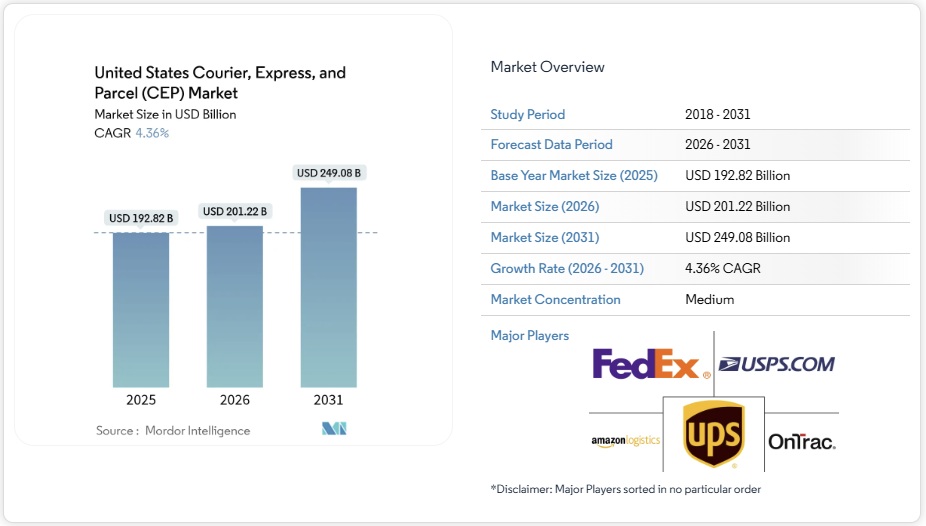
米国の宅配便、速達便、小包市場規模は、2026年には2,012.2億米ドルと推定され、2025年の1,928.2億米ドルから拡大し、2031年には2,490.8億米ドルに達すると予測されています。これは、2026年から2031年にかけて年平均成長率(CAGR)4.36%で成長する見込みです。近年の取扱量増加は、堅調なeコマース基盤、オムニチャネル在庫の正常化、そして2024年に裁量的支出を一時停止した企業向け郵便サービスの復活に起因しています。地域運送業者間の統合、米国郵政公社(USPS)による価格改定されたGround Advantage商品、そしてインテグレーターによる規律あるキャパシティ増強により、ピークシーズンにおける価格競争は緩和されています。API駆動型の可視化ツールからAI支援による仕分けに至るまで、技術のアップグレードは、特に高密度輸送ルートにおいて、ネットワーク速度の向上を続けています。同時に、労働組合の賃金交渉、道路渋滞、最小限の基準値の変更などの逆風により、運用コストは高止まりしており、運送業者はより環境に優しい航空機の導入や、価格とサービス保証をより一致させる契約の再交渉へと向かっています。
セグメント分析
- Eコマースは2025年の出荷量の42.10%を占め、マーケットプレイスのプロモーション、「今すぐ購入・後払い」サービスの普及、ソーシャルコマースとのクロスオーバーイベントに牽引され、引き続き小包需要の牽引役となっています。注文頻度の高さはフルフィルメントセンターの稼働率を高め、返品プログラムによって小包の数量が逆パイプラインへと拡大しています。ヘルスケア分野は、厳格な流通管理規制の対象となる温度管理医薬品、在宅診断キット、遠隔医療機器の増加により、2026年から2031年にかけて4.58%のCAGRで成長が見込まれます。
- 認証済み卸売業者(VDI)のステータスを持つ運送業者は、センサー付き梱包材を活用し、FDA監査のためのレーンレベルのコンプライアンス記録機能を活用することで、温度管理レーンでのシェアを獲得しています。製造業はジャストインタイム方式の部品補充を活用し、卸売・小売業は棚在庫予測分析を用いて補充頻度を最適化しています。これらの垂直分野を組み合わせることで、米国の宅配便、速達便、小包の市場シェアが強化され、業界特有の低迷に対する緩衝材となり、サービスの青写真が広がります。
- 2025年には、統一された規制、標準化された住所、そしてほぼすべての郵便番号をカバーする緊密なラストマイル網に支えられ、国内配送は米国の宅配便、エクスプレス便、小包市場の76.15%を占めることになります。安定した家計消費、堅調な中小企業の設立、そしてUSPSのユニバーサルサービス保証により、発送地と到着地は圧倒的に国内に集中しています。国際配送は規模こそ小さいものの、米国の販売業者がグローバルマーケットプレイスに出品し、カナダとメキシコの消費者が米国の幅広い品揃えを活用することで、2026年から2031年の間に年平均成長率4.64%で拡大すると予想されます。
- 国際的な成長は、簡素化された電子通関申告と海外の郵便局とのハンドオフ手順の改善に支えられていますが、差し迫った軽微な改正により、事務手続きと仲介手数料の増加が懸念されています。運送業者は、商品分類をリアルタイムで解析するセクション321準拠エンジンに投資することで、リスクヘッジを図っています。また、ネットワークプランナーは、ラレドとオタイメサの混雑を回避し、ピーク時のサービス提供を確保するため、米国とメキシコの国境を越えてトラックと航空のハイブリッドモデルを展開しています。国境を越えた輸送形態の変化により、世界の物流と連動した米国の宅配便、エクスプレス便、小包市場の規模は、今後10年間で絶対的にも相対的にも拡大することが確実です。
- 米国宅配便・速達・小包(CEP)市場レポートは、配送先(国内および国際)、配送速度(速達および非速達)、モデル(企業間(B2B)など)、貨物重量(重量貨物、軽量貨物など)、輸送モード(航空、陸上、その他)、エンドユーザー産業(Eコマースなど)別にセグメント化されています。
United States Courier, Express, And Parcel (CEP) Market Analysis
United States courier, express, and parcel market size in 2026 is estimated at USD 201.22 billion, growing from 2025 value of USD 192.82 billion with 2031 projections showing USD 249.08 billion, growing at 4.36% CAGR over 2026-2031. Recent volume gains stem from a resilient e-commerce base, normalization of omnichannel inventories, and the return of corporate mailers that paused discretionary spending in 2024. Consolidation among regional carriers, the U.S. Postal Service’s re-priced Ground Advantage product, and disciplined capacity additions by integrators have tempered competitive pricing during peak seasons. Technology upgrades—ranging from API-driven visibility tools to AI-assisted sortation—continue to improve network velocity, especially in high-density corridors. At the same time, headwinds such as union wage settlements, road congestion, and shifting de-minimis thresholds keep operating costs elevated, nudging carriers toward greener fleets and contract renegotiations that better align pricing with service guarantees.
United States Courier, Express, And Parcel (CEP) Market Trends and Insights
Explosive E-commerce Order Volumes Post-Pandemic
A sustained shift toward online buying keeps the order book elevated well beyond the 2024 holiday peak, when U.S. retailers logged 255% more Black Friday transactions than average October Fridays. High-volume corridors now stretch beyond coastal megapolises, with 52% of national e-commerce parcels originating in only nine states, enabling carriers to raise daily stop density and lower last-mile unit costs. Consumers increasingly expect full shipment visibility; as a result, retailers integrate carrier APIs that push proactive alerts, minimizing “where-is-my-package” inquiries and smoothing courier workloads. Elevated demand pressures sortation hubs, prompting integrators to deploy machine-vision scanners that reduce mis-sorts and support flexible labor models during volume surges. These structural gains sustain the 1.2-point uplift to the United States courier, express, and parcel market CAGR over the medium term.
Growth of Same-Day / On-Demand Delivery Ecosystems
Same-day fulfillment has moved from optional to essential, with 26% of merchants targeting 2-day delivery and 12% pursuing next-day as their standard promise. Autonomous sidewalk robots, delivery drones, and micro-fulfillment nodes now cluster within five miles of dense consumer pockets, cutting average transit to below two hours for enrolled merchants. Suburban adoption accelerates as cost-per-delivery drops and consumers display parity in urgency preferences compared with urban peers. In response, 45% of retailers plan to embed AI-driven shipping software that optimizes carrier mix and automates exception handling, while 51% budget predictive analytics for returns to shrink reverse-logistics overhead. Fragmented municipal regulations, however, necessitate costly jurisdiction-specific compliance, nudging multi-city carriers to pilot modular hardware that meets varying curb-space mandates. The ecosystem’s 0.8-point boost to CAGR is front-loaded into the next two years.
Escalating Union Wage and Benefit Costs for Drivers
The driver pool tightens as the shortage persists at 80,000 positions in 2025, and demographic shifts could more than double the gap by 2030. Large integrators confront turnover above 90%, forcing wage escalators and retention bonuses that ripple through regional peers. Collective-bargaining rounds reset industry baselines, compelling non-union fleets to match headline figures or risk capacity attrition during peak periods. Classification reforms threaten the owner-operator model that underpins smaller parcel contractors, potentially raising compliance outlays and narrowing net margins. Over the long term, escalating wages shave 0.7 points from the market CAGR as carriers pass along costs through general rate increases that may curb discretionary shipment growth.
Other drivers and restraints analyzed in the detailed report include:
- Retailers’ Shift to Omnichannel and Store-Based Fulfillment
- USPS Ground Advantage Relaunch Expanding Low-Cost Capacity
- Aging Road and Bridge Infrastructure Causing Delays
For complete list of drivers and restraints, kindly check the Table Of Contents.
Segment Analysis
E-commerce contributed 42.10% of 2025 shipments and remains the lodestar for parcel demand, driven by marketplace promotions, buy-now-pay-later penetration, and social-commerce crossover events. High order frequency keeps fulfillment centers pulsing, while returns programs extend parcel counts into the reverse pipeline. Healthcare rises at a 4.58% CAGR between 2026-2031, fueled by controlled-temperature pharmaceuticals, at-home diagnostic kits, and telehealth devices subject to strict chain-of-custody regulations.
Carriers with Verified-Accredited Wholesale Distributor status win share in temperature-controlled lanes, leveraging sensor-equipped packaging that records lane-level compliance for FDA audits. The manufacturing sector leans on just-in-time parts replenishment, while wholesale and retail trade entities optimize replenishment frequency using predictive shelf-stock analytics. Together, these verticals fortify the United States courier, express, and parcel market share, cushioning it against sector-specific downturns and broadening the service blueprint.
Domestic shipments own a 76.15% slice of the United States courier, express, and parcel market in 2025, buoyed by unified regulations, standardized addressing, and dense last-mile coverage that reaches virtually every ZIP code. Stable household consumption, robust small-business formation, and USPS universal-service guarantees keep origin-and-destination pairs overwhelmingly domestic. The international leg, while smaller, expands at a 4.64% CAGR between 2026-2031 as U.S. sellers list on global marketplaces and Canadian and Mexican consumers tap U.S. assortment breadth.
International growth leans on simplified electronic customs declarations and improved hand-off protocols with foreign posts, but looming de-minimis revisions threaten to add paperwork and brokerage fees. Carriers hedge by investing in section-321 compliance engines that parse product classifications in real time. Network planners also deploy hybrid truck-air models across the US-Mexico border to sidestep congestion at Laredo and Otay Mesa, protecting service commitments during peak periods. The evolving cross-border mix ensures that the United States courier, express, and parcel market size linked to global flows grows in both absolute and relative terms over the decade.
The United States Courier, Express, and Parcel (CEP) Market Report is Segmented by Destination (Domestic and International), Speed of Delivery (Express and Non-Express), Model (Business-To-Business (B2B) and More), Shipment Weight (Heavy Weight Shipment, Light Weight Shipment, and More), Mode of Transport (Air, Road, and Others), and End User Industry (E-Commerce and More). The Market Forecasts are Provided in Terms of Value (USD).
List of Companies Covered in this Report:
- Amazon
- Aramex
- DHL Group
- Dropoff Inc.
- FedEx
- International Distributions Services (including GLS)
- OnTrac
- Spee-Dee Delivery Service, Inc.
- United Parcel Service (UPS)
- USA Couriers
- USPS
- WeDo Logistics Limited (including Lone Star Overnight Inc.)
Additional Benefits:
- The market estimate (ME) sheet in Excel format
- 3 months of analyst support
Table of Contents
1 Introduction
1.1 Study Assumptions and Market Definition
1.2 Scope of the Study
2 Research Methodology
3 Executive Summary
4 Market Landscape
4.1 Market Overview
4.2 Demographics
4.3 GDP Distribution by Economic Activity
4.4 GDP Growth by Economic Activity
4.5 Inflation
4.6 Economic Performance and Profile
4.6.1 Trends in E-Commerce Industry
4.6.2 Trends in Manufacturing Industry
4.7 Transport and Storage Sector GDP
4.8 Export Trends
4.9 Import Trends
4.10 Fuel Price
4.11 Logistics Performance
4.12 Infrastructure
4.13 Regulatory Framework
4.14 Value Chain and Distribution Channel Analysis
4.15 Market Drivers
4.15.1 Explosive E-Commerce Order Volumes Post-Pandemic
4.15.2 Growth of Same-Day / On-demand Delivery Ecosystems
4.15.3 Retailers’ Shift To Omnichannel and Store-Based Fulfilment
4.15.4 USPS “Ground Advantage” Relaunch Expanding Low-Cost Capacity
4.15.5 Surge in C2C Recommerce Parcels from Second-Hand Platforms
4.15.6 Ev-Fleet Purchase Incentives Lowering Long-Term Last-Mile OPEX
4.16 Market Restraints
4.16.1 Escalating Union Wage and Benefit Costs for Drivers
4.16.2 Ageing Road and Bridge Infrastructure Causing Delays
4.16.3 Urban Curb-Space Regulations Limiting Van Access
4.16.4 Stricter De-Minimis Rules Raising Cross-Border Costs
4.17 Technology Innovations in the Market
4.18 Porter’s Five Forces Analysis
4.18.1 Threat of New Entrants
4.18.2 Bargaining Power of Buyers
4.18.3 Bargaining Power of Suppliers
4.18.4 Threat of Substitutes
4.18.5 Competitive Rivalry
5 Market Size and Growth Forecasts (Value, USD)
5.1 Destination
5.1.1 Domestic
5.1.2 International
5.2 Speed of Delivery
5.2.1 Express
5.2.2 Non-Express
5.3 Model
5.3.1 Business-to-Business (B2B)
5.3.2 Business-to-Consumer (B2C)
5.3.3 Consumer-to-Consumer (C2C)
5.4 Shipment Weight
5.4.1 Heavy Weight Shipments
5.4.2 Light Weight Shipments
5.4.3 Medium Weight Shipments
5.5 Mode of Transport
5.5.1 Air
5.5.2 Road
5.5.3 Others
5.6 End User Industry
5.6.1 E-Commerce
5.6.2 Financial Services (BFSI)
5.6.3 Healthcare
5.6.4 Manufacturing
5.6.5 Primary Industry
5.6.6 Wholesale and Retail Trade (Offline)
5.6.7 Others
6 Competitive Landscape
6.1 Market Concentration
6.2 Key Strategic Moves
6.3 Market Share Analysis
6.4 Company Profiles (Includes Global Level Overview, Market Level Overview, Core Segments, Financials as Available, Strategic Information, Market Rank/Share for Key Companies, Products and Services, and Recent Developments)
6.4.1 Amazon
6.4.2 Aramex
6.4.3 DHL Group
6.4.4 Dropoff Inc.
6.4.5 FedEx
6.4.6 International Distributions Services (including GLS)
6.4.7 OnTrac
6.4.8 Spee-Dee Delivery Service, Inc.
6.4.9 United Parcel Service (UPS)
6.4.10 USA Couriers
6.4.11 USPS
6.4.12 WeDo Logistics Limited (including Lone Star Overnight Inc.)
7 Market Opportunities and Future Outlook
7.1 White-Space and Unmet-Need Assessment