
Telematics - Market Share Analysis, Industry Trends & Statistics, Growth Forecasts (2026 - 2031)
テレマティクス市場レポートは、チャネル (OEM およびアフターマーケット)、ソリューション (組み込み、スマートフォンベース、ポータブル/プラグイン)、提供タイプ (ハードウェア、サービス - エントリーレベル、サービス - ミッドティアなど)、車両タイプ (乗用車、小型商用車など)、アプリケーション (フリート管理など)、および地域 (北米、ヨーロッパなど) 別にセグメント化されています。
The Telematics Market Report is Segmented by Channel (OEM, and Aftermarket), Solution (Embedded, Smartphone-Based, Portable/Plug-in), Offering Type (Hardware, Services - Entry-Level, Services - Mid-Tier, and More), Vehicle Type (Passenger Cars, Light Commercial Vehicles, and More), Application (Fleet Management, and More), and Geography (North America, Europe, and More).
| 出版 | Mordor Intelligence |
| 出版年月 | 2026年02月 |
| ページ数 | 171 |
| 価格 | 記載以外のライセンスについてはお問合せください |
| シングルユーザ | USD 4,750 |
| 種別 | 英文調査報告書 |
| 商品番号 | SMR-14526 |

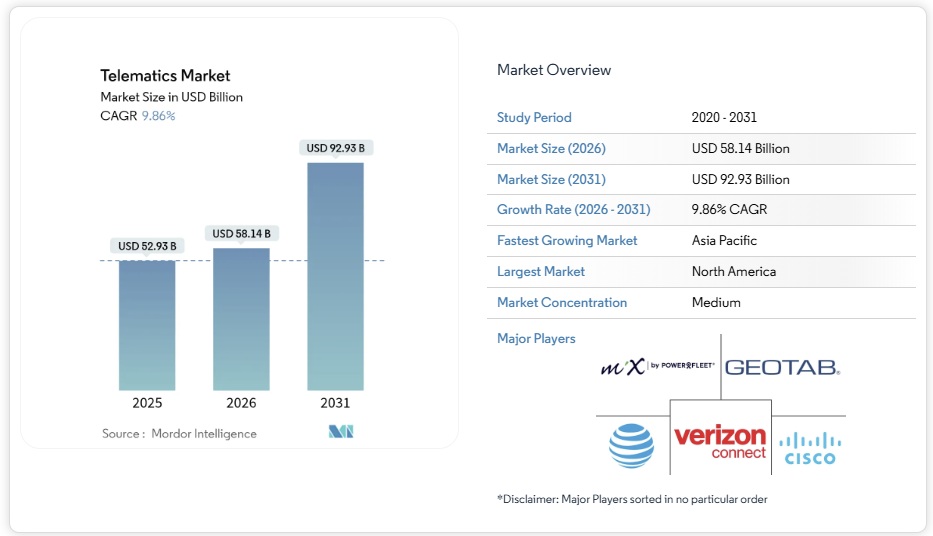
テレマティクス市場は2025年に529.3億米ドルと評価され、2026年の581.4億米ドルから2031年には929.3億米ドルに達し、予測期間(2026~2031年)中に9.86%のCAGRで成長すると予測されています。 法規制、特に欧州のeCallやインドのAIS 140は、自動車メーカーとフリートに工場レベルでの接続性の組み込みを迫っており、OEM需要を加速させています。 車両1台あたりの半導体容量は2030年までに倍増すると見込まれており、ハードウェアコストは上昇する一方で、高度な分析を支えるより豊富なデータストリームが可能になります。 リアルタイムの運転データを利用した使用ベースの保険プログラムは、北米と欧州で急速に拡大しており、コネクテッドカーのビジネスケースを強化しています。 5Gとエッジコンピューティングの急速な導入により、テレマティクスは単純な追跡から予測メンテナンスや車両とあらゆるものの通信へと変化しています。 UNECE WP.29 および ISO/SAE 21434 に基づくサイバーセキュリティのコンプライアンス コストの上昇により、小規模ベンダーは圧力を受けていますが、十分な資金力を持つプレーヤーは競争上の優位性を得ています。
セグメント分析
- アフターマーケットソリューションは、2025年にはテレマティクス市場の56.30%のシェアを占め、従来から後付けや混合フリート市場において重要な役割を果たしてきたことを反映しています。OEMシステムは2031年まで年平均成長率11.62%で急速に拡大しており、よりクリーンなデータストリームとシームレスな保証統合を実現する工場出荷時の接続性への転換を示唆しています。テレマティクス市場は、このデュアルチャネル構造の恩恵を受けています。なぜなら、旧型車両は依然として後付けデバイスを必要とする一方で、新車は工場出荷時に接続済みだからです。
- アフターマーケットのeCallに関する規制の標準化により、サードパーティプロバイダーの競争力は維持されますが、EUデータ法などのOEMデータ共有規則は、組み込みチャネルを優遇しています。自動車メーカーがコネクテッドカー向けサブスクリプションを商用化するにつれて、下流での価値獲得が拡大し、アフターマーケットのマージンプールは縮小しています。そのため、プロバイダーはテレマティクス市場における地位を維持するために、分析機能とフリート間の互換性を重視しています。
- 組み込みユニットは、2025年のテレマティクス市場規模の47.80%を占め、年平均成長率(CAGR)12.94%と最も高い成長率を示しています。この変化は、予知保全、EVのバッテリー管理、そして車両との緊密な統合を必要とする規制上のデータ共有義務によって推進されています。スマートフォンベースのソリューションは、コスト重視のフリートでは依然として有効ですが、パフォーマンスとデータ忠実度は組み込みアーキテクチャに劣っています。
- フリートオペレーターは、電気自動車フリートのエネルギー費用を55%削減するスマート充電アルゴリズムなど、ミッションクリティカルな分析機能に組み込みハードウェアを好んでいます。5Gモジュールが標準化されるにつれて、組み込みソリューションはV2Xや高精度測位などの高度なアプリケーションを席巻し、テレマティクス市場における戦略的重要性を強固なものにするでしょう。
- テレマティクス市場レポートは、チャネル(OEM、アフターマーケット)、ソリューション(組み込み、スマートフォンベース、ポータブル/プラグイン)、提供タイプ(ハードウェア、サービス – エントリーレベル、サービス – ミッドティアなど)、車両タイプ(乗用車、小型商用車など)、アプリケーション(フリートマネジメントなど)、地域(北米、欧州など)別にセグメント化されています。
Telematics Market Analysis
The telematics market was valued at USD 52.93 billion in 2025 and estimated to grow from USD 58.14 billion in 2026 to reach USD 92.93 billion by 2031, at a CAGR of 9.86% during the forecast period (2026-2031). Regulatory mandates, especially eCall in Europe and AIS 140 in India, are compelling automakers and fleets to embed connectivity at the factory level, which accelerates OEM demand. Semiconductor content per vehicle is set to double by 2030, raising hardware costs yet enabling richer data streams that underpin advanced analytics. Usage-based insurance programs, powered by real-time driving data, are expanding quickly across North America and Europe, reinforcing the business case for connected cars. Rapid adoption of 5G and edge computing is transforming telematics from simple tracking to predictive maintenance and vehicle-to-everything communication. Rising cybersecurity compliance costs under UNECE WP.29 and ISO/SAE 21434 are pressuring smaller vendors but giving well-capitalized players a competitive edge.
Global Telematics Market Trends and Insights
Expanding OEM-embedded connectivity mandates
Automakers are integrating telematics directly into vehicle electronics to meet new data-sharing rules such as the EU Data Act, which applies from 2025 and obliges manufacturers to open vehicle data to third-party service providers. Geotab’s collaboration with Volvo Cars lifts its OEM integrations to more than 157 brands, proving that embedded connectivity is scaling quickly. Analysts estimate connected services could yield USD 1,600 revenue per car, incentivizing automakers to treat data as a profit center. Specialized vendors like WirelessCar now offer compliance toolkits that help OEMs operationalize the Data Act, accelerating rollout timelines. As regulations tighten, factory-fitted units are becoming standard, shrinking the addressable aftermarket and reshaping the telematics market.
Usage-based insurance adoption surging post-2025
Insurance carriers are shifting from demographic to behaviour-based pricing, fuelled by real-time driving data. Intuit embedded Zendrive analytics into the Credit Karma app, sending 4 million policy offers to its 6 million members in 2025, which demonstrates mainstream scale. Kia and LexisNexis rolled out driver-score sharing in 27 EU countries, simplifying customer enrolment while preserving GDPR compliance. Safe drivers can secure premium cuts of up to 30%, boosting consumer demand and improving loss ratios for insurers. Cambridge Mobile Telematics added fuel consumption scoring, proving that insurers now value eco-efficient driving as well as safety. These advances reinforce data-centric underwriting and amplify the telematics market’s growth.
Escalating cybersecurity compliance cost
UNECE WP.29 obliges automakers to operate certified Cyber Security Management Systems across the vehicle lifecycle. Compliance demands continuous monitoring, incident reporting and secure update channels, which raises engineering costs and lengthens development cycles. ISO/SAE 21434 adds lifecycle risk-management steps, while the U.S. now blocks connected-vehicle components sourced from certain countries, forcing supply-chain audits. Vendors like HARMAN have built consulting practices to help OEMs navigate certification, showing that compliance is transforming from an engineering task to a line-item expense. Smaller suppliers may struggle to shoulder these costs, slowing new-entrant momentum within the telematics market.
Other drivers and restraints analyzed in the detailed report include:
- Government eCall and AIS 140 regulations
- 5G/edge-enabled over-the-air analytics
- High upfront TCU hardware price volatility
For complete list of drivers and restraints, kindly check the Table Of Contents.
Segment Analysis
Aftermarket solutions held 56.30% of the telematics market share in 2025, reflecting their historical role in retrofits and mixed fleets. OEM systems are scaling faster at an 11.62% CAGR to 2031, signalling a pivot toward factory-installed connectivity that delivers cleaner data streams and seamless warranty integration. The telematics market benefits from this dual-channel structure because older vehicles still need retrofit devices, while new cars roll off the line connected.
Regulatory standardization of aftermarket eCall ensures that third-party providers remain relevant, yet OEM data-sharing rules like the EU Data Act favour embedded channels. As automakers commercialize connected-car subscriptions, they capture more downstream value, narrowing the aftermarket’s margin pool. Providers are thus emphasizing analytics and cross-fleet compatibility to preserve their position in the telematics market.
Embedded units accounted for 47.80% of the telematics market size in 2025 and exhibit the highest growth at a 12.94% CAGR. The shift is propelled by predictive maintenance, battery management in EVs, and regulatory data-sharing obligations that all require deep vehicle integration. Smartphone-based offerings remain viable in cost-sensitive fleets, but performance and data fidelity lag behind embedded architectures.
Fleet operators prefer embedded hardware for mission-critical analytics such as smart charging algorithms that cut energy expenses by 55% in electric fleets. As 5G modules become standard, embedded solutions will dominate advanced applications like V2X and high-accuracy positioning, cementing their strategic weight in the telematics market.
The Telematics Market Report is Segmented by Channel (OEM, and Aftermarket), Solution (Embedded, Smartphone-Based, Portable/Plug-in), Offering Type (Hardware, Services – Entry-Level, Services – Mid-Tier, and More), Vehicle Type (Passenger Cars, Light Commercial Vehicles, and More), Application (Fleet Management, and More), and Geography (North America, Europe, and More). The Market Forecasts are Provided in Terms of Value (USD).
Geography Analysis
Europe led the telematics market with a 31.95% share in 2025, underpinned by mandatory eCall, GDPR protections, and an installed base of 27.6 million fleet management units projected by 2028. The EU Data Act, effective in 2025, compels data sharing and is expected to stimulate a new wave of third-party services while maintaining privacy safeguards. Suppliers are branding connectivity suites, such as Continental’s Aumovio, to meet tighter integration and compliance demands.
Asia-Pacific is the fastest-growing region, forecast at a 12.26% CAGR through 2031. India’s AIS 140 mandate and the government’s geospatial investment of INR 100 crore (USD 12 million) will broaden foundational mapping infrastructure. China’s new driver-assistance safety rules also raise the bar for OEM connectivity. Rapid urbanization and large commercial fleets create volume, pulling global vendors into local partnerships and expanding the telematics market size across the region.
North America maintains a mature but still growing base, helped by ELD mandates and sizeable government-fleet deployments such as the US General Services Administration’s 400,000-vehicle contract with Geotab. Fleet management units in the Americas are projected to reach 43 million by 2028. Supply-chain security rules limiting certain foreign components could elevate hardware costs yet may also spur domestic chip investments that stabilize long-term supply for the telematics market.
List of Companies Covered in this Report:
- Verizon Communications Inc. (Verizon Connect)
- Geotab Inc.
- Trimble Inc.
- TomTom N.V.
- MiX Telematics Ltd
- ATandT Inc.
- Cisco Systems Inc.
- LG Electronics Inc.
- Continental AG
- Robert Bosch GmbH
- ZF Friedrichshafen AG
- Harman International Industries Inc.
- Valeo SA
- Inseego Corp. (Ctrack)
- Microlise Group PLC
- Aplicom Oy
- Huawei Technologies Co. Ltd.
- Sierra Wireless Inc.
- Octo Telematics S.p.A.
- CalAmp Corp.
Additional Benefits:
- The market estimate (ME) sheet in Excel format
- 3 months of analyst support
Table of Contents
1 INTRODUCTION
1.1 Study Assumptions and Market Definition
1.2 Scope of the Study
2 RESEARCH METHODOLOGY
3 EXECUTIVE SUMMARY
4 MARKET LANDSCAPE
4.1 Market Overview
4.2 Market Drivers
4.2.1 Expanding OEM-embedded connectivity mandates
4.2.2 Usage-based insurance (UBI) adoption surging post-2025
4.2.3 Government eCall and AIS 140 regulations
4.2.4 5G/edge-enabled over-the-air (OTA) analytics
4.2.5 Fleet electrification demands real-time battery analytics
4.2.6 Rise of mobility-as-a-service (MaaS) platforms
4.3 Market Restraints
4.3.1 Escalating cybersecurity compliance cost
4.3.2 High upfront TCU* hardware price volatility
4.3.3 Multi-jurisdictional data-sovereignty hurdles
4.3.4 Inertia in legacy commercial fleets
4.4 Industry Value-Chain Analysis
4.5 Regulatory Landscape
4.6 Technological Outlook
4.7 Porter’s Five Forces Analysis
4.7.1 Threat of New Entrants
4.7.2 Bargaining Power of Buyers
4.7.3 Bargaining Power of Suppliers
4.7.4 Threat of Substitutes
4.7.5 Intensity of Competitive Rivalry
5 MARKET SIZE AND GROWTH FORECASTS (VALUE)
5.1 By Channel
5.1.1 Original-Equipment Manufacturer (OEM)
5.1.2 Aftermarket
5.2 By Solution
5.2.1 Embedded
5.2.2 Smartphone-based
5.2.3 Portable/Plug-in
5.3 By Offering Type
5.3.1 Hardware
5.3.2 Services – Entry-level
5.3.3 Services – Mid-tier
5.3.4 Services – High-end
5.4 By Vehicle Type
5.4.1 Passenger Cars
5.4.2 Light Commercial Vehicles (LCV)
5.4.3 Heavy Commercial Vehicles (HCV)
5.5 By Application
5.5.1 Fleet Management
5.5.2 Insurance Telematics
5.5.3 Predictive Maintenance and Diagnostics
5.5.4 Navigation and Infotainment
5.5.5 Car-sharing and Subscription Services
5.6 By Geography
5.6.1 North America
5.6.1.1 United States
5.6.1.2 Canada
5.6.1.3 Mexico
5.6.2 Europe
5.6.2.1 United Kingdom
5.6.2.2 Germany
5.6.2.3 France
5.6.2.4 Italy
5.6.2.5 Rest of Europe
5.6.3 Asia-Pacific
5.6.3.1 China
5.6.3.2 Japan
5.6.3.3 India
5.6.3.4 South Korea
5.6.3.5 Rest of Asia
5.6.4 Middle East
5.6.4.1 Israel
5.6.4.2 Saudi Arabia
5.6.4.3 United Arab Emirates
5.6.4.4 Turkey
5.6.4.5 Rest of Middle East
5.6.5 Africa
5.6.5.1 South Africa
5.6.5.2 Egypt
5.6.5.3 Rest of Africa
5.6.6 South America
5.6.6.1 Brazil
5.6.6.2 Argentina
5.6.6.3 Rest of South America
6 COMPETITIVE LANDSCAPE
6.1 Market Concentration
6.2 Strategic Moves
6.3 Market Share Analysis
6.4 Company Profiles (includes Global level Overview, Market level overview, Core Segments, Financials as available, Strategic Information, Market Rank/Share for key companies, Products and Services, and Recent Developments)
6.4.1 Verizon Communications Inc. (Verizon Connect)
6.4.2 Geotab Inc.
6.4.3 Trimble Inc.
6.4.4 TomTom N.V.
6.4.5 MiX Telematics Ltd
6.4.6 ATandT Inc.
6.4.7 Cisco Systems Inc.
6.4.8 LG Electronics Inc.
6.4.9 Continental AG
6.4.10 Robert Bosch GmbH
6.4.11 ZF Friedrichshafen AG
6.4.12 Harman International Industries Inc.
6.4.13 Valeo SA
6.4.14 Inseego Corp. (Ctrack)
6.4.15 Microlise Group PLC
6.4.16 Aplicom Oy
6.4.17 Huawei Technologies Co. Ltd.
6.4.18 Sierra Wireless Inc.
6.4.19 Octo Telematics S.p.A.
6.4.20 CalAmp Corp.
7 MARKET OPPORTUNITIES AND FUTURE OUTLOOK
7.1 White-space and Unmet-need Assessment