
South Korea Home Appliances - Market Share Analysis, Industry Trends & Statistics, Growth Forecasts (2026 - 2031)
韓国の家電製品市場は、主要家電製品(冷蔵庫、冷凍庫など)、小型家電製品(掃除機、グリル、ロースターなど)、流通チャネル(マルチブランドストア、ブランド限定アウトレット、オンラインなど)、および地域(忠清道、江原道、京畿道、慶尚道、全羅道、済州道)別に区分されています。
South Korea Home Appliances Market is Segmented by Major Appliances (Refrigerators, Freezers, and More), Small Appliances (Vacuum Cleaners, Grills and Roasters, and More), and Distribution Channel (Multi-Brand Stores, Exclusive Brand Outlets, Online, and More, and by Geography (Chungcheong, Gangwon, Gyeonggi, Gyeongsang, Jeolla, and Jeju).
| 出版 | Mordor Intelligence |
| 出版年月 | 2026年02月 |
| ページ数 | 120 |
| 価格 | 記載以外のライセンスについてはお問合せください |
| シングルユーザ | USD 4,750 |
| 種別 | 英文調査報告書 |
| 商品番号 | SMR-14678 |

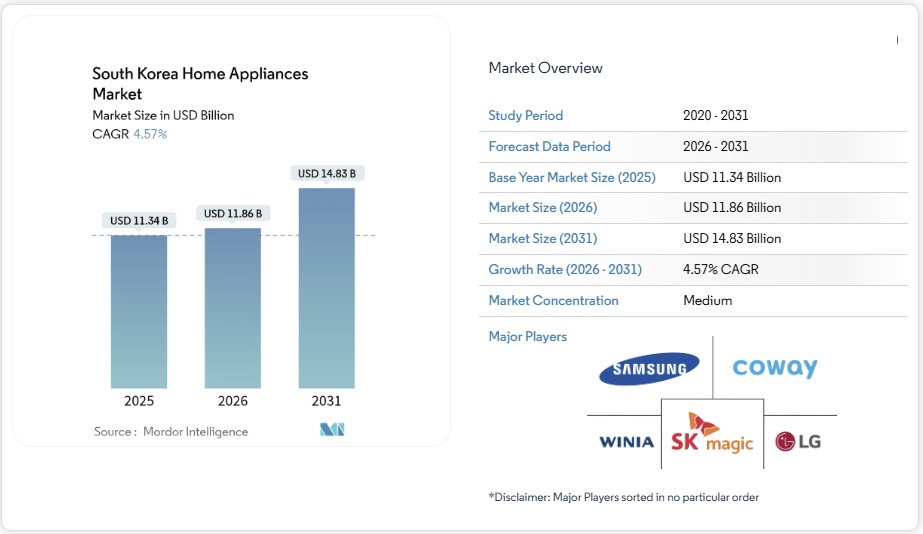
韓国の家電製品市場規模は2026年には118億6,000万米ドルに達すると推定され、2025年の113億4,000万米ドルから増加しています。2031年には148億3,000万米ドルに達すると予測されており、2026年から2031年にかけて年平均成長率(CAGR)4.57%で成長します。この拡大は、安定したマクロ経済見通し、単身世帯の急増、およびグレード1省エネ製品に対する積極的な公的インセンティブを反映しています。都市部の消費者は家電製品の選択をライフスタイルの利便性と結び付ける傾向が強まっていますが、農村部の購入者は光熱費を抑える耐久性のある省電力モデルを重視しています。冷蔵庫、洗濯機、空気処理装置へのAI統合によりプレミアム価格が固定される一方で、サブスクリプションプランや下取り制度により交換サイクルが短縮されています。サムスンとLGが、ロボット掃除機のロボロックや洗濯機のハイアールといった低価格帯の競合相手からエコシステムのリーダーシップを守るため、競争圧力は依然として強いままです。モバイル決済と即日配送に支えられたオンライン小売は、価格の透明性、幅広いSKUの入手可能性、顧客レビューを通じて、韓国の家電製品市場全体を再編しつつあります。
セグメント分析
- 冷蔵庫は2025年の売上高の29.62%を占め、韓国の家電製品市場における主力製品としての地位を確固たるものにしました。サムスンとLGは、デュアルモジュール冷却システム、カスタムドアパネル、AI搭載の鮮度アラートといった技術を導入することで、平均販売価格を引き上げ、シェアを維持しようとしています。食文化に根ざした電気炊飯器は、メーカー各社がIH加熱、穀物種別認識、音声アシスタント機能を導入したことで、2031年まで5.39%という最も高いCAGR(年平均成長率)を記録します。炊飯器の中でも高級なサブセグメントは、現在、カテゴリー売上の大きなシェアを占めており、高度な機能に対する強い購入意欲を示しています。食器洗い機やハイブリッド電子レンジなどの中型家電は、コンパクトなキッチンレイアウトに対応し、ロボット掃除機は空気清浄ドックとのバンドル販売を通じてクロスオーバー成長を遂げています。継続的なイノベーションが、このカテゴリーの勢いを支えています。
- 冷蔵庫には内蔵カメラが搭載されており、賞味期限切れを知らせるアラート機能や、季節に合わせて冷凍庫と冷蔵室を切り替えるコンバーチブルコンパートメントなどを備えています。炊飯器にはレシピ読み込み用のNFCタグが組み込まれており、利便性を重視する若い世代のユーザーを惹きつけています。健康志向の消費者は、ソーシャルメディアを起点とした料理トレンドの恩恵を受けている乾燥機、スロージューサー、エアフライヤーへの需要を牽引しています。その結果、韓国の家電市場における小型スマート家電の規模は、大型家電の買い替えとともに着実に拡大すると予測されています。
- 韓国の家電製品市場は、大型家電(冷蔵庫、冷凍庫など)、小型家電(掃除機、グリル・ロースターなど)、流通チャネル(マルチブランドストア、ブランド直営店、オンラインストアなど)、地域(忠清道、江原道、京畿道、慶尚道、全羅道、済州道)によって区分されています。
South Korea Home Appliances Market Analysis
South Korea home appliances market size in 2026 is estimated at USD 11.86 billion, growing from 2025 value of USD 11.34 billion with 2031 projections showing USD 14.83 billion, growing at 4.57% CAGR over 2026-2031. The expansion reflects a stable macroeconomic outlook, the rapid rise of one-person households, and aggressive public incentives for Grade-1 energy-efficient products. Urban consumers increasingly link appliance choice to lifestyle convenience, while rural buyers focus on durable, power-saving models that lower utility bills. AI integration into refrigerators, washers, and air treatment devices anchors premium pricing, whereas subscription plans and trade-in schemes shorten replacement cycles. Competitive pressure remains intense as Samsung and LG defend ecosystem leadership against low-cost challengers, especially Roborock in robot vacuums and Haier in washing machines. Online retail, bolstered by mobile payments and same-day logistics, is reshaping the entire South Korean home appliances market through price transparency, wide SKU availability, and customer reviews.
South Korea Home Appliances Market Trends and Insights
Rising Disposable Income and Urban Lifestyle Shifts
Stable wage growth and low unemployment keep discretionary spending resilient, allowing many families to upgrade to premium refrigerators, washers, and air conditioners. The Bank of Korea links 88% of monthly consumption changes to sentiment, signalling that appliance purchases hold steady even when GDP slows . Compact apartments dominate new housing, and 53.1% of households now live in apartments, encouraging demand for built-in, space-saving appliances. Samsung’s Bespoke AI Combo washer-dryer sold 3,000 units in 12 days, underlining the appetite for multi-function units that reduce footprint. Higher electricity tariffs also make energy ratings a central buying criterion, supporting the South Korean home appliances market’s migration toward Grade-1 models.
Expansion of E-Commerce & Quick-Commerce Logistics
Mobile transactions accounted for 71.2% of all online purchases in 2021, and home appliances represented 12.4% of those orders. Same-day delivery options now cover bulky goods thanks to upgraded fulfilment centres in the Seoul–Incheon logistics belt. Government support under the National Logistics Basic Plan (2021–2030) subsidises warehouse automation, letting retailers promise timed installations even for premium devices . The convenience of doorstep returns and digital financing accelerates repeat purchases and widens the South Korean home appliances market to rural districts that lack big-box outlets.
Category Saturation in Refrigerators & Washers
Penetration rates exceed 95% for both refrigerators and washing machines, leaving growth reliant on replacement demand. Longer product durability has extended turnover cycles to 12–15 years, depressing annual unit demand. Chinese brands such as Haier win a significant share of washing machine sales by offering competitive prices and solid reliability. Domestic players respond with AI-driven premium tiers, but these attract existing owners rather than first-time buyers, limiting overall volume expansion in the South Korea home appliances market.
Other drivers and restraints analyzed in the detailed report include:
- Mandatory Grade-1 Energy-Efficiency Incentives
- Growth of Single-Person Households Demands Compact Appliances
- Rising Raw Material and Production Costs
For complete list of drivers and restraints, kindly check the Table Of Contents.
Segment Analysis
Refrigerators held 29.62% of 2025 revenue, confirming their role as the anchor product in the South Korean home appliances market. Samsung and LG have turned to dual-module cooling systems, custom door panels, and AI-powered freshness alerts to lift average selling prices and defend share. Electric rice cookers, rooted in dietary culture, post the fastest 5.39% CAGR through 2031 as makers introduce induction heating, grain-type recognition, and voice-assistant control. The premium sub-segment of cookers now accounts for a significant share of category sales, illustrating robust willingness to pay for advanced features. Mid-size appliances such as dishwashers and microwave-oven hybrids ride on compact kitchen layouts, while robot vacuums enjoy crossover growth through bundling with air-purification docks. Continued innovation sustains category momentum.
Refrigerators equipped with internal cameras send expiration alerts, and convertible compartments shift between freezer and fridge modes based on season. Rice cookers integrate NFC tags for recipe loading, appealing to younger users who value convenience. Health-centric buyers steer demand toward dehydrators, slow juicers, and air fryers, each benefiting from social media-driven cooking trends. As a result, the South Korean home appliances market size for small smart appliances is projected to climb steadily alongside major-appliance replacements.
South Korea Home Appliances Market is Segmented by Major Appliances (Refrigerators, Freezers, and More), Small Appliances (Vacuum Cleaners, Grills and Roasters, and More), and Distribution Channel (Multi-Brand Stores, Exclusive Brand Outlets, Online, and More, and by Geography (Chungcheong, Gangwon, Gyeonggi, Gyeongsang, Jeolla, and Jeju). The Market Forecasts are Provided in Terms of Value (USD).
List of Companies Covered in this Report:
- Samsung Electronics
- LG Electronics
- Winia Electronics (Daewoo)
- Coway Co., Ltd.
- SK Magic
- Cuckoo Electronics
- Whirlpool Corp.
- Electrolux AB
- Panasonic Corp.
- BSH Hausgeräte GmbH
- Arçelik AŞ (Beko)
- Dyson Ltd.
- iRobot Corp.
- Xiaomi Corp. (Mijia)
- Midea Group
- Haier Smart Home
- Gorenje Group
- Mitsubishi Electric Corp.
- SHARP Corp.
- Hitachi Global Life Solutions
Additional Benefits:
- The market estimate (ME) sheet in Excel format
- 3 months of analyst support
Table of Contents
1 Introduction
1.1 Study Assumptions & Market Definition
1.2 Scope of the Study
2 Research Methodology
3 Executive Summary
4 Market Landscape
4.1 Market Overview
4.2 Market Drivers
4.2.1 Rising Disposable Income and Urban Lifestyle Shifts
4.2.2 Expansion Of E-Commerce & Quick-Commerce Logistics
4.2.3 Mandatory Grade-1 Energy-Efficiency Incentives
4.2.4 Growth Of Single-Person Households Demanding Compact Appliances
4.2.5 Blockchain E-Receipt Scheme Accelerating Replacement & Trade-In Cycles
4.2.6 Smart-City Pilots Mandating IoT-Ready Appliances
4.3 Market Restraints
4.3.1 Category Saturation In Refrigerators & Washers
4.3.2 Slowing New-Build Housing Completions
4.3.3 Rising Raw Material and Production Costs
4.3.4 Low Price Competition
4.4 Industry Value Chain Analysis
4.5 Porter’s Five Forces Analysis
4.5.1 Threat of New Entrants
4.5.2 Bargaining Power of Suppliers
4.5.3 Bargaining Power of Buyers
4.5.4 Threat of Substitutes
4.5.5 Competitive Rivalry
4.6 Insights into the Latest Trends and Innovations in the Market
4.7 Insights on Recent Developments (New Product Launches, Strategic Initiatives, Investments, Partnerships, JVs, Expansion, M&As, etc.) in the Market
5 Market Size & Growth Forecasts (Value)
5.1 By Product
5.1.1 Major Home Appliances
5.1.1.1 Refrigerators
5.1.1.2 Freezers
5.1.1.3 Washing Machines
5.1.1.4 Dishwashers
5.1.1.5 Ovens (Incl. Combi & Microwave)
5.1.1.6 Air Conditioners
5.1.1.7 Other Major Home Appliances
5.1.2 Small Home Appliances
5.1.2.1 Coffee Makers
5.1.2.2 Food Processors
5.1.2.3 Grills & Roasters
5.1.2.4 Electric Kettles
5.1.2.5 Juicers & Blenders
5.1.2.6 Air Fryers
5.1.2.7 Vacuum Cleaners
5.1.2.8 Electric Rice Cookers
5.1.2.9 Other Small Home Appliances
5.2 By Distribution Channel
5.2.1 Multi-Brand Stores
5.2.2 Exclusive Brand Outlets
5.2.3 Online
5.2.4 Other Distribution Channels
5.3 By Geography
5.3.1 Chungcheong
5.3.2 Gangwon
5.3.3 Gyeonggi
5.3.4 Gyeongsang
5.3.5 Jeolla
5.3.6 Jeju
6 Competitive Landscape
6.1 Market Concentration
6.2 Strategic Moves
6.3 Market Share Analysis
6.4 Company Profiles (includes Global level Overview, Market level overview, Core Segments, Financials as available, Strategic Information, Market Rank/Share for key companies, Products & Services, and Recent Developments)
6.4.1 Samsung Electronics
6.4.2 LG Electronics
6.4.3 Winia Electronics (Daewoo)
6.4.4 Coway Co., Ltd.
6.4.5 SK Magic
6.4.6 Cuckoo Electronics
6.4.7 Whirlpool Corp.
6.4.8 Electrolux AB
6.4.9 Panasonic Corp.
6.4.10 BSH Hausgeräte GmbH
6.4.11 Arçelik AŞ (Beko)
6.4.12 Dyson Ltd.
6.4.13 iRobot Corp.
6.4.14 Xiaomi Corp. (Mijia)
6.4.15 Midea Group
6.4.16 Haier Smart Home
6.4.17 Gorenje Group
6.4.18 Mitsubishi Electric Corp.
6.4.19 SHARP Corp.
6.4.20 Hitachi Global Life Solutions
7 Market Opportunities & Future Outlook
7.1 Premium and Health-Focused Appliance Growth