
Smart Glass - Market Share Analysis, Industry Trends & Statistics, Growth Forecasts (2025 - 2030)
Smart Glass Market Report is Segmented by Technology Type (Electrochromic, Thermochromic, Photochromic, and More), End User (Automotive, Avionics, Marine, Retail, and More), Control Mode (Wired Switch / Wall Panel, Remote / RF Controller, Dimming Panel / Slider, and More), Application (Facades and Curtain Walls, Interior Partitions and Privacy Panels, and More), and Geography.
スマート ガラス市場レポートは、テクノロジーの種類 (エレクトロクロミック、サーモクロミック、フォトクロミックなど)、エンド ユーザー (自動車、航空電子工学、船舶、小売など)、制御モード (有線スイッチ/壁パネル、リモート/RF コントローラー、調光パネル/スライダーなど)、アプリケーション (ファサードとカーテン ウォール、内部の仕切りとプライバシー パネルなど)、および地域別にセグメント化されています。
| 出版 | Mordor Intelligence |
| 出版年月 | 2025年07月 |
| ページ数 | 120 |
| 価格 | 記載以外のライセンスについてはお問合せください |
| シングルユーザ | USD 4,750 |
| 種別 | 英文調査報告書 |
| 商品番号 | SMR-1233912339 |

スマートガラス市場は2025年に111億6,000万米ドルに達し、2030年には184億7,000万米ドルに達すると予測されており、年平均成長率(CAGR)10.60%で拡大します。この成長は、エネルギー性能に関する義務的規制、エレクトロクロミック技術の効率向上、そして技術投資回収サイクルを短縮する高級車への普及によって推進されています。商業施設のオーナーはHVACコスト管理を優先し、自動車メーカーは高利益率のトリムにダイナミックサンルーフを同梱し、材料科学者は生産コストを削減する電極レスデバイスの開発に注力しています。同時に、先進製造業や5G対応ファサードに対する政府の優遇措置も、スマートガラス市場の機会を拡大させています。
Smart Glass Market Analysis
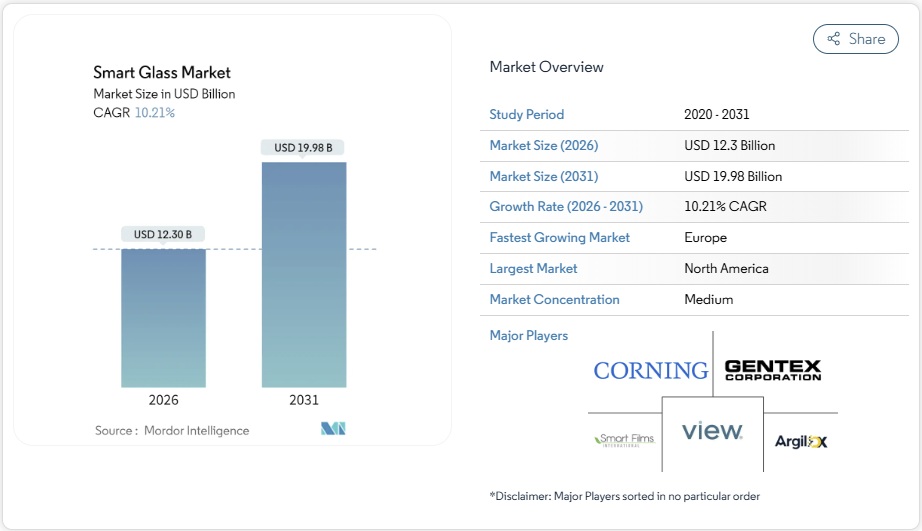
The smart glass market stands at USD 11.16 billion in 2025 and is forecast to post USD 18.47 billion by 2030, expanding at a 10.60% CAGR. This trajectory is propelled by mandatory energy-performance codes, electrochromic efficiency gains, and premium automotive adoption that shortens technology payback cycles. Commercial landlords are prioritizing HVAC cost control, automotive OEMs are bundling dynamic sunroofs into high-margin trims, and materials scientists are converging on electrode-free devices that lower production costs. Simultaneously, government incentives for advanced manufacturing and 5G-ready façades are enlarging the smart glass market opportunity set.
Global Smart Glass Market Trends and Insights
Stringent Green-Building Codes and Retrofit Mandates
Mandatory envelope performance thresholds such as California’s 2025 Building Energy Efficiency Standards are creating non-discretionary demand for electrochromic façades that outperform conventional glazing on U-factor and Solar Heat Gain Coefficient criteria. The 2024 International Energy Conservation Code revision delivers 9.8% incremental savings versus the prior cycle, eliminating trade-off loopholes and elevating glass performance baselines. Similar measures in Europe, including the Netherlands’ hybrid-furnace initiative, reinforce a compliance-driven procurement cycle that lifts retrofit activity. As owners witness lower peak cooling loads, green-finance eligibility, and enhanced asset values, the smart glass market gains a durable regulatory tailwind.
Rapid Adoption in Premium Automotive Glazing and Sunroofs
Automakers are deploying dynamic light-control roofs to differentiate cabins and trim HVAC loads. Renault’s Solarbay PDLC sunroof supplies segmental opacification while using nearly 50% recycled content. AGC’s SPD-based Wonderlite roof on the Mercedes S-Class Coupé cuts air-conditioning demand and lowers tailpipe CO₂. Hyundai’s Nano Cooling Film shows mainstream migration by shaving interior temperatures by 12.33 °C in pilot fleets. Automotive design cycles of 3-5 years accelerate cost degression that cascades into the building sector, expanding the smart glass market addressable base.
High Upfront Cost vs. Conventional Glazing
Electrochromic windows still price at USD 180–250 m² against USD 20–30 m² for standard units. Analysts peg USD 215 m² (USD 20 ft²) as the crossover point for mass substitution, prompting an innovation race. Electrode-free electrochromic prototypes have sliced costs toward USD 80 m² by stripping indium-tin-oxide layers. Plasma-enhanced chemical vapor deposition promises costs near USD 5.26 m² at 1.4 million m² annual scale. Installation complexity is receding as contractor familiarity grows, but price resistance remains the foremost limiting factor in cost-sensitive slices of the smart glass market.
Other drivers and restraints analyzed in the detailed report include:
- Energy-Cost Savings for Commercial Real-Estate Operators
- IoT-Ready Glass-as-a-Sensor Platforms for Smart Buildings
- Reliability Issues in Extreme Climates
For complete list of drivers and restraints, kindly check the Table Of Contents.
Segment Analysis
Electrochromic solutions dominated 2024 with 43.00% smart glass market share. Their low‐power operation, gradual tinting, and proven 50,000 cycle life make them the default choice for large façades and corporate campuses. The smart glass market size for electrochromic products is projected to expand from USD 4.80 billion in 2025 to USD 7.70 billion by 2030 at a 9.8% CAGR. Cost-out roadmaps ranging from in-line sputtering to all-solid-state chemistries keep capex budgets predictable. Meanwhile, hybrid photovoltaic glass is scaling at an 18.50% CAGR, leveraging transparent organic photovoltaics that already hit 12.3% cell efficiency in Denmark’s CitySolar project. NEXT Energy Technologies estimates these panels could offset 25% of typical office demand while retaining architectural clarity, positioning hybrids as the disruptor that challenges electrochromic incumbency.
Suspended Particle Device products maintain a niche where sub-second switching is critical—cockpits, rail cabins, and luxury sedans. Polymer-Dispersed Liquid Crystal windows are penetrating healthcare suites and conference rooms as low-voltage privacy partitions. Thermochromic and photochromic variants stay limited to passive climates, yet their wiring-free installation appeals to retrofit budgets. The technology stack is therefore bifurcating: electrochromic for energy mandates and hybrid PV for net-zero façades, with SPD and PDLC covering speed and privacy use cases.
Commercial real-estate applications captured 38.20% of 2024 revenue through broad office and retail uptake. The segment relied on energy savings, daylight optimization, and ESG credentialing to justify premium costs. Smart glass market size for commercial real estate is forecast to grow at 9.6% CAGR, moving from USD 4.27 billion in 2025 to USD 6.75 billion in 2030. Healthcare, however, secures the steepest 17.50% CAGR as infection-control protocols privilege touch-free privacy. Intensive-care wards deploy instant-opaque PDLC panels to reduce curtain laundering, while psychiatric units harness break-resistant dynamic glass to balance patient oversight with dignity.
Automotive glazing remains the third revenue pillar, particularly within luxury and electric vehicles, where dynamic skylights offset battery-draining HVAC. Residential uptake is slower, but tax incentives and lower module prices are shifting the ROI narrative for high-performance homes. Aerospace, rail, and marine progress steadily, albeit off smaller bases, and consumer electronics experiment with miniaturized electrochromic screens and AR headsets.
Smart Glass Market Report is Segmented by Technology Type (Electrochromic, Thermochromic, Photochromic, and More), End User (Automotive, Avionics, Marine, Retail, and More), Control Mode (Wired Switch / Wall Panel, Remote / RF Controller, Dimming Panel / Slider, and More), Application (Facades and Curtain Walls, Interior Partitions and Privacy Panels, and More), and Geography.
Geography Analysis
North America anchored 34.70% of 2024 revenue as California’s building code raised glazing baselines and the federal CHIPS Act funnelled incentives to high-purity glass fabs. Corning’s USD 315 million fused-silica expansion in New York exemplifies local supply-chain maturation that lowers lead times and underwrites five-year service warranties. The regional smart glass market is also buoyed by OEM demand for panoramic roofs and public-private retrofit programmes targeting federal properties.
Asia Pacific charts the fastest 14.60% CAGR through 2030, propelled by China’s BOE USD 8.8 billion OLED campus, Japan’s 5G façade pilots, and South Korea’s EV-glass upgrades. Chinese producers such as Fuyao are adding CNY 5.8 billion of auto-grade capacity, amplifying economies of scale that compress selling prices. While tungsten-oxide precursor restrictions pose supply risk, regional governments are accelerating localised mining and recycling to fortify strategic autonomy.
Europe advances at a stable pace underpinned by stricter EPC ratings and renovation-wave subsidies. Saint-Gobain’s low-carbon ORAÉ glass and AGC Interpane’s multi-site expansion validate a regional focus on recycled content and net-zero manufacturing. However, elevated electricity prices and overlapping permitting frameworks dampen return profiles in mass-market housing, steering demand toward commercial towers and premium retrofits. Together, these dynamics sustain a geographically diversified smart glass market footprint.
List of Companies Covered in this Report:
- AGC Inc.
- Compagnie de Saint-Gobain S.A. (SageGlass)
- Guardian Glass LLC
- View Inc.
- Halio International SA
- Gentex Corporation
- Corning Incorporated
- Nippon Sheet Glass Co. Ltd. (NSG)
- Polytronix Inc.
- Research Frontiers Inc.
- Pleotint LLC
- EControl-Glas GmbH
- BOE Technology Group Co.
- Hitachi Chemical Co.
- Merck KGaA (liquid-crystal materials)
- Smart Films International
- uniteGlass (CNBM)
- Pro Display / Intelligent Glass
- Magic Film Factory
- Argil Inc.
Additional Benefits:
- The market estimate (ME) sheet in Excel format
- 3 months of analyst support