
| 出版社 | Mordor Intelligence |
| 出版年月 | 2025年7月 |
Holographic Display – Market Share Analysis, Industry Trends & Statistics, Growth Forecasts (2025 – 2030)

ホログラフィックディスプレイ市場レポートは、コンポーネント (ハードウェア、ソフトウェア、サービス)、テクノロジー (電子ホログラフィック、タッチ可能/空中触覚など)、製品タイプ (デジタル サイネージおよびキオスク、スマート TV およびモニターなど)、エンドユーザー (民生用電子機器、小売および展示会など)、および地域別にセグメント化されています。
ホログラフィックディスプレイ市場規模は、2025年に43億6,000万米ドルに達すると推定されており、18.11%のCAGRに支えられ、2030年までに100億2,000万米ドルに達する見込みです。堅調な需要は、自動車の高級ブランドによる拡張現実(AR)ヘッドアップディスプレイの展開、米国のティア1病院による立体手術室の設置、高級小売店による360度サイネージの採用に起因しています。これらのユースケースは、マイクロLED導波路の歩留まり向上とAI駆動型コンテンツエンジンによる制作コストの削減に伴い、研究パイロットから量産展開への決定的な移行を示しています。ドイツと中国の自動車メーカーがフロントガラスの導入の大部分を占める一方、米国の医療機関は手術室の計画サイクルを短縮する3Dイメージングの購入を加速しています。アジアは引き続き生産規模とコンテンツの革新をリードしていますが、中東の小売セクターは地域で最も速い拡大を遂げています。光学、コンピューティング、コンテンツ作成の融合により、企業が没入型エクスペリエンスを収益化し、永続的な競争上の優位性を生み出すことができるエコシステムが支えられます。
Holographic Display Market Analysis
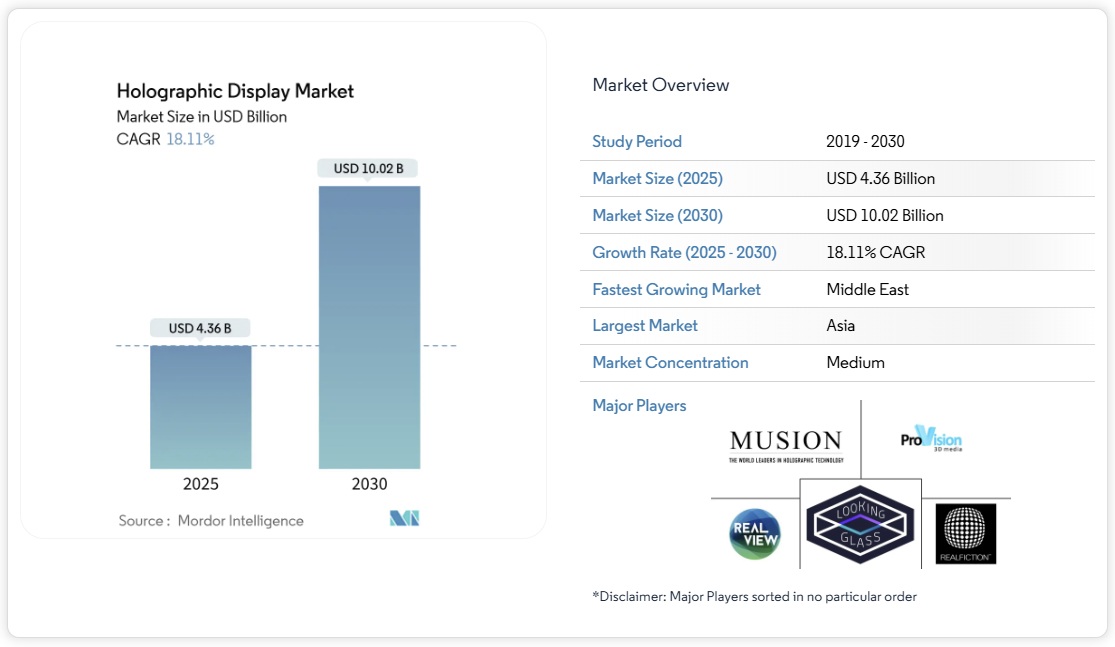
The holographic display market size is estimated posted a current value of USD 4.36 billion in 2025, and it is on track to reach USD 10.02 billion by 2030, supported by an 18.11% CAGR. Robust demand stems from automotive premium brands rolling out augmented-reality head-up displays, tier-1 U.S. hospitals installing volumetric surgical suites, and luxury retailers adopting 360-degree signage. These use-cases signal a decisive move from research pilots to production roll-outs as micro-LED waveguide yields improve and AI-driven content engines cut creation costs. German and Chinese automakers account for the bulk of windshield deployments, while U.S. health providers accelerate 3D imaging purchases that shorten operating-room planning cycles. Asia continues to lead production scale and content innovation, whereas the Middle East’s retail sector delivers the fastest regional expansion. The convergence of optics, computing, and content creation underpins an ecosystem where enterprises can monetize immersive experiences and create durable competitive advantage.
Holographic Display – Market Share Analysis, Industry Trends & Statistics, Growth Forecasts (2025 – 2030)
List of Companies Covered in this Report:
- HYPERVSN (Kino-mo)
- Looking Glass Factory Inc.
- RealFiction Holding AB
- Holoxica Ltd
- RealView Imaging Ltd
- Samsung Electronics Co. Ltd.
- Sony Corporation
- Konica Minolta Inc.
- Qualcomm Technologies Inc.
- Leia Inc.
- Voxon Photonics
- IKIN Inc.
- Zebra Imaging Inc.
- Burton Inc.
- Light Field Lab, Inc.
- SeeReal Technologies GmbH
- Creal SA
- Jade Bird Display Inc.
- Holitech Technology Co., Ltd.
- Shenzhen SMX Display Technology Co., Ltd.
- MDH Hologram Ltd
- Provision Holding Inc
Geography Analysis
Asia Pacific generated 36.9% of 2024 revenue, leveraging China’s electric-vehicle boom, Japan’s entertainment tech, and South Korea’s semiconductor ecosystem. Public-private programs funnel incentives into micro-LED backplanes and metasurface optics, fortifying regional supply dominance. The holographic display market size attributed to Asia Pacific also benefits from dense retail deployments in Tokyo, Seoul, and Shanghai. Europe follows with automotive design wins but faces brightness restrictions that temper growth, although collaborations such as Zeiss-Hyundai sustain innovation pipelines.
North America exhibits steady momentum anchored by U.S. tier-1 hospitals that upgrade surgical visualization suites and defense agencies procuring volumetric mission-planning tables. Canada’s live-event promoters experiment with hologram festivals, extending market reach. The Middle East posts the highest 21.5% CAGR through 2030 as luxury malls in Dubai, Riyadh, and Doha invest heavily in 360-degree holographic showcases that elevate brand storytelling. Government smart-city initiatives in Abu Dhabi and Neom foster further experimentation.
Latin America and Africa remain early-stage, constrained by import duties and bandwidth limitations, yet pilot projects in São Paulo retail and South African mining visualization hint at downstream expansion. Global supply chains nonetheless route critical waveguide fabrication through Japan and South Korea, exposing all regions to potential bottlenecks, a factor that stakeholders across the holographic display market monitor closely for risk mitigation.