
Cross-Domain Solution - Market Share Analysis, Industry Trends & Statistics, Growth Forecasts (2026 - 2031)
クロスドメインソリューション市場レポートは、コンポーネント(ハードウェア、ソフトウェア、サービス)、ソリューションタイプ(アクセスソリューション、転送ソリューション、マルチレベルソリューション)、展開形態(クラウド、オンプレミス、ハイブリッド)、エンドユーザー(航空宇宙・防衛、法執行機関・セキュリティ機関、重要インフラ事業者など)、および地域別に分類されています。
The Cross-Domain Solution Market Report is Segmented by Component (Hardware, Software, and Services), Solution Type (Access Solutions, Transfer Solutions, and Multi-Level Solutions), Deployment (Cloud, On-Premises, and Hybrid), End-User (Aerospace and Defense, Law-Enforcement and Security Agencies, Critical Infrastructure Operators, and More), and Geography.
| 出版 | Mordor Intelligence |
| 出版年月 | 2026年02月 |
| ページ数 | 120 |
| 価格 | 記載以外のライセンスについてはお問合せください |
| シングルユーザ | USD 4,750 |
| 種別 | 英文調査報告書 |
| 商品番号 | SMR-1567615676 |

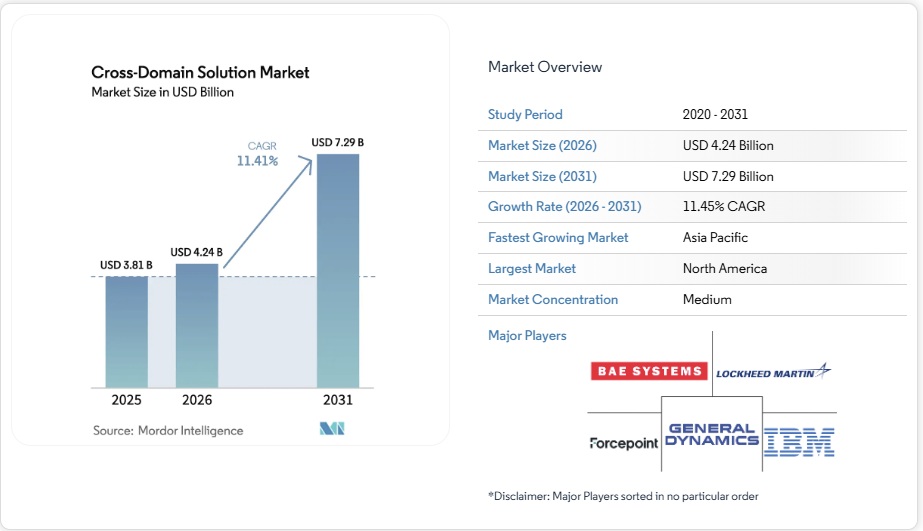
クロスドメインソリューション市場は、2025年の38億1,000万米ドルから2026年には42億4,000万米ドルに成長し、2026年から2031年にかけて年平均成長率(CAGR)11.41%で、2031年には72億9,000万米ドルに達すると予測されています。この成長は、機密データ量の増加、義務付けられたゼロトラストイニシアチブ、老朽化したエアギャップインフラストラクチャを置き換える近代化プログラムによって牽引されています。需要が最も強いのは、漏洩のリスクなしに複数のセキュリティドメイン間でデータを移動する必要がある国防機関、情報機関、重要インフラ事業者です。データダイオードなどのハードウェアアプライアンスが依然として導入の主流ですが、政府のクラウドエンクレーブが成熟するにつれて、クラウドホスト型ゲートウェイとマネージドサービスが注目を集めています。地政学的緊張は支出をさらに加速させており、特にインド太平洋地域では、各国政府がサイバー防御をゼロから構築しています。一方、認証取得に要する期間の長期化や人材不足が短期的な導入を抑制し、既存の大手防衛企業とニッチな専門企業が共存する市場を生み出している。
セグメント分析
- ハードウェアアプライアンスは、2025年にはクロスドメインソリューション市場の52.55%を占めると予測されています。これは、厳格な軍事試験基準を満たす高信頼性データダイオードの普及によるものです。同時に、サービス市場は、人材不足を補うために各機関がマネージドオペレーションへと移行するにつれ、年平均成長率(CAGR)14.23%で成長すると予測されています。そのため、マネージドサービスのクロスドメインソリューション市場規模は、設備投資よりも速いペースで拡大すると見込まれており、これは予算制約のあるプログラムにおいて運用コストが重視される傾向を反映しています。24時間365日の監視、パッチ管理、継続的な認証サポートをパッケージ化したベンダーは、予測可能なコストとコンプライアンス保証を求める顧客にとってますます魅力的な存在となっています。
- ハードウェアセグメントは静的なものではなく、サプライヤーは現在、FPGAベースのポリシーエンジンを組み込み、クラウドゲートウェイと統合する仮想化ダイオード機能を提供しています。しかしながら、調達チームは依然として、最高機密レベルのシステムには物理的に隔離された送信専用チャネルを好んでいます。予測期間において、成功を収めるベンダーは、ハードウェアの信頼性とソフトウェア定義のオーケストレーションを融合させ、ゼロトラストスタックへの統合を容易にしつつ、改ざん防止経路を維持できる企業となるでしょう。
- 転送ゲートウェイは2025年の売上高の48.23%を占めましたが、アクセス中心の製品は年平均成長率(CAGR)15.54%で成長すると予測されており、このペースは2031年までにクロスドメインソリューション市場の構図を大きく変える可能性があります。ID駆動型アクセス制御はゼロトラストの原則と完全に合致しており、管理者はドメイン間でファイルを一括移動するのではなく、特定のデータセットに対して時間制限付きかつコンテキストに応じたアクセス権限を付与できます。アクセスゲートウェイのクロスドメインソリューション市場シェアは、エンタープライズIAMおよびSIEMプラットフォームに直接接続できる機能によって押し上げられています。
- 転送に特化したベンダーは現在、属性ベースのアクセス要素を組み込んでおり、アクセス専門ベンダーはファイル転送機能やプロトコル違反機能を追加することで、統合プラットフォームの未来を示唆しています。その結果、個別のシステムスタックを維持すると監査の複雑さとライフサイクルコストが増大するため、購入者は統合されたポリシーエンジンを提供するサプライヤーを優先的に検討する傾向が強まっている。
Cross-Domain Solution Market Analysis
The cross-domain solution market is expected to grow from USD 3.81 billion in 2025 to USD 4.24 billion in 2026 and is forecast to reach USD 7.29 billion by 2031 at 11.41% CAGR over 2026-2031. This growth is driven by rising classified data volumes, mandatory zero-trust initiatives, and modernization programs that replace aging air-gapped infrastructure. Demand is strongest among defense agencies, intelligence services, and critical-infrastructure operators that must move data between multiple security domains without risking leakage. Hardware appliances such as data diodes still dominate deployments, yet cloud-hosted gateways and managed services are gaining traction as government cloud enclaves mature. Geopolitical tensions further accelerate spending, especially in the Indo-Pacific region where governments are building cyber defenses from the ground up. Meanwhile, prolonged certification cycles and talent shortages temper near-term adoption, creating a market where established defense primes and niche specialists coexist.
Global Cross-Domain Solution Market Trends and Insights
Escalating Volume of Multi-Domain Classified Data Flows
Classified sensors, satellites, and ISR platforms now generate terabytes of data daily that must cross between SECRET, TOP SECRET, and coalition networks. Manual sneaker-net transfers are no longer feasible, and the U.S. DoD’s Raise-the-Bar program explicitly demands automated cross-domain pipelines to cope with a 300% jump in classified traffic since 2020. NATO’s joint operations further amplify requirements for seamless yet compartmented data sharing, pushing agencies toward certified cross-domain gateways that assure confidentiality while enabling real-time collaboration.
Stringent Zero-Trust Mandates in U.S. DoD and NATO
The 2025 DoD Zero Trust Strategy stipulates continuous verification for every transaction, forcing cross-domain solutions to embed granular identity checks and behavioral analytics. NATO allies mirror the approach, having earmarked USD 150 billion for cybersecurity modernization in 2024. Vendors able to prove alignment with NIST SP 800-207 and to pass Common Criteria evaluations now command premium pricing, while legacy perimeter-based products face rapid displacement.
Complex Multi-Authority Certification Cycles
Products must clear NIAP, NSA, and NCDSMO reviews on top of Common Criteria EAL4+ testing, adding 18–24 months to delivery schedules. Each NATO nation also runs its own scheme, prompting vendors to pursue duplicate evaluations and increasing barriers for new entrants.
Other drivers and restraints analyzed in the detailed report include:
- Rapid Proliferation of AI/ML Decision-Support Systems
- Growing Use of Commercial Cloud Enclaves for Secret Workloads
- Scarcity of Cross-Domain-Aware DevSecOps Talent
For complete list of drivers and restraints, kindly check the Table Of Contents.
Segment Analysis
Hardware appliances captured 52.55% of the cross-domain solution market in 2025, propelled by high-assurance data diodes that satisfy rigorous military test criteria. At the same time, services are forecast to grow at a 14.23% CAGR as agencies pivot toward managed operations to offset skills shortages. The cross-domain solution market size for managed services is therefore expected to expand faster than capital purchases, reflecting an operating-expense preference among budget-constrained programs. Vendors that bundle 24/7 monitoring, patch management, and continuous accreditation support increasingly appeal to customers seeking predictable costs and compliance guarantees.
The hardware segment is not static; suppliers now embed FPGA-based policy engines and offer virtualized diode functions that integrate with cloud gateways. Nevertheless, procurement teams still favor physically isolated transmit-only channels for the highest classification tiers. Over the forecast period, successful vendors will be those fusing hardware reliability with software-defined orchestration, thereby easing integration into zero-trust stacks while preserving tamper-resistant pathways.
Transfer gateways maintained a 48.23% share of 2025 revenues, yet access-centric products are slated for a 15.54% CAGR, a pace that could redraw the cross-domain solution market landscape by 2031. Identity-driven access controls align neatly with zero-trust doctrine, letting administrators grant time-bounded, context-aware entry to specific datasets instead of bulk-moving files across domains. The cross-domain solution market share for access gateways is boosted by their ability to hook directly into enterprise IAM and SIEM platforms.
Transfer-focused vendors now embed attribute-based access elements, while access specialists add file-transfer and protocol break functions, hinting at a converged platform future. As a result, buyers increasingly shortlist suppliers that deliver unified policy engines, since maintaining separate stacks inflates audit complexity and lifecycle costs.
Cross-Domain Solution Market Report is Segmented by Component (Hardware, Software, Services), Solution Type (Access Solutions, Transfer Solutions, Other Types), Deployment (Cloud, On-Premises), End-User (Aerospace and Defense, Law-Enforcement and Security Agencies, Critical Infrastructure Operators, Others), and by Geography. The Market Forecasts are Provided in Terms of Value (USD).
Geography Analysis
North America generated 41.45% of 2025 revenues, undergirded by the U.S. DoD’s USD 841 billion appropriation and well-established certification pathways. Prime contractors such as Lockheed Martin logged USD 71.07 billion in 2024 sales, guaranteeing a sustained pipeline of cross-domain deployments and upgrades. Federal cloud enclaves, including AWS Secret Region and Azure Government Secret, accelerate adoption by offering turnkey hosting for classified workloads at Impact Level 6.
Asia-Pacific is the fastest-growing theatre at 17.02% CAGR. Japan’s record USD 734 billion 2025 defense budget, Australia’s REDSPICE cyber initiative, and India’s ongoing tri-service modernization create fertile ground for indigenous and Western gateway suppliers. The QUAD partnership sets common interoperability benchmarks, giving compliant vendors a head start in multi-nation command-and-control projects.
Europe maintains steady momentum through NATO’s Digital Transformation vision and the EU Cybersecurity Certification Framework, which simplifies multi-state approvals. Germany, France, and the United Kingdom invest in cross-domain platforms that support coalition data sharing while satisfying domestic data-sovereignty statutes.
Elsewhere, Middle East and Africa markets are nascent yet strategic: Saudi Arabia’s National Cybersecurity Authority mandates diode-based segmentation for energy facilities, and South Africa’s defense forces plan to embed cross-domain guards in forthcoming satellite-ground stations.
List of Companies Covered in this Report:
- BAE Systems plc
- Lockheed Martin Corporation
- General Dynamics Corporation
- Forcepoint LLC
- IBM Corporation
- Advenica AB
- Cisco Systems Inc.
- Everfox Inc.
- Owl Cyber Defense Solutions LLC
- 4Secure Ltd.
- Raytheon Technologies Corp.
- Northrop Grumman Corp.
- Airbus Defence and Space
- Thales Group
- Leonardo S.p.A.
- Rohde and Schwarz GmbH and Co. KG
- Ultra Intelligence and Communications
- Seceon Inc.
- Waterfall Security Solutions Ltd.
- Belden Inc.
Additional Benefits:
- The market estimate (ME) sheet in Excel format
- 3 months of analyst support
Table of Contents
1 INTRODUCTION
1.1 Study Assumptions and Market Definition
1.2 Scope of the Study
2 RESEARCH METHODOLOGY
3 EXECUTIVE SUMMARY
4 MARKET LANDSCAPE
4.1 Market Overview
4.2 Market Drivers
4.2.1 Escalating volume of multi-domain classified data flows
4.2.2 Stringent zero-trust mandates in U.S. DoD and NATO
4.2.3 Rapid proliferation of AI/ML decision-support systems requiring air-gapped feeds
4.2.4 Growing use of commercial cloud enclaves for secret workloads
4.2.5 Space-to-ground telemetry security gaps in new satellite constellations
4.2.6 Surge in OT-IT convergence across critical infrastructure
4.3 Market Restraints
4.3.1 Complex multi-authority certification cycles
4.3.2 Scarcity of cross-domain aware DevSecOps talent
4.3.3 Lack of interoperability standards for data-diode protocols
4.3.4 High TCO for small-footprint deployments
4.4 Supply-Chain Analysis
4.5 Regulatory Landscape
4.6 Technological Outlook
4.7 Porter’s Five Forces Analysis
4.7.1 Bargaining Power of Suppliers
4.7.2 Bargaining Power of Consumers
4.7.3 Threat of New Entrants
4.7.4 Threat of Substitute Products
4.7.5 Intensity of Competitive Rivalry
4.8 Macroeconomic Impact Assessment
5 MARKET SIZE AND GROWTH FORECASTS (VALUE)
5.1 By Component
5.1.1 Hardware
5.1.2 Software
5.1.3 Services
5.2 By Solution Type
5.2.1 Access Solutions
5.2.2 Transfer Solutions
5.2.3 Other Types
5.3 By Deployment
5.3.1 Cloud
5.3.2 On-Premises
5.4 By End-user
5.4.1 Aerospace and Defense
5.4.2 Law-Enforcement and Security Agencies
5.4.3 Critical Infrastructure Operators
5.4.4 Others
5.5 By Geography
5.5.1 North America
5.5.1.1 United States
5.5.1.2 Canada
5.5.1.3 Mexico
5.5.2 South America
5.5.2.1 Brazil
5.5.2.2 Argentina
5.5.2.3 Rest of South America
5.5.3 Europe
5.5.3.1 United Kingdom
5.5.3.2 Germany
5.5.3.3 France
5.5.3.4 Italy
5.5.3.5 Spain
5.5.3.6 Russia
5.5.3.7 Rest of Europe
5.5.4 Asia-Pacific
5.5.4.1 China
5.5.4.2 Japan
5.5.4.3 India
5.5.4.4 South Korea
5.5.4.5 Australia and New Zealand
5.5.4.6 Rest of Asia-Pacific
5.5.5 Middle East and Africa
5.5.5.1 Middle East
5.5.5.1.1 Saudi Arabia
5.5.5.1.2 UAE
5.5.5.1.3 Turkey
5.5.5.1.4 Rest of Middle East
5.5.5.2 Africa
5.5.5.2.1 South Africa
5.5.5.2.2 Nigeria
5.5.5.2.3 Kenya
5.5.5.2.4 Rest of Africa
6 COMPETITIVE LANDSCAPE
6.1 Market Concentration
6.2 Strategic Moves
6.3 Market Share Analysis
6.4 Company Profiles (includes Global level Overview, Market level overview, Core Segments, Financials as available, Strategic Information, Market Rank/Share for key companies, Products and Services, and Recent Developments)
6.4.1 BAE Systems plc
6.4.2 Lockheed Martin Corporation
6.4.3 General Dynamics Corporation
6.4.4 Forcepoint LLC
6.4.5 IBM Corporation
6.4.6 Advenica AB
6.4.7 Cisco Systems Inc.
6.4.8 Everfox Inc.
6.4.9 Owl Cyber Defense Solutions LLC
6.4.10 4Secure Ltd.
6.4.11 Raytheon Technologies Corp.
6.4.12 Northrop Grumman Corp.
6.4.13 Airbus Defence and Space
6.4.14 Thales Group
6.4.15 Leonardo S.p.A.
6.4.16 Rohde and Schwarz GmbH and Co. KG
6.4.17 Ultra Intelligence and Communications
6.4.18 Seceon Inc.
6.4.19 Waterfall Security Solutions Ltd.
6.4.20 Belden Inc.
7 MARKET OPPORTUNITIES AND FUTURE OUTLOOK
7.1 White-space and Unmet-Need Assessment