
Cloud AI - Market Share Analysis, Industry Trends & Statistics, Growth Forecasts (2026 - 2031)
クラウド AI 市場レポートは、タイプ (ソリューションおよびサービス)、エンドユーザー垂直 (BFSI、ヘルスケア、自動車およびモビリティなど)、展開モデル (パブリック クラウド、プライベート クラウド、ハイブリッドおよびマルチクラウド)、アプリケーション (カスタマー サービスおよびコンタクト センター AI など)、テクノロジー (機械学習、コンピューター ビジョンなど)、および地域別にセグメント化されています。
The Cloud AI Market Report is Segmented by Type (Solutions, and Services), End-User Vertical (BFSI, Healthcare, Automotive and Mobility, and More), Deployment Model (Public Cloud, Private Cloud, and Hybrid and Multi-Cloud), Application (Customer Service and Contact-Center AI, and More), Technology (Machine Learning, Computer Vision, and More), and Geography.
| 出版 | Mordor Intelligence |
| 出版年月 | 2026年02月 |
| ページ数 | 120 |
| 価格 | 記載以外のライセンスについてはお問合せください |
| シングルユーザ | USD 4,750 |
| 種別 | 英文調査報告書 |
| 商品番号 | SMR-1423014230 |

クラウドAI市場は2025年に894.3億米ドルと評価され、2026年の1,172.6億米ドルから2031年には4,540.2億米ドルに達し、予測期間(2026~2031年)中に31.10%の年平均成長率(CAGR)で成長すると予測されています。MicrosoftによるOpenAIへの130億米ドルのコミットメントやAmazonによるAnthropicへの80億米ドルの投資といった生成AIパートナーシップは、キャパシティの拡大、参入障壁の低下、そして企業の価値実現までの時間の短縮につながっています。GPUフラクショナライゼーション技術がインフラコストを削減する一方で、ヘルスケアや金融サービスにおける業種特有の規制は、堅牢なガバナンスを実証できるプロバイダーを優遇しており、中堅企業での導入が増加しています。特に高帯域幅メモリにおけるサプライチェーンのダイナミクスは、ハイパースケーラー間のチップ多様化戦略を促し、CO2排出量を考慮したワークロードオーケストレーションは、データセンターの立地決定に影響を与え始めています。
セグメント分析
- 2025年のクラウドAI市場において、ソリューションは62.40%を占めました。企業は、既存のDevOpsパイプラインと統合し、迅速な導入と一貫したパフォーマンスを実現するパッケージ型プラットフォームに注目しています。導入が進むにつれて、移行ロードマップとガバナンスのための専門家のガイダンスが不可欠となり、サービスセグメントは33.42%のCAGR(年平均成長率)に達すると予測されています。
- サービスの成長は、戦略策定、モデルチューニング、運用管理を含む複数年にわたる変革プログラムを反映しています。アクセンチュアなどの企業は、1,400人のエンジニアをAnthropic on AWSの実装に向けて再教育し、企業のスキルギャップに直接対処しました。ソリューションとサービスを組み合わせたサービスは人気が高まっており、組織は社内のコンピテンシーを構築しながらAIを迅速に導入することが可能です。
- BFSIは、不正分析やロボアドバイザーのユースケースにより、2025年にはクラウドAI市場シェアの28.55%を占めました。一方、ヘルスケア分野は、AIを活用した診断とアンビエント臨床文書の活用により、年平均成長率34.98%で成長すると予想されています。
- 病院は、放射線科におけるトリアージや個別治療の推奨に大規模言語モデルを導入しています。FDAの2025年1月のガイダンスは、明確な規制の方向性を示し、資本投資を促しています。製造業と小売業もこれに追随し、それぞれ欠陥検出と在庫最適化にAIを活用しています。
- クラウド AI 市場レポートは、タイプ (ソリューションとサービス)、エンドユーザー垂直 (BFSI、ヘルスケア、自動車とモビリティなど)、展開モデル (パブリック クラウド、プライベート クラウドなど)、アプリケーション (不正とリスク分析、マーケティングとパーソナライゼーションなど)、テクノロジー (機械学習、生成 AI など)、および地域別にセグメント化されています。
Cloud AI Market Analysis
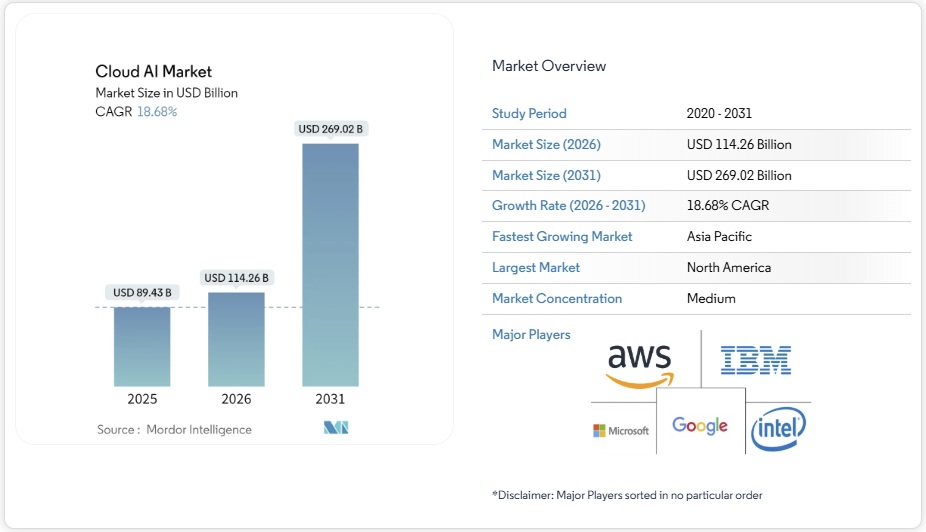
The Cloud AI market was valued at USD 89.43 billion in 2025 and estimated to grow from USD 117.26 billion in 2026 to reach USD 454.02 billion by 2031, at a CAGR of 31.10% during the forecast period (2026-2031). Generative AI partnerships, such as Microsoft’s USD 13 billion commitment to OpenAI and Amazon’s USD 8 billion investment in Anthropic, are expanding capacity, lowering entry barriers, and accelerating time-to-value for enterprises. Mid-market adoption is rising as GPU-fractionalization technologies reduce infrastructure costs, while sector-specific regulations in healthcare and financial services favor providers that can demonstrate robust governance. Supply-chain dynamics, notably in high-bandwidth memory, spur chip diversification strategies among hyperscalers, and carbon-aware workload orchestration begins to influence data-center siting decisions.
Global Cloud AI Market Trends and Insights
Growing Adoption of AI-as-a-Service (AIaaS)
Enterprises are shifting from capital-heavy on-premises deployments to pay-as-you-go AI services. Microsoft’s AI business reached a USD 13 billion annual run rate in Q2 FY 2025, contributing 16 percentage points to Azure growth. Custom silicon such as AWS Trainium2 delivers 30-40% price-performance gains, broadening AI accessibility for mid-market firms that must meet regional data-sovereignty rules. Uptake is evident across Europe and Asia, where 60% of mid-size enterprises expect regionally trained language models by 2025.
Rising Big-Data Volume
Unstructured data exceeds 80% of enterprise information assets, driving demand for real-time AI analytics. Healthcare use cases include Mayo Clinic processing genomic records from 100,000 patients to improve early disease detection. Financial services apply cloud AI to reduce false positives in anti-money-laundering screening by 95%. Edge-cloud convergence allows manufacturers to perform predictive maintenance on IoT data streams with millisecond response times.
Persistent GPU/HBM Supply-Chain Shortages
SK Hynix controls 70% of the HBM market and reports full allocation through 2025, creating cost pressures for cloud providers. AWS counters with Trainium custom chips, while Oracle procures thousands of NVIDIA Blackwell GPUs to sustain training capacity. Tight memory supply has triggered price spikes in DDR5 and VRAM, with Samsung inking a USD 3 billion HBM3E supply deal with AMD.
Other drivers and restraints analyzed in the detailed report include:
- Increasing Demand for Virtual Assistants and GenAI Chatbots
- GenAI GPU-Fractionalization Expanding SME Access
- Lack of Skilled Workforce and Data-Security Concerns
For complete list of drivers and restraints, kindly check the Table Of Contents.
Segment Analysis
Solutions represented 62.40% of the Cloud AI market in 2025. Enterprises gravitated to packaged platforms that integrate with existing DevOps pipelines, ensuring quick deployment and consistent performance. As adoption deepens, professional guidance becomes essential for migration roadmaps and governance, pushing the Services segment to a forecast 33.42% CAGR.
Services growth reflects multi-year transformation programs that include strategy, model tuning, and managed operations. Firms such as Accenture have retrained 1,400 engineers for Anthropic-on-AWS implementations, directly addressing enterprise skills gaps. Combined solution-service offerings are growing in popularity, enabling organizations to onboard AI quickly while building internal competencies.
BFSI held 28.55% Cloud AI market share in 2025 due to fraud analytics and robo-advisory use cases. However, Healthcare is set to grow at 34.98% CAGR, buoyed by AI-enabled diagnostics and ambient clinical documentation.
Hospitals deploy large language models for radiology triage and personalized treatment recommendations. The FDA’s January 2025 guidance provides a clear regulatory path, encouraging capital investment. Manufacturing and retail follow, leveraging AI for defect detection and inventory optimization, respectively.
The Cloud AI Market Report is Segmented by Type (Solution and Service), End-User Vertical (BFSI, Healthcare, Automotive and Mobility, and More), Deployment Model (Public Cloud, Private Cloud, and More), Application (Fraud and Risk Analytics, Marketing and Personalisation, and More), Technology (Machine Learning, Generative AI, and More), and Geography.
Geography Analysis
North America retained 40.60% Cloud AI market share in 2025, anchored by hyperscaler footprints and venture funding. Regulatory clarity, exemplified by the FDA’s AI device guidelines, encourages adoption across life-sciences and finance. Capital outlays include Amazon’s USD 8 billion Anthropic investment and Microsoft’s continued OpenAI integration, reinforcing regional dominance.
Asia Pacific is the fastest-growing territory with 31.88% CAGR. China’s projected USD 46 billion cloud spend for 2025, along with Alibaba’s multi-year capex commitment, fuels infrastructure expansion. Japan accelerates with Oracle’s USD 8 billion pledge and Tokyo’s selection for OpenAI’s first Indo-Pacific branch. India and Southeast Asia benefit from digital public-infrastructure programs and rising developer communities.
Europe shows steady growth amid complex regulation. The EU AI Act provides a harmonized framework that advantages providers with certified governance. Sovereign cloud initiatives and carbon-reduction mandates encourage hybrid architectures. Emerging markets in the Middle East and Africa witness early uptake, backed by sovereign-wealth investments in data centers.
List of Companies Covered in this Report:
- Amazon Web Services
- Microsoft Corp.
- Google LLC
- IBM Corp.
- Salesforce Inc.
- NVIDIA Corp.
- Oracle Corp.
- Alibaba Cloud
- SAP SE
- ServiceNow
- Databricks
- Snowflake Inc.
- Hugging Face
- OpenAI LP
- Anthropic PBC
- CoreWeave
- AMD Inc.
- Intel Corp.
- Wipro Ltd.
- Infosys Ltd.
- SoundHound AI Inc.
- Twilio Inc.
Additional Benefits:
- The market estimate (ME) sheet in Excel format
- 3 months of analyst support
Table of Contents
1 INTRODUCTION
1.1 Study Assumptions and Market Definition
1.2 Scope of the Study
2 RESEARCH METHODOLOGY
3 EXECUTIVE SUMMARY
4 MARKET LANDSCAPE
4.1 Market Overview
4.2 Market Drivers
4.2.1 Rising big-data volume
4.2.2 Growing adoption of AI-as-a-Service (AIaaS)
4.2.3 Increasing demand for virtual assistants and GenAI chatbots
4.2.4 GenAI GPU-fractionalization expanding SME access
4.2.5 Edge-cloud AI interoperability standards (e.g., ONNX, MEDAL)
4.2.6 Carbon-aware workload orchestration incentives
4.3 Market Restraints
4.3.1 Lack of skilled workforce and data-security concerns
4.3.2 Persistent GPU/HBM supply-chain shortages
4.3.3 AI datacentre energy constraints and carbon regulations
4.3.4 Geopolitical GPU export-control frameworks
4.4 Value Chain Analysis
4.5 Regulatory Landscape
4.6 Technological Outlook
4.7 Porter’s Five Forces Analysis
4.7.1 Threat of New Entrants
4.7.2 Bargaining Power of Suppliers
4.7.3 Bargaining Power of Buyers
4.7.4 Threat of Substitutes
4.7.5 Intensity of Competitive Rivalry
5 MARKET SIZE AND GROWTH FORECASTS (VALUE)
5.1 By Type
5.1.1 Solution
5.1.2 Service
5.2 By End-user Vertical
5.2.1 BFSI
5.2.2 Healthcare
5.2.3 Automotive and Mobility
5.2.4 Retail and E-commerce
5.2.5 Government and Public Sector
5.2.6 Education
5.2.7 Manufacturing
5.3 By Deployment Model
5.3.1 Public Cloud
5.3.2 Private Cloud
5.3.3 Hybrid / Multi-cloud
5.4 By Application
5.4.1 Customer Service and Contact-Centre AI
5.4.2 Predictive Maintenance and Asset Ops
5.4.3 Fraud and Risk Analytics
5.4.4 Marketing and Personalisation
5.4.5 Computer-Vision-as-a-Service
5.5 By Technology
5.5.1 Machine Learning
5.5.2 Natural Language Processing
5.5.3 Computer Vision
5.5.4 Generative AI
5.5.5 Reinforcement and Edge AI
5.6 By Geography
5.6.1 North America
5.6.1.1 United States
5.6.1.2 Canada
5.6.1.3 Mexico
5.6.2 South America
5.6.2.1 Brazil
5.6.2.2 Argentina
5.6.2.3 Chile
5.6.2.4 Rest of South America
5.6.3 Europe
5.6.3.1 Germany
5.6.3.2 United Kingdom
5.6.3.3 France
5.6.3.4 Italy
5.6.3.5 Spain
5.6.3.6 Netherlands
5.6.3.7 Russia
5.6.3.8 Rest of Europe
5.6.4 Asia Pacific
5.6.4.1 China
5.6.4.2 India
5.6.4.3 Japan
5.6.4.4 South Korea
5.6.4.5 ASEAN
5.6.4.6 Rest of Asia Pacific
5.6.5 Middle East and Africa
5.6.5.1 Middle East
5.6.5.1.1 GCC (Saudi Arabia, UAE, Qatar, etc.)
5.6.5.1.2 Turkey
5.6.5.1.3 Rest of Middle East
5.6.5.2 Africa
5.6.5.2.1 South Africa
5.6.5.2.2 Nigeria
5.6.5.2.3 Kenya
5.6.5.2.4 Rest of Africa
6 COMPETITIVE LANDSCAPE
6.1 Market Concentration
6.2 Strategic Moves
6.3 Market Share Analysis
6.4 Company Profiles (includes Global level Overview, Market level overview, Core Segments, Financials as available, Strategic Information, Market Rank/Share for key companies, Products and Services, and Recent Developments)
6.4.1 Amazon Web Services
6.4.2 Microsoft Corp.
6.4.3 Google LLC
6.4.4 IBM Corp.
6.4.5 Salesforce Inc.
6.4.6 NVIDIA Corp.
6.4.7 Oracle Corp.
6.4.8 Alibaba Cloud
6.4.9 SAP SE
6.4.10 ServiceNow
6.4.11 Databricks
6.4.12 Snowflake Inc.
6.4.13 Hugging Face
6.4.14 OpenAI LP
6.4.15 Anthropic PBC
6.4.16 CoreWeave
6.4.17 AMD Inc.
6.4.18 Intel Corp.
6.4.19 Wipro Ltd.
6.4.20 Infosys Ltd.
6.4.21 SoundHound AI Inc.
6.4.22 Twilio Inc.
7 MARKET OPPORTUNITIES AND FUTURE OUTLOOK
7.1 White-space and Unmet-need Assessment