
| 出版社 | MarketsandMarkets |
| 出版年月 | 2025年11月 |
Spare Part Management Market – Global Forecast To 2030

スペアパーツ管理(SPM)市場 – ソリューション(スペアパーツ追跡と自動化、在庫管理、調達と注文管理、レポートと分析、計画と予測)、スペアパーツ管理サービス、タイプ – 2030年までの世界予測
スペアパーツ管理(SPM)市場は、2025年の推定10億2,130万米ドルから2030年には18億2,020万米ドルに達すると予測され、年平均成長率12.3%で拡大する見通しです。
市場は着実に拡大しており、その牽引役は、計画外のダウンタイムによる資産時間コストの増大、精密なサービス計画への需要の高まり、そしてメーカーの収益源としてのアフターマーケットへの依存度の高まりです。設備故障による財務リスクの増大に直面する組織は、部品の入手性向上、補充の迅速化、そして分散したオペレーション全体におけるサービス中断の最小化を実現するインテリジェントな計画プラットフォームを導入しています。AIを活用した需要予測は、資産の健全性シグナル、使用状況の変動、修理履歴を解釈することで充足率の精度を高め、在庫管理の精度とサービスレベルのパフォーマンスを向上させます。アフターマーケットがマージン成長において果たす役割の拡大に伴い、計画、価格設定、保証、修理・返品ワークフローを連携させる統合機能への需要も高まっています。
市場の拡大は、OEMおよびサービスエコシステム全体にわたるデータアクセスを制限する独自のロックイン、そして予測の信頼性と在庫調整を低下させる不正確で一貫性のない部品データによって抑制されています。脆弱なタクソノミー構造と標準化されていない分類フレームワークは、相互運用性を制限し、グローバルネットワーク間の調和を遅らせることで、運用効率をさらに阻害します。これらの制約にもかかわらず、データ品質、高度な分析、そしてサービスサプライチェーンの統合への投資は、稼働時間の向上とアフターマーケットの収益性強化において、最新のスペアパーツ管理システムが果たす重要な役割を引き続き強調しています。
調査対象範囲
本調査レポートでは、スペアパーツ管理(SPM)市場を、提供内容(ソリューション(計画・予測、調達・発注管理、在庫管理、スペアパーツ追跡・自動化、レポート・分析、その他)および専門サービス(トレーニング・コンサルティング、統合・導入、サポート・保守)、種類(スタンドアロンSPMソフトウェア、統合SPMソフトウェア)、導入形態(オンプレミス、クラウド)、組織規模(大企業、中小企業)、業種(製造業、運輸・物流、建設・不動産、ヘルスケア・ライフサイエンス、エネルギー・公益事業、IT・通信、石油・ガス、その他の業種(BFSI、小売・消費財))に基づいて分類しています。スペアパーツ管理市場は、北米、ヨーロッパ、アジア太平洋、中東・アフリカ、ラテンアメリカといった地域にまたがって成長しています。本レポートは、スペアパーツ管理市場の成長に影響を与える主要な要因(推進要因、制約要因、課題、機会など)に関する詳細な情報を網羅しています。主要プレーヤーの詳細な分析を実施し、事業概要、ソリューション、サービスに加え、主要戦略、契約、パートナーシップ、合意、新製品・サービスの発売、合併・買収、スペアパーツ管理市場に関連する最近の動向についても洞察を提供しています。また、本レポートは、スペアパーツ管理市場エコシステムにおける新興企業の競合分析も網羅しています。
本レポートを購入する理由
本レポートは、市場リーダー企業と新規参入企業に対し、スペアパーツ管理市場全体とそのサブセグメントの収益数値に関する近似値を提供します。これにより、ステークホルダーは競争環境を理解し、自社のポジショニングを改善し、適切な市場開拓戦略を策定するための洞察を深めることができます。また、ステークホルダーが市場の動向を把握し、主要な市場牽引要因、制約要因、課題、そして機会に関する情報を提供するのに役立ちます。
本レポートでは、以下の点について洞察を提供しています。
主要な推進要因(計画外のダウンタイムによる資産時間コストの増大、AI需要予測による充足率の精度向上、利益源としてのアフターマーケットへの依存度の高まり)、制約要因(独自のロックインとデータアクセス制限、不正確で一貫性のないスペアパーツデータ、脆弱な部品分類と一貫性のない分類基準)、機会(在庫可視化のためのリアルタイムIoTテレメトリ、サービス化と稼働時間ベースの契約への移行、資産集約型産業における保守の集中化)、課題(ロングテールで回転率の低いスペアパーツの複雑さへの対応、充足率に影響を与えるサプライヤーのリードタイム変動)の分析。
- 製品開発/イノベーション:スペアパーツ管理(SPM)市場における今後の技術、研究開発活動、新製品・新サービスの投入に関する詳細な洞察。
- 市場開発:収益性の高い市場に関する包括的な情報。
- 本レポートでは、様々な地域におけるスペアパーツ管理市場を分析しています。
- 市場の多様化:スペアパーツ管理(SPM)市場における新製品・新サービス、未開拓地域、最近の動向、投資に関する包括的な情報。
- 競合評価: PTC (米国)、Syncron (スウェーデン)、Fiix (カナダ)、Dassault Systemes (フランス)、IBM (米国)、Oracle (米国)、Baxter Planning (米国)、IFS (スウェーデン)、Tavant (米国)、Cryotos (インド)、eMaint (米国)、Erpag (米国)、Megaventory (米国)、Upkeep (米国)、Infraon (米国)、ValueApex (中国)、MPulse Software (米国)、AntMyErp (インド)、Limble CMMS (米国)、Fleataable (カナダ)、Verusen (ジョージア)、Mastek (インド)、Raseed (インド)、PartsCloud (ドイツ)、Spartech (ドイツ)、Partful (イギリス)、Facilio (米国)、ToolsGroup (米国) などの主要企業の市場シェア、成長戦略、サービス提供の詳細な評価。このレポートは、関係者がスペアパーツ管理市場の動向を理解するのにも役立ち、主要な市場の推進要因、制約、課題、機会に関する情報も提供します。
Report Description
The spare parts management market is projected to expand at a CAGR of 12.3%, reaching USD 1,820.2 million by 2030 from an estimated USD 1,021.3 million in 2025.
The market is expanding steadily, driven by escalating unplanned downtime asset-hour costs, rising demands for precise service planning, and the growing dependence on the aftermarket as a profit center for manufacturers. As organizations face increasing financial exposure due to equipment failures, they are adopting intelligent planning platforms that enhance parts availability, expedite replenishment, and minimize service interruptions across their distributed operations. AI-driven demand forecasting enhances fill-rate precision by interpreting asset health signals, usage variability, and repair histories, which improves stocking accuracy and service-level performance. The aftermarket’s expanding role in margin growth is also increasing demand for unified capabilities that connect planning, pricing, warranty, and repair-return workflows. The market’s expansion is restrained by proprietary lock-ins that limit data access across OEM and service ecosystems, as well as by inaccurate and inconsistent parts data that reduces forecasting reliability and inventory alignment. Weak taxonomy structures and non-standardized classification frameworks further hinder operational efficiency by restricting interoperability and slowing down harmonization across global networks. Despite these restraints, investment in data quality, advanced analytics, and service supply chain integration continues to underscore the critical role of modern spare parts management systems in enhancing uptime and bolstering aftermarket profitability.
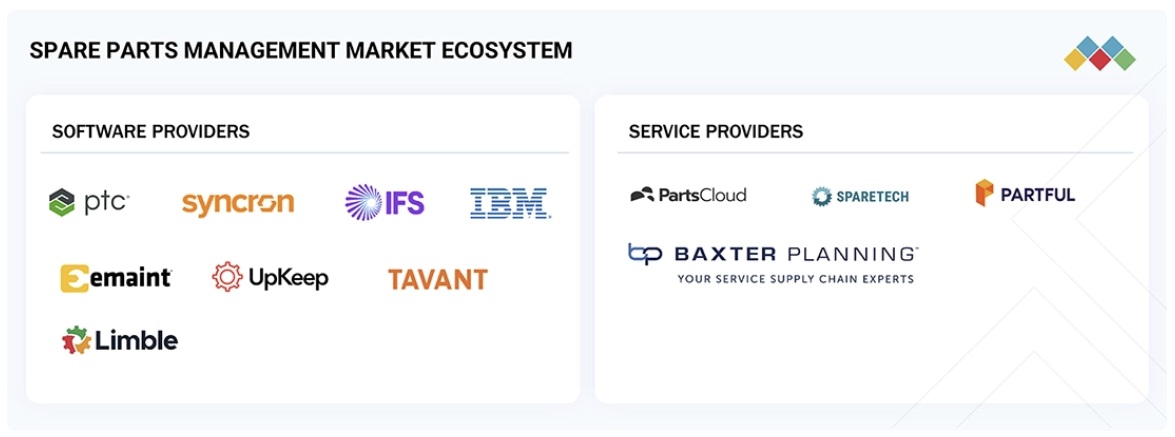
Spare Part Management Market – Global Forecast To 2030 – ecosystem
The report includes a study of key players offering spare parts management products. It profiles major market players, which include PTC (US), Syncron (Sweden), Fiix (Canada), Dassault Systemes (France), IBM (US), Oracle (US), Baxter Planning (US), IFS (Sweden), Tavant (US), Cryotos (India), eMaint (US), Erpag (US), Megaventory (US), Upkeep (US), Infraon (US), ValueApex (China), MPulse Software (US), AntMyErp (India), Limble CMMS (US), Fleataable (Canada), Verusen (Georgia), Mastek (India), Raseed (India), PartsCloud (Germany), Spartech (Germany), Partful (England), Facilio (US), and ToolsGroup (US).
Research Coverage
This research report categorizes the spare parts management market based on offering (solutions [planning & forecasting, procurement & order management, inventory management, spare parts tracking & automation, reporting & analytics, others] and professional services [training & consultation, integration & implementation, support & maintenance]), type (standalone SPM software, integration SPM software), deployment mode (on-premises, cloud), organization size (large enterprises, SMEs), vertical (manufacturing, transportation & logistics, construction & real estate, healthcare & life sciences, energy & utilities, IT & telecom, oil & gas, other verticals [BFSI, retail & consumer goods]), and Region (North America, Europe, Asia Pacific, Middle East & Africa, and Latin America). The report’s scope covers detailed information regarding the major factors, such as drivers, restraints, challenges, and opportunities, influencing the growth of the spare parts management market. A detailed analysis of key industry players was conducted to provide insights into their business overview, solutions, and services, as well as key strategies, contracts, partnerships, agreements, new product & service launches, mergers and acquisitions, and recent developments associated with the spare parts management market. This report also covers the competitive analysis of upcoming startups in the spare parts management market ecosystem.
Reason to Buy this Report
The report would provide market leaders and new entrants with information on the closest approximations of the revenue numbers for the overall spare parts management market and its subsegments. It would help stakeholders understand the competitive landscape and gain more insights to better position their businesses and plan suitable go-to-market strategies. It also helps stakeholders understand the market’s pulse and provides them with information on key market drivers, restraints, challenges, and opportunities.
The report provides insights on the following pointers:
- Analysis of key drivers (Escalating unplanned downtime asset-hour costs, improvement in fill-rate precision with AI demand forecasting, growing dependence on aftermarket as a profit center), restraints (Proprietary lock-ins and restricted data access, inaccurate and inconsistent spare parts data, weak parts taxonomy and inconsistent classification standards), opportunities (Real-time IoT telemetry for inventory visibility, shift toward servitization and uptime-based contracts, expanding maintenance intensity across asset-heavy industries), and challenges (Managing long-tail, low-turn spare parts complexity, supplier lead-time volatility impacting fill rates).
- Product Development/Innovation: Detailed insights on upcoming technologies, research & development activities, and new product & service launches in the spare parts management market.
- Market Development: Comprehensive information about lucrative markets – the report analyses the spare parts management market across varied regions.
- Market Diversification: Exhaustive information about new products & services, untapped geographies, recent developments, and investments in the spare parts management market.
- Competitive Assessment: In-depth assessment of market shares, growth strategies, and service offerings of leading players such as PTC (US), Syncron (Sweden), Fiix (Canada), Dassault Systemes (France), IBM (US), Oracle (US), Baxter Planning (US), IFS (Sweden), Tavant (US), Cryotos (India), eMaint (US), Erpag (US), Megaventory (US), Upkeep (US), Infraon (US), ValueApex (China), MPulse Software (US), AntMyErp (India), Limble CMMS (US), Fleataable (Canada), Verusen (Georgia), Mastek (India), Raseed (India), PartsCloud (Germany), Spartech (Germany), Partful (England), Facilio (US), and ToolsGroup (US). The report also helps stakeholders understand the spare parts management market’s pulse and provides information on key market drivers, restraints, challenges, and opportunities.