
| 出版社 | MarketsandMarkets |
| 出版年月 | 2025年8月 |
Smart City Platforms Market – Global Forecast to 2030

本市場レポートは、スマートシティ・プラットフォーム市場を様々なセグメントにわたって網羅しています。提供内容、導入、用途、地域に基づき、多くのセグメントにおける市場規模と成長ポテンシャルを推定しました。主要市場参加者の徹底的な競合分析、各社の事業情報、製品提供に関する重要な考察、現在のトレンド、そして重要な市場戦略を網羅しています。
本調査は、スマートシティ・プラットフォーム業界全体とそのサブセグメントにおける最も正確な収益予測に関する情報を提供し、市場リーダー企業と新規参入企業の両方にとって有益です。ステークホルダーは、本レポートによって競争環境への理解を深め、自社のポジショニングを改善し、市場開拓戦略を策定する上で大きなメリットを享受できます。本調査は、主要な市場牽引要因、制約、機会、課題に関する情報を提供し、業界関係者が業界の動向を把握する上で役立ちます。
世界のスマートシティ・プラットフォーム市場は、2025年の245億1,000万米ドルから2030年には395億2,000万米ドルに拡大し、予測期間中の年平均成長率(CAGR)は10.0%となる見込みです。スマートシティ・プラットフォーム市場は、急速な都市化が進む中で推進されており、交通、エネルギー、公共安全といった都市運営を管理するための、よりスマートなインフラ整備が求められています。アジア太平洋、欧州、中東などでは、政府主導のスマートシティ構想がプラットフォーム導入を加速させています。IoT、5G、エッジコンピューティングといった技術の進歩に加え、環境持続可能性への取り組みの高まりも、統合プラットフォームの必要性をさらに高めています。さらに、AIや高度な分析技術の活用により、リアルタイムの意思決定と運用効率が向上しています。しかしながら、市場は初期投資や導入コストの高さ、データプライバシーやサイバーセキュリティへの懸念が根強いなど、制約に直面しています。レガシーシステムとの統合の課題や相互運用性の問題が技術的な障壁となり、熟練した労働力の不足や規制の枠組みが不明確であることが大規模な導入をさらに妨げています。
The global smart city platforms market will grow from USD 24.51 billion in 2025 to USD 39.52 billion by 2030 at a compounded annual growth rate (CAGR) of 10.0% during the forecast period. The smart city platforms market is primarily driven by rapid urbanization, which necessitates smarter infrastructure to manage city operations such as transportation, energy, and public safety. Government-led smart city initiatives across regions such as Asia Pacific, Europe, and the Middle East are accelerating platform adoption. Technological advancements in IoT, 5G, and edge computing, combined with growing environmental sustainability goals, are further fueling the need for integrated platforms. Additionally, the use of AI and advanced analytics is enhancing real-time decision-making and operational efficiency. However, the market faces restraints, including high initial investment and deployment costs, as well as persistent concerns over data privacy and cybersecurity. Integration challenges with legacy systems and interoperability issues pose technical barriers, while a lack of a skilled workforce and unclear regulatory frameworks further hinder large-scale adoption.
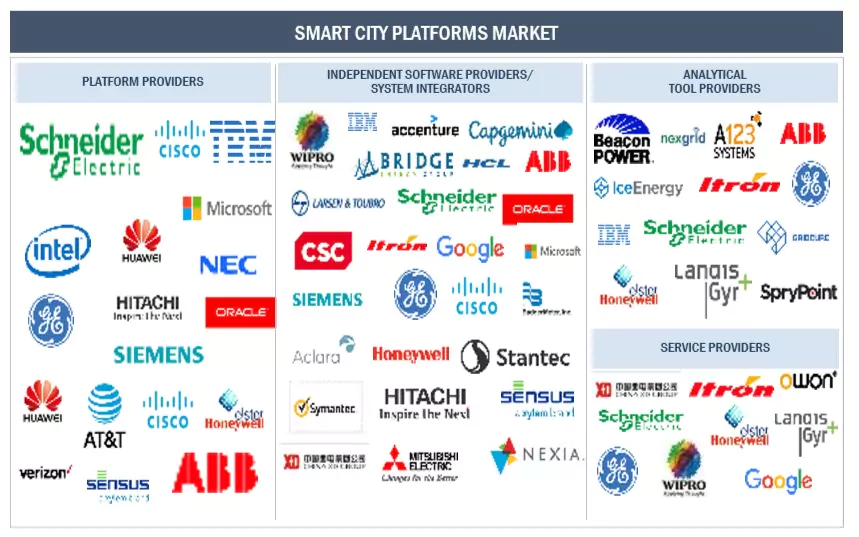
Some of the major smart city platform vendors are IBM (US), Siemens (Germany), Cisco (US), Hitachi (Japan), Microsoft (US), Huawei (China), AWS (US), AT&T (US), Nokia (Finland), and Atos (France).
smart-city-platforms-market-new-ecosystem
The report provides insights on the following pointers:
Analysis of key drivers (Preference for platforms over standalone solutions, exponential rise in urban population resulting in need for smart management, increasing adoption of IoT technology for infrastructure management and city monitoring, inefficient utilization of resources in emerging economies, digital transformation augmenting scope for smart cities), restraints (Cost-intensive infrastructure of smart city platforms, possibility of privacy and security breaches in smart city platforms, lack of standardization in IoT protocols), opportunities (Development of smart infrastructure, industrial and commercial deployment of smart city platforms, rising smart city initiatives worldwide), and challenges (Increasing concern over data privacy and security, growing cybersecurity attacks due to proliferation of IoT devices, disruption in logistics and supply chain of IoT devices).
- Product Development/Innovation: Comprehensive analysis of emerging technologies, R&D initiatives, and new service and product introductions in the smart city platforms market.
- Market Development: In-depth details regarding profitable markets: the paper examines the global smart city platforms market.
- Market Diversification: Comprehensive details regarding recent advancements, investments, unexplored regions, new goods and services, and the smart city platforms market.
- Competitive Assessment: Thorough analysis of the market shares, expansion plans, platforms, and service portfolios of the top competitors in the smart city platforms industry, such as IBM (US), Siemens (Germany), Cisco (US), Hitachi (Japan), Microsoft (US), Huawei (China), AWS (US), AT&T (US), Nokia (Finland), Atos (France), SAP (Germany), NEC (Japan), Fujitsu (Japan), Schneider Electric (France), Alibaba Cloud (China), Ericsson (Sweden), Bosch.io (Germany), Itron (US), PwC (UK), SICE (Spain), thethings.iO (Spain), KaaIoT Technologies (US), Quantela (US), Ubicquia (US), Igor (US), 75F (US), Telensa (UK), Enevo (US), KETOS (US), Cleverciti (Germany), Gaia Smart Cities (India), Globetom (South Africa), Tadoom (Oman), and Athena SmartCities (US).