
| 出版社 | MarketsandMarkets |
| 出版年月 | 2025年11月 |
Semantic Web Market – Global Forecast to 2030

セマンティックウェブ市場 – オファリング(ナレッジグラフプラットフォーム、データ統合ツール、推論エンジン)、テクノロジー(RDF、OWL、SPARQL、オントロジー)、用途(データの相互運用性と統合、デジタルアセット) – 2030年までの世界予測
世界のセマンティックウェブ市場規模は、2025年の27億1,000万米ドルから2030年には77億3,000万米ドルに拡大し、年平均成長率(CAGR)は23.3%になると予測されています。市場の成長は、デジタルエコシステム全体における一貫性、相互運用性、機械可読性を確保するために、企業が構造化され説明可能なデータインフラストラクチャにますます注力していることに牽引されています。組織は、分散したデータソースを統合し、コンテキスト検索を強化し、AIと分析ワークフロー全体で正確な推論を可能にするために、ナレッジグラフプラットフォームとオントロジー主導のフレームワークを導入しています。金融サービス、ヘルスケア、公共部門における規制圧力もこの変化を後押ししており、データの透明性、リネージ追跡、そしてエビデンスに基づく意思決定がコンプライアンス戦略の中心となっています。
クラウドベースのグラフ管理およびオントロジーホスティングプラットフォームは、セマンティックテクノロジーへのアクセスを拡大し、インフラストラクチャの複雑さを軽減し、マルチクラウド環境全体にわたるスケーラブルな導入をサポートします。セマンティックモデリングとAIおよび自然言語理解の融合は、データ解釈とインサイトの創出を変革し、リアルタイム分析、自律システム、インテリジェントオートメーションにおける新たな機会を生み出しています。企業が従来のデータ管理から、俊敏性、ガバナンス、そして大規模な説明可能なAIをサポートするセマンティックデータアーキテクチャへと移行する中で、堅牢なリンクデータ統合、SPARQLクエリ、そしてスキーマ進化機能を提供するベンダーは、競争優位性を獲得すると期待されています。
本調査レポートは、セマンティックウェブ市場を、提供サービス、技術、アプリケーション、および垂直市場に分類しています。提供サービスセグメントは、セマンティックウェブソフトウェアとセマンティックウェブサービスに分かれています。ソフトウェアセグメントはさらに、オントロジー管理ツール、RDFデータ管理システム、推論エンジン、リンクトデータプラットフォーム、セマンティックアノテーションツール、ナレッジグラフプラットフォーム、その他のソフトウェアに分かれています。サービスセグメントは、トレーニングおよびコンサルティングサービス、統合および導入サービス、ブロックチェーン監査サービス、セマンティックウェブ開発サービス、セマンティックウェブストリーミングサービスで構成されています。技術セグメントは、コアセマンティックウェブ技術と隣接技術に分かれています。セマンティックウェブのコア技術には、RDF、RDFS、OWL、SPARQL、URI、オントロジー、リンクトデータ原則、セマンティックアノテーションが含まれます。隣接技術には、AIおよび機械学習、エッジコンピューティング、クラウドおよびビッグデータ、ブロックチェーンが含まれます。アプリケーションセグメントは、ナレッジ&データ管理、データ相互運用性と統合、IoTとスマート環境、セマンティックアノテーション、Webとデジタルアノテーション、そしてその他のアプリケーション(デジタルアセット、DAOSと分散型ガバナンス、分散型アイデンティティとプライバシー)を網羅しています。垂直セグメントは、BFSI、小売・eコマース、ヘルスケア・ライフサイエンス、IT・ソフトウェア、メディア・エンターテインメント、通信、物流、エネルギー・公益事業、政府機関、その他の垂直分野に分かれています。市場地域分析は、北米、ヨーロッパ、アジア太平洋、中東・アフリカ(MEA)、ラテンアメリカを対象としています。
本レポートは、セマンティックウェブ市場の成長に影響を与える主要な要因(促進要因、制約要因、課題、機会など)に関する詳細な情報を網羅しています。主要業界プレーヤーの詳細な分析により、事業概要、ソリューション、サービスに加え、主要戦略、契約、パートナーシップ、合意、製品・サービスの発売、合併・買収、セマンティックウェブ市場に関連する最近の動向に関する洞察を提供しています。本レポートは、セマンティックウェブ市場エコシステムにおける新興スタートアップ企業の競合分析を提供します。
本レポートは、市場リーダーと新規参入企業に対し、セマンティックウェブ市場全体とそのサブセグメントの収益数値に関する近似値を提供します。これにより、関係者は競争環境を理解し、自社のポジショニングを改善し、適切な市場開拓戦略を策定するための洞察を深めることができます。また、市場の動向を把握し、主要な市場牽引要因、制約要因、課題、そして機会に関する情報も提供します。
このレポートでは、以下の点について洞察を提供しています。
主な推進要因(ナレッジグラフの利用増加により、構造化され説明可能なデータインフラストラクチャの需要が高まっている、W3C標準の更新により相互運用性が向上し、企業の長期的な導入に対する信頼が高まっている、規制対象セクター全体で「FAIR」データに関する厳格な規制により、組織がセマンティックデータモデルを採用するようになっている、クラウドベースのグラフおよびオントロジーサービスの拡張により参入障壁が低下し、商用利用が拡大している)、制約(オントロジーおよび推論の人材が慢性的に不足しているため、プロジェクトのデリバリーが遅れ、導入コストが増加している、推論および推論のパフォーマンス制約により、リアルタイムのスケーラビリティが制限され、企業の準備態勢が整わない)、機会(医療、金融、エネルギーの分野固有のオントロジーにより、価値の高いセマンティックソリューションが生まれる、ニューラルシンボリック統合により、ベンダーはセマンティック推論をGen AIおよびハイブリッドAIプラットフォームに拡張できる、リンクデータの商用化により、APIおよびマーケットプレイスを通じてキュレーションされたセマンティックデータセットの収益化が可能になる、BIおよびデータカタログのセマンティック拡張により、既存のエンタープライズにオントロジーレイヤーを埋め込むことで導入が拡大している)の分析ツール)、課題(連合された進化するデータセット全体でオントロジーの一貫性を維持することは、拡張性に対する技術的な障壁として残っており、遅延や冗長性を追加せずにセマンティックシステムとリレーショナルシステムを統合することは、依然として重要なエンジニアリング上の課題である)
- 製品開発/イノベーション:セマンティックウェブ市場における今後の技術、研究開発活動、製品・サービスの発売に関する詳細な洞察
- 市場開発:収益性の高い市場に関する包括的な情報 – さまざまな地域におけるセマンティックウェブ市場の分析
- 市場多様化:セマンティックウェブ市場における新製品・サービス、未開拓地域、最近の動向、投資に関する包括的な情報
- 競合評価:IBM(米国)、AWS(米国)、Oracle(米国)、Microsoft(米国)、SAP(ドイツ)、Dassault Systems(フランス)、Altair(Siemens)(米国)、Progress Software(米国)、Huawei(中国)、OpenText(カナダ)、Informatica(米国)、Yext(米国)、Glean(米国)、Zifo RnD Solutions(インド)、Collibra(ベルギー)、TIBCO(米国)、Qlik(米国)、SAS Institute(米国)、Neo4j(米国)、Chainalysis(米国)、Pentaho(Hitachi Vantara)(米国)、Fluree(米国)、SciBite(Elsevier)(米国)、Data Graphs(英国)、Noetica AI(米国)、Veezoo(スイス)、Datavid(英国)、Writer(米国)、Alation(米国)、Stardog(米国)、Ontotext(GraphWise)(ブルガリア)、Semantic Web Companyの市場シェア、成長戦略、サービス提供に関する詳細な評価。セマンティックウェブ市場における主要企業としては、GraphWise(オーストリア)、Metaphacts(ドイツ)、Franz Inc.(米国)、eccenca(ドイツ)、OpenLink Software(米国)、TopQuadrant(米国)、Synaptica(Squirro)(米国)、Timbr(イスラエル)、Oxford Semantic Technologies(サムスン)(英国)、BioBox Analytics(カナダ)などが挙げられます。本レポートは、主要な市場牽引要因、制約要因、課題、そして機会に関する情報を提供することで、関係者がセマンティックウェブ市場の動向を理解する上で役立ちます。
Report Description
The global semantic web market size is projected to grow from USD 2.71 billion in 2025 to USD 7.73 billion by 2030, at a CAGR of 23.3%. Market growth is driven by the increasing enterprise focus on structured and explainable data infrastructure to ensure consistency, interoperability, and machine readability across digital ecosystems. Organizations are adopting knowledge graph platforms and ontology-driven frameworks to unify disparate data sources, enhance contextual search, and enable accurate reasoning across AI and analytics workflows. Regulatory pressure in the financial services, healthcare, and public sectors is reinforcing this shift, as data transparency, lineage tracking, and evidence-based decision-making become central to compliance strategies.
The report includes the study and in-depth company profiles of key players offering semantic web software and services. The major players in the semantic web market include IBM (US), AWS (US), Oracle (US), Microsoft (US), SAP (Germany), Dassault Systems (France), Altair (Siemens) (US), Progress Software (US), Huawei (China), OpenText (Canada), Informatica (US), Yext (US), Glean (US), Zifo RnD Solutions (India), Collibra (Belgium), TIBCO (US), Qlik (US), SAS Institute (US), Neo4j (US), Chainalysis (US), Pentaho (Hitachi Vantara) (US), Fluree (US), SciBite (Elsevier) (US), Data Graphs (UK), Noetica AI (US), Veezoo (Switzerland), Datavid (UK), Writer (US), Alation (US), Stardog (US), Ontotext (GraphWise) (Bulgaria), Semantic Web Company (GraphWise) (Austria), Metaphacts (Germany), Franz Inc. (US), eccenca (Germany), OpenLink Software (US), TopQuadrant (US), Synaptica (Squirro) (US), Timbr (Israel), Oxford Semantic Technologies (Samsung) (UK), and BioBox Analytics (Canada).
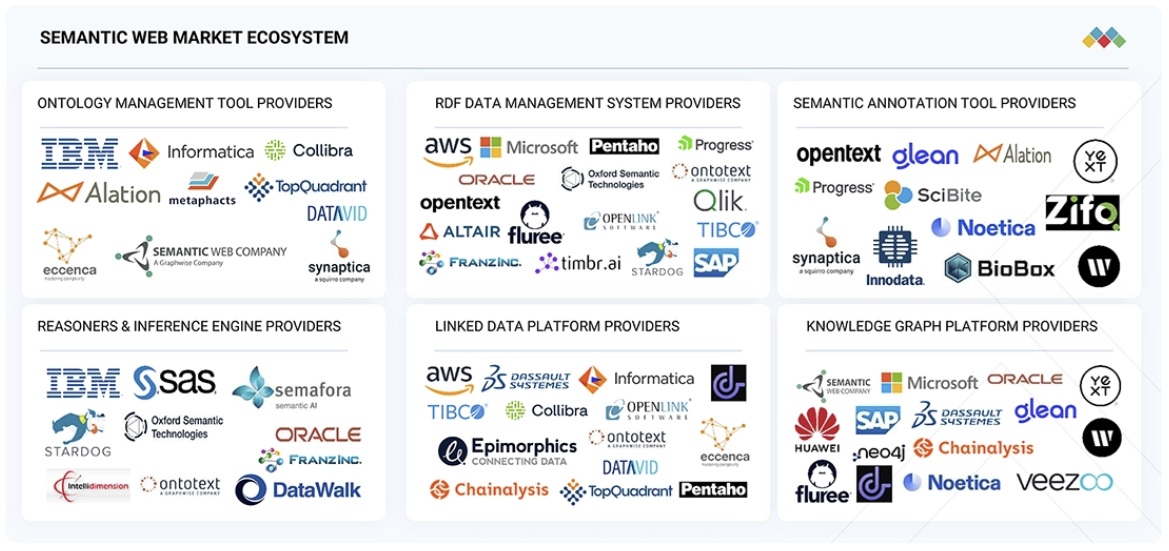
Semantic Web Market – Global Forecast to 2030 – ecosystem
Research Coverage
This research report categorizes the Semantic Web market by offering, technology, application, and vertical. The offering segment is split into semantic web software and semantic web services. The software segment is further split into ontology management tools, RDF data management systems, reasoners & inference engines, linked data platforms, semantic annotation tools, knowledge graph platforms, and other software. The services segment comprises training & consulting services, integration & deployment services, blockchain auditing services, semantic web development services, and semantic web streaming services. The technology segment is divided into core semantic web technologies and adjacent technologies. The semantic web core technologies include RDF, RDFS, OWL, SPARQL, URIs, ontologies, linked data principles, and semantic annotations. The adjacent technologies include AI & machine learning, edge computing, cloud & big data, and blockchain. The application segment spans knowledge & data management, data interoperability & integration, IoT & smart environments, semantic annotations, web & digital annotations, and other applications (digital assets, DAOS & decentralized governance, and decentralized identity & privacy). The vertical segment is split into BFSI, retail & e-commerce, healthcare & life sciences, IT & software, media & entertainment, telecommunications, logistics, energy & utilities, government, and other verticals. The regional analysis of the market covers North America, Europe, Asia Pacific, the Middle East & Africa (MEA), and Latin America.
The report’s scope encompasses detailed information on the major factors, including drivers, restraints, challenges, and opportunities, that influence the growth of the semantic web market. A detailed analysis of key industry players has been conducted to provide insights into their business overview, solutions, and services, as well as key strategies, contracts, partnerships, agreements, product & service launches, mergers and acquisitions, and recent developments associated with the semantic web market. This report provides a competitive analysis of emerging startups in the semantic web market ecosystem.
Key Benefits of Buying the Report
The report will provide market leaders and new entrants with information on the closest approximations of the revenue numbers for the overall semantic web market and its subsegments. It would help stakeholders understand the competitive landscape and gain more insights to better position their business and plan suitable go-to-market strategies. It also helps stakeholders understand the pulse of the market and provides them with information on key market drivers, restraints, challenges, and opportunities.
The report provides insights into the following pointers:
Analysis of key drivers (Growing use of knowledge graphs fuels demand for structured, explainable data infrastructure, W3C standard updates are improving interoperability and driving enterprise confidence in long-term adoption, Stringent mandates on ‘FAIR’ data across regulated sectors are pushing organizations toward semantic data models, Expanding cloud-based graph and ontology services is lowering entry barriers and broadening commercial uptake), restraints (Persistent shortage of ontology and reasoning talent slowing project delivery and increasing deployment costs, Performance constraints in reasoning and inference limit real-time scalability and reduce enterprise readiness), opportunities (Domain-specific ontologies in healthcare, finance, and energy create high-value semantic solutions, Neural-symbolic integration allows vendors to extend semantic reasoning into Gen AI and hybrid AI platforms, Linked-data commercialization enables monetization of curated semantic datasets through APIs and marketplaces, Semantic extensions in BI and data catalogs expand adoption by embedding ontology layers in existing enterprise tools), and challenges (Maintaining ontology consistency across federated and evolving datasets remains a technical barrier to scale, Integrating semantic and relational systems without adding latency or redundancy remains a key engineering challenge)
- Product Development/Innovation: Detailed insights into upcoming technologies, research & development activities, and product & service launches in the semantic web market
- Market Development: Comprehensive information about lucrative markets – analysis of the semantic web market across varied regions
- Market Diversification: Exhaustive information about new products & services, untapped geographies, recent developments, and investments in the semantic web market
- Competitive Assessment: In-depth assessment of market shares, growth strategies and service offerings of IBM (US), AWS (US), Oracle (US), Microsoft (US), SAP (Germany), Dassault Systems (France), Altair (Siemens) (US), Progress Software (US), Huawei (China), OpenText (Canada), Informatica (US), Yext (US), Glean (US), Zifo RnD Solutions (India), Collibra (Belgium), TIBCO (US), Qlik (US), SAS Institute (US), Neo4j (US), Chainalysis (US), Pentaho (Hitachi Vantara) (US), Fluree (US), SciBite (Elsevier) (US), Data Graphs (UK), Noetica AI (US), Veezoo (Switzerland), Datavid (UK), Writer (US), Alation (US), Stardog (US), Ontotext (GraphWise) (Bulgaria), Semantic Web Company (GraphWise) (Austria), Metaphacts (Germany), Franz Inc. (US), eccenca (Germany), OpenLink Software (US), TopQuadrant (US), Synaptica (Squirro) (US), Timbr (Israel), Oxford Semantic Technologies (Samsung) (UK), and BioBox Analytics (Canada), among others, in the semantic web market. The report also helps stakeholders understand the pulse of the semantic web market, providing them with information on key market drivers, restraints, challenges, and opportunities.