
| 出版社 | MarketsandMarkets |
| 出版年月 | 2025年10月 |
Natural Gas Power Generation Market – Global Forecast To 2030

天然ガス発電市場 – 技術(コンバインドサイクル、オープンサイクル、コージェネレーション)、エンドユーザー(電力会社、産業、住宅、商業)、燃料源(パイプライン、液化)、発電量、地域別 – 2030年までの世界予測
世界の天然ガス発電市場は、2025年の969億5,000万米ドルから2030年には1,224億9,000万米ドルへと、年平均成長率(CAGR)4.8%で成長すると予測されています。天然ガス発電市場は、よりクリーンで柔軟性の高いエネルギー源に対する世界的な需要の高まりによって牽引されています。急速な都市化と工業化は、特に新興国において電力消費量を増加させています。石炭に比べて炭素排出量が比較的少ない天然ガスは、環境規制が厳格化する中で、移行燃料として好まれています。コンバインドサイクル技術とオープンサイクル技術の進歩は、効率性を向上させ、運用コストを削減します。さらに、天然ガス発電所は系統安定性と迅速な立ち上げ能力を備えており、不安定な再生可能エネルギー源の統合を支援します。LNG取引の増加は、燃料のアクセス性をさらに向上させます。
本レポートは、天然ガス発電市場を技術、燃料源、発電量、エンドユーザーの観点から定義、説明、予測しています。また、市場の詳細な定性・定量分析も提供しています。主要な市場推進要因、制約要因、機会、課題について包括的な分析を提供しています。さらに、市場の様々な重要な側面についても網羅しており、競争環境、市場ダイナミクス、市場規模予測、そして天然ガス発電市場の将来動向の分析も含まれています。
天然ガス発電市場は、よりクリーンで柔軟なエネルギー源への世界的な移行、特に各国が炭素排出量の削減と安定した電力供給の確保を目指していることから、牽引役となっています。天然ガスは石炭や石油に比べて排出量が少ない代替エネルギー源であり、産業、商業、住宅部門における増大する電力需要を満たすのに最適です。急速な立ち上げ能力は、系統の安定性と、太陽光や風力といった間欠的な再生可能エネルギー源の統合を支えます。政府の支援政策、排出規制、そしてよりクリーンな燃料に対するインセンティブは、ガス火力発電所への投資を促しています。コンバインドサイクル、オープンサイクル、そしてLNGインフラにおける技術の進歩は、効率性の向上、運用コストの削減、そしてエネルギー安全保障の向上に役立っています。持続可能で信頼性の高い電力への需要が高まる中、天然ガスは世界的なエネルギー移行における重要な橋渡し燃料であり続けています。
Report Description
The global natural gas power generation market is expected to grow from USD 96.95 billion in 2025 to USD 122.49 billion in 2030, with a CAGR of 4.8%. The natural gas power generation market is driven by the increasing global demand for cleaner and more flexible energy sources. Rapid urbanization and industrialization are boosting electricity consumption, particularly in emerging economies. The relatively lower carbon emissions of natural gas compared to coal make it a preferred transition fuel amid tightening environmental regulations. Advancements in combined cycle and open cycle technologies enhance efficiency and reduce operational costs. Additionally, natural gas power plants offer grid stability and quick ramp-up capabilities, supporting the integration of intermittent renewable energy sources. Rising LNG trade further improves fuel accessibility.
The natural gas power generation market is dominated by a few major players that have a wide regional presence. The leading players in the natural gas power generation market are GE Vernova (US), Siemens Energy (Germany), Tecogen, Inc. (US), Destinus Energy (US), Bechtel Corporation (US), Fluor Corporation (US), Worley (Australia), MITSUBISHI HEAVY INDUSTRIES, LTD. (Japan), Caterpillar Inc. (US), Wärtsilä (Finland), McDermott (US) and Clarke Energy (UK), among others.
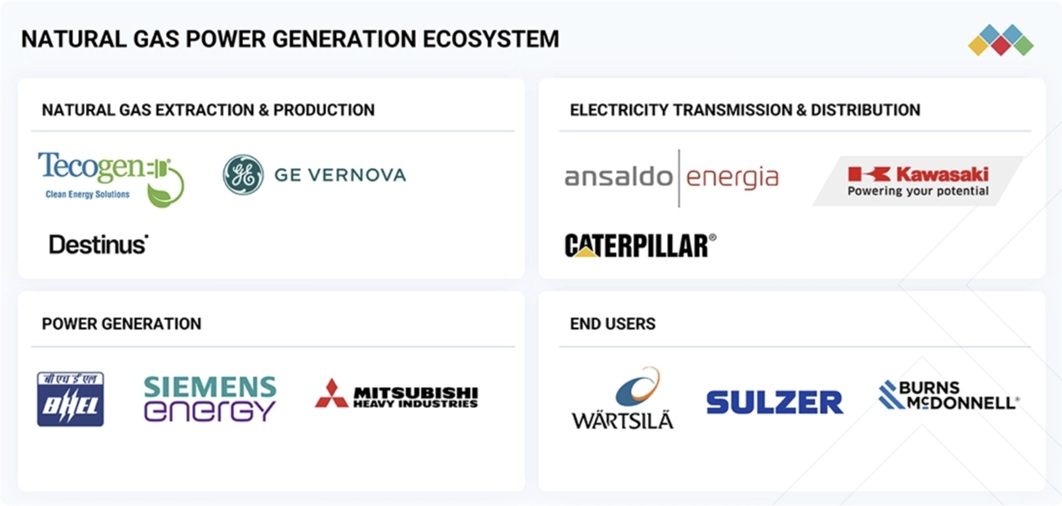
Natural Gas Power Generation Market – Global Forecast To 2030 – ecosystem
Study Coverage:
The report defines, describes, and forecasts the natural gas power generation market by technology, fuel source, power output, and end user. It also offers a detailed qualitative and quantitative analysis of the market. The report provides a comprehensive review of the major market drivers, restraints, opportunities, and challenges. It also covers various important aspects of the market. These include an analysis of the competitive landscape, market dynamics, market estimates in terms of value, and future trends in natural gas power generation market.
Key Benefits of Buying the Report
- The natural gas power generation market is driven by the global transition toward cleaner and more flexible energy sources, particularly as countries aim to reduce carbon emissions while ensuring a reliable electricity supply. Natural gas offers a lower-emission alternative to coal and oil, making it ideal for meeting growing power demand in industrial, commercial, and residential sectors. Its fast ramp-up capabilities support grid stability and the integration of intermittent renewable energy sources such as solar and wind. Supportive government policies, emission regulations, and incentives for cleaner fuels are encouraging investment in gas-fired power plants. Technological advancements in combined cycle, open cycle, and LNG infrastructure are enhancing efficiency, reducing operational costs, and improving energy security. With the rising need for sustainable and reliable power, natural gas remains a crucial bridge fuel in the global energy transition.
- Product Development/Innovation: The natural gas power generation market is advancing through technological innovations aimed at improving efficiency, flexibility, and environmental performance. Companies are focusing on combined cycle and open cycle advancements that maximize energy output while reducing fuel consumption and emissions. Innovations in turbine design, heat recovery systems, and combustion technologies are enhancing operational efficiency and lowering greenhouse gas intensity. Modular and scalable gas-fired power plants enable faster deployment and flexible integration with renewable energy sources. Digitalization, including real-time monitoring, predictive maintenance, and smart grid integration, is optimizing plant performance and reliability. Additionally, developments in carbon capture, hydrogen blending, and co-firing strategies are further reducing the environmental footprint of natural gas power generation, making it a key transitional technology in the global shift toward sustainable energy.
- Market Development: In September 2025, Electricity Supply Board (ESB) of Ireland and GE Vernova partnered on a major life extension and modernization project for the Dublin Bay power plant to boost performance, reliability, output, and support Ireland’s Net Zero 2040 targets. Under a new service agreement, GE Vernova will deploy its GT26 High Efficiency (HE) upgrade, SEMIPOL technology for Static Excitation Equipment (SEE), and Startup Frequency Converter (SFC). The project, scheduled for completion in 2026, will modernize the facility, which was commissioned in 2002 and currently produces up to 415 MW with a single-shaft GT26 gas turbine.
- Market Diversification: In August 2025, GE Vernova will invest in its Quebec factories at Sorel-Tracy (hydropower) and La Prairie (grid) sites. The move aligns with Hydro-Québec’s USD 200 billion 2035 Action Plan, including USD 150 billion in capital expansion to upgrade the grid, boost hydropower and wind capacity, and modernize infrastructure. GE Vernova’s expansion aims to strengthen energy resilience, meet customer needs, and support long-term energy security.
- Competitive Assessment: Assessment of rankings of some of the key players, including of GE Vernova (US), Siemens Energy (Germany), Tecogen, Inc. (US), Destinus Energy (US), Bechtel Corporation (US), Fluor Corporation (US), Worley (Australia), MITSUBISHI HEAVY INDUSTRIES, LTD. (Japan), Caterpillar Inc. (US), Wärtsilä (Finland), McDermott (US) and Clarke Energy (UK), among others.