
| 出版社 | MarketsandMarkets |
| 出版年月 | 2025年7月 |
In-building Wireless Market – Global Forecast to 2030

この市場調査では、ビル内ワイヤレス市場の規模と、提供内容(ハードウェア、ソフトウェア、サービス)、ハードウェア(ヘッドエンドユニット、リモートユニット、リピーター、アンテナ、フェムトセル、その他のハードウェア)、ソフトウェア(ネットワークの計画と設計、ネットワーク管理、その他のソフトウェア)、サービス(プロフェッショナル、導入と統合、トレーニング、サポートとメンテナンス、ネットワーク設計サービス、マネージドサービス)、テクノロジー(DAS、アクティブ、パッシブ、ハイブリッド、DRS、DSC、その他のテクノロジー)、ビジネスモデル(サービスプロバイダー、企業、ニュートラルホストオペレーター)、建物の規模(大規模ビル、中規模ビル、小規模ビル)、ネットワークタイプ(パブリックネットワーク、プライベートネットワーク)、エンドユーザー(商業キャンパス、政府機関、運輸と物流、接客業、工業と製造業、娯楽とスポーツ施設、教育、ヘルスケア、その他のエンドユーザー)、地域など、さまざまなセグメントにわたる成長の可能性について調査しています。この調査には、主要な市場プレーヤー、その企業プロファイル、製品とビジネス提供に関する主要な観察、最近の動向、市場戦略が含まれています。
The in-building wireless market is estimated to be USD 22.58 billion in 2025 and reach USD 39.46 billion in 2030 at a CAGR of 11.8%, from 2025 to 2030. As over 80% of mobile traffic now originates indoors, businesses are under mounting pressure to deliver seamless, secure, and high-capacity indoor networks. This shift is pronounced in healthcare, logistics, and high-density commercial campuses, where latency, security, and device density cannot be compromised. A recent collaboration between Cisco and Charter Communications to deliver managed private 5G and Wi-Fi 6 within enterprise environments highlights how service providers are evolving from passive bandwidth suppliers to infrastructure partners offering end-to-end control, security, and orchestration.
ビル内ワイヤレス市場は、2025年には225億8,000万米ドル、2030年には394億6,000万米ドルに達すると予測されており、2025年から2030年にかけて年平均成長率(CAGR)11.8%で成長します。現在、モバイルトラフィックの80%以上が屋内から発生しているため、企業はシームレスで安全かつ大容量の屋内ネットワークの提供を迫られています。この変化は、遅延、セキュリティ、デバイス密度を犠牲にできない医療、物流、高密度の商業キャンパスにおいて顕著です。シスコとチャーターコミュニケーションズが最近提携し、エンタープライズ環境内でマネージドプライベート5GとWi-Fi 6を提供することで、サービスプロバイダーが受動的な帯域幅サプライヤーから、エンドツーエンドの制御、セキュリティ、オーケストレーションを提供するインフラパートナーへと進化していることが浮き彫りになっています。
However, aging infrastructure in Tier-1 urban zones restricts hardware installation and signal propagation, often requiring invasive retrofitting or building-wide rewiring. Moreover, the inconsistent global approach to shared spectrum, such as fragmented CBRS licensing models in the US versus localized spectrum sandboxing in Asia Pacific creates uncertainty for enterprises planning cross-regional wireless strategies. Retrofitting heritage campuses such as Oxford University with modern in-building wireless systems requires customized engineering solutions due to structural constraints and strict preservation guidelines.
しかし、ティア1都市圏の老朽化したインフラは、ハードウェアの設置と信号伝播を制限し、多くの場合、大規模な改修や建物全体の配線工事が必要になります。さらに、米国ではCBRSライセンスモデルが断片化されているのに対し、アジア太平洋地域では地域限定のスペクトルサンドボックス化が進むなど、スペクトル共有に対する世界的なアプローチの一貫性の欠如は、地域をまたぐ無線戦略を計画する企業にとって不確実性を生み出しています。オックスフォード大学のような歴史的キャンパスに最新の建物内無線システムを改修するには、構造上の制約と厳格な保存ガイドラインにより、カスタマイズされたエンジニアリングソリューションが必要となります。
The major players in the in-building wireless market are CommScope (US), Airspan Networks (US), Ericsson (Sweden), Huawei (China), Nokia (Finland), Samsung (South Korea), Comba Telecom (China), ZTE (China), Solid (South Korea), Fujitsu (Japan), NEC (Japan), Sercomm (Taiwan), Amphenol (US), Huber+Suhner (Switzerland), and JMA Wireless (US). These players have adopted various growth strategies, such as partnerships, agreements and collaborations, product launches, product enhancements, and acquisitions to expand their footprint in the in-building wireless market.
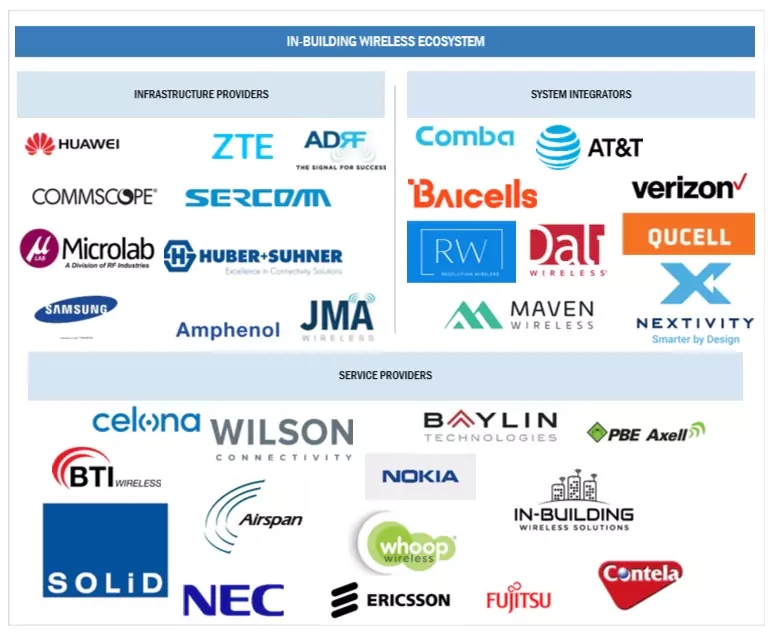
in-building-wireless-market-new-ecosystem
Key Benefits of Buying the Report
The report will help market leaders and new entrants with information on the closest approximations of the global in-building wireless market’s revenue numbers and subsegments. It will also help stakeholders understand the competitive landscape and gain more insights to position their businesses better and plan suitable go-to-market strategies. Moreover, the report will provide insights for stakeholders to understand the market’s pulse and provide them with information on key market drivers, restraints, challenges, and opportunities.
The report provides insights into the following points:
- Analysis of key drivers (rising indoor data consumption, 5G rollout acceleration, enterprise demand for private networks, regulatory push for public-safety das, IoT and smart building integration), restraints (high deployment and hardware costs, complex retrofitting in older buildings, spectrum licensing limitations, integration challenges across multi-vendor systems), opportunities (growth of medium-sized smart buildings, expansion of CBRS and shared spectrum use, neutral host adoption in public venues, AI-driven network optimization, edge computing integration), and challenges (skilled workforce shortages, interference in dense urban environments, evolving compliance standards, long deployment timelines in large infrastructures) influencing the growth of the in-building wireless market
- Product Development/Innovation: Detailed insights into upcoming technologies, research & development activities, and product & service launches in the in-building wireless market
- Market Development: Comprehensive information about lucrative markets – analyzing the in-building wireless market across various regions
- Market Diversification: Exhaustive information about new products & services, untapped geographies, recent developments, and investments in the in-building wireless market
- Competitive Assessment: In-depth assessment of market shares, growth strategies, and service offerings of leading players such as CommScope (US), Airspan Networks (US), Ericsson (Sweden), Huawei (China), Nokia (Finland), Samsung (South Korea), Comba Telecom (China), ZTE (China), Solid (South Korea), Fujitsu (Japan), NEC (Japan), Sercomm (Taiwan), Amphenol (US), Huber+Suhner (Switzerland), and JMA Wireless (US)