
| 出版社 | MarketsandMarkets |
| 出版年月 | 2025年7月 |
Fuel Cell Market – Global Forecast To 2030

本レポートでは、燃料電池市場を、タイプ(プロトン交換膜、固体酸化物、リン酸、アルカリ、微生物、直接メタノール、その他の燃料電池)、燃料タイプ(水素、アンモニア、メタノール、エタノール、その他の燃料タイプ)、コンポーネント(スタックおよびバランスオブプラント(BOP)、用途(ポータブル、定置型、燃料電池車両)、規模(小規模(200kWまで)および大規模(200kW以上))、エンドユーザー(住宅、商業および工業、輸送、データセンター、軍事および防衛、公益事業および政府/地方自治体機関)、および地域(北米、ヨーロッパ、アジア太平洋、その他の地域)別に定義、説明、および予測しています。本レポートの対象範囲は、燃料電池市場の成長に影響を与える推進要因、制約、課題、機会などの主要な要因に関する詳細な情報を網羅しています。主要な業界プレーヤーの徹底的な分析により、事業概要、ソリューション、サービス、契約、パートナーシップ、合意、拡張、製品などの主要戦略に関する洞察が得られています。燃料電池市場における新興企業の立ち上げ、提携、買収、そして最近の動向について分析します。本レポートでは、燃料電池市場エコシステムにおける新興企業の競争力分析を網羅しています。
The global fuel cell market is projected to reach USD 18.16 billion by 2030 from USD 5.66 billion in 2025, registering a CAGR of 26.3%. The global fuel cell market is on a growth trajectory driven by the increasing trend of switching to low-emission and sustainable energy solutions for transportation, power generation, and industrial uses. The current supportive broader political environment, decarbonization targets, and hydrogen infrastructure are enabling expansion in the level of adoption. Fuel cell technology is advancing, leading to improved efficiencies, the development of new materials, and reduced costs. This progress will allow it to expand beyond industrialized nations into other regions. As demand rises, major organizations are increasing their global presence through manufacturing, partnerships, and more comprehensive service options.
世界の燃料電池市場は、2025年の56億6,000万米ドルから2030年には181億6,000万米ドルに達し、年平均成長率(CAGR)26.3%で成長すると予測されています。世界の燃料電池市場は、輸送、発電、産業用途における低排出で持続可能なエネルギーソリューションへの移行の高まりを背景に、成長軌道に乗っています。現在の広範な政治的支援環境、脱炭素化目標、そして水素インフラの整備は、燃料電池の普及拡大を後押ししています。燃料電池技術は進歩しており、効率性の向上、新素材の開発、コスト削減につながっています。この進歩により、燃料電池は先進国だけでなく他の地域にも拡大していくでしょう。需要の増加に伴い、大手企業は製造、パートナーシップ、そしてより包括的なサービスオプションを通じて、世界的なプレゼンスを高めています。
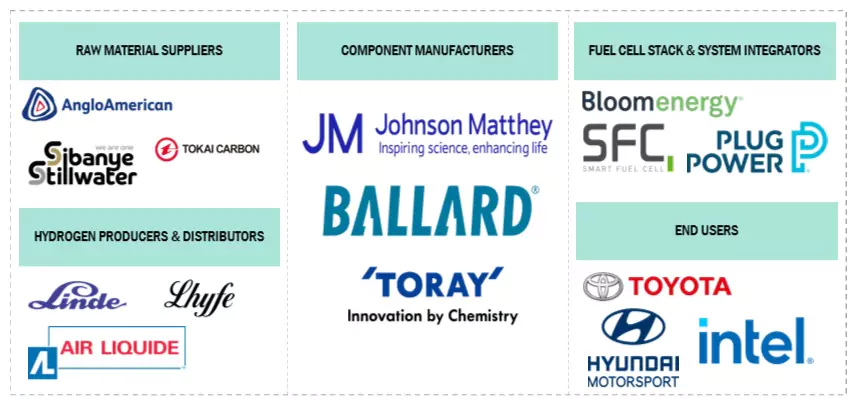
Bloom Energy (US), Plug Power Inc. (US), AISIN CORPORATION (Japan), Ballard Power Systems (Canada), FuelCell Energy, Inc. (US), KYOCERA Corporation (Japan), Doosan Fuel Cell Co., Ltd. (South Korea), Cummins Inc. (US), MITSUBISHI HEAVY INDUSTRIES, LTD. (Japan), ElringKlinger AG (Germany), TOSHIBA CORPORATION (Japan), Nedstack Fuel Cell Technology BV (Netherlands), PowerCell Sweden AB (Sweden), SFC Energy AG (Germany), AFC Energy (UK), Fuji Electric Co., Ltd. (Japan), Intelligent Energy Limited (UK), Horizon Fuel Cell Technologies (Singapore), Hyster-Yale Materials Handling, Inc. (US), AVL (Austria), ADELAN (UK), Ecospray Technologies S.r.l. (Italy), and Special Power Sources (US) are key players in the fuel cell market. The study includes an in-depth competitive analysis of these key players in the fuel cell market, with their company profiles, recent developments, and key market strategies.
fuel-cell-market-new-ecosystem
Key Benefits of Buying the Report:
- The report includes the analysis of key drivers (Burgeoning adoption of low-carbon vehicles to address climate change, rising implementation of strict carbon emission regulations, quicker refueling time and more extended range of FCEVs than BEVs, and growing emphasis on decarbonizing maritime industry), restraints (Requirement for expensive materials and complex manufacturing processes, high flammability of hydrogen), opportunities (Implementation of incentive programs to support distributed power generation, governments’ focus on initiating hydrogen programs), and challenges (High adoption of BEVs with increasing investment in lithium-ion batteries, supply chain bottlenecks, and lack of infrastructure for hydrogen production and refueling.)
- Product Development/Innovation: Fuel cell manufacturers continually capitalize on new materials, automated production, and modular systems to optimize performance and cost. We see several new advancements in the fuel cell market, including AI-based performance monitoring, digital twin models to check stacks, and predictive maintenance to improve reliability and lifespan. The market is embracing emerging catalysts, low-platinum and non-platinum options, and advanced membranes to produce higher levels of efficiency and decreased environmental impact. These possibilities enable fuel cell companies to deliver high levels of performance, scalable and clean energy solutions in response to global decarbonization and distributed energy expectations.
- Market Development: In February 2025, Bloom Energy and Equinix signed a partnership deal for over 100 megawatts of fuel cell capacity across 19 Equinix data centers in six US states. Starting from a 1 MW pilot in 2015, the partnership now includes 75 MW operational and 30 MW under construction, providing cleaner, on-site power to meet the growing energy demands of AI-driven computing. Bloom’s fuel cells offer reliable electricity with minimal environmental impact, enhancing Equinix’s sustainability efforts and reducing reliance on traditional grid power. This report provides a detailed analysis of fuel cell manufacturers’ strategies critical for project success, providing stakeholders with actionable insights into trends and opportunities for growth in the fuel cell market.
- Market Diversification: The report offers a comprehensive analysis of the strategies employed by manufacturers to facilitate market diversification. It outlines innovative products, operating models, and new partnership frameworks across various regions, which are underpinned by technology-driven business lines. The findings emphasize opportunities for expansion beyond traditional operations, identifying geographical areas and customer segments that are currently served but remain underserved and are suitable for strategic entry.
- Competitive Assessment: The report provides in-depth assessment of market shares, growth strategies, and service offerings of leading players, such as Bloom Energy (US), Plug Power Inc. (US), AISIN CORPORATION (Japan), Ballard Power Systems (Canada), FuelCell Energy, Inc. (US), KYOCERA Corporation (Japan), Doosan Fuel Cell Co., Ltd. (South Korea), Cummins Inc. (US), MITSUBISHI HEAVY INDUSTRIES, LTD. (Japan), ElringKlinger AG (Germany), TOSHIBA CORPORATION (Japan), Nedstack Fuel Cell Technology BV (Netherlands), PowerCell Sweden AB (Sweden), among others, in the fuel cell market.