
| 出版社 | MarketsandMarkets |
| 出版年月 | 2025年9月 |
Cathode Materials Market – Global Forecast to 2030

正極材料市場 – 電池の種類(鉛蓄電池、リチウムイオン電池、ニッケルカドミウム電池(NiCd))、材質(リチウムイオン電池(LFP、LCO、NMC、NCA、LMO)、二酸化鉛)、最終用途(自動車、民生用電子機器、産業用)、および地域別 – 2030年までの世界予測
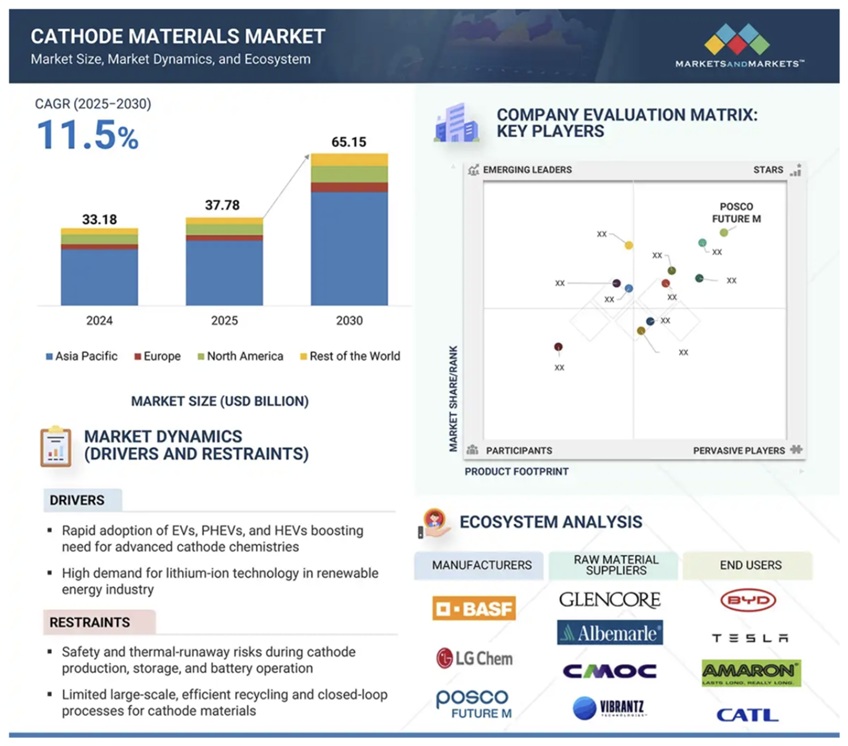
世界のカソード材料市場は、予測期間中に年平均成長率11.5%で成長し、2025年の377億8,000万米ドルから2030年には651億5,000万米ドルに達すると予測されています。
正極材料市場は急速に拡大しており、これらの化合物は現代の充電式電池の性能と信頼性に不可欠であり続けています。正極材料は正極として機能し、エネルギー密度、電圧出力、サイクル寿命といった重要な電池特性を左右します。主要な化学組成には、ニッケルマンガンコバルトリチウム(NMC)、リン酸鉄リチウム(LFP)、ニッケルコバルトアルミニウム(NCA)、コバルト酸リチウム(LCO)、マンガン酸リチウム(LMO)などがあり、それぞれがコスト、安定性、エネルギー容量の独自のバランスを提供しています。需要は主要な電池タイプに及びますが、特にリチウムイオン電池は電気自動車、携帯型電子機器、定置型エネルギー貯蔵システムの用途で主流となっています。自動車、民生用電子機器、産業用電力といった最終用途産業は成長を続けており、より高度な化学組成と大規模生産が求められています。同時に、固体合成や共沈法といった製造プロセスの改善により、製品の一貫性と拡張性が向上しています。ギガファクトリーへの投資増加、クリーンエネルギー導入に対する政府のインセンティブ、そして高ニッケル・コバルトフリー正極に関する継続的な研究が、市場の勢いを強めています。これらの要因が相まって、正極材料は世界的な電化と持続可能なエネルギーソリューションへの移行の礎となるでしょう。
本レポートは、正極材料市場を材料、電池の種類、最終用途、地域に基づいて定義、セグメント化し、予測しています。市場の成長に影響を与える主要要因(牽引要因、制約要因、機会、課題など)に関する詳細な情報を提供しています。また、正極材料メーカーを戦略的にプロファイリングし、市場シェアとコアコンピテンシーを包括的に分析するとともに、買収、契約、合弁事業、事業拡大といった競合動向を追跡・分析しています。
本レポートは、正極材料市場とそのセグメントの収益数値に関する最も近似値を提供することで、市場リーダー/新規参入企業を支援することが期待されています。また、ステークホルダーが市場の競争環境をより深く理解し、事業の地位向上のための洞察を獲得し、適切な市場開拓戦略を策定する上でも役立つことが期待されます。さらに、ステークホルダーが市場の動向を把握し、主要な市場牽引要因、制約要因、課題、そして機会に関する情報を提供することを可能にします。
The global cathode materials market is projected to grow from USD 37.78 billion in 2025 to USD 65.15 billion by 2030, at a CAGR of 11.5% during the forecast period. The cathode materials market is expanding rapidly as these compounds remain essential to the performance and reliability of modern rechargeable batteries. Serving as the positive electrode, cathode materials govern critical battery characteristics such as energy density, voltage output, and cycle life. Key chemistries include lithium nickel manganese cobalt (NMC), lithium iron phosphate (LFP), nickel cobalt aluminum (NCA), lithium cobalt oxide (LCO), and lithium manganese oxide (LMO), each offering distinct balances of cost, stability, and energy capacity. Demand spans major battery types, particularly lithium-ion, which dominates applications in electric vehicles, portable electronics, and stationary energy storage systems. End-use industries such as automotive, consumer electronics, and industrial power continue to grow, requiring ever more advanced chemistries and large-scale production. At the same time, improvements in manufacturing processes, including solid-state synthesis and co-precipitation, are enhancing product consistency and scalability. Rising investments in gigafactories, government incentives for clean energy adoption, and ongoing research into high-nickel and cobalt-free cathodes reinforce market momentum. These combined factors position cathode materials as a cornerstone of the global transition toward electrification and sustainable energy solutions.
XTC New Energy Materials (Xiamen) Co., Ltd. (China), Shenzhen Dynanonic Co., Ltd. (China), Hunan Yuneng New Energy Battery Materials Co., Ltd. (China), LANDF CORP. (South Korea), POSCO FUTURE M (South Korea), and BASF (Germany) are some of the major players operating in the cathode materials market. The key players have adopted agreements, joint ventures, partnerships, expansions, acquisitions, investments, memorandum of understanding (MoU), collaborations, and contracts to increase their market share and business revenue.
Cathode Materials Market – Global Forecast to 2030
Reasons to Buy the Report:
The report is expected to help the market leaders/new entrants by providing them with the closest approximations of revenue numbers of the cathode materials market and its segments. This report is also expected to help stakeholders obtain an improved understanding of the market’s competitive landscape, gain insights to improve the position of their businesses, and develop suitable go-to-market strategies. It also enables stakeholders to understand the market’s pulse and provides information on key market drivers, restraints, challenges, and opportunities.
The report provides insights on the following pointers:
- Analysis of critical drivers (rapid adoption of EVs, PHEVs, and HEVs boosting need for advanced cathode chemistries, high demand for lithium-ion technology in renewable energy industry, and expanding consumer electronics market sustaining steady demand), restraints (safety and thermal-runaway risks during cathode production, storage, and battery operation), opportunities (breakthroughs in solid-state batteries and novel chemistries such as LMFP, high-manganese, or cobalt-free cathodes and regional supply-chain localization and government incentives encouraging new cathode plants), and challenges (maintaining product consistency while ramping high-volume production, navigating evolving environmental regulations and carbon-footprint requirements, and ensuring long-term supply security for critical raw materials) influencing the growth of the cathode materials market.
- Product Development/Innovation: Detailed insights on upcoming technologies and research & development activities in the cathode materials market.
- Market Development: Comprehensive information about lucrative markets – the report analyses the cathode materials market across varied regions.
- Market Diversification: Exhaustive information about new products, various types, untapped geographies, recent developments, and investments in the cathode materials market.
- Competitive Assessment: In-depth assessment of market shares, growth strategies, and product offerings of leading players such as XTC New Energy Materials (Xiamen) Co., Ltd. (China), Shenzhen Dynanonic Co., Ltd. (China), Hunan Yuneng New Energy Battery Materials Co., Ltd. (China), LANDF CORP. (South Korea), POSCO FUTURE M (South Korea), and BASF (Germany).