
| 出版社 | Juniper Research |
| 出版年月 | 2025年8月 |
Smart Buildings Market: 2025-2030

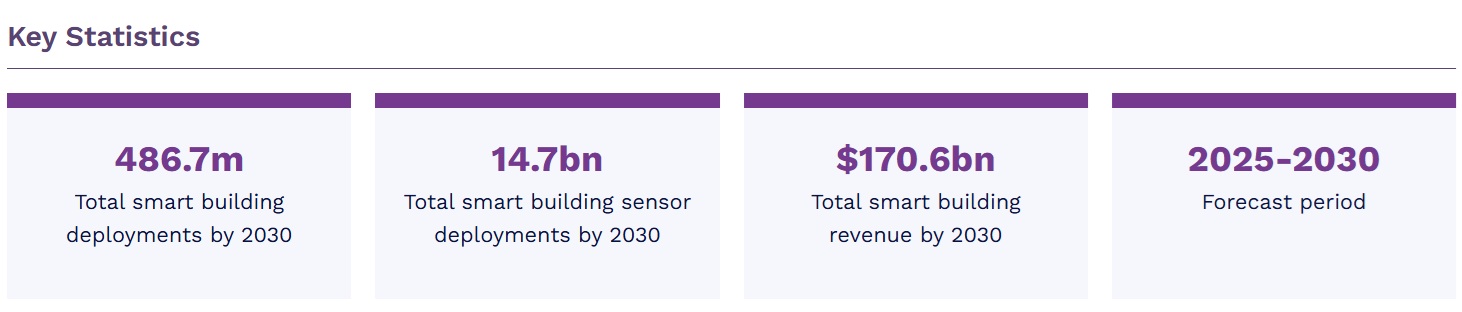
Juniper Researchのスマート ビルディング研究スイートでは、ハードウェアおよびソフトウェア サービス プロバイダーがモノのインターネット (IoT) と AI を使用して、スマート ビルディング ソリューションを生きたエコシステムとしてどのように再考しているかについて、詳細な分析と評価を提供します。
このレポートには、61カ国における市場規模の分析と、商業、工業、住宅の3つの市場セグメントにおける主要な予測データを提供するデータ成果物が含まれています。また、主要なトレンド、課題、そしてステークホルダーへの推奨事項を包括的に評価した市場動向と戦略に関するドキュメントも含まれています。これらを総合的に活用することで、急速に発展するこの市場を理解するための重要なツールとなり、ビルディングオートメーションベンダー、IoTベンダー、エネルギー消費管理ベンダー、スマートビルディングベンダーが将来の戦略を策定するのに役立ちます。
Overview
Our Smart Buildings research suite provides in-depth analysis and evaluation of how hardware and software service providers are reimagining smart building solutions as living ecosystems, using Internet of Things (IoT) and AI.
Smart Buildings Market 2025-2030
The suite includes a data deliverable; sizing the market and providing key forecast data across 61 countries and three market segments – Commercial, Industrial, and Residential. It also includes a Market Trends and Strategies document, which gives a complete assessment of the key trends, challenges, and recommendations for stakeholders. Collectively, they provide a critical tool for understanding this rapidly emerging market; allowing building automation vendors, IoT vendors, energy consumption management vendors, and smart building vendors to shape their future strategy.
All report content is delivered in the English language.
Key Features
- Key Takeaways & Strategic Recommendations: In-depth analysis of key development opportunities and findings within the smart buildings market; accompanied by key strategic recommendations for stakeholders.
- Market Dynamics: Insights into key trends and market expansion challenges within the market; addressing challenges posed by the highly technical nature of smart building systems, as well as ongoing consumer and building manager fears regarding security, privacy and the future impacts of industry 5.0. It analyses economical drivers (energy costs from energy consumption and carbon emission tracking, and net zero goals driving energy efficiency) as well as technological drivers (smart technology such as IoT technologies and digital transformation) within the market. Our Smart Buildings market research also includes a regional market growth analysis on the current development and segment growth of the smart building market in 61 countries; providing a future outlook.
- Benchmark Industry Forecasts: The business overview of smart building service providers includes forecasts for total revenue for smart building technologies, split by commercial, industrial, and residential sectors.
- Juniper Research Competitor Leaderboard: Key player capability and capacity assessment for 18 network operators, via the Juniper Research Competitor Leaderboard.
Competitor Leaderboard Report
This market study includes a Competitor Leaderboard report, which provides detailed evaluation and market positioning of 18 smart buildings vendors. The vendors are positioned as established leaders, leading challengers, or disruptors and challengers, based on product and capability assessments.
Juniper Research’s Competitor Leaderboard for Smart Buildings includes the following key players:
- ABB
- Avnet
- Bosch
- Carrier Global Corporation
- Cisco Systems
- Delta Controls
- Hitachi
- Honeywell
- Huawei
- IBM
- Intel
- Johnson Controls
- Legrand
- Schneider Electric
- Siemens
- Telit Cinterion
- Verdigris Technologies
- Boldyn Networks
プレスリリース
Industrial Smart Buildings: Energy Wastage and Bespoke Vertical Solutions to Drive 525% Surge in Deployments by 2030
Hampshire, UK – 12th August 2025: Juniper Research, the foremost experts in IoT markets, forecasts that global industrial smart building deployments will grow from 26 million in 2025 to over 165 million by 2030.
To achieve this growth, Juniper Research believes that leading platforms must develop bespoke solutions that tackle vertical-specific pain points, as well as driving greater energy efficiency.
“We have identified technologies that reduce energy consumption as key to attracting new smart building users. The increasing pressure to reduce operational spend on buildings, driven by global rising energy prices, is driving interest in solutions that enable sustainability goals to be met,” explains Frederick Savage, Senior Market Data Analyst.
Technologies for Reducing Energy Waste
Juniper Research expects cloud-based energy management systems in smart building platforms; ideal for achieving sustainability initiatives. These solutions enable building owners to adjust energy usage based on real-time information on occupancy and operations; reducing energy waste.
This will be most evident in industries such as healthcare, manufacturing and retail that require high energy usage for machinery. However, levels of requirement vary in each industry, and we expect companies tailoring energy management solutions to each requirement the likeliest to succeed.
According to Savage, “Smart building platforms’ most substantial challenge is demonstrating a return on investment into energy management systems. This will be most notable when targeting building managers in nascent industries, where there will be little real-world evidence on the benefits of smart building technology.”
About the Research Suite
The smart building market will place more attention on key industry verticals for deployment; particularly in education and healthcare. The new research suite offers the most comprehensive assessment of smart building market revenue prospects and strategies to date, including insightful market analysis and in-depth forecasts for 61 countries. The report includes a dataset covering a five-year period, a ‘Competitor Leaderboard’, and an examination of current and future market opportunities.