
LED Chip Market Size, Share, Trends and Forecast by Product, Application, and Region, 2026-2034
LEDチップ市場の規模、シェア、動向、および製品別、用途別、地域別の予測 2026-2034年
| 出版 | IMARC Group |
| 出版年月 | 2026年03月 |
| ページ数 | 149 |
| 価格 | 記載以外のライセンスについてはお問合せください |
| シングルユーザ | USD 3,999 |
| 種別 | 英文調査報告書 |
| 商品番号 | SMR-16674 |

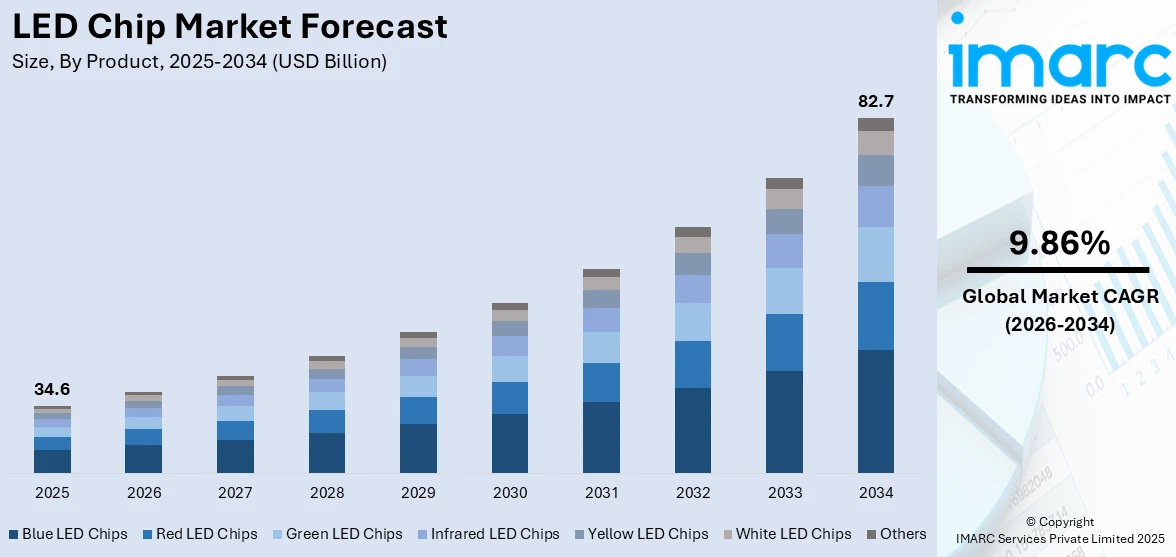
世界のLEDチップ市場規模は、2025年には346億米ドルと評価されました。IMARCグループは、今後、市場規模は2034年までに827億米ドルに達し、2026年から2034年にかけて年平均成長率(CAGR)9.86%で成長すると予測しています。アジア太平洋地域は現在市場を牽引しており、2025年には41.0%を超える大きな市場シェアを占めています。エネルギー効率の高い照明ソリューションへの需要の高まり、自動車や家電製品における用途の拡大、継続的な技術革新、省エネルギーを促進する政府規制、急速な都市化、そして持続可能なインフラ開発への注目の高まりなどが、市場における魅力的な機会を生み出しています。
世界市場は主に、住宅、商業、産業用途といった主要セクターにおけるLEDの採用拡大によって牽引されており、これは持続可能で費用対効果の高いソリューションへの需要の高まりによるものです。さらに、輝度の向上、色品質の向上、寿命の延長など、LED技術の継続的な技術革新が市場の成長を促進しています。さらに、自動車照明、家電製品、屋外ディスプレイにおけるLEDの急速な普及も、市場の成長を後押ししています。これに伴い、政府の有利な規制や省エネ対策の導入も、市場の明るい見通しを後押ししています。例えば、2025年1月6日、インド電力省は、全国で3億6,870万個のLED電球を配布し、年間191億5,300万ルピーの節約を実現したUJALAスキームの10周年を祝いました。このスキームは、エネルギー消費量と二酸化炭素排出量を大幅に削減し、インドの環境持続可能性目標の達成に貢献しています。UJALAスキームは、エネルギー効率と消費者の経済的節約に対する国の取り組みを示す好例です。
Report Overview
The global LED chip market size was valued at USD 34.6 Billion in 2025. Looking forward, IMARC Group estimates the market to reach USD 82.7 Billion by 2034, exhibiting a CAGR of 9.86% during 2026-2034. Asia Pacific currently dominates the market, holding a significant market share of over 41.0% in 2025. The augmenting demand for energy-efficient lighting solutions, expanding applications in automotive and consumer electronics, ongoing technological advancements, government regulations promoting energy conservation, rapid urbanization, and the increasing focus on sustainable infrastructure development are creating lucrative opportunities in the market.
The global market is primarily driven by the growing adoption across key sectors, including residential, commercial, and industrial applications, driven by increasing demand for sustainable and cost-effective solutions. Moreover, continual technological advancements in LED technology, including improved brightness, enhanced color quality, and extended lifespan, are fostering market growth. Additionally, the rapid utilization of LEDs in automotive lighting, consumer electronics, and outdoor displays is further adding to the growth of the market. In line with this, favorable government regulations along with the introduction of energy-saving initiatives are also creating a positive outlook for the market. For instance, on January 6, 2025, the Indian Ministry of Power celebrated the 10th anniversary of the UJALA scheme, which has distributed 36.87 crores (368.7 million) LED bulbs across the country, saving INR 19,153 Crore annually. This scheme has significantly reduced energy consumption and carbon emissions, helping India achieve its environmental sustainability goals. The UJALA scheme is a prime example of the nation’s commitment to energy efficiency and economic savings for consumers.
The United States stands out as a key regional market, driven by the increasing demand for energy-efficient lighting solutions, especially in commercial and industrial sectors. Additionally, the rising usage of IoT-enabled smart lighting solutions across numerous end-use sectors is increasing the overall market penetration. Moreover, an enhanced focus on sustainable urban development and infrastructure modernization is propelling demand for advanced LED chips. Recent industry reports indicate 66% of the cities in United States are making substantial investments in smart city technologies. Notably, on December 10, 2024, Actelis Networks was selected by Seattle, recognized as the smartest city in the U.S., to deploy hybrid fiber-copper networking solutions for a major infrastructure modernization project enhancing connectivity and supporting advanced smart city applications. By upgrading legacy copper networks with hybrid fiber-copper solutions, the initiative aims to enhance smart city applications, benefiting traffic management and public safety systems, highlighting Seattle’s commitment towards urban efficiency and sustainability. Besides, numerous innovations in miniaturized LED chip designs, making their usage more popular across a diverse set of industries, for applications in wearable devices and automobiles, are providing an impetus to the market.
LED CHIP MARKET TRENDS:
Increasing Adoption of Smart Cities
The growth of smart cities has been a prominent driver for the growth of the LED chip market. Notably, the IMARC report states that the global smart cities market size stood at USD 1,233.7 Billion in 2023. Looking ahead, the market is expected to reach USD 4,633.9 Billion by 2032, expanding at a growth rate (CAGR) of 15.4% during 2024-2032. The smart cities are run on energy efficiency and sustainability. The LED lighting takes a very crucial role in the achievement of these goals. LED chips consume much less energy compared to conventional light systems. These factors are expected to drive the share of the LED chip in the market in the near future.
Expanding Automotive Applications
The applications of LEDs are rising in automotive fields, which include headlights, taillights, and interior lighting. This is due to their lower energy consumption, durability, and improved design flexibility are making their demand increase in the automotive industry. As per the industry report, in January 2024, Kenwood released LED headlights for the Indian market. The product will be available in 4300 Kelvin and 6000 Kelvin varieties for cars and SUVs, including H1, H4 / H19, H7, H8, H27, 9005, and 9006. These factors further positively influence the LED chip market forecast.
Ongoing Technological Innovations
Continuous innovations in LED chip technology, such as the development of micro-LEDs and quantum dots, are enhancing performance and expanding applications. These advancements lead to better color accuracy, brightness, and overall user experience. For instance, in May 2024, TCL introduced Next-Generation QD Mini LED Technology. The LED series has an unusual number of dimming zones (up to 5,000), remarkable peak brightness (up to 5,000 nits), and QLED ULTRA technology, which provides 97%+ of the DCI-P3 color gamut and 100% color volume. Its HEXA Mini LED Chip, UWA Optical Lens, and ODR LED Technology provide great brightness, precision light control, and increased optical stability, thereby boosting the LED chip market revenue.
LED Chip Market Report Scope:
| Report Features | Details |
|---|---|
| Base Year of the Analysis | 2025 |
| Historical Period | 2020-2025 |
| Forecast Period | 2026-2034 |
| Units | Billion USD |
| Scope of the Report | Exploration of Historical Trends and Market Outlook, Industry Catalysts and Challenges, Segment-Wise Historical and Future Market Assessment:
|
| Products Covered | Blue LED Chips, Red LED Chips, Green LED Chips, Infrared LED Chips, Yellow LED Chips, White LED Chips, Others |
| Applications Covered | Backlighting, Illumination, Automotive, Signs and Signal, Others |
| Regions Covered | Asia Pacific, Europe, North America, Latin America, Middle East and Africa |
| Companies Covered | AVA Technologies, Inc., Bright LED Electronics Corporation, Cree, Inc., Bridgelux, Inc., Hitachi Cable, Ltd., Huga Optech, Inc., Dowa Electronics Materials Co., Ltd., Epistar Corporation, Nichia Corporation, Formosa Epitaxy, Inc., Goldeneye, Inc., Kingbright Electronic Co. Ltd., Optek Technology (TT Electronic PLC), OSA Opto Light GmbH, Osram Opto Semiconductors GmbH, etc. |
| Customization Scope | 10% Free Customization |
| Post-Sale Analyst Support | 10-12 Weeks |
| Delivery Format | PDF and Excel through Email (We can also provide the editable version of the report in PPT/Word format on special request) |
LED CHIP INDUSTRY SEGMENTATION:
IMARC Group provides an analysis of the key trends in each segment of the global LED chip market, along with forecasts at the global and regional levels from 2026-2034. The market has been categorized based on product and application.
Analysis by Product:
- Blue LED Chips
- Red LED Chips
- Green LED Chips
- Infrared LED Chips
- Yellow LED Chips
- White LED Chips
- Others
Blue LED chips lead the market with around 28.9% of the market share in 2025. According to the LED chip market outlook, blue LED chips are important in many display technologies, such as LCD and OLED screens. Furthermore, their ability to produce bright and vibrant colors makes them indispensable for high-definition televisions, computer monitors, and smartphones, which is driving the market further. Moreover, these chips are increasingly being used in automotive applications, such as headlights and interior lighting, which in turn is fostering market growth. Their bright illumination improves visibility and safety while providing aesthetic appeal.
Analysis by Application:
- Backlighting
- Illumination
- Automotive
- Signs and Signal
- Others
Backlighting leads the market in 2025. LED backlighting, as indicated in the LED chip market overview, is far more energy-efficient compared to traditional lighting technologies such as CCFL, or cold cathode fluorescent lamp. The greater demand for reducing energy consumption and subsequently cutting down the cost of operations boosts the demand for LED backlighting. Furthermore, different types of display technologies such as LCD, OLED, and AMOLED, are becoming very popular, leading to an increase in the demand for LED chips. The rise of backlighting in consumer electronics means there is an ever-growing need for efficient solutions to backlight.
Analysis by Region:
- Asia Pacific
- North America
- Europe
- Middle East and Africa
- Latin America
In 2025, Asia-Pacific accounted for the largest market share of over 41.0%. According to the LED chip market statistics, the Asia Pacific region is experiencing rapid urbanization in such places that add to the construction of associated infrastructure. For instance, fast urbanization places a considerable burden on the commercial and residential sectors in terms of efficient lighting solutions such as LED chips. In addition, the escalating consumer electronics sector in countries such as China, Japan, and South Korea fuel demand for LED chips. Moreover, increased use of LED technology in smartphones, televisions, and other electronic devices is an indicator of the expansion of the market. Apart from this, accelerating demand for electric vehicles in Asia Pacific is also bolstering the growth of the LED chip market. Notably, the market size of electric vehicles in India has been USD 1,327.8 Million in 2023, with IMARC providing an estimate that the market will grow to USD 102,610.8 Million by 2032 at a CAGR of 60.2% in the 2024-2032 period. Electric vehicles usually are fitted with higher lighting systems. Also, LED lights are used for headlights, taillights, and interior illumination.
KEY REGIONAL TAKEAWAYS:
UNITED STATES LED CHIP MARKET ANALYSIS
In 2025, the United States represented 86.40% of the North America LED Chip market driven by the ongoing technological advancements and increased focus on energy efficient solutions. Increasing demand for sustainable solutions for lighting, along with incentives and strict environment regulations given by government, has placed LED chips as one of the best choices for various sectors. The growth of industrial IoT is also fueling the transition towards energy-efficient lighting, with the US industrial IoT market valued at USD 135.6 Billion in 2024, further propelling the need for smart lighting systems integrated with LED technology. LEDs are widely used in consumer electronics, automotive applications, and signage, thereby contributing to the growth of the market. There has been increased adoption of LED lighting solutions as part of smart city development and smart infrastructure integration such as streetlights and public transportation through IoT. Other sectors such as retail and hospitality are increasingly becoming attracted to using LED lighting in their premises mainly due to it reduces costs, provides longer usage lifespan, and ensures improved lighting quality. As consumer awareness of energy conservation increases, LED technology is becoming an integral part of various sectors, including healthcare, agriculture, and residential spaces, which is further strengthening the US position in the global LED chip market.
ASIA PACIFIC LED CHIP MARKET ANALYSIS
The LED chip market in the Asia-Pacific (APAC) region is driven by rapid urbanization, increasing disposable incomes, and government initiatives promoting energy-efficient lighting. According to the World Bank, East Asia and the Pacific has average annual urbanization rate of 3%, marking one of the most rapid urbanization rates. Urban growth is fostering the demand for smart lighting solutions, in particular, LED chips have become the focal point in infrastructure projects in the city. Currently, China, India, and Japan are leading the pack in adopting LED technology in various applications such as electronics, automotive, and public lighting. And incentives and programs backed by governments also accelerate this pace further. Apart from this, the growing affordability of LED chips amid rising awareness of energy conservation, is fueling the continuing shift from conventional lighting to more sustainable solutions. The region’s strong manufacturing capabilities and presence of leading LED chip manufacturers further supports market growth, establishing APAC as a major player in the global LED chip industry.
EUROPE LED CHIP MARKET ANALYSIS
Europe’s LED chip market is primarily driven by stringent environmental regulations and a growing emphasis on sustainability. The commitment to reducing carbon emissions by the European Union has seen energy-efficient LED lighting become the most important focus area in residential, commercial, and industrial sectors. According to industry reports, 90% of European consumers were more attentive to the sustainability of products in 2022, further fueling demand for LED solutions. Government incentives, including tax rebates and subsidies for adopting energy-efficient lighting, are major growth accelerators. Moreover, the growth of smart cities, where LED chips are an integral part of smart lighting systems, supports demand. The commercial sector, especially retail and hospitality, is increasingly opting for LED lighting due to its cost-effectiveness, longer lifespan, and environmental benefits. In addition, the European automotive sector is adopting LED technology for the development of novel vehicle lighting. As consumers demand more sustainable and energy-efficient products, LED chips will play an increasingly crucial role in the lighting industry of Europe, establishing the region as a global market leader.
LATIN AMERICA LED CHIP MARKET ANALYSIS
The LED chip market is growing steadily in Latin America with increasing urbanization and government efforts to promote energy-efficient lighting. Researchers stated that urbanization in Latin American countries has reached nearly 80% and is considerably higher than in most other regions, which is quite significantly fostering demand for modern lighting solutions. The increased interest in energy saving, combined with the availability of LED chips at affordable prices, has led to increased adoption across infrastructure, retail, and residential sectors. Government favorable initiatives for energy-efficient technologies have also contributed to the transition from traditional lighting to LED lighting in the region.
MIDDLE EAST AND AFRICA LED CHIP MARKET ANALYSIS
The Middle East and Africa region is experiencing significant penetration of LED chips, driven by ongoing infrastructure development activities and a strong commitment towards the adoption of energy-efficient technologies. The region’s growing smart cities market is a significant contributor, with a projected CAGR of 22.82% from 2024 to 2032. Countries such as the UAE and Saudi Arabia are leading investments in smart city projects, where LED chips play a crucial role in energy-efficient street lighting and smart infrastructure. Government policies promoting sustainability and energy conservation continue to accelerate the transition to LED lighting across residential, commercial, and automotive sectors.
COMPETITIVE LANDSCAPE:
The global market is highly competitive, driven by ongoing technological advancements and the increasing demand for energy-efficient lighting solutions. Market participants are focusing on developing innovative products such as miniaturized and high-performance chips to cater to diverse applications, including automotive, consumer electronics, and smart lighting. Additionally, strategic partnerships and investments in research and development are also helping companies strengthen their market presence. Adoption of sustainable manufacturing processes and entry into new emerging markets are the other key competitive strategies shaping the market landscape. Notably, On December 10, 2024, Mouser Electronics announced its collaboration with American Bright Optoelectronics as a new authorized distributor for their LED and optoelectronic components. The partnership aims to provide advanced LED solutions, including lighting, automotive, and industrial applications, to meet the growing global demand. Mouser’s portfolio is strengthened by this addition, which furthers the company’s dedication to providing cutting-edge goods to a wide range of client base.
The report provides a comprehensive analysis of the competitive landscape in the LED chip market with detailed profiles of all major companies, including:
- AVA Technologies, Inc.
- Bright LED Electronics Corporation
- Cree, Inc.
- Bridgelux, Inc.
- Hitachi Cable, Ltd.
- Huga Optech, Inc.
- Dowa Electronics Materials Co., Ltd.
- Epistar Corporation
- Nichia Corporation
- Formosa Epitaxy, Inc.
- Goldeneye, Inc.
- Kingbright Electronic Co. Ltd.
- Optek Technology (TT Electronic PLC)
- OSA Opto Light GmbH
- Osram Opto Semiconductors GmbH
KEY QUESTIONS ANSWERED IN THIS REPORT
- How big is the global LED Chip market?
- What is the expected growth rate of the global LED chip market during 2026-2034?
- What are the key factors driving the global LED chip market?
- What are the key regions in the global LED chip market?
- Who are the key players/companies in the global LED chip market?
Table of Contents
1 Preface
2 Scope and Methodology
2.1 Objectives of the Study
2.2 Stakeholders
2.3 Data Sources
2.3.1 Primary Sources
2.3.2 Secondary Sources
2.4 Market Estimation
2.4.1 Bottom-Up Approach
2.4.2 Top-Down Approach
2.5 Forecasting Methodology
3 Executive Summary
4 Introduction
4.1 Overview
4.2 Key Industry Trends
5 Global LED Chip Market
5.1 Market Overview
5.2 Market Performance
5.3 Impact of COVID-19
5.4 Market Breakup by Product
5.5 Market Breakup by Application
5.6 Market Breakup by Region
5.7 Market Forecast
6 Market Breakup by Product
6.1 Blue LED Chips
6.1.1 Market Trends
6.1.2 Market Forecast
6.2 Red LED Chips
6.2.1 Market Trends
6.2.2 Market Forecast
6.3 Green LED Chips
6.3.1 Market Trends
6.3.2 Market Forecast
6.4 Infrared LED Chips
6.4.1 Market Trends
6.4.2 Market Forecast
6.5 Yellow LED Chips
6.5.1 Market Trends
6.5.2 Market Forecast
6.6 White LED Chips
6.6.1 Market Trends
6.6.2 Market Forecast
6.7 Others
6.7.1 Market Trends
6.7.2 Market Forecast
7 Market Breakup by Application
7.1 Backlighting
7.1.1 Market Trends
7.1.2 Market Forecast
7.2 Illumination
7.2.1 Market Trends
7.2.2 Market Forecast
7.3 Automotive
7.3.1 Market Trends
7.3.2 Market Forecast
7.4 Signs and Signal
7.4.1 Market Trends
7.4.2 Market Forecast
7.5 Others
7.5.1 Market Trends
7.5.2 Market Forecast
8 Market Breakup by Region
8.1 Asia Pacific
8.1.1 Market Trends
8.1.2 Market Forecast
8.2 Europe
8.2.1 Market Trends
8.2.2 Market Forecast
8.3 North America
8.3.1 Market Trends
8.3.2 Market Forecast
8.4 Middle East and Africa
8.4.1 Market Trends
8.4.2 Market Forecast
8.5 Latin America
8.5.1 Market Trends
8.5.2 Market Forecast
9 Global LED Chip Industry: SWOT Analysis
9.1 Overview
9.2 Strengths
9.3 Weaknesses
9.4 Opportunities
9.5 Threats
10 Global LED Chip Industry: Value Chain Analysis
10.1 Overview
10.2 Research and Development
10.3 Raw Material Procurement
10.4 Manufacturing
10.5 Marketing
10.6 Distribution
10.7 End-Use
11 Global LED Chip Industry: Porters Five Forces Analysis
11.1 Overview
11.2 Bargaining Power of Buyers
11.3 Bargaining Power of Suppliers
11.4 Degree of Competition
11.5 Threat of New Entrants
11.6 Threat of Substitutes
12 Global LED Chip Industry: Price Analysis
12.1 Price Indicators
12.2 Price Structure
12.3 Margin Analysis
13 LED Chip Manufacturing Process
13.1 Product Overview
13.2 Raw Material Requirements
13.3 Manufacturing Process
13.4 Key Success and Risk Factors
14 Competitive Landscape
14.1 Market Structure
14.2 Key Players
14.3 Profiles of Key Players
14.3.1 AVA Technologies Inc.
14.3.2 Bright LED Electronics Corporation
14.3.3 Cree, Inc.
14.3.4 Bridgelux, Inc.
14.3.5 Hitachi Cable, Ltd.
14.3.6 Huga Optech, Inc.
14.3.7 Dowa Electronics Materials Co., Ltd.
14.3.8 Epistar Corporation
14.3.9 Nichia Corporation
14.3.10 Formosa Epitaxy, Inc.
14.3.11 Goldeneye, Inc.
14.3.12 Kingbright Electronic Co. Ltd.
14.3.13 Optek Technology (TT Electronic PLC)
14.3.14 OSA Opto Light GmbH
14.3.15 Osram Opto Semiconductors GmbH
List of Tables
Table 1: Global: LED Chip Market: Key Industry Highlights, 2025 and 2034
Table 2: Global: LED Chip Market Forecast: Breakup by Product (in Million USD), 2026-2034
Table 3: Global: LED Chip Market Forecast: Breakup by Application (in Million USD), 2026-2034
Table 4: Global: LED Chip Market Forecast: Breakup by Region (in Million USD), 2026-2034
Table 5: LED Chip: Raw Material Requirements
Table 6: Global: LED Chip Market Structure
Table 7: Global: LED Chip Market: Key Players
List of Figures
Figure 1: Global: LED Chip Market: Major Drivers and Challenges
Figure 2: Global: LED Chip Market: Sales Value (in Billion USD), 2020-2025
Figure 3: Global: LED Chip Market: Breakup by Product (in %), 2025
Figure 4: Global: LED Chip Market: Breakup by Application (in %), 2025
Figure 5: Global: LED Chip Market: Breakup by Region (in %), 2025
Figure 6: Global: LED Chip Market Forecast: Sales Value (in Billion USD), 2026-2034
Figure 7: Global: LED Chip Industry: SWOT Analysis
Figure 8: Global: LED Chip Industry: Value Chain Analysis
Figure 9: Global: LED Chip Industry: Porter’s Five Forces Analysis
Figure 10: Global: LED Chip (Blue LED Chips) Market: Sales Value (in Million USD), 2020 & 2025
Figure 11: Global: LED Chip (Blue LED Chips) Market Forecast: Sales Value (in Million USD), 2026-2034
Figure 12: Global: LED Chip (Red LED Chips) Market: Sales Value (in Million USD), 2020 & 2025
Figure 13: Global: LED Chip (Red LED Chips) Market Forecast: Sales Value (in Million USD), 2026-2034
Figure 14: Global: LED Chip (Green LED Chips) Market: Sales Value (in Million USD), 2020 & 2025
Figure 15: Global: LED Chip (Green LED Chips) Market Forecast: Sales Value (in Million USD), 2026-2034
Figure 16: Global: LED Chip (Infrared LED Chips) Market: Sales Value (in Million USD), 2020 & 2025
Figure 17: Global: LED Chip (Infrared LED Chips) Market Forecast: Sales Value (in Million USD), 2026-2034
Figure 18: Global: LED Chip (Yellow LED Chips) Market: Sales Value (in Million USD), 2020 & 2025
Figure 19: Global: LED Chip (Yellow LED Chips) Market Forecast: Sales Value (in Million USD), 2026-2034
Figure 20: Global: LED Chip (White LED Chips) Market: Sales Value (in Million USD), 2020 & 2025
Figure 21: Global: LED Chip (White LED Chips) Market Forecast: Sales Value (in Million USD), 2026-2034
Figure 22: Global: LED Chip (Other Product Types) Market: Sales Value (in Million USD), 2020 & 2025
Figure 23: Global: LED Chip (Other Product Types) Market Forecast: Sales Value (in Million USD), 2026-2034
Figure 24: Global: LED Chip (Backlighting) Market: Sales Value (in Million USD), 2020 & 2025
Figure 25: Global: LED Chip (Backlighting) Market Forecast: Sales Value (in Million USD), 2026-2034
Figure 26: Global: LED Chip (Illumination) Market: Sales Value (in Million USD), 2020 & 2025
Figure 27: Global: LED Chip (Illumination) Market Forecast: Sales Value (in Million USD), 2026-2034
Figure 28: Global: LED Chip (Automotive) Market: Sales Value (in Million USD), 2020 & 2025
Figure 29: Global: LED Chip (Automotive) Market Forecast: Sales Value (in Million USD), 2026-2034
Figure 30: Global: LED Chip (Signs and Signal) Market: Sales Value (in Million USD), 2020 & 2025
Figure 31: Global: LED Chip (Signs and Signal) Market Forecast: Sales Value (in Million USD), 2026-2034
Figure 32: Global: LED Chip (Other Applications) Market: Sales Value (in Million USD), 2020 & 2025
Figure 33: Global: LED Chip (Other Applications) Market Forecast: Sales Value (in Million USD), 2026-2034
Figure 34: Asia Pacific: LED Chip Market: Sales Value (in Million USD), 2020 & 2025
Figure 35: Asia Pacific: LED Chip Market Forecast: Sales Value (in Million USD), 2026-2034
Figure 36: Europe: LED Chip Market: Sales Value (in Million USD), 2020 & 2025
Figure 37: Europe: LED Chip Market Forecast: Sales Value (in Million USD), 2026-2034
Figure 38: North America: LED Chip Market: Sales Value (in Million USD), 2020 & 2025
Figure 39: North America: LED Chip Market Forecast: Sales Value (in Million USD), 2026-2034
Figure 40: Middle East and Africa: LED Chip Market: Sales Value (in Million USD), 2020 & 2025
Figure 41: Middle East and Africa: LED Chip Market Forecast: Sales Value (in Million USD), 2026-2034
Figure 42: Latin America: LED Chip Market: Sales Value (in Million USD), 2020 & 2025
Figure 43: Latin America: LED Chip Market Forecast: Sales Value (in Million USD), 2026-2034
Figure 44: LED Chip Manufacturing: Process Flow