
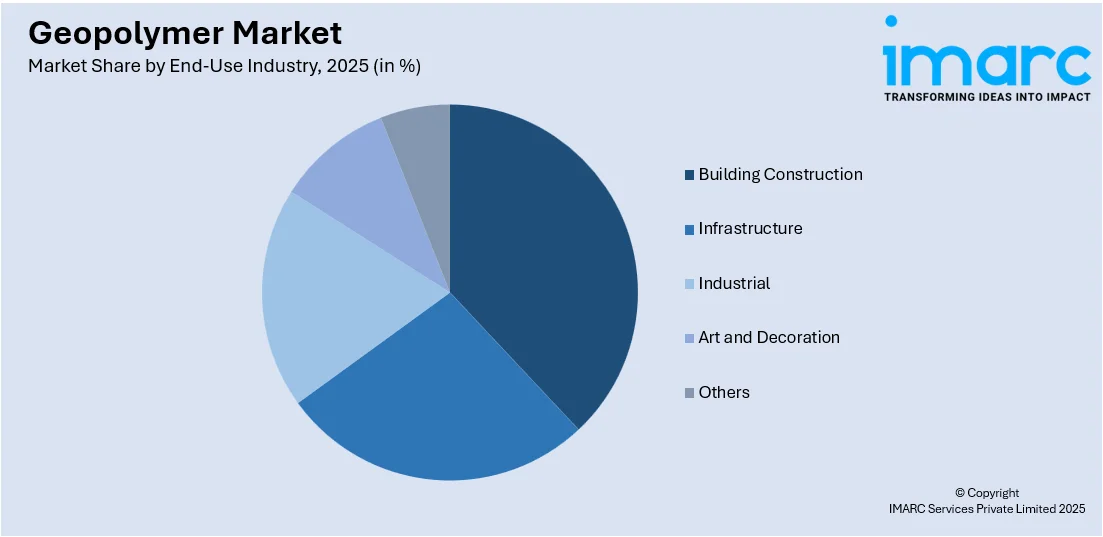
ジオポリマー市場レポート:用途別(セメント・コンクリート、炉・原子炉絶縁体、複合材料、装飾品)、最終用途産業別(建築建設、インフラ、工業、芸術・装飾、その他)、地域別(2026~2034年)
Geopolymer Market Report by Application (Cement and Concrete, Furnace and Reactor Insulators, Composites, Decorative Artifacts), End-Use Industry (Building Construction, Infrastructure, Industrial, Art and Decoration, and Others), and Region 2026-2034
| 出版 | IMARC Group |
| 出版年月 | 2026年03月 |
| ページ数 | 138 |
| 価格 | 記載以外のライセンスについてはお問合せください |
| シングルユーザ | USD 3,999 |
| 種別 | 英文調査報告書 |
| 商品番号 | SMR-1517315173 |

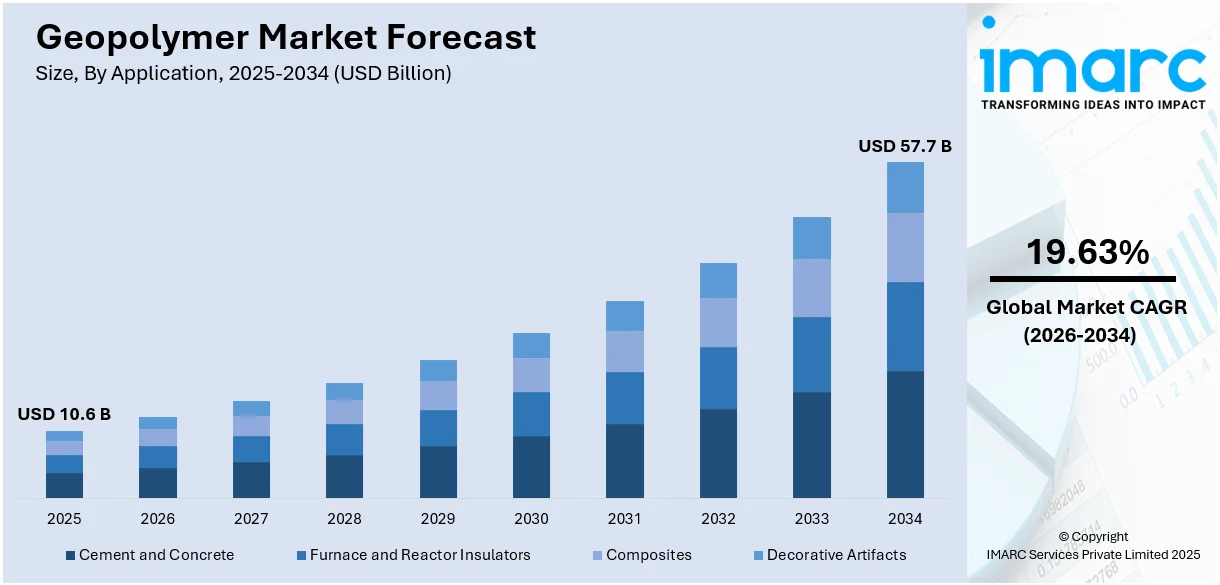
世界のジオポリマー市場規模は2025年に106億米ドルに達しました。IMARCグループは、今後、市場規模が2034年までに577億米ドルに達し、2026年から2034年にかけて年平均成長率(CAGR)19.63%で成長すると予測しています。二酸化炭素排出量を削減するための持続可能な建設手法への関心の高まり、環境汚染に対する意識の高まり、政府の好ましい取り組み、そして廃棄物管理ソリューションに対する需要の増加などが、市場を牽引する主要な要因となっています。
ジオポリマーは、アルミノケイ酸塩材料とアルカリ溶液(通常はフライアッシュやスラグなどの産業副産物を含む)の反応からなる化学プロセスによって製造される鉱物ベースの材料です。純粋無機ジオポリマーとハイブリッドジオポリマーとして広く入手可能です。従来のセメントと比較して、優れた機械的特性、高い耐火性、耐薬品性を備え、二酸化炭素排出量も低減します。建設・インフラプロジェクトにおいて環境に優しく持続可能な選択肢となるため、ジオポリマーの需要は世界中で高まっています。
現在、建設分野における環境に優しく高強度の材料に対する需要の高まりが、市場にプラスの影響を与えています。さらに、世界中で橋梁、トンネル、道路の補修にジオポリマーの利用が増加していることも、市場の成長を後押ししています。さらに、ジオポリマーは製造時のエネルギー消費量を削減するため、需要の高まりも市場を好調に推移させています。さらに、耐火・耐熱コーティングや接着剤におけるこれらのポリマーの利用増加は、業界投資家にとって魅力的な成長機会を提供しています。さらに、地球温暖化抑制へのニーズの高まりも市場の成長を後押ししています。さらに、コンクリートのバインダーとして、ポルトランドセメントに代わる費用対効果の高い代替品に対する需要の高まりも、市場の成長に貢献しています。
本レポートで回答する主要な質問
- 2025年の世界のジオポリマー市場の規模はどの程度でしたか?
- 2026年から2034年にかけての世界のジオポリマー市場の予想成長率はどの程度ですか?
- 世界のジオポリマー市場を牽引する主な要因は何ですか?
- COVID-19は世界のジオポリマー市場にどのような影響を与えましたか?
- 用途別における世界のジオポリマー市場の内訳は?
- 最終用途産業別における世界のジオポリマー市場の内訳は?
- 世界のジオポリマー市場の主要地域は?
- 世界のジオポリマー市場の主要プレーヤー/企業は?
Report Overview
The global geopolymer market size reached USD 10.6 Billion in 2025. Looking forward, IMARC Group expects the market to reach USD 57.7 Billion by 2034, exhibiting a growth rate (CAGR) of 19.63% during 2026-2034. The growing focus on sustainable construction practices to reduce carbon footprint, rising awareness about environmental pollution, along with favorable government initiatives, and increasing demand for waste management solutions are some of the major factors propelling the market.
geopolymer market
Geopolymer is a mineral-based material that is manufactured through a chemical process that comprises the reaction of aluminosilicate materials with an alkaline solution, commonly involving industrial by-products, such as fly ash or slag. It is widely available as pure inorganic and hybrid geopolymers. It exhibits enhanced mechanical properties, high resistance to fire and chemicals, and has a lower carbon footprint as compared to conventional cement. As it is an eco-friendly and sustainable choice for construction and infrastructure projects, the demand for geopolymers is rising across the globe.
At present, the increasing demand for environmentally friendly and high tensile strength materials in the construction sector is influencing the market positively. Moreover, the rising utilization of geopolymers for repairing bridges, tunnels, and roads across the globe is strengthening the growth of the market. Apart from this, the growing demand for geopolymers, as they reduce energy consumption during production, is offering a favorable market outlook. Additionally, the rising utilization of these polymers in fire and heat-resistant coatings and adhesives is offering lucrative growth opportunities to industry investors. Besides this, the increasing need to reduce global warming is impelling the growth of the market. In addition to this, the rising demand for cost-effective alternatives to Portland cement as a binder in concrete is contributing to the growth of the market.
Geopolymer Market Trends/Drivers:
Rising focus on sustainable construction practices
The increasing focus on sustainable construction practices among individuals and builders across the globe is contributing to the growth of the market. Traditional cement production is a major contributor to carbon dioxide (CO2) emissions and resource depletion. Furthermore, there is a rise in awareness about the harmful impact of greenhouse gas (GHG) emissions in the environment. Apart from this, geopolymers, with their lower carbon footprint and reduced reliance on finite resources, align well with the sustainability goals. In line with this, governing agencies of various countries are encouraging the adoption of sustainable materials by reducing carbon footprint and supporting eco-friendly solutions, which is offering a favorable market outlook.
Increasing awareness about environmental pollution
The rising awareness about environmental pollution that causes various severe diseases among individuals is bolstering the growth of the market. In line with this, geopolymers offer a suitable and eco-friendly alternative to conventional cement that produces significantly fewer greenhouse gas (GHG) emissions. These polymers assist in minimizing resource consumption and improving waste management that aligns closely with the goals of pollution reduction and sustainable development. Apart from this, governing agencies and regulatory bodies of numerous countries are incentivizing the use of environmentally friendly materials by implementing stringent rules and policies to curb carbon emissions. Furthermore, this encourages construction companies to innovate geopolymer-based products and provide a more sustainable environment.
Growing demand for waste management solutions
The rising demand for these polymers in waste management systems, as they address environmental concerns and promote sustainable waste disposal solutions, is strengthening the growth of the market. These polymer-based materials encapsulate hazardous and toxic waste effectively, minimize leaching, and prevent soil and groundwater contamination. This makes them suitable for the creation of durable and stable waste containment structures, such as landfill liners and caps. In line with this, they can utilize industrial by-products like fly ash and slag that divert these materials from landfills. Furthermore, the rising utilization of these polymers, as they offer a practical and ecological solution for managing various types of waste and promoting a safer and cleaner environment for communities and ecosystems, is bolstering the growth of the market.
Geopolymer Market Report Scope:
| Report Features | Details |
|---|---|
| Base Year of the Analysis | 2025 |
| Historical Period | 2020-2025 |
| Forecast Period | 2026-2034 |
| Units | Billion USD |
| Scope of the Report | Exploration of Historical Trends and Market Outlook, Industry Catalysts and Challenges, Segment-Wise Historical and Predictive Market Assessment:
|
| Applications Covered | Cement and Concrete, Furnace and Reactor Insulators, Composites, Decorative Artifacts |
| End-Use Industries Covered | Building Construction, Infrastructure, Industrial, Art and Decoration, Others |
| Regions Covered | Asia Pacific, Europe, North America, Latin America, Middle East and Africa |
| Companies Covered | Imerys Group, Milliken & Company Inc., PCI Augsburg GMBH, Rocla, Wagners, Universal Enterprise, Schlumberger Ltd, Murray & Roberts Cementation Co. Ltd, Banah UK Ltd, Zeobond Pty Ltd, Uretek, BASF, Corning Inc., Nu-Core, Pyromeral Systems and Airbus, etc. |
| Customization Scope | 10% Free Customization |
| Post-Sale Analyst Support | 10-12 Weeks |
| Delivery Format | PDF and Excel through Email (We can also provide the editable version of the report in PPT/Word format on special request) |
Geopolymer Industry Segmentation:
IMARC Group provides an analysis of the key trends in each segment of the global geopolymer market report, along with forecasts at the global and regional levels for 2026-2034. Our report has categorized the market based on application and end-use industry.
Breakup by Application:
- Cement and Concrete
- Furnace and Reactor Insulators
- Composites
- Decorative Artifacts
Cement and concrete represent the largest market segment
The report has provided a detailed breakup and analysis of the market based on the application. This includes cement and concrete, furnace and reactor insulators, composites, and decorative artifacts. According to the report, cement and concrete represented the largest segment. Cement and concrete offer a sustainable alternative to traditional Portland cement. Geopolymer cement is produced by activating aluminosilicate materials with alkali solutions, forming a binder that can replace or supplement conventional cement in construction. Apart from this, it offers enhanced durability, reduced carbon emissions, and improved resistance to chemicals and corrosion. It also aligns with the increasing demand for eco-friendly building materials by addressing the environmental impacts of construction. In addition, various industries are focusing on sustainable practices to minimize the carbon footprint of the industry.
Breakup by End-Use Industry:
- Building Construction
- Infrastructure
- Industrial
- Art and Decoration
- Others
Infrastructure accounts for the majority of the market share
The report has provided a detailed breakup and analysis of the market based on the end-use industry. This includes building construction, infrastructure, industrial, art and decoration, and others. According to the report, infrastructure represented the largest segment. The rising utilization of these polymers in infrastructure development projects due to their improved durability, decreased environmental impact, and versatility. In addition, they offer extended service life, as they are highly resistant to deterioration from factors like harsh weather conditions and chemical exposure. They are utilized in various infrastructure applications, such as roads, bridges, and tunnels. Furthermore, their lower carbon footprint aligns with sustainability goals and attracts public organizations to invest in resilient and environmentally conscious infrastructure.
Breakup by Region:
- Asia Pacific
- Europe
- North America
- Middle East and Africa
- Latin America
Asia Pacific exhibits a clear dominance, accounting for the largest geopolymer market share
The market research report has also provided a comprehensive analysis of all the major regional markets, which include Asia Pacific, Europe, North America, the Middle East and Africa, and Latin America. According to the report, Asia Pacific accounted for the largest market share.
Asia Pacific held the biggest market share due to the growing number of power plants. In addition, the rising adoption of geopolymers to manufacture railroad sleepers is bolstering the growth of the market in the Asia Pacific region. Moreover, the increasing demand for these polymers in the concrete mix to reduce the amount of carbon dioxide (CO2) emissions in the region is supporting the growth of the market. Apart from this, the rising focus on eco-friendly practices is contributing to the growth of the market in the region.
Competitive Landscape:
Key players companies are investing in research and development (R&D) activities to develop new formulations, optimize production processes, and enhance the performance characteristics of geopolymer products. This includes exploring different raw materials, alkali activators, and curing techniques to tailor properties for specific applications. In line with this, they are diversifying their product offerings to cater to a broader range of industries and applications. This involves creating specialized blends for construction, infrastructure, aerospace, and other sectors and addressing their unique requirements. Apart from this, companies are forming collaborations with research institutions, universities, and other industry players to share knowledge, leverage expertise, and enhance technologies. Furthermore, manufacturers are ensuring their products adhere to international standards and regulations.
The report has provided a comprehensive analysis of the competitive landscape in the market. Detailed profiles of all major companies have also been provided. Some of the key players in the market include:
- Imerys Group
- Milliken & Company Inc.
- PCI Augsburg GMBH
- Rocla
- Wagners
- Universal Enterprise
- Schlumberger Ltd
- Murray & Roberts Cementation Co. Ltd
- Banah UK Ltd
- Zeobond Pty Ltd
- Uretek
- BASF
- Corning Inc.
- Nu-Core
- Pyromeral Systems
- Airbus
Key Questions Answered in This Report
- What was the size of the global geopolymer market in 2025?
- What is the expected growth rate of the global geopolymer market during 2026-2034?
- What are the key factors driving the global geopolymer market?
- What has been the impact of COVID-19 on the global geopolymer market?
- What is the breakup of the global geopolymer market based on application?
- What is the breakup of the global geopolymer market based on the end-use industry?
- What are the key regions in the global geopolymer market?
- Who are the key players/companies in the global geopolymer market?
Table of Contents
1 Preface
2 Scope and Methodology
2.1 Objectives of the Study
2.2 Stakeholders
2.3 Data Sources
2.3.1 Primary Sources
2.3.2 Secondary Sources
2.4 Market Estimation
2.4.1 Bottom-Up Approach
2.4.2 Top-Down Approach
2.5 Forecasting Methodology
3 Executive Summary
4 Introduction
4.1 Overview
4.2 Properties
4.3 Key Industry Trends
5 Global Geopolymer Market
5.1 Market Overview
5.2 Market Performance
5.3 Impact of COVID-19
5.4 Market Breakup by Application
5.5 Market Breakup by End-Use Industry
5.6 Market Breakup by Region
5.7 Market Forecast
6 Market Breakup by Application
6.1 Cement and Concrete
6.1.1 Market Trends
6.1.2 Market Forecast
6.2 Furnace and Reactor Insulators
6.2.1 Market Trends
6.2.2 Market Forecast
6.3 Composites
6.3.1 Market Trends
6.3.2 Market Forecast
6.4 Decorative Artifacts
6.4.1 Market Trends
6.4.2 Market Forecast
7 Market Breakup by End-Use Industry
7.1 Building Construction
7.1.1 Market Trends
7.1.2 Market Forecast
7.2 Infrastructure
7.2.1 Market Trends
7.2.2 Market Forecast
7.3 Industrial
7.3.1 Market Trends
7.3.2 Market Forecast
7.4 Art and Decoration
7.4.1 Market Trends
7.4.2 Market Forecast
7.5 Others
7.5.1 Market Trends
7.5.2 Market Forecast
8 Market Breakup by Region
8.1 Asia Pacific
8.1.1 Market Trends
8.1.2 Market Forecast
8.2 Europe
8.2.1 Market Trends
8.2.2 Market Forecast
8.3 North America
8.3.1 Market Trends
8.3.2 Market Forecast
8.4 Middle East and Africa
8.4.1 Market Trends
8.4.2 Market Forecast
8.5 Latin America
8.5.1 Market Trends
8.5.2 Market Forecast
9 Global Geopolymer Industry: SWOT Analysis
9.1 Overview
9.2 Strengths
9.3 Weaknesses
9.4 Opportunities
9.5 Threats
10 Global Geopolymer Industry: Value Chain Analysis
10.1 Overview
10.2 Research and Development
10.3 Raw Material Procurement
10.4 Manufacturing
10.5 Marketing
10.6 Distribution
10.7 End-Use
11 Global Geopolymer Industry: Porters Five Forces Analysis
11.1 Overview
11.2 Bargaining Power of Buyers
11.3 Bargaining Power of Suppliers
11.4 Degree of Competition
11.5 Threat of New Entrants
11.6 Threat of Substitutes
12 Global Geopolymer Industry: Price Analysis
12.1 Price Indicators
12.2 Price Structure
12.3 Margin Analysis
13 Geopolymer Manufacturing Process
13.1 Product Overview
13.2 Raw Material Requirements
13.3 Manufacturing Process
13.4 Key Success and Risk Factors
14 Competitive Landscape
14.1 Market Structure
14.2 Key Players
14.3 Profiles of Key Players
14.3.1 Imerys Group
14.3.2 Milliken & Company Inc.
14.3.3 PCI Augsburg GMBH
14.3.4 Rocla
14.3.5 Wagners
14.3.6 Universal Enterprise
14.3.7 Schlumberger Ltd
14.3.8 Murray & Roberts Cementation Co. Ltd
14.3.9 Banah UK Ltd
14.3.10 Zeobond Pty Ltd
14.3.11 Uretek
14.3.12 BASF
14.3.13 Corning Inc.
14.3.14 Nu-Core
14.3.15 Pyromeral Systems
14.3.16 Airbus
List of Tables
Table 1: Global: Geopolymer Market: Key Industry Highlights, 2025 and 2034
Table 2: Global: Geopolymer Market Forecast: Breakup by Application (in Million USD), 2026-2034
Table 3: Global: Geopolymer Market Forecast: Breakup by End-Use Industry (in Million USD), 2026-2034
Table 4: Global: Geopolymer Market Forecast: Breakup by Region (in Million USD), 2026-2034
Table 5: Geopolymer: Raw Material Requirements
Table 6: Global: Geopolymer Market Structure
Table 7: Global: Geopolymer Market: Key Players
List of Figures
Figure 1: Global: Geopolymer Market: Major Drivers and Challenges
Figure 2: Global: Geopolymer Market: Sales Value (in Billion USD), 2020-2025
Figure 3: Global: Geopolymer Market: Breakup by Application (in %), 2025
Figure 4: Global: Geopolymer Market: Breakup by End-Use Industry (in %), 2025
Figure 5: Global: Geopolymer Market: Breakup by Region (in %), 2025
Figure 6: Global: Geopolymer Market Forecast: Sales Value (in Billion USD), 2026-2034
Figure 7: Global: Geopolymer Industry: SWOT Analysi
Figure 8: Global: Geopolymer Industry: Value Chain Analysis
Figure 9: Global: Geopolymer Industry: Porter’s Five Forces Analysis
Figure 10: Global: Geopolymer (Cement and Concrete) Market: Sales Value (in Million USD), 2020 & 2025
Figure 11: Global: Geopolymer (Cement and Concrete) Market Forecast: Sales Value (in Million USD), 2026-2034
Figure 12: Global: Geopolymer (Furnace and Reactor Insulators) Market: Sales Value (in Million USD), 2020 & 2025
Figure 13: Global: Geopolymer (Furnace and Reactor Insulators) Market Forecast: Sales Value (in Million USD), 2026-2034
Figure 14: Global: Geopolymer (Composites) Market: Sales Value (in Million USD), 2020 & 2025
Figure 15: Global: Geopolymer (Composites) Market Forecast: Sales Value (in Million USD), 2026-2034
Figure 16: Global: Geopolymer (Decorative Artifacts) Market: Sales Value (in Million USD), 2020 & 2025
Figure 17: Global: Geopolymer (Decorative Artifacts) Market Forecast: Sales Value (in Million USD), 2026-2034
Figure 18: Global: Geopolymer (Building Construction) Market: Sales Value (in Million USD), 2020 & 2025
Figure 19: Global: Geopolymer (Building Construction) Market Forecast: Sales Value (in Million USD), 2026-2034
Figure 20: Global: Geopolymer (Infrastructure) Market: Sales Value (in Million USD), 2020 & 2025
Figure 21: Global: Geopolymer (Infrastructure) Market Forecast: Sales Value (in Million USD), 2026-2034
Figure 22: Global: Geopolymer (Industrial) Market: Sales Value (in Million USD), 2020 & 2025
Figure 23: Global: Geopolymer (Industrial) Market Forecast: Sales Value (in Million USD), 2026-2034
Figure 24: Global: Geopolymer (Art and Decoration) Market: Sales Value (in Million USD), 2020 & 2025
Figure 25: Global: Geopolymer (Art and Decoration) Market Forecast: Sales Value (in Million USD), 2026-2034
Figure 26: Global: Geopolymer (Others) Market: Sales Value (in Million USD), 2020 & 2025
Figure 27: Global: Geopolymer (Others) Market Forecast: Sales Value (in Million USD), 2026-2034
Figure 28: Asia Pacific: Geopolymer Market: Sales Value (in Million USD), 2020 & 2025
Figure 29: Asia Pacific: Geopolymer Market Forecast: Sales Value (in Million USD), 2026-2034
Figure 30: Europe: Geopolymer Market: Sales Value (in Million USD), 2020 & 2025
Figure 31: Europe: Geopolymer Market Forecast: Sales Value (in Million USD), 2026-2034
Figure 32: North America: Geopolymer Market: Sales Value (in Million USD), 2020 & 2025
Figure 33: North America: Geopolymer Market Forecast: Sales Value (in Million USD), 2026-2034
Figure 34: Middle East and Africa: Geopolymer Market: Sales Value (in Million USD), 2020 & 2025
Figure 35: Middle East and Africa: Geopolymer Market Forecast: Sales Value (in Million USD), 2026-2034
Figure 36: Latin America: Geopolymer Market: Sales Value (in Million USD), 2020 & 2025
Figure 37: Latin America: Geopolymer Market Forecast: Sales Value (in Million USD), 2026-2034
Figure 38: Geopolymer Manufacturing: Process Flow