
Automotive Biometric Market Size, Share, Trends and Forecast
Automotive Biometric Market Size, Share, Trends and Forecast by Technology, Vehicle Type, Sales Channel, Application, and Region, 2026-2034
自動車用生体認証市場の規模、シェア、動向、予測 : 技術別、車種別、販売チャネル別、用途別、地域別、2026-2034年
| 出版 | IMARC Group |
| 出版年月 | 2026年04月 |
| ページ数 | 138 |
| 価格 | 記載以外のライセンスについてはお問合せください |
| シングルユーザ | USD 3,999 |
| 種別 | 英文調査報告書 |
| 商品番号 | SMR-17328 |

世界の自動車用生体認証市場規模は、2025年には12億6,300万米ドルと評価されました。IMARC Groupは、今後、市場規模は2034年までに36億9,207万米ドルに達し、2026年から2034年にかけて年平均成長率(CAGR)12.2%で成長すると予測しています。現在、北米が市場を牽引しており、2025年には市場シェア34.8%を占めています。この地域は、車両の安全性とセキュリティ基準を義務付ける強力な規制枠組み、コネクテッドカー技術の普及、現代の自動車における生体認証の有用性に関する消費者の高い認識といった恩恵を受けており、これらすべてが自動車用生体認証市場のシェアを支えています。
世界の自動車用生体認証市場は、技術革新と、車両のセキュリティおよびパーソナライゼーションに関する消費者の期待の高まりが相まって、著しい拡大を遂げています。世界中で車両盗難や不正アクセスが増加するにつれ、堅牢な認証ソリューションへの需要が高まっており、生体認証システムは従来の鍵ベースのメカニズムでは実現できないレベルのセキュリティを提供しています。さらに、人工知能と機械学習が生体認証プラットフォームに急速に統合されたことで、認証プロセスの精度、速度、信頼性が大幅に向上し、多様な車種への導入が加速しています。加えて、高度道路交通システムを推進する政府の支援策や、世界規模でのコネクテッドカーおよび自動運転車プログラムの継続的な拡大も、自動車用生体認証市場の成長を後押しし、生体認証を次世代自動車設計に不可欠な要素として位置づけています。
Report Overview
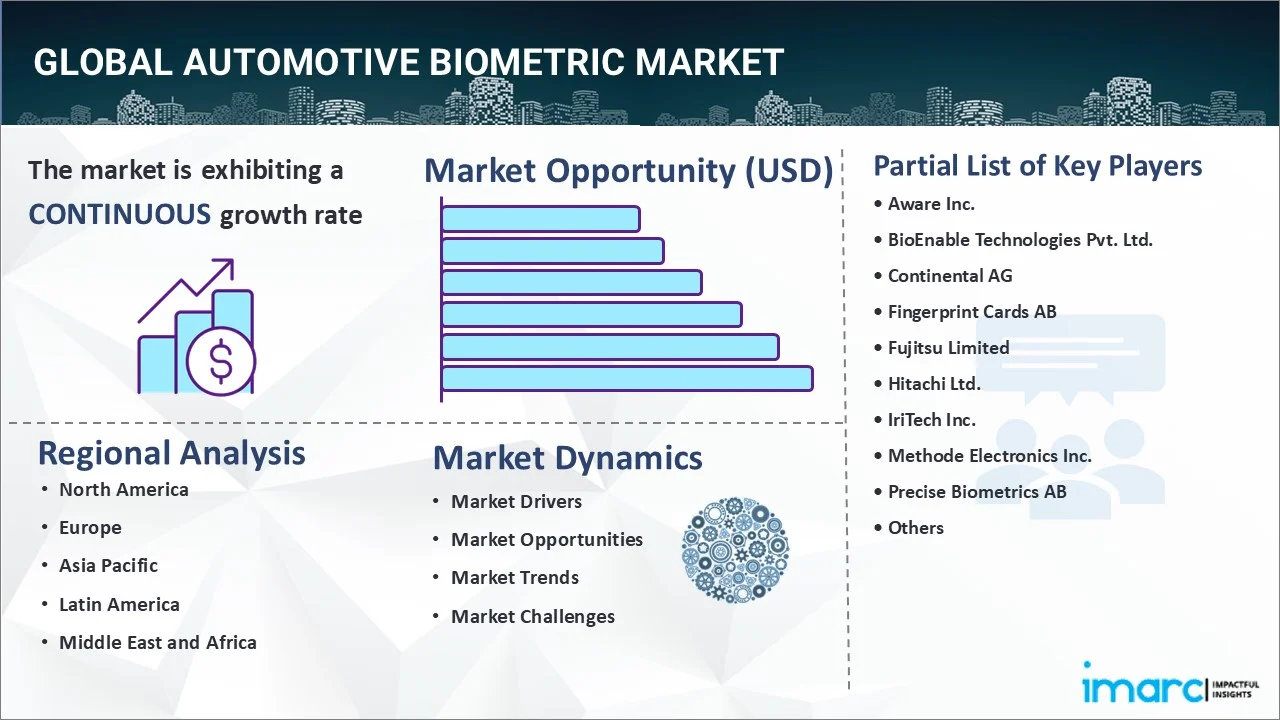
The global automotive biometric market size was valued at USD 1,263.00 Million in 2025. Looking forward, IMARC Group estimates the market to reach USD 3,692.07 Million by 2034, exhibiting a CAGR of 12.2% from 2026-2034. North America currently dominates the market, holding a market share of 34.8% in 2025. The region benefits from strong regulatory frameworks mandating vehicle safety and security standards, widespread adoption of connected vehicle technologies, and high consumer awareness regarding the utility of biometric authentication in modern automobiles, all of which collectively underpin the automotive biometric market share.
The global automotive biometric market is experiencing significant expansion, driven by a confluence of technological advancements and evolving consumer expectations around vehicle security and personalization. The rising prevalence of vehicle theft and unauthorized access worldwide has intensified the demand for robust authentication solutions, with biometric systems offering a level of security that traditional key-based mechanisms cannot match. Additionally, the rapid integration of artificial intelligence and machine learning into biometric recognition platforms has substantially improved the accuracy, speed, and reliability of authentication processes, accelerating their deployment across diverse vehicle categories. Furthermore, supportive government initiatives promoting intelligent transportation systems and the continued expansion of connected and autonomous vehicle programs on a global scale are collectively reinforcing the automotive biometric market growth, positioning biometrics as an indispensable component of next-generation automotive design.
The United States has emerged as a major region in the automotive biometric market owing to many factors. The country benefits from a highly advanced automotive manufacturing ecosystem, with original equipment manufacturers and tier-one suppliers actively integrating biometric authentication solutions into their production pipelines to enhance vehicle safety and user experience. Strong consumer demand for premium and technologically advanced vehicles has encouraged automakers to differentiate their offerings through biometric features, including fingerprint scanning, facial recognition, and voice authentication. In January 2024, Continental introduced its “Face Authentication Display” at CES 2024, enabling vehicles to unlock and start automatically using biometric facial recognition while also supporting driver monitoring and secure in-vehicle services. Additionally, the dense concentration of technology companies and cybersecurity firms in the United States accelerates innovation in automotive-grade biometric solutions, ensuring a steady stream of sophisticated products entering the market.
AUTOMOTIVE BIOMETRIC MARKET TRENDS:
Growing Demand for Vehicle Security Enhancement
The escalating concern over vehicle theft and unauthorized access has become one of the most compelling drivers shaping the automotive biometric market. Traditional security mechanisms, such as key fobs and PINs, are increasingly regarded as insufficient in the face of sophisticated theft techniques, prompting automakers and technology developers to explore more reliable alternatives. Biometric authentication solutions, which verify identity through unique physiological characteristics, offer a fundamentally superior level of protection by ensuring that only verified individuals can operate a vehicle. As per sources, Mastercard and Mercedes-Benz introduced an in-car payment system allowing drivers to authorize fuel payments using a fingerprint sensor integrated into the vehicle’s infotainment system, highlighting the growing use of biometric authentication in automobiles.
Rise of Multimodal Biometric Authentication Systems
The automotive industry is transitioning toward multimodal biometric authentication, combining fingerprint, facial, and voice recognition to enhance driver verification accuracy, strengthen vehicle security, and minimize the chances of false acceptance or rejection.In December 2024, Continental AG announced its “Intelligent Vehicle Experience Car,” demonstrating biometric technologies such as facial recognition and movement analysis that identify authorized users and automatically unlock vehicles or enable personalized interactions. From a broader perspective, the positive automotive biometric market outlook is reinforced by the growing expectation that next-generation vehicles will offer a completely personalized and seamlessly secured driving environment, where multimodal biometrics serve as the cornerstone of intelligent vehicle access, driver profiling, and adaptive in-cabin experience management.
Integration with Connected and Autonomous Vehicles
The rapid growth of connected and autonomous vehicle technologies is creating substantial new opportunities for biometric systems across the automotive industry. As vehicles become increasingly networked with external infrastructure, digital services, and cloud-based platforms, verifying the identity of occupants through reliable biometric means becomes critical to maintaining data privacy, preventing unauthorized control, and enabling personalized digital services. In April 2025, FORVIA and Smart Eye introduced in-car biometric authentication using combined iris and facial recognition, enabling secure driver identification and in-vehicle services such as app access and digital payments. The automotive biometric market forecast reflects robust confidence in this trajectory, as industry participants continue to invest in developing biometric technologies capable of meeting the stringent accuracy, latency, and privacy standards required for integration into connected and autonomous vehicle architectures.
AUTOMOTIVE BIOMETRIC INDUSTRY SEGMENTATION:
IMARC Group provides an analysis of the key trends in each segment of the global automotive biometric market, along with forecast at the global, regional, and country levels from 2026-2034. The market has been categorized based on technology, vehicle type, sales channel, and application.
Analysis by Technology:
- Fingerprint Scan
- Voice Recognition
- Facial Recognition
- Others
Fingerprint scan holds 46.2% of the market share, owing to its combination of high accuracy, compact sensor form factor, cost-effectiveness relative to alternative biometric modalities, and broad consumer familiarity with the technology from widespread use in smartphones and access control systems. The sensors can be seamlessly embedded into door handles, start buttons, steering wheels, and gear shift levers without significantly altering the vehicle’s aesthetic or ergonomic design. Automotive-grade fingerprint sensors are engineered to operate reliably across extreme temperature ranges, under wet or greasy finger conditions, and with rapid response times that are compatible with driver expectations. The expanding portfolio of affordable yet precise capacitive and optical fingerprint sensors available from component manufacturers further reduces integration costs for automakers, accelerating deployment across entry-level and mid-range vehicle segments in addition to premium categories. These evolving automotive biometric market trends signal a broadening of fingerprint-based authentication beyond premium vehicles, positioning it as a mainstream security feature across diverse model categories worldwide.
Analysis by Vehicle Type:
- Passenger Car
- Commercial Vehicle
Passenger car leads the market with a share of 72.5%, reflecting the segment’s sheer volume and the particular emphasis consumers place on personal safety and convenience in privately owned vehicles. Passenger cars serve as the primary use case for biometric integration because drivers prioritize seamless, personalized experiences that eliminate the inconvenience of remembering PINs or carrying physical keys. The integration of biometric authentication into infotainment, climate control, and seat memory systems enhances the ownership experience by enabling the vehicle to automatically configure itself to the verified driver’s preferences upon authentication. Premium and luxury passenger car manufacturers have been early adopters of biometric technologies, incorporating fingerprint, facial recognition, and voice recognition features as standard or optional equipment to differentiate their models in a competitive market. This trajectory is now extending to the mid-range segment as sensor costs decline and consumer demand for advanced safety features permeates a broader price spectrum across global markets.
Analysis by Sales Channel:
- OEMs
- Aftermarket
OEMs dominate the market, with a share of 78.5%, reflecting the strategic advantages of factory-level integration compared to aftermarket retrofitting. When biometric systems are designed and validated as part of the vehicle’s original architecture, they benefit from seamless compatibility with the vehicle’s electronic control units, software stack, communication buses, and power management systems. OEM integration also ensures that biometric authentication is tied directly to safety-critical functions, such as ignition authorization and driver monitoring systems, in a manner that meets automotive functional safety standards. Automakers maintain substantial leverage over their supply chains, enabling them to negotiate competitive pricing for high-volume biometric components while ensuring that all systems meet their proprietary quality and durability specifications. The sustained and growing investment by major global automakers in biometric-enabled vehicle platforms cements the OEM channel’s leading position as the primary driver of market expansion across all geographies.
Analysis by Application:
- Vehicle Security System
- Driver Safety System
- Advanced Steering and Infotainment
- Others
Vehicle security system represents the leading segment, with a market share of 42.5%. Vehicle security systems represent the foundational application for biometric integration in automobiles, driven by the fundamental need to prevent unauthorized access and vehicle theft. By replacing or supplementing conventional key-based authentication with biometric verification, vehicle security systems provide a substantially higher barrier to unauthorized access, as biometric identifiers cannot be duplicated, stolen, or easily circumvented in the way that physical keys or remote fobs can be. In September 2024, Precise Biometrics and Infineon Technologies AG announced a joint biometric solution integrating fingerprint authentication software with automotive sensors to enable secure vehicle unlocking, driver personalization, and in-car payment authentication. Biometric-based vehicle security solutions also facilitate the implementation of multi-user access management, allowing fleet operators and families to define role-based access profiles for different drivers, thereby enhancing operational security across both private and commercial applications.
Regional Analysis:
- North America
o United States
o Canada
- Asia-Pacific
o China
o Japan
o India
o South Korea
o Australia
o Indonesia
o Others
- Europe
o Germany
o France
o United Kingdom
o Italy
o Spain
o Russia
o Others
- Latin America
o Brazil
o Mexico
o Others
- Middle East and Africa
North America, accounting for 34.8% of the share, maintaining the leading position in the market. The region’s dominance stems from the presence of a highly developed automotive manufacturing infrastructure alongside a strong ecosystem of biometric technology developers and cybersecurity innovators that collectively accelerate the deployment of advanced authentication solutions within vehicles. North America’s regulatory environment, including federal mandates related to vehicle safety and driver monitoring in commercial transportation, provides a systematic impetus for biometric adoption across both passenger and commercial vehicle segments. Consumer awareness in the United States and Canada regarding the risks of vehicle theft and the value of personalized vehicle experiences is substantially higher than in many other regions, supporting premium pricing for biometric-enabled vehicles and incentivizing automakers to expand their offerings. The robust investment activity of automotive technology companies headquartered in the region, combined with the concentration of connected vehicle research and development programs, positions North America as the primary growth engine for the global automotive biometric market over the forecast period.
KEY REGIONAL TAKEAWAYS:
UNITED STATES AUTOMOTIVE BIOMETRIC MARKET ANALYSIS
The United States represents the most mature and innovation-driven market for automotive biometrics globally, underpinned by the country’s robust automotive manufacturing base, technology-oriented consumer culture, and the persistent emphasis on vehicle security and personalization across all vehicle segments. The prevalence of premium vehicle ownership, combined with high disposable incomes and strong consumer demand for advanced safety features, has made the United States an early and sustained adopter of biometric authentication technologies. Federal transportation policy, including initiatives from the national highway traffic safety administration targeting driver safety and distraction reduction, continues to create a favorable regulatory environment for the integration of biometric driver monitoring and authentication systems. The United States also benefits from the proximity of leading biometric technology companies, semiconductor manufacturers, and automotive cybersecurity firms, which facilitates rapid innovation cycles and the timely delivery of automotive-grade biometric components to domestic automakers. This dense and interconnected ecosystem ensures that new biometric modalities and enhanced sensor technologies are adopted into vehicle platforms faster in the United States than in most other global markets.
EUROPE AUTOMOTIVE BIOMETRIC MARKET ANALYSIS
Europe represents a significant and growing market for automotive biometric technologies, shaped by stringent regulatory requirements on vehicle safety, data privacy legislation, and the strong emphasis European consumers place on security and reliability in their vehicle purchases. The European union’s general data protection regulation has established a rigorous legal framework governing the collection and processing of biometric data within vehicles, compelling automakers and technology suppliers to design systems that are both secure by architecture and compliant with privacy-by-design principles. Leading European automotive manufacturers have been proactive in integrating biometric solutions into premium and performance vehicles, leveraging the continent’s reputation for engineering excellence to deliver sophisticated authentication systems. Germany, France, and the United Kingdom are the primary contributors to regional market performance, hosting both major vehicle production facilities and active research and development programs focused on intelligent vehicle technologies. The progressive adoption of electric vehicles across Europe is further stimulating biometric integration, as EV platforms provide a clean software-defined architecture that readily accommodates advanced biometric authentication.
ASIA-PACIFIC AUTOMOTIVE BIOMETRIC MARKET ANALYSIS
Asia-Pacific is emerging as a high-growth region in the global automotive biometric market, propelled by the enormous vehicle production volumes in China, Japan, South Korea, and India, alongside rapidly evolving consumer preferences for technology-rich automotive experiences. China, in particular, is witnessing accelerated adoption of biometric features in new energy vehicles and smart electric cars, driven by the country’s strategic national programs promoting intelligent transportation systems and the competitive domestic electric vehicle market where biometric differentiation plays a pivotal marketing role. In February 2025, BYD Company Limited announced the rollout of its “DiPilot” intelligent driving assistance system across multiple vehicle models, integrating advanced sensors, cameras, and AI-based software to support smart driving and vehicle intelligence features. Japan and South Korea contribute through their globally recognized automotive brands and component manufacturers, which are integrating biometric modules into export-oriented vehicle models.
LATIN AMERICA AUTOMOTIVE BIOMETRIC MARKET ANALYSIS
Latin America represents an emerging opportunity in the global automotive biometric market, driven primarily by increasing vehicle theft rates and growing consumer awareness of advanced vehicle security solutions in major economies such as Brazil and Mexico. The region’s expanding middle class and rising new vehicle sales volumes are gradually enabling the penetration of biometric authentication features beyond the premium vehicle segment. Government-led road safety improvement programs and the increasing presence of international automakers investing in local production facilities are supporting the deployment of biometric-enabled vehicles, reinforcing the gradual yet consistent market development trajectory across Latin America.
MIDDLE EAST AND AFRICA AUTOMOTIVE BIOMETRIC MARKET ANALYSIS
The Middle East and Africa region presents growing opportunities for the automotive biometric market, supported by the high-income consumer base in Gulf Cooperation Council countries and their strong preference for premium, feature-rich vehicles equipped with advanced security and personalization technologies. The UAE and Saudi Arabia, in particular, demonstrate robust demand for luxury and high-technology vehicles, making the region receptive to biometric authentication systems. In Africa, rising urbanization and gradual economic growth are slowly expanding the base of new vehicle consumers, and increased vehicle theft incidences are creating a growing awareness of the need for superior vehicle security solutions, progressively opening the market to biometric adoption.
COMPETITIVE LANDSCAPE:
The global automotive biometric market is characterized by a moderately consolidated competitive landscape, with participation from established biometric technology companies, automotive-focused semiconductor firms, and Tier-1 automotive suppliers that integrate biometric modules into broader vehicle systems. Leading players are channeling substantial investments into research and development initiatives aimed at improving sensor accuracy, reducing costs, and achieving the functional safety certifications required for integration into safety-critical automotive applications. Strategic partnerships and collaborations between biometric technology developers and original equipment manufacturers represent a dominant go-to-market strategy, as OEM partnerships provide guaranteed volume commitments and facilitate validation within complex automotive development cycles. Companies are also facing challenges related to data privacy compliance across different jurisdictions, cybersecurity vulnerabilities in connected biometric platforms, and the technical complexity of achieving consistent biometric performance across the extreme environmental conditions encountered in automotive deployments, necessitating continuous investment in testing and quality assurance processes.
The report provides a comprehensive analysis of the competitive landscape in the automotive biometric market with detailed profiles of all major companies, including:
- Aware Inc.
- BioEnable Technologies Pvt. Ltd.
- Continental AG
- Fingerprint Cards AB
- Fujitsu Limited
- Hitachi Ltd.
- IriTech Inc.
- Methode Electronics Inc.
- Precise Biometrics AB
- Shenzhen Goodix Technology Co. Ltd.
- Synaptics Incorporated
- VOXX International Corporation
Automotive Biometric Market Report Scope:
| Report Features | Details |
|---|---|
| Base Year of the Analysis | 2025 |
| Historical Period | 2020-2025 |
| Forecast Period | 2026-2034 |
| Units | Million USD |
| Scope of the Report | Exploration of Historical Trends and Market Outlook, Industry Catalysts and Challenges, Segment-Wise Historical and Future Market Assessment:
|
| Technologies Covered | Fingerprint Scan, Voice Recognition, Facial Recognition, Others |
| Vehicle Types Covered | Passenger Car, Commercial Vehicle |
| Sales Channels Covered | OEMs, Aftermarket |
| Applications Covered | Vehicle Security System, Driver Safety System, Advanced Steering and Infotainment, Others |
| Region Covered | North America, Asia-Pacific, Europe, Latin America, Middle East and Africa |
| Countries Covered | United States, Canada, China, Japan, India, South Korea, Australia, Indonesia, Germany, France, United Kingdom, Italy, Spain, Russia, Brazil, Mexico |
| Companies Covered | Aware Inc., BioEnable Technologies Pvt. Ltd., Continental AG, Fingerprint Cards AB, Fujitsu Limited, Hitachi Ltd., IriTech Inc., Methode Electronics Inc., Precise Biometrics AB, Shenzhen Goodix Technology Co. Ltd., Synaptics Incorporated, VOXX International Corporation, etc. |
| Customization Scope | 10% Free Customization |
| Post-Sale Analyst Support | 10-12 Weeks |
| Delivery Format | PDF and Excel through Email (We can also provide the editable version of the report in PPT/Word format on special request) |
KEY QUESTIONS ANSWERED IN THIS REPORT
- How big is the automotive biometric market?
- What is the future outlook of the automotive biometric market?
- What are the key factors driving the automotive biometric market?
- Which region accounts for the largest automotive biometric market share?
- Which are the leading companies in the global automotive biometric market?
Table of Contents
1 Preface
2 Scope and Methodology
2.1 Objectives of the Study
2.2 Stakeholders
2.3 Data Sources
2.3.1 Primary Sources
2.3.2 Secondary Sources
2.4 Market Estimation
2.4.1 Bottom-Up Approach
2.4.2 Top-Down Approach
2.5 Forecasting Methodology
3 Executive Summary
4 Introduction
4.1 Overview
4.2 Key Industry Trends
5 Global Automotive Biometric Market
5.1 Market Overview
5.2 Market Performance
5.3 Impact of COVID-19
5.4 Market Forecast
6 Market Breakup by Technology
6.1 Fingerprint Scan
6.1.1 Market Trends
6.1.2 Market Forecast
6.2 Voice Recognition
6.2.1 Market Trends
6.2.2 Market Forecast
6.3 Facial Recognition
6.3.1 Market Trends
6.3.2 Market Forecast
6.4 Others
6.4.1 Market Trends
6.4.2 Market Forecast
7 Market Breakup by Vehicle Type
7.1 Passenger Car
7.1.1 Market Trends
7.1.2 Market Forecast
7.2 Commercial Vehicle
7.2.1 Market Trends
7.2.2 Market Forecast
8 Market Breakup by Sales Channel
8.1 OEMs
8.1.1 Market Trends
8.1.2 Market Forecast
8.2 Aftermarket
8.2.1 Market Trends
8.2.2 Market Forecast
9 Market Breakup by Application
9.1 Vehicle Security System
9.1.1 Market Trends
9.1.2 Market Forecast
9.2 Driver Safety System
9.2.1 Market Trends
9.2.2 Market Forecast
9.3 Advanced Steering and Infotainment
9.3.1 Market Trends
9.3.2 Market Forecast
9.4 Others
9.4.1 Market Trends
9.4.2 Market Forecast
10 Market Breakup by Region
10.1 North America
10.1.1 United States
10.1.1.1 Market Trends
10.1.1.2 Market Forecast
10.1.2 Canada
10.1.2.1 Market Trends
10.1.2.2 Market Forecast
10.2 Asia-Pacific
10.2.1 China
10.2.1.1 Market Trends
10.2.1.2 Market Forecast
10.2.2 Japan
10.2.2.1 Market Trends
10.2.2.2 Market Forecast
10.2.3 India
10.2.3.1 Market Trends
10.2.3.2 Market Forecast
10.2.4 South Korea
10.2.4.1 Market Trends
10.2.4.2 Market Forecast
10.2.5 Australia
10.2.5.1 Market Trends
10.2.5.2 Market Forecast
10.2.6 Indonesia
10.2.6.1 Market Trends
10.2.6.2 Market Forecast
10.2.7 Others
10.2.7.1 Market Trends
10.2.7.2 Market Forecast
10.3 Europe
10.3.1 Germany
10.3.1.1 Market Trends
10.3.1.2 Market Forecast
10.3.2 France
10.3.2.1 Market Trends
10.3.2.2 Market Forecast
10.3.3 United Kingdom
10.3.3.1 Market Trends
10.3.3.2 Market Forecast
10.3.4 Italy
10.3.4.1 Market Trends
10.3.4.2 Market Forecast
10.3.5 Spain
10.3.5.1 Market Trends
10.3.5.2 Market Forecast
10.3.6 Russia
10.3.6.1 Market Trends
10.3.6.2 Market Forecast
10.3.7 Others
10.3.7.1 Market Trends
10.3.7.2 Market Forecast
10.4 Latin America
10.4.1 Brazil
10.4.1.1 Market Trends
10.4.1.2 Market Forecast
10.4.2 Mexico
10.4.2.1 Market Trends
10.4.2.2 Market Forecast
10.4.3 Others
10.4.3.1 Market Trends
10.4.3.2 Market Forecast
10.5 Middle East and Africa
10.5.1 Market Trends
10.5.2 Market Breakup by Country
10.5.3 Market Forecast
11 SWOT Analysis
11.1 Overview
11.2 Strengths
11.3 Weaknesses
11.4 Opportunities
11.5 Threats
12 Value Chain Analysis
13 Porters Five Forces Analysis
13.1 Overview
13.2 Bargaining Power of Buyers
13.3 Bargaining Power of Suppliers
13.4 Degree of Competition
13.5 Threat of New Entrants
13.6 Threat of Substitutes
14 Price Analysis
15 Competitive Landscape
15.1 Market Structure
15.2 Key Players
15.3 Profiles of Key Players
15.3.1 Aware Inc.
15.3.1.1 Company Overview
15.3.1.2 Product Portfolio
15.3.1.3 Financials
15.3.2 BioEnable Technologies Pvt. Ltd.
15.3.2.1 Company Overview
15.3.2.2 Product Portfolio
15.3.3 Continental AG
15.3.3.1 Company Overview
15.3.3.2 Product Portfolio
15.3.3.3 Financials
15.3.3.4 SWOT Analysis
15.3.4 Fingerprint Cards AB
15.3.4.1 Company Overview
15.3.4.2 Product Portfolio
15.3.4.3 Financials
15.3.5 Fujitsu Limited
15.3.5.1 Company Overview
15.3.5.2 Product Portfolio
15.3.5.3 Financials
15.3.5.4 SWOT Analysis
15.3.6 Hitachi Ltd.
15.3.6.1 Company Overview
15.3.6.2 Product Portfolio
15.3.6.3 Financials
15.3.6.4 SWOT Analysis
15.3.7 IriTech Inc.
15.3.7.1 Company Overview
15.3.7.2 Product Portfolio
15.3.8 Methode Electronics Inc.
15.3.8.1 Company Overview
15.3.8.2 Product Portfolio
15.3.8.3 Financials
15.3.9 Precise Biometrics AB
15.3.9.1 Company Overview
15.3.9.2 Product Portfolio
15.3.9.3 Financials
15.3.10 Shenzhen Goodix Technology Co. Ltd.
15.3.10.1 Company Overview
15.3.10.2 Product Portfolio
15.3.10.3 Financials
15.3.11 Synaptics Incorporated
15.3.11.1 Company Overview
15.3.11.2 Product Portfolio
15.3.11.3 Financials
15.3.12 VOXX International Corporation
15.3.12.1 Company Overview
15.3.12.2 Product Portfolio
15.3.12.3 Financials
List of Tables
Table 1: Global: Automotive Biometric Market: Key Industry Highlights, 2025 and 2034
Table 2: Global: Automotive Biometric Market Forecast: Breakup by Technology (in Million USD), 2026-2034
Table 3: Global: Automotive Biometric Market Forecast: Breakup by Vehicle Type (in Million USD), 2026-2034
Table 4: Global: Automotive Biometric Market Forecast: Breakup by Sales Channel (in Million USD), 2026-2034
Table 5: Global: Automotive Biometric Market Forecast: Breakup by Application (in Million USD), 2026-2034
Table 6: Global: Automotive Biometric Market Forecast: Breakup by Region (in Million USD), 2026-2034
Table 7: Global: Automotive Biometric Market: Competitive Structure
Table 8: Global: Automotive Biometric Market: Key Players
List of Figures
Figure 1: Global: Automotive Biometric Market: Major Drivers and Challenges
Figure 2: Global: Automotive Biometric Market: Sales Value (in Million USD), 2020-2025
Figure 3: Global: Automotive Biometric Market Forecast: Sales Value (in Million USD), 2026-2034
Figure 4: Global: Automotive Biometric Market: Breakup by Technology (in %), 2025
Figure 5: Global: Automotive Biometric Market: Breakup by Vehicle Type (in %), 2025
Figure 6: Global: Automotive Biometric Market: Breakup by Sales Channel (in %), 2025
Figure 7: Global: Automotive Biometric Market: Breakup by Application (in %), 2025
Figure 8: Global: Automotive Biometric Market: Breakup by Region (in %), 2025
Figure 9: Global: Automotive Biometric (Fingerprint Scan) Market: Sales Value (in Million USD), 2020 & 2025
Figure 10: Global: Automotive Biometric (Fingerprint Scan) Market Forecast: Sales Value (in Million USD), 2026-2034
Figure 11: Global: Automotive Biometric (Voice Recognition) Market: Sales Value (in Million USD), 2020 & 2025
Figure 12: Global: Automotive Biometric (Voice Recognition) Market Forecast: Sales Value (in Million USD), 2026-2034
Figure 13: Global: Automotive Biometric (Facial Recognition) Market: Sales Value (in Million USD), 2020 & 2025
Figure 14: Global: Automotive Biometric (Facial Recognition) Market Forecast: Sales Value (in Million USD), 2026-2034
Figure 15: Global: Automotive Biometric (Other Technologies) Market: Sales Value (in Million USD), 2020 & 2025
Figure 16: Global: Automotive Biometric (Other Technologies) Market Forecast: Sales Value (in Million USD), 2026-2034
Figure 17: Global: Automotive Biometric (Passenger Car) Market: Sales Value (in Million USD), 2020 & 2025
Figure 18: Global: Automotive Biometric (Passenger Car) Market Forecast: Sales Value (in Million USD), 2026-2034
Figure 19: Global: Automotive Biometric (Commercial Vehicle) Market: Sales Value (in Million USD), 2020 & 2025
Figure 20: Global: Automotive Biometric (Commercial Vehicle) Market Forecast: Sales Value (in Million USD), 2026-2034
Figure 21: Global: Automotive Biometric (OEMs) Market: Sales Value (in Million USD), 2020 & 2025
Figure 22: Global: Automotive Biometric (OEMs) Market Forecast: Sales Value (in Million USD), 2026-2034
Figure 23: Global: Automotive Biometric (Aftermarket) Market: Sales Value (in Million USD), 2020 & 2025
Figure 24: Global: Automotive Biometric (Aftermarket) Market Forecast: Sales Value (in Million USD), 2026-2034
Figure 25: Global: Automotive Biometric (Vehicle Security System) Market: Sales Value (in Million USD), 2020 & 2025
Figure 26: Global: Automotive Biometric (Vehicle Security System) Market Forecast: Sales Value (in Million USD), 2026-2034
Figure 27: Global: Automotive Biometric (Driver Safety System) Market: Sales Value (in Million USD), 2020 & 2025
Figure 28: Global: Automotive Biometric (Driver Safety System) Market Forecast: Sales Value (in Million USD), 2026-2034
Figure 29: Global: Automotive Biometric (Advanced Steering and Infotainment) Market: Sales Value (in Million USD), 2020 & 2025
Figure 30: Global: Automotive Biometric (Advanced Steering and Infotainment) Market Forecast: Sales Value (in Million USD), 2026-2034
Figure 31: Global: Automotive Biometric (Other Applications) Market: Sales Value (in Million USD), 2020 & 2025
Figure 32: Global: Automotive Biometric (Other Applications) Market Forecast: Sales Value (in Million USD), 2026-2034
Figure 33: North America: Automotive Biometric Market: Sales Value (in Million USD), 2020 & 2025
Figure 34: North America: Automotive Biometric Market Forecast: Sales Value (in Million USD), 2026-2034
Figure 35: United States: Automotive Biometric Market: Sales Value (in Million USD), 2020 & 2025
Figure 36: United States: Automotive Biometric Market Forecast: Sales Value (in Million USD), 2026-2034
Figure 37: Canada: Automotive Biometric Market: Sales Value (in Million USD), 2020 & 2025
Figure 38: Canada: Automotive Biometric Market Forecast: Sales Value (in Million USD), 2026-2034
Figure 39: Asia-Pacific: Automotive Biometric Market: Sales Value (in Million USD), 2020 & 2025
Figure 40: Asia-Pacific: Automotive Biometric Market Forecast: Sales Value (in Million USD), 2026-2034
Figure 41: China: Automotive Biometric Market: Sales Value (in Million USD), 2020 & 2025
Figure 42: China: Automotive Biometric Market Forecast: Sales Value (in Million USD), 2026-2034
Figure 43: Japan: Automotive Biometric Market: Sales Value (in Million USD), 2020 & 2025
Figure 44: Japan: Automotive Biometric Market Forecast: Sales Value (in Million USD), 2026-2034
Figure 45: India: Automotive Biometric Market: Sales Value (in Million USD), 2020 & 2025
Figure 46: India: Automotive Biometric Market Forecast: Sales Value (in Million USD), 2026-2034
Figure 47: South Korea: Automotive Biometric Market: Sales Value (in Million USD), 2020 & 2025
Figure 48: South Korea: Automotive Biometric Market Forecast: Sales Value (in Million USD), 2026-2034
Figure 49: Australia: Automotive Biometric Market: Sales Value (in Million USD), 2020 & 2025
Figure 50: Australia: Automotive Biometric Market Forecast: Sales Value (in Million USD), 2026-2034
Figure 51: Indonesia: Automotive Biometric Market: Sales Value (in Million USD), 2020 & 2025
Figure 52: Indonesia: Automotive Biometric Market Forecast: Sales Value (in Million USD), 2026-2034
Figure 53: Others: Automotive Biometric Market: Sales Value (in Million USD), 2020 & 2025
Figure 54: Others: Automotive Biometric Market Forecast: Sales Value (in Million USD), 2026-2034
Figure 55: Europe: Automotive Biometric Market: Sales Value (in Million USD), 2020 & 2025
Figure 56: Europe: Automotive Biometric Market Forecast: Sales Value (in Million USD), 2026-2034
Figure 57: Germany: Automotive Biometric Market: Sales Value (in Million USD), 2020 & 2025
Figure 58: Germany: Automotive Biometric Market Forecast: Sales Value (in Million USD), 2026-2034
Figure 59: France: Automotive Biometric Market: Sales Value (in Million USD), 2020 & 2025
Figure 60: France: Automotive Biometric Market Forecast: Sales Value (in Million USD), 2026-2034
Figure 61: United Kingdom: Automotive Biometric Market: Sales Value (in Million USD), 2020 & 2025
Figure 62: United Kingdom: Automotive Biometric Market Forecast: Sales Value (in Million USD), 2026-2034
Figure 63: Italy: Automotive Biometric Market: Sales Value (in Million USD), 2020 & 2025
Figure 64: Italy: Automotive Biometric Market Forecast: Sales Value (in Million USD), 2026-2034
Figure 65: Spain: Automotive Biometric Market: Sales Value (in Million USD), 2020 & 2025
Figure 66: Spain: Automotive Biometric Market Forecast: Sales Value (in Million USD), 2026-2034
Figure 67: Russia: Automotive Biometric Market: Sales Value (in Million USD), 2020 & 2025
Figure 68: Russia: Automotive Biometric Market Forecast: Sales Value (in Million USD), 2026-2034
Figure 69: Others: Automotive Biometric Market: Sales Value (in Million USD), 2020 & 2025
Figure 70: Others: Automotive Biometric Market Forecast: Sales Value (in Million USD), 2026-2034
Figure 71: Latin America: Automotive Biometric Market: Sales Value (in Million USD), 2020 & 2025
Figure 72: Latin America: Automotive Biometric Market Forecast: Sales Value (in Million USD), 2026-2034
Figure 73: Brazil: Automotive Biometric Market: Sales Value (in Million USD), 2020 & 2025
Figure 74: Brazil: Automotive Biometric Market Forecast: Sales Value (in Million USD), 2026-2034
Figure 75: Mexico: Automotive Biometric Market: Sales Value (in Million USD), 2020 & 2025
Figure 76: Mexico: Automotive Biometric Market Forecast: Sales Value (in Million USD), 2026-2034
Figure 77: Others: Automotive Biometric Market: Sales Value (in Million USD), 2020 & 2025
Figure 78: Others: Automotive Biometric Market Forecast: Sales Value (in Million USD), 2026-2034
Figure 79: Middle East and Africa: Automotive Biometric Market: Sales Value (in Million USD), 2020 & 2025
Figure 80: Middle East and Africa: Automotive Biometric Market: Breakup by Country (in %), 2025
Figure 81: Middle East and Africa: Automotive Biometric Market Forecast: Sales Value (in Million USD), 2026-2034
Figure 82: Global: Automotive Biometric Industry: SWOT Analysis
Figure 83: Global: Automotive Biometric Industry: Value Chain Analysis
Figure 84: Global: Automotive Biometric Industry: Porter’s Five Forces Analysis