
Agriculture Drones Market Size, Share, Trends and Forecast
Agriculture Drones Market Size, Share, Trends and Forecast by Offering, Component, Farming Environment, Application, and Region, 2026-2034
農業用ドローン市場の規模、シェア、トレンド、予測 : 製品、コンポーネント、農業環境、用途、地域別、2026-2034年
| 出版 | IMARC Group |
| 出版年月 | 2026年04月 |
| ページ数 | 140 |
| 価格 | 記載以外のライセンスについてはお問合せください |
| シングルユーザ | USD 3,999 |
| 種別 | 英文調査報告書 |
| 商品番号 | SMR-17455 |

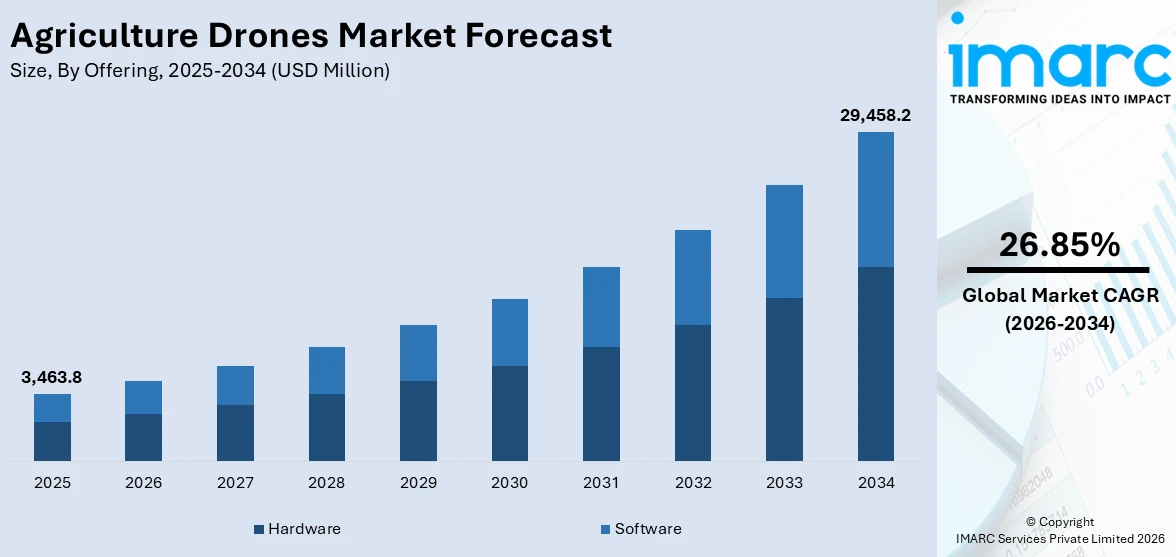
世界の農業用ドローン市場規模は、2025年には34億6,380万米ドルと評価されました。IMARCグループは、今後、市場規模は2034年までに294億5,820万米ドルに達し、2026年から2034年の間に年平均成長率(CAGR)26.85%を示すと予測しています。北米は現在市場を支配しており、2025年には33.2%を超える大きな市場シェアを占めています。継続的な技術進歩、世界的な労働力不足の深刻化、人々の環境意識の高まり、さまざまな政府イニシアチブの実施、より良い品質に対する消費者の期待の高まり、気象パターンの予測不可能性の増大などが、農業用ドローン市場のシェアを押し上げる主な要因です。
市場は主に、精密な家畜監視および疾病検出アプリケーションの拡大によって牽引されており、これにより導入率が上昇しています。これらの技術により、農家は資源を最適化し、家畜の損失を減らし、全体的な生産性を向上させることができます。業界レポートによると、2024年6月末までに、農業用ドローンは世界中で5億ヘクタール以上の農地に導入されました。この広範な利用は、大規模事業におけるドローンの重要性の高まりを反映しています。ドローンの運用効率により、資源の大幅な節約が実現し、世界中で約2億1000万トンの水を節約し、約4万7000トンの農薬使用量を削減しました。これらの利点により、地域全体でドローンの需要が高まり続けています。さらに、民間企業や研究機関によるドローン支援型スマート農業試験への投資の増加は、多様な気候帯でのより広範な利用を促進しています。加えて、新興国における支援的な法的枠組みも、ドローンサービスプロバイダーの参入障壁を下げており、市場に勢いを与えています。
Report Overview
The global agriculture drones market size was valued at USD 3,463.8 Million in 2025. Looking forward, IMARC Group estimates the market to reach USD 29,458.2 Million by 2034, exhibiting a CAGR of 26.85% during 2026-2034. North America currently dominates the market, holding a significant market share of over 33.2% in 2025. The continual technological advancements, rising labor shortage across the globe, escalating environmental consciousness among the masses, implementation of various government initiatives, escalating consumer expectation for better-quality, and increasing unpredictability of weather patterns are some of the major factors propelling the agriculture drones market share.
The market is primarily driven by the expansion of precision livestock monitoring and disease detection applications, which is increasing the adoption rate. These technologies are enabling farmers to optimize resources, reduce livestock losses, and improve overall productivity. According to an industry report, agricultural drones were deployed across more than 500 Million hectares of farmland globally by the end of June 2024. This widespread utilization reflects their growing importance in large-scale operations. Their operational efficiency has resulted in significant resource conservation, saving approximately 210 Million Metric Tons of water and reducing pesticide use by nearly 47,000 Metric Tons worldwide. These benefits continue to fuel their rising demand across regions. Furthermore, increased investments by private firms and research institutions in drone-assisted smart farming trials are encouraging broader use across diverse climatic zones. In addition to this, supportive legal frameworks in emerging economies are also lowering entry barriers for drone service providers, which is providing an impetus to the market.
The market in the United States is significantly expanding, propelled by the presence of a well-established digital infrastructure, which enables seamless integration of drone-collected data into farm management systems. Moreover, the surge in organic farming and demand for pesticide efficiency is driving the adoption of drones, which is an emerging agriculture drone market trend. Also, strategic collaborations between drone manufacturers, resulting in highly tailored drone platforms that cater to the specific needs of U.S. growers. For instance, on December 10, 2024, Agri Spray Drones announced a strategic partnership with EAVision to enhance its agricultural drone offerings in the United States. This collaboration introduces EAVision’s J100 drone, featuring integrated lidar technology and advanced mist nozzles aimed at improving precision spraying for diverse crop types. Apart from this, increased funding through USDA innovation grants and state-level pilot programs is encouraging small and mid-sized farms to implement UAV technologies.
AGRICULTURE DRONES MARKET TRENDS:
The rising labor shortage across the globe
The agricultural sector is facing a growing labor shortage problem, which is driving the need for automated solutions, such as drones, which is positively impacting agriculture drones market outlook. Additionally, the rising geriatric population in many developed countries and younger generations increasingly moving towards urban areas for employment opportunities are causing a shortage of skilled labor for farming activities. According to the United Nations, 55% of the world’s population currently resides in urban areas, a figure projected to rise to 68% by 2050. Besides this, manual labor is not only hard to find but can also be expensive and seasonal, adding to the inconsistency in workforce availability. Drones provide a solution to this labor gap by automating many tasks, such as crop monitoring, that would otherwise require significant human effort. In addition, they can also apply fertilizers and pesticides in a targeted manner, thus reducing the need for manpower. As a result, drones allow agricultural enterprises to maintain or even increase productivity despite labor shortages.
The escalating environmental consciousness among the masses
The growing environmental consciousness is a crucial factor driving agriculture drones market demand. Traditional farming practices involve the indiscriminate use of resources, such as water and fertilizers , which cause soil degradation and water pollution. The United Nations Environment Programme highlights the severity of this issue, reporting that 11,000 people die annually due to the toxic effects of pesticides, while chemical residues degrade ecosystems, diminish soil health, and reduce farmers’ resilience to climate change. Drones, with their precision agriculture capabilities, address these concerns effectively by enabling targeted application of fertilizers and pesticides, thereby reducing wastage and minimizing environmental impact. In addition, drones can generate detailed maps of farmland, highlighting areas that may require special attention, such as those with poor drainage or soil conditions. This data aids in the optimal utilization of resources, thus preserving the environment, saving costs, and promoting eco-friendly practices. The agriculture drones market revenue is projected to increase due to widespread adoption of precision farming techniques worldwide. Moreover, the agriculture drones market forecast anticipates growth driven by the demand for precision farming solutions.
Significant technological advancements
Continual technological advancement in drone capabilities is a key driver influencing the agriculture drones market value. Drones are becoming more specialized and equipped with advanced features tailored to agricultural needs. In line with this, the integration of sophisticated sensors, such as multispectral, hyperspectral, and thermal cameras, has enabled the collection of highly accurate data, which can be analyzed in real-time for informed decision-making. Furthermore, the incorporation of advanced global positioning systems (GPS) and geographic information systems (GIS) to offer precise location tracking and data mapping is positively impacting the market. This trend aligns with the broader expansion of the global GIS market, which reached USD 14.4 Billion in 2024 and is projected to grow to USD 37.1 Billion by 2033 at a CAGR of 11.1% (2025-2033). Apart from this, the advancements in artificial intelligence (AI) and machine learning (ML) algorithms that are revolutionizing data analytics and providing actionable insights into crop health, soil conditions, and irrigation needs are contributing to the agriculture drones market growth.
AGRICULTURE DRONES INDUSTRY SEGMENTATION:
IMARC Group provides an analysis of the key trends in each segment of the global agriculture drones market, along with forecasts at the global, regional, and country levels from 2026-2034. The market has been categorized based on offering, component, farming environment, and application.
Analysis by Offering:
- Hardware
o Fixed Wing
o Rotary Wing
o Hybrid Wing
- Software
o Data Management Software
o Imaging Software
o Data Analytics Software
o Others
Hardware (fixed wing) leads the market with around 62.1% of market share in 2025. It offers longer flight times compared to its rotary-wing counterparts, allowing for the surveying of larger agricultural fields in a single flight. Furthermore, it is generally faster, covering more ground in less time, which enhances its suitability for large-scale agricultural applications, such as crop monitoring, soil analysis, and mapping. Moreover, fixed-wing drones are more energy-efficient, as they require less power to stay aloft, which makes them highly cost-effective in the long run, lowering operational cost for farmers and agricultural companies. Additionally, their designs enable them to carry heavier payloads, including advanced imaging technologies and larger batteries. This capacity allows for more sophisticated data collection, which is crucial for modern, data-driven agricultural practices.
Analysis by Component:
- Controller Systems
- Propulsion Systems
- Cameras
- Batteries
- Navigation Systems
Camera leads the market in 2025. Cameras provide high-resolution imaging, which allows detailed crop monitoring, soil assessment, and mapping, enabling farmers to make informed decisions. Additionally, the recent advancements in camera technology, which have led to the development of specialized cameras capable of multispectral, hyperspectral, and thermal imaging, are contributing to the market growth. Besides this, cameras are becoming increasingly cost-effective, making them an accessible option for even smaller agricultural operations. Furthermore, the cost-effectiveness and wider affordability has accelerated the adoption of camera-equipped drones across the agricultural sector. Moreover, the ease of integrating cameras with drone hardware and data analytics platforms facilitates efficient data processing and interpretation, which is crucial for modern agriculture practices that rely on real-time information.
Analysis by Farming Environment:
- Indoor
- Outdoor
Outdoor leads the market with around 81.8% of market share in 2025. Outdoor farming environments, such as large farms and plantations, cover vast areas that are difficult to monitor manually. Drones offer an efficient, scalable solution to survey these large tracts of land, making them highly suitable for outdoor applications. Furthermore, agricultural drones are primarily used for field mapping, crop monitoring, and soil analysis, tasks that are predominantly relevant to outdoor farming practices. Additionally, outdoor farming often involves varied terrains and ecological conditions, which can be challenging to navigate through ground-based methods. In line with this, drones offer the flexibility to easily adapt to different outdoor conditions, thus offering more reliable and efficient data collection. Moreover, the outdoor environment provides more opportunities for the deployment of advanced drone technologies, such as multispectral imaging and LIDAR.
agriculture drones market – by application
Analysis by Application:
- Field Mapping
- Variable Rate Application
- Crop Scouting
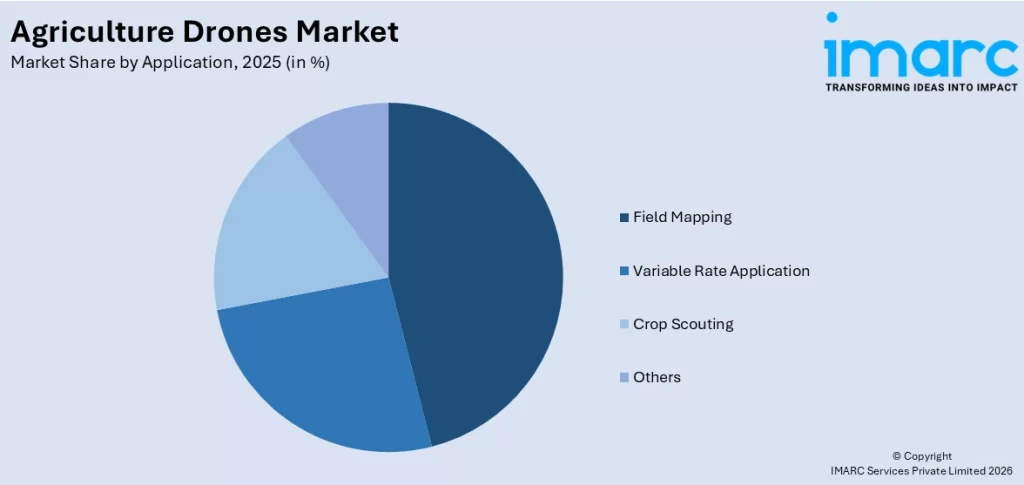
Field mapping is dominating the market in 2025, as it provides critical data that helps farmers understand the variability in their fields, allowing them to make informed decisions about irrigation, fertilization, and pest control. Furthermore, the advancements in drone technology, which have enabled high-resolution imaging capabilities, making field mapping more precise and accurate, are offering a favorable agriculture drones market outlook. Additionally, the advent of precision agriculture, which depends heavily on accurate field maps, is acting as another growth-inducing factor. Moreover, field mapping with drones is significantly faster and provides the ability to quickly gather data, which allows timely interventions, such as planting adjustments, irrigation modifications, or pest treatments. Along with this, the imposition of favorable policies by governments to encourage the use of drones for non-intrusive applications like field mapping is catalyzing the agriculture drones market demand.
Regional Analysis:
- North America
o United States
o Canada
- Asia Pacific
o China
o Japan
o India
o South Korea
o Australia
o Indonesia
o Others
- Europe
o Germany
o France
o United Kingdom
o Italy
o Spain
o Russia
o Others
- Latin America
o Brazil
o Mexico
o Others
- Middle East and Africa
In 2025, North America accounted for the largest market share of over 33.2%. North America has a strong technological infrastructure that readily supports advancements in drone technology. Along with this, the region hosts some of the world’s leading tech companies specializing in drone manufacturing. Furthermore, North America benefits from robust regulatory frameworks that facilitate easier implementation of drone technology in agriculture, including clear guidelines and quicker approvals for drone operations. Besides this, the regional farmers possess the capital required to invest in sophisticated drone systems, making it a lucrative market for agriculture drone companies. Additionally, the agricultural sector in the region is more industrialized and open to adopting new technologies to improve efficiency and yield. Moreover, North America has a vast expanse of arable land, which necessitates more effective and scalable solutions, such as drones, for crop monitoring, soil assessment, and yield prediction.
KEY REGIONAL TAKEAWAYS:
UNITED STATES AGRICULTURE DRONES MARKET ANALYSIS
The United States holds a substantial share of the North America agriculture drones market with 76.80% in 2025. The market in the United States is witnessing significant growth, driven by advancements in precision farming and the increasing adoption of automation in agriculture. Farmers are leveraging drones for crop monitoring, field mapping, and yield estimation, leading to improved productivity and resource efficiency. The integration of artificial intelligence and data analytics further enhances decision-making, optimizing input usage and reducing operational costs. Government initiatives supporting precision agriculture and the rising demand for sustainable farming practices are propelling market expansion. Notably, USDA climate-smart agriculture investments, initiated during the Biden-Harris Administration, are projected to support over 180,000 farms and 225 Million acres within five years, further encouraging the adoption of smart technologies, including agricultural drones. Additionally, the inclusion of high-resolution imaging and multispectral sensors is improving data accuracy, contributing to enhanced farm management. The market is also benefiting from the rapid development of autonomous drone technologies, reducing manual labor dependency. Drones are gaining importance in agriculture due to labor shortages and climate variability, enhancing efficiency and sustainability in pesticide and fertilizer spraying, thereby expanding the sector.
EUROPE AGRICULTURE DRONES MARKET ANALYSIS
The European agriculture drone market is growing due to demand for precision farming solutions and sustainable practices. Drones are used for real-time crop health monitoring, field surveying, and irrigation management, optimizing resources, and increasing yields. Advanced imaging technologies and AI-driven analytics enhance decision-making. Regulations supporting drone usage in agriculture contribute to market expansion. Automation in farming is gaining traction, leading to increased integration of drones with other digital solutions. Targeted pesticide spraying enhances productivity while minimizing environmental impact. Climate-resilient farming techniques are also accelerating adoption. Market growth is also supported by research and innovation in drone-based analytics, enabling farmers to improve efficiency. According to IMARC Group, the Europe agricultural robot market size reached USD 2.8 Billion in 2024 and is expected to grow at a CAGR of 12.4%, reaching USD 8.1 Billion by 2033. This rising adoption of agricultural automation further strengthens the demand for drones, as they play a crucial role in enhancing farm productivity.
ASIA PACIFIC AGRICULTURE DRONES MARKET ANALYSIS
The Asia Pacific agriculture drone market is expanding rapidly due to smart farming technologies and automation. Drones are used for field monitoring, crop assessment, and precision spraying, improving productivity and resource management. The integration of AI and remote sensing enhances efficiency, enabling real-time decision-making. Growing awareness about modern farming techniques encourages widespread drone adoption, particularly in large-scale farming. Technological advancements like multispectral imaging and GPS-enabled drones drive further market growth. Additionally, the use of drones for pesticide and fertilizer application is gaining popularity, reducing manual labor and optimizing input usage. Investments in digital agriculture are further accelerating market expansion. According to Agro Spectrum India, the Indian government’s commitment to digital agriculture was reinforced in the Interim Budget 2024, which allocated INR 600 Crore for the development of technology in the agriculture sector and INR 450 Crore for the Digital Agriculture Mission. Such initiatives highlight the growing emphasis on integrating cutting-edge technology in farming operations.
LATIN AMERICA AGRICULTURE DRONES MARKET ANALYSIS
The Latin American agriculture drone market is expanding due to improved farming efficiency and yield optimization. Farmers use drones for precision spraying, crop health monitoring, and land assessment. Automation reduces labor dependency and improves operational efficiency. Advanced technologies like multispectral imaging and AI-based analytics enhance decision-making. The integration of drones with digital agriculture solutions contributes to market growth. According to the Presidency of the Republic, Private investments in the agro-industrial sector are anticipated to reach BRL 296.3 Billion by 2029, highlighting the region’s commitment to modernizing agriculture. This growing investment landscape is likely to accelerate the adoption of drone technology, enabling farmers to optimize resources and enhance productivity. As agricultural activities continue to modernize, drones are expected to play a vital role in optimizing farming operations, improving efficiency, and supporting the region’s push toward precision agriculture.
MIDDLE EAST AND AFRICA AGRICULTURE DRONES MARKET ANALYSIS
The Middle East and Africa’s agriculture drone market is growing due to smart farming technologies, including crop monitoring, irrigation management, and precision spraying. AI and remote sensing integration improves decision-making, while advanced imaging and data analytics optimize crop management. Automation in agriculture is gaining traction for large-scale farming. Additionally, the growing focus on sustainable farming solutions is increasing market demand. According to the World Bank Group, in a major step toward developing climate-smart agriculture solutions, the World Bank has granted USD 40 Million in IDA loans for the Accelerating Impacts of Climate Research for Africa project. Investment in precision farming tools, including drones, is expected to boost agricultural resilience, efficiency, productivity, and sustainability, contributing to the advancement of agricultural modernization.
COMPETITIVE LANDSCAPE:
The leading players are focusing on technological innovations to provide drones with advanced features, such as enhanced imaging capabilities, machine learning (ML) algorithms for crop analysis, and improved battery life for extended flight times. Besides this, various companies are entering into partnerships and collaborations with agricultural tech firms and research institutions to develop drones with specialized functionalities. Furthermore, they are participating in agricultural exhibitions, hosting webinars, and publishing case studies to demonstrate the effectiveness of drone technology in modern agriculture. Additionally, several product manufacturers are actively working with governmental bodies to help define regulations that are conducive to the agricultural drone industry, ensuring safety and compliance. Moreover, they are exploring various pricing models, including leasing options, to make drone technology accessible to small and medium-sized farms, thus broadening the consumer base.
The report provides a comprehensive analysis of the competitive landscape in the agriculture drones market with detailed profiles of all major companies, including:
- 3D Robotics Inc.
- AeroVironment Inc.
- AGCO Corporation
- AgEagle Aerial Systems Inc.
- American Robotics Inc. (Ondas Holdings Inc.)
- DJI
- DroneDeploy
- Parrot Drone SAS
- PrecisionHawk
- Trimble Inc.
- Yamaha Motor Co. Ltd.
Agriculture Drones Market Report Scope:
| Report Features | Details |
|---|---|
| Base Year of the Analysis | 2025 |
| Historical Period | 2020-2025 |
| Forecast Period | 2026-2034 |
| Units | Million USD |
| Scope of the Report | Exploration of Historical Trends and Market Outlook, Industry Catalysts and Challenges, Segment-Wise Historical and Predictive Market Assessment:
|
| Offerings Covered |
|
| Components Covered | Controller Systems, Propulsion Systems, Cameras, Batteries, Navigation Systems, Others |
| Farming Environments Covered | Indoor, Outdoor |
| Applications Covered | Field Mapping, Variable Rate Application, Crop Scouting, Others |
| Regions Covered | North America, Asia Pacific, Europe, Latin America, Middle East and Africa |
| Countries Covered | United States, Canada, China, Japan, India, South Korea, Australia, Indonesia, Germany, France, United Kingdom, Italy, Spain, Russia, Brazil, Mexico |
| Companies Covered | 3D Robotics Inc., AeroVironment Inc., AGCO Corporation, AgEagle Aerial Systems Inc., American Robotics Inc. (Ondas Holdings Inc.), DJI, DroneDeploy, Parrot Drone SAS, PrecisionHawk, Trimble Inc., Yamaha Motor Co. Ltd, etc. |
| Customization Scope | 10% Free Customization |
| Post-Sale Analyst Support | 10-12 Weeks |
| Delivery Format | PDF and Excel through Email (We can also provide the editable version of the report in PPT/Word format on special request) |
KEY QUESTIONS ANSWERED IN THIS REPORT
- How big is the agriculture drones market?
- What is the future outlook of the agriculture drones market?
- What are the key factors driving the agriculture drones market?
- Which region accounts for the largest agriculture drones market share?
- Which are the leading companies in the global agriculture drones market?
Table of Contents
1 Preface
2 Scope and Methodology
2.1 Objectives of the Study
2.2 Stakeholders
2.3 Data Sources
2.3.1 Primary Sources
2.3.2 Secondary Sources
2.4 Market Estimation
2.4.1 Bottom-Up Approach
2.4.2 Top-Down Approach
2.5 Forecasting Methodology
3 Executive Summary
4 Introduction
4.1 Overview
4.2 Key Industry Trends
5 Global Agriculture Drones Market
5.1 Market Overview
5.2 Market Performance
5.3 Impact of COVID-19
5.4 Market Forecast
6 Market Breakup by Offering
6.1 Hardware
6.1.1 Market Trends
6.1.2 Key Segments
6.1.2.1 Fixed Wing
6.1.2.2 Rotary Wing
6.1.2.3 Hybrid Wing
6.1.3 Market Forecast
6.2 Software
6.2.1 Market Trends
6.2.2 Key Segments
6.2.2.1 Data Management Software
6.2.2.2 Imaging Software
6.2.2.3 Data Analytics Software
6.2.2.4 Others
6.2.3 Market Forecast
7 Market Breakup by Component
7.1 Controller Systems
7.1.1 Market Trends
7.1.2 Market Forecast
7.2 Propulsion Systems
7.2.1 Market Trends
7.2.2 Market Forecast
7.3 Cameras
7.3.1 Market Trends
7.3.2 Market Forecast
7.4 Batteries
7.4.1 Market Trends
7.4.2 Market Forecast
7.5 Navigation Systems
7.5.1 Market Trends
7.5.2 Market Forecast
7.6 Others
7.6.1 Market Trends
7.6.2 Market Forecast
8 Market Breakup by Farming Environment
8.1 Indoor
8.1.1 Market Trends
8.1.2 Market Forecast
8.2 Outdoor
8.2.1 Market Trends
8.2.2 Market Forecast
9 Market Breakup by Application
9.1 Field Mapping
9.1.1 Market Trends
9.1.2 Market Forecast
9.2 Variable Rate Application
9.2.1 Market Trends
9.2.2 Market Forecast
9.3 Crop Scouting
9.3.1 Market Trends
9.3.2 Market Forecast
9.4 Others
9.4.1 Market Trends
9.4.2 Market Forecast
10 Market Breakup by Region
10.1 North America
10.1.1 United States
10.1.1.1 Market Trends
10.1.1.2 Market Forecast
10.1.2 Canada
10.1.2.1 Market Trends
10.1.2.2 Market Forecast
10.2 Asia-Pacific
10.2.1 China
10.2.1.1 Market Trends
10.2.1.2 Market Forecast
10.2.2 Japan
10.2.2.1 Market Trends
10.2.2.2 Market Forecast
10.2.3 India
10.2.3.1 Market Trends
10.2.3.2 Market Forecast
10.2.4 South Korea
10.2.4.1 Market Trends
10.2.4.2 Market Forecast
10.2.5 Australia
10.2.5.1 Market Trends
10.2.5.2 Market Forecast
10.2.6 Indonesia
10.2.6.1 Market Trends
10.2.6.2 Market Forecast
10.2.7 Others
10.2.7.1 Market Trends
10.2.7.2 Market Forecast
10.3 Europe
10.3.1 Germany
10.3.1.1 Market Trends
10.3.1.2 Market Forecast
10.3.2 France
10.3.2.1 Market Trends
10.3.2.2 Market Forecast
10.3.3 United Kingdom
10.3.3.1 Market Trends
10.3.3.2 Market Forecast
10.3.4 Italy
10.3.4.1 Market Trends
10.3.4.2 Market Forecast
10.3.5 Spain
10.3.5.1 Market Trends
10.3.5.2 Market Forecast
10.3.6 Russia
10.3.6.1 Market Trends
10.3.6.2 Market Forecast
10.3.7 Others
10.3.7.1 Market Trends
10.3.7.2 Market Forecast
10.4 Latin America
10.4.1 Brazil
10.4.1.1 Market Trends
10.4.1.2 Market Forecast
10.4.2 Mexico
10.4.2.1 Market Trends
10.4.2.2 Market Forecast
10.4.3 Others
10.4.3.1 Market Trends
10.4.3.2 Market Forecast
10.5 Middle East and Africa
10.5.1 Market Trends
10.5.2 Market Breakup by Country
10.5.3 Market Forecast
11 SWOT Analysis
11.1 Overview
11.2 Strengths
11.3 Weaknesses
11.4 Opportunities
11.5 Threats
12 Value Chain Analysis
13 Porters Five Forces Analysis
13.1 Overview
13.2 Bargaining Power of Buyers
13.3 Bargaining Power of Suppliers
13.4 Degree of Competition
13.5 Threat of New Entrants
13.6 Threat of Substitutes
14 Price Analysis
15 Competitive Landscape
15.1 Market Structure
15.2 Key Players
15.3 Profiles of Key Players
15.3.1 3D Robotics Inc.
15.3.1.1 Company Overview
15.3.1.2 Product Portfolio
15.3.2 AeroVironment Inc.
15.3.2.1 Company Overview
15.3.2.2 Product Portfolio
15.3.2.3 Financials
15.3.2.4 SWOT Analysis
15.3.3 AGCO Corporation
15.3.3.1 Company Overview
15.3.3.2 Product Portfolio
15.3.3.3 Financials
15.3.3.4 SWOT Analysis
15.3.4 AgEagle Aerial Systems Inc.
15.3.4.1 Company Overview
15.3.4.2 Product Portfolio
15.3.4.3 Financials
15.3.5 American Robotics Inc. (Ondas Holdings Inc.)
15.3.5.1 Company Overview
15.3.5.2 Product Portfolio
15.3.6 DJI
15.3.6.1 Company Overview
15.3.6.2 Product Portfolio
15.3.7 DroneDeploy
15.3.7.1 Company Overview
15.3.7.2 Product Portfolio
15.3.8 Parrot Drone SAS
15.3.8.1 Company Overview
15.3.8.2 Product Portfolio
15.3.9 PrecisionHawk
15.3.9.1 Company Overview
15.3.9.2 Product Portfolio
15.3.10 Trimble Inc.
15.3.10.1 Company Overview
15.3.10.2 Product Portfolio
15.3.10.3 Financials
15.3.10.4 SWOT Analysis
15.3.11 Yamaha Motor Co. Ltd.
15.3.11.1 Company Overview
15.3.11.2 Product Portfolio
15.3.11.3 Financials
15.3.11.4 SWOT Analysis
List of Tables
Table 1: Global: Agriculture Drones Market: Key Industry Highlights, 2025 and 2034
Table 2: Global: Agriculture Drones Market Forecast: Breakup by Offering (in Million USD), 2026-2034
Table 3: Global: Agriculture Drones Market Forecast: Breakup by Component (in Million USD), 2026-2034
Table 4: Global: Agriculture Drones Market Forecast: Breakup by Farming Environment (in Million USD), 2026-2034
Table 5: Global: Agriculture Drones Market Forecast: Breakup by Application (in Million USD), 2026-2034
Table 6: Global: Agriculture Drones Market Forecast: Breakup by Region (in Million USD), 2026-2034
Table 7: Global: Agriculture Drones Market: Competitive Structure
Table 8: Global: Agriculture Drones Market: Key Players
List of Figures
Figure 1: Global: Agriculture Drones Market: Major Drivers and Challenges
Figure 2: Global: Agriculture Drones Market: Sales Value (in Million USD), 2020-2025
Figure 3: Global: Agriculture Drones Market Forecast: Sales Value (in Million USD), 2026-2034
Figure 4: Global: Agriculture Drones Market: Breakup by Offering (in %), 2025
Figure 5: Global: Agriculture Drones Market: Breakup by Component (in %), 2025
Figure 6: Global: Agriculture Drones Market: Breakup by Farming Environment (in %), 2025
Figure 7: Global: Agriculture Drones Market: Breakup by Application (in %), 2025
Figure 8: Global: Agriculture Drones Market: Breakup by Region (in %), 2025
Figure 9: Global: Agriculture Drones (Hardware) Market: Sales Value (in Million USD), 2020 & 2025
Figure 10: Global: Agriculture Drones (Hardware) Market Forecast: Sales Value (in Million USD), 2026-2034
Figure 11: Global: Agriculture Drones (Software) Market: Sales Value (in Million USD), 2020 & 2025
Figure 12: Global: Agriculture Drones (Software) Market Forecast: Sales Value (in Million USD), 2026-2034
Figure 13: Global: Agriculture Drones (Controller Systems) Market: Sales Value (in Million USD), 2020 & 2025
Figure 14: Global: Agriculture Drones (Controller Systems) Market Forecast: Sales Value (in Million USD), 2026-2034
Figure 15: Global: Agriculture Drones (Propulsion Systems) Market: Sales Value (in Million USD), 2020 & 2025
Figure 16: Global: Agriculture Drones (Propulsion Systems) Market Forecast: Sales Value (in Million USD), 2026-2034
Figure 17: Global: Agriculture Drones (Cameras) Market: Sales Value (in Million USD), 2020 & 2025
Figure 18: Global: Agriculture Drones (Cameras) Market Forecast: Sales Value (in Million USD), 2026-2034
Figure 19: Global: Agriculture Drones (Batteries) Market: Sales Value (in Million USD), 2020 & 2025
Figure 20: Global: Agriculture Drones (Batteries) Market Forecast: Sales Value (in Million USD), 2026-2034
Figure 21: Global: Agriculture Drones (Navigation Systems) Market: Sales Value (in Million USD), 2020 & 2025
Figure 22: Global: Agriculture Drones (Navigation Systems) Market Forecast: Sales Value (in Million USD), 2026-2034
Figure 23: Global: Agriculture Drones (Other Components) Market: Sales Value (in Million USD), 2020 & 2025
Figure 24: Global: Agriculture Drones (Other Components) Market Forecast: Sales Value (in Million USD), 2026-2034
Figure 25: Global: Agriculture Drones (Indoor) Market: Sales Value (in Million USD), 2020 & 2025
Figure 26: Global: Agriculture Drones (Indoor) Market Forecast: Sales Value (in Million USD), 2026-2034
Figure 27: Global: Agriculture Drones (Outdoor) Market: Sales Value (in Million USD), 2020 & 2025
Figure 28: Global: Agriculture Drones (Outdoor) Market Forecast: Sales Value (in Million USD), 2026-2034
Figure 29: Global: Agriculture Drones (Field Mapping) Market: Sales Value (in Million USD), 2020 & 2025
Figure 30: Global: Agriculture Drones (Field Mapping) Market Forecast: Sales Value (in Million USD), 2026-2034
Figure 31: Global: Agriculture Drones (Variable Rate Application) Market: Sales Value (in Million USD), 2020 & 2025
Figure 32: Global: Agriculture Drones (Variable Rate Application) Market Forecast: Sales Value (in Million USD), 2026-2034
Figure 33: Global: Agriculture Drones (Crop Scouting) Market: Sales Value (in Million USD), 2020 & 2025
Figure 34: Global: Agriculture Drones (Crop Scouting) Market Forecast: Sales Value (in Million USD), 2026-2034
Figure 35: Global: Agriculture Drones (Other Applications) Market: Sales Value (in Million USD), 2020 & 2025
Figure 36: Global: Agriculture Drones (Other Applications) Market Forecast: Sales Value (in Million USD), 2026-2034
Figure 37: North America: Agriculture Drones Market: Sales Value (in Million USD), 2020 & 2025
Figure 38: North America: Agriculture Drones Market Forecast: Sales Value (in Million USD), 2026-2034
Figure 39: United States: Agriculture Drones Market: Sales Value (in Million USD), 2020 & 2025
Figure 40: United States: Agriculture Drones Market Forecast: Sales Value (in Million USD), 2026-2034
Figure 41: Canada: Agriculture Drones Market: Sales Value (in Million USD), 2020 & 2025
Figure 42: Canada: Agriculture Drones Market Forecast: Sales Value (in Million USD), 2026-2034
Figure 43: Asia-Pacific: Agriculture Drones Market: Sales Value (in Million USD), 2020 & 2025
Figure 44: Asia-Pacific: Agriculture Drones Market Forecast: Sales Value (in Million USD), 2026-2034
Figure 45: China: Agriculture Drones Market: Sales Value (in Million USD), 2020 & 2025
Figure 46: China: Agriculture Drones Market Forecast: Sales Value (in Million USD), 2026-2034
Figure 47: Japan: Agriculture Drones Market: Sales Value (in Million USD), 2020 & 2025
Figure 48: Japan: Agriculture Drones Market Forecast: Sales Value (in Million USD), 2026-2034
Figure 49: India: Agriculture Drones Market: Sales Value (in Million USD), 2020 & 2025
Figure 50: India: Agriculture Drones Market Forecast: Sales Value (in Million USD), 2026-2034
Figure 51: South Korea: Agriculture Drones Market: Sales Value (in Million USD), 2020 & 2025
Figure 52: South Korea: Agriculture Drones Market Forecast: Sales Value (in Million USD), 2026-2034
Figure 53: Australia: Agriculture Drones Market: Sales Value (in Million USD), 2020 & 2025
Figure 54: Australia: Agriculture Drones Market Forecast: Sales Value (in Million USD), 2026-2034
Figure 55: Indonesia: Agriculture Drones Market: Sales Value (in Million USD), 2020 & 2025
Figure 56: Indonesia: Agriculture Drones Market Forecast: Sales Value (in Million USD), 2026-2034
Figure 57: Others: Agriculture Drones Market: Sales Value (in Million USD), 2020 & 2025
Figure 58: Others: Agriculture Drones Market Forecast: Sales Value (in Million USD), 2026-2034
Figure 59: Europe: Agriculture Drones Market: Sales Value (in Million USD), 2020 & 2025
Figure 60: Europe: Agriculture Drones Market Forecast: Sales Value (in Million USD), 2026-2034
Figure 61: Germany: Agriculture Drones Market: Sales Value (in Million USD), 2020 & 2025
Figure 62: Germany: Agriculture Drones Market Forecast: Sales Value (in Million USD), 2026-2034
Figure 63: France: Agriculture Drones Market: Sales Value (in Million USD), 2020 & 2025
Figure 64: France: Agriculture Drones Market Forecast: Sales Value (in Million USD), 2026-2034
Figure 65: United Kingdom: Agriculture Drones Market: Sales Value (in Million USD), 2020 & 2025
Figure 66: United Kingdom: Agriculture Drones Market Forecast: Sales Value (in Million USD), 2026-2034
Figure 67: Italy: Agriculture Drones Market: Sales Value (in Million USD), 2020 & 2025
Figure 68: Italy: Agriculture Drones Market Forecast: Sales Value (in Million USD), 2026-2034
Figure 69: Spain: Agriculture Drones Market: Sales Value (in Million USD), 2020 & 2025
Figure 70: Spain: Agriculture Drones Market Forecast: Sales Value (in Million USD), 2026-2034
Figure 71: Russia: Agriculture Drones Market: Sales Value (in Million USD), 2020 & 2025
Figure 72: Russia: Agriculture Drones Market Forecast: Sales Value (in Million USD), 2026-2034
Figure 73: Others: Agriculture Drones Market: Sales Value (in Million USD), 2020 & 2025
Figure 74: Others: Agriculture Drones Market Forecast: Sales Value (in Million USD), 2026-2034
Figure 75: Latin America: Agriculture Drones Market: Sales Value (in Million USD), 2020 & 2025
Figure 76: Latin America: Agriculture Drones Market Forecast: Sales Value (in Million USD), 2026-2034
Figure 77: Brazil: Agriculture Drones Market: Sales Value (in Million USD), 2020 & 2025
Figure 78: Brazil: Agriculture Drones Market Forecast: Sales Value (in Million USD), 2026-2034
Figure 79: Mexico: Agriculture Drones Market: Sales Value (in Million USD), 2020 & 2025
Figure 80: Mexico: Agriculture Drones Market Forecast: Sales Value (in Million USD), 2026-2034
Figure 81: Others: Agriculture Drones Market: Sales Value (in Million USD), 2020 & 2025
Figure 82: Others: Agriculture Drones Market Forecast: Sales Value (in Million USD), 2026-2034
Figure 83: Middle East and Africa: Agriculture Drones Market: Sales Value (in Million USD), 2020 & 2025
Figure 84: Middle East and Africa: Agriculture Drones Market: Breakup by Country (in %), 2025
Figure 85: Middle East and Africa: Agriculture Drones Market Forecast: Sales Value (in Million USD), 2026-2034
Figure 86: Global: Agriculture Drones Industry: SWOT Analysis
Figure 87: Global: Agriculture Drones Industry: Value Chain Analysis
Figure 88: Global: Agriculture Drones Industry: Porter’s Five Forces Analysis