
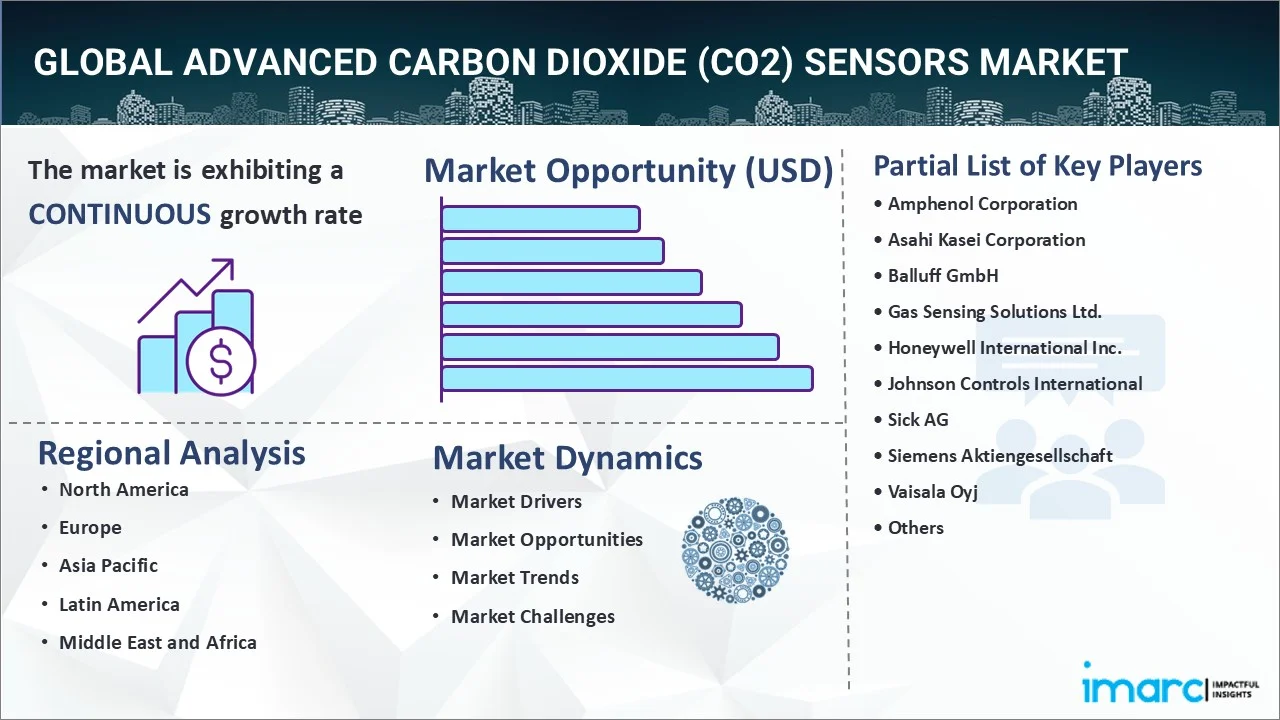
先進二酸化炭素(CO2)センサー市場レポート:製品別(非分散型赤外線(NDIR)CO2センサー、化学CO2センサー)、接続方式別(有線CO2センサー、無線CO2センサー)、最終用途産業別(ヘルスケア、自動車、石油化学、ビルディングオートメーション、家電、その他)、地域別 2026-2034年
Advanced Carbon Dioxide (CO2) Sensors Market Report by Product (Non-Dispersive Infrared (NDIR) CO2 Sensors, Chemical CO2 Sensors), Connectivity (Wired CO2 Sensors, Wireless CO2 Sensors), End Use Industry (Healthcare, Automotive, Petrochemical, Building Automation, Consumer Electronics, and Others), and Region 2026-2034
| 出版 | IMARC Group |
| 出版年月 | 2026年03月 |
| ページ数 | 147 |
| 価格 | 記載以外のライセンスについてはお問合せください |
| シングルユーザ | USD 3,999 |
| 種別 | 英文調査報告書 |
| 商品番号 | SMR- |

世界の先進二酸化炭素(CO2)センサー市場規模は、2025年に6億8,510万米ドルに達しました。IMARCグループは、今後、市場規模は2034年までに12億360万米ドルに達し、2026年から2034年にかけて年平均成長率(CAGR)6.27%で成長すると予測しています。市場を牽引する要因としては、室内空気質モニタリングの需要の高まり、自動車台数の増加、産業オートメーションへの注目の高まり、エネルギー効率の高い建物の重要性に対する意識の高まりなどが挙げられます。
先進二酸化炭素(CO₂)センサー市場分析:
- 主要市場推進要因:厳格な環境規制とスマートシティの拡大により、市場は緩やかな成長を遂げています。
- 主要市場トレンド:自動車分野の成長と産業オートメーションへの注目の高まりが、主要な市場トレンドです。
- 競合状況:先進二酸化炭素(CO₂)センサー業界の主要企業には、アンフェノール株式会社、旭化成株式会社、Balluff GmbH、Gas Sensing Solutions Ltd.、Honeywell International Inc.、Johnson Controls International、Sick AG、Siemens Aktiengesellschaft、Vaisala Oyj、Veris Industries LLC(Schneider Electric)などが挙げられます。
- 課題と機会:初期費用が高いことが、市場における主要な課題となっています。しかしながら、スマートビルディングへの統合とIoT(モノのインターネット)の普及拡大により、これらの課題は克服され、新たな市場機会が生まれると予想されます。
Report Overview
The global advanced carbon dioxide (CO2) sensors market size reached USD 685.1 Million in 2025. Looking forward, IMARC Group expects the market to reach USD 1,203.6 Million by 2034, exhibiting a growth rate (CAGR) of 6.27% during 2026-2034. There are several factors that are driving the market, which include the escalating demand for indoor air quality monitoring, rising number of automobiles, increasing focus on industrial automation, and the growing awareness about the importance of energy-efficient buildings.
ADVANCED CARBON DIOXIDE (CO 2 ) SENSORS MARKET ANALYSIS:
- Major Market Drivers: The market is experiencing moderate growth because of stringent environmental regulations and the expansion of smart cities.
- Key Market Trends: The growth in the automotive sector and rising focus on industrial automation are key market trends.
- Competitive Landscape: Major market players in the advanced carbon dioxide (CO 2 ) sensors industry are Amphenol Corporation, Asahi Kasei Corporation, Balluff GmbH, Gas Sensing Solutions Ltd., Honeywell International Inc., Johnson Controls International, Sick AG, Siemens Aktiengesellschaft, Vaisala Oyj, Veris Industries LLC (Schneider Electric)., among many others.
- Challenges and Opportunities: High initial costs represent a key market challenge. Nonetheless, the smart building integration, along with the increasing adoption of the Internet of Things (IoT), is anticipated to overcome these challenges and offer recent market opportunities.
ADVANCED CARBON DIOXIDE (CO 2 ) SENSORS MARKET TRENDS:
Growth in the Automotive Sector
The automotive industry relies on advanced CO 2 sensors to improve in-cabin comfort and environmental performance. These sensors benefit in exhaust system monitoring and guarantee that vehicles meet these regulations. These sensors allow for more accurate engine modifications, maximizing fuel efficiency and reducing emissions by giving real time data on CO 2 levels. The rising incorporation of superior climate control systems that maintain optimal air quality inside the cabin in vehicles is propelling the advanced carbon dioxide (CO 2 ) sensors market growth. These sensors can monitor the amount of CO 2 inside the vehicle, majorly in electric and autonomous cars. When CO 2 levels rise due to prolonged closure of windows, these sensors trigger the heating, ventilation, and air conditioning (HVAC) system to increase ventilation, ensuring fresh air circulation. As the adoption of electric and autonomous vehicles grows, so does the need for energy-efficient systems. As per the S&P Global, approximately 88.3 million new vehicles are anticipated to be sold out in 2024.
Rising Focus on Industrial Automation
The growing focus on industrial automation is offering a favorable advanced carbon dioxide (CO 2 ) sensors market outlook. In real time environmental monitoring, these sensors are becoming valuable for guaranteeing efficiency, safety, and regulatory compliance. Emissions from equipment, machinery, and chemical processes can cause high levels of CO 2 in automated industrial operations. CO 2 sensors can scan the atmosphere to identify hazardous gas concentrations before they become detrimental. Accurate CO 2 monitoring is required for efficiency and quality control in several industrial settings. In addition, these sensors lower waste and energy consumption while enhancing the performance and consistency of automated manufacturing processes by ensuring that the levels are within ideal limits. As per the research report of the IMARC Group, the global industrial automation services market is anticipated to reach US$ 434.9 Billion by 2032.
Growing Demand for Indoor Air Quality Monitoring
The heightened awareness among individuals about the health risks associated with poor indoor air quality is increasing advanced carbon dioxide (CO 2 ) sensors market share. High occupancy in office buildings, shopping centers, and other commercial settings can result in elevated CO 2 concentrations, which can cause headaches, exhaustion, and decreased productivity. HVAC systems incorporate CO 2 sensors to monitor the quality of the air within. Strict air quality control is also necessary in hospitals and clinics to minimize the transmission of airborne infections and provide a sterile atmosphere. In addition, companies are developing CO 2 sensors, which are the recommended option for air quality monitoring. For instance, Senseair unveiled Senseair S88 that is an accurate, compact, and maintenance-free CO 2 sensing module on 25 March 2024. The product is ideal for indoor air quality monitoring and building automation control across a variety of environments. For CO 2 detection, the S88 uses non-dispersive infrared (NDIR) technology.
Advanced Carbon Dioxide (CO2) Sensors Market Report Scope:
| Report Features | Details |
|---|---|
| Base Year of the Analysis | 2025 |
| Historical Period | 2020-2025 |
| Forecast Period | 2026-2034 |
| Units | Million USD |
| Scope of the Report | Exploration of Historical Trends and Market Outlook, Industry Catalysts and Challenges, Segment-Wise Historical and Future Market Assessment:
|
| Products Covered | Non-Dispersive Infrared (NDIR) CO2 Sensors, Chemical CO2 Sensors |
| Connectivities Covered | Wired CO2 Sensors, Wireless CO2 Sensors |
| End Use Industries Covered | Healthcare, Automotive, Petrochemical, Building Automation, Consumer Electronics, Others |
| Regions Covered | Asia Pacific, Europe, North America, Latin America, Middle East and Africa |
| Countries Covered | United States, Canada, Germany, France, United Kingdom, Italy, Spain, Russia, China, Japan, India, South Korea, Australia, Indonesia, Brazil, Mexico |
| Companies Covered | Amphenol Corporation, Asahi Kasei Corporation, Balluff GmbH, Gas Sensing Solutions Ltd., Honeywell International Inc., Johnson Controls International, Sick AG, Siemens Aktiengesellschaft, Vaisala Oyj, Veris Industries LLC (Schneider Electric), etc. |
| Customization Scope | 10% Free Customization |
| Post-Sale Analyst Support | 10-12 Weeks |
| Delivery Format | PDF and Excel through Email (We can also provide the editable version of the report in PPT/Word format on special request) |
ADVANCED CARBON DIOXIDE (CO 2 ) SENSORS MARKET SEGMENTATION:
IMARC Group provides an analysis of the key trends in each segment of the market, along with forecasts at the global, regional, and country levels for 2026-2034. Our report has categorized the market based on product, connectivity, and end use industry.
Breakup by Product:
- Non-Dispersive Infrared (NDIR) CO 2 Sensors
- Chemical CO 2 Sensors
The report has provided a detailed breakup and analysis of the market based on the product. This includes non-dispersive infrared (NDIR) CO 2 sensors and chemical CO 2 sensors.
Non-dispersive infrared (NDIR) CO 2 sensors measure the absorption of infrared light by CO 2 molecules as to provide precise CO 2 level readings. They are gaining popularity in industries like automotive and building automation as these sectors require consistent and reliable CO 2 monitoring for air quality control. Their ability to operate without frequent calibration makes them a suitable choice for long-term applications.
Chemical CO 2 sensors work by detecting CO 2 through chemical reactions. These sensors have a sensing material that reacts with CO 2 , changing its properties, which are then analyzed to ascertain the concentration of CO 2.
Breakup by Connectivity:
- Wired CO 2 Sensors
- Wireless CO 2 Sensors
A detailed breakup and analysis of the market based on the connectivity have also been provided in the report. This includes wired CO 2 sensors and wireless CO 2 sensors.
Systems where reliable and continuous data transmission is essential use wired CO 2 sensors. These sensors are frequently integrated into building automation systems, industrial monitoring systems, and HVAC systems, when stable power and direct data connections are available. The main advantages of wired CO 2 sensors are their dependability as they are less likely to experience interference or lose data.
Wireless CO 2 sensors are becoming more and more common owing to their adaptability, simplicity of installation, and lower wiring costs. They can be used in temporary monitoring setups or retrofitting older structures. In applications where mobility and scalability, wireless CO 2 sensors are frequently utilized.
Breakup by End Use Industry:
- Healthcare
- Automotive
- Petrochemical
- Building Automation
- Consumer Electronics
- Others
The report has provided a detailed breakup and analysis of the market based on the end use industry. This includes healthcare, automotive, petrochemical, building automation, consumer electronics, and others.
Advanced CO 2 sensors are used in healthcare settings, particularly in vital areas such as intensive care units, patient wards, and operating rooms in order to maintain ideal ventilation and monitor indoor air quality. Sustaining appropriate CO 2 levels is essential for lowering the risk of infection and guaranteeing patient welfare.
These sensors are required for monitoring cabin air quality and controlling emissions in the automotive sector. These sensors are incorporated into HVAC systems, especially electric and driverless vehicles, to guarantee fresh air and passenger comfort. These sensors also benefit manufacturers comply with strict environmental standards.
In the petrochemical sector, these sensors are vital for ensuring worker safety by monitoring for harmful CO 2 levels. They are employed in gas detection systems to promise that CO 2 concentrations stay below acceptable bounds and to avert hazards like explosions or asphyxia in small areas.
Advanced CO 2 sensors are widely utilized in building automation systems to control ventilation and energy consumption and air quality. When included into intelligent HVAC systems, they ensure the best possible airflow depending on occupancy. There is a rise in the focus on energy-efficiency while maintaining comfort and air safety for occupants.
These sensors are becoming common in consumer electronics and easily found in smart home appliances like climate control systems and air quality monitors. These sensors enable users to control ventilation and lower CO 2 accumulation in their living areas by giving access to real time data on indoor air quality to individuals.
Breakup by Region:
- North America
o United States
o Canada
- Asia Pacific
o China
o Japan
o India
o South Korea
o Australia
o Indonesia
o Others
- Europe
o Germany
o France
o United Kingdom
o Italy
o Spain
o Russia
o Others
- Latin America
o Brazil
o Mexico
o Others
- Middle East and Africa
The report has also provided a comprehensive analysis of all the major regional markets, which include North America (the United States and Canada); Asia Pacific (China, Japan, India, South Korea, Australia, Indonesia, and others); Europe (Germany, France, the United Kingdom, Italy, Spain, Russia, and others); Latin America (Brazil, Mexico, and others); and the Middle East and Africa.
North America’s advanced CO 2 sensors market is driven by stringent environmental regulations, particularly in the United States and Canada. Industries like automotive, healthcare, and building automation are adopting these sensors for emissions control and air quality monitoring.
The increasing focus on smart city initiatives, coupled with rising environmental concerns, is catalyzing the demand for CO 2 sensors in industrial, automotive, and commercial applications. Additionally, the region’s thriving automotive and electronics sectors also contribute to the market growth.
There is a rise in the need for these sensors because of stringent environmental regulations and energy efficiency goals in Europe. Countries like Germany, the UK, and France are leading adopters of these sensors. The push towards reducing carbon emissions and improving air quality standards is impelling the market growth.
The growing focus on maintaining air quality is influencing the market positively in the Latin America region. Brazil and Mexico are emerging markets on account of industrial expansion, particularly in petrochemicals and automotive industries.
The Middle East and Africa region is gradually adopting advanced CO 2 sensors, due to concerns about air quality and environmental sustainability. The region’s focus on modernizing infrastructure and incorporating smart technologies is supporting the market growth.
COMPETITIVE LANDSCAPE:
- The market research report has also provided a comprehensive analysis of the competitive landscape in the market. Detailed profiles of all major companies have also been provided. Some of the major market players in the advanced carbon dioxide (CO 2 ) sensors industry include Amphenol Corporation, Asahi Kasei Corporation, Balluff GmbH, Gas Sensing Solutions Ltd., Honeywell International Inc., Johnson Controls International, Sick AG, Siemens Aktiengesellschaft, Vaisala Oyj, Veris Industries LLC (Schneider Electric). ()
- Top market players are investing in research and development (R&D) efforts to develop more accurate, reliable, and energy-efficient CO 2 sensors. They are launching sensors with improved detection capabilities, miniaturization, and wireless. Moreover, several companies are engaging in partnerships with technology providers and smart building companies to integrate these sensors into larger systems. Furthermore, companies are introducing technologies that can quickly detect these harmful gases. For example, on 26 June 2023, Toshiba Corporation unveiled the world’s first compact sensor technology that can monitor gas concentrations in real world environments quickly and concurrently, even for gas mixtures having three or more gases, like CO 2 , hydrogen (H 2 ), and carbon monoxide (CO).
KEY QUESTIONS ANSWERED IN THIS REPORT
- How big is the advanced carbon dioxide (CO2) sensors market?
- What is the future outlook of advanced carbon dioxide (CO2) sensors market?
- What are the key factors driving the advanced carbon dioxide (CO2) sensors market?
- Which are the leading companies in the global advanced carbon dioxide (CO2) sensors market?
Table of Contents
1 Preface
2 Scope and Methodology
2.1 Objectives of the Study
2.2 Stakeholders
2.3 Data Sources
2.3.1 Primary Sources
2.3.2 Secondary Sources
2.4 Market Estimation
2.4.1 Bottom-Up Approach
2.4.2 Top-Down Approach
2.5 Forecasting Methodology
3 Executive Summary
4 Introduction
4.1 Overview
4.2 Key Industry Trends
5 Global Advanced Carbon Dioxide (CO2) Sensors Market
5.1 Market Overview
5.2 Market Performance
5.3 Impact of COVID-19
5.4 Market Forecast
6 Market Breakup by Product
6.1 Non-Dispersive Infrared (NDIR) CO2 Sensors
6.1.1 Market Trends
6.1.2 Market Forecast
6.2 Chemical CO2 Sensors
6.2.1 Market Trends
6.2.2 Market Forecast
7 Market Breakup by Connectivity
7.1 Wired CO2 Sensors
7.1.1 Market Trends
7.1.2 Market Forecast
7.2 Wireless CO2 Sensors
7.2.1 Market Trends
7.2.2 Market Forecast
8 Market Breakup by End Use Industry
8.1 Healthcare
8.1.1 Market Trends
8.1.2 Market Forecast
8.2 Automotive
8.2.1 Market Trends
8.2.2 Market Forecast
8.3 Petrochemical
8.3.1 Market Trends
8.3.2 Market Forecast
8.4 Building Automation
8.4.1 Market Trends
8.4.2 Market Forecast
8.5 Consumer Electronics
8.5.1 Market Trends
8.5.2 Market Forecast
8.6 Others
8.6.1 Market Trends
8.6.2 Market Forecast
9 Market Breakup by Region
9.1 North America
9.1.1 United States
9.1.1.1 Market Trends
9.1.1.2 Market Forecast
9.1.2 Canada
9.1.2.1 Market Trends
9.1.2.2 Market Forecast
9.2 Asia Pacific
9.2.1 China
9.2.1.1 Market Trends
9.2.1.2 Market Forecast
9.2.2 Japan
9.2.2.1 Market Trends
9.2.2.2 Market Forecast
9.2.3 India
9.2.3.1 Market Trends
9.2.3.2 Market Forecast
9.2.4 South Korea
9.2.4.1 Market Trends
9.2.4.2 Market Forecast
9.2.5 Australia
9.2.5.1 Market Trends
9.2.5.2 Market Forecast
9.2.6 Indonesia
9.2.6.1 Market Trends
9.2.6.2 Market Forecast
9.2.7 Others
9.2.7.1 Market Trends
9.2.7.2 Market Forecast
9.3 Europe
9.3.1 Germany
9.3.1.1 Market Trends
9.3.1.2 Market Forecast
9.3.2 France
9.3.2.1 Market Trends
9.3.2.2 Market Forecast
9.3.3 United Kingdom
9.3.3.1 Market Trends
9.3.3.2 Market Forecast
9.3.4 Italy
9.3.4.1 Market Trends
9.3.4.2 Market Forecast
9.3.5 Spain
9.3.5.1 Market Trends
9.3.5.2 Market Forecast
9.3.6 Russia
9.3.6.1 Market Trends
9.3.6.2 Market Forecast
9.3.7 Others
9.3.7.1 Market Trends
9.3.7.2 Market Forecast
9.4 Latin America
9.4.1 Brazil
9.4.1.1 Market Trends
9.4.1.2 Market Forecast
9.4.2 Mexico
9.4.2.1 Market Trends
9.4.2.2 Market Forecast
9.4.3 Others
9.4.3.1 Market Trends
9.4.3.2 Market Forecast
9.5 Middle East and Africa
9.5.1 Market Trends
9.5.2 Market Breakup by Country
9.5.3 Market Forecast
10 SWOT Analysis
10.1 Overview
10.2 Strengths
10.3 Weaknesses
10.4 Opportunities
10.5 Threats
11 Value Chain Analysis
12 Porters Five Forces Analysis
12.1 Overview
12.2 Bargaining Power of Buyers
12.3 Bargaining Power of Suppliers
12.4 Degree of Competition
12.5 Threat of New Entrants
12.6 Threat of Substitutes
13 Price Analysis
14 Competitive Landscape
14.1 Market Structure
14.2 Key Players
14.3 Profiles of Key Players
14.3.1 Amphenol Corporation
14.3.1.1 Company Overview
14.3.1.2 Product Portfolio
14.3.1.3 Financials
14.3.1.4 SWOT Analysis
14.3.2 Asahi Kasei Corporation
14.3.2.1 Company Overview
14.3.2.2 Product Portfolio
14.3.2.3 Financials
14.3.2.4 SWOT Analysis
14.3.3 Balluff GmbH
14.3.3.1 Company Overview
14.3.3.2 Product Portfolio
14.3.3.3 Financials
14.3.4 Gas Sensing Solutions Ltd.
14.3.4.1 Company Overview
14.3.4.2 Product Portfolio
14.3.4.3 Financials
14.3.5 Honeywell International Inc.
14.3.5.1 Company Overview
14.3.5.2 Product Portfolio
14.3.5.3 Financials
14.3.5.4 SWOT Analysis
14.3.6 Johnson Controls International
14.3.6.1 Company Overview
14.3.6.2 Product Portfolio
14.3.6.3 Financials
14.3.7 Sick AG
14.3.7.1 Company Overview
14.3.7.2 Product Portfolio
14.3.7.3 Financials
14.3.8 Siemens Aktiengesellschaft
14.3.8.1 Company Overview
14.3.8.2 Product Portfolio
14.3.8.3 Financials
14.3.8.4 SWOT Analysis
14.3.9 Vaisala Oyj
14.3.9.1 Company Overview
14.3.9.2 Product Portfolio
14.3.9.3 Financials
14.3.10 Veris Industries LLC (Schneider Electric)
14.3.10.1 Company Overview
14.3.10.2 Product Portfolio
List of Tables
Table 1: Global: Advanced Carbon Dioxide Sensors Market: Key Industry Highlights, 2025 and 2034
Table 2: Global: Advanced Carbon Dioxide Sensors Market Forecast: Breakup by Product (in Million USD), 2026-2034
Table 3: Global: Advanced Carbon Dioxide Sensors Market Forecast: Breakup by Connectivity (in Million USD), 2026-2034
Table 4: Global: Advanced Carbon Dioxide Sensors Market Forecast: Breakup by End Use Industry (in Million USD), 2026-2034
Table 5: Global: Advanced Carbon Dioxide Sensors Market Forecast: Breakup by Region (in Million USD), 2026-2034
Table 6: Global: Advanced Carbon Dioxide Sensors Market: Competitive Structure
Table 7: Global: Advanced Carbon Dioxide Sensors Market: Key Players
List of Figures
Figure 1: Global: Advanced Carbon Dioxide Sensors Market: Major Drivers and Challenges
Figure 2: Global: Advanced Carbon Dioxide Sensors Market: Sales Value (in Million USD), 2020-2025
Figure 3: Global: Advanced Carbon Dioxide Sensors Market: Breakup by Product (in %), 2025
Figure 4: Global: Advanced Carbon Dioxide Sensors Market: Breakup by Connectivity (in %), 2025
Figure 5: Global: Advanced Carbon Dioxide Sensors Market: Breakup by End Use Industry (in %), 2025
Figure 6: Global: Advanced Carbon Dioxide Sensors Market: Breakup by Region (in %), 2025
Figure 7: Global: Advanced Carbon Dioxide Sensors Market Forecast: Sales Value (in Million USD), 2026-2034
Figure 8: Global: Advanced Carbon Dioxide Sensors (Non-Dispersive Infrared/NDIR CO2 Sensors) Market: Sales Value (in Million USD), 2020 & 2025
Figure 9: Global: Advanced Carbon Dioxide Sensors (Non-Dispersive Infrared/NDIR CO2 Sensors) Market Forecast: Sales Value (in Million USD), 2026-2034
Figure 10: Global: Advanced Carbon Dioxide Sensors (Chemical CO2 Sensors) Market: Sales Value (in Million USD), 2020 & 2025
Figure 11: Global: Advanced Carbon Dioxide Sensors (Chemical CO2 Sensors) Market Forecast: Sales Value (in Million USD), 2026-2034
Figure 12: Global: Advanced Carbon Dioxide Sensors (Wired CO2 Sensors) Market: Sales Value (in Million USD), 2020 & 2025
Figure 13: Global: Advanced Carbon Dioxide Sensors (Wired CO2 Sensors) Market Forecast: Sales Value (in Million USD), 2026-2034
Figure 14: Global: Advanced Carbon Dioxide Sensors (Wireless CO2 Sensors) Market: Sales Value (in Million USD), 2020 & 2025
Figure 15: Global: Advanced Carbon Dioxide Sensors (Wireless CO2 Sensors) Market Forecast: Sales Value (in Million USD), 2026-2034
Figure 16: Global: Advanced Carbon Dioxide Sensors (Healthcare) Market: Sales Value (in Million USD), 2020 & 2025
Figure 17: Global: Advanced Carbon Dioxide Sensors (Healthcare) Market Forecast: Sales Value (in Million USD), 2026-2034
Figure 18: Global: Advanced Carbon Dioxide Sensors (Automotive) Market: Sales Value (in Million USD), 2020 & 2025
Figure 19: Global: Advanced Carbon Dioxide Sensors (Automotive) Market Forecast: Sales Value (in Million USD), 2026-2034
Figure 20: Global: Advanced Carbon Dioxide Sensors (Petrochemical) Market: Sales Value (in Million USD), 2020 & 2025
Figure 21: Global: Advanced Carbon Dioxide Sensors (Petrochemical) Market Forecast: Sales Value (in Million USD), 2026-2034
Figure 22: Global: Advanced Carbon Dioxide Sensors (Building Automation) Market: Sales Value (in Million USD), 2020 & 2025
Figure 23: Global: Advanced Carbon Dioxide Sensors (Building Automation) Market Forecast: Sales Value (in Million USD), 2026-2034
Figure 24: Global: Advanced Carbon Dioxide Sensors (Consumer Electronics) Market: Sales Value (in Million USD), 2020 & 2025
Figure 25: Global: Advanced Carbon Dioxide Sensors (Consumer Electronics) Market Forecast: Sales Value (in Million USD), 2026-2034
Figure 26: Global: Advanced Carbon Dioxide Sensors (Other End Use Industries) Market: Sales Value (in Million USD), 2020 & 2025
Figure 27: Global: Advanced Carbon Dioxide Sensors (Other End Use Industries) Market Forecast: Sales Value (in Million USD), 2026-2034
Figure 28: North America: Advanced Carbon Dioxide Sensors Market: Sales Value (in Million USD), 2020 & 2025
Figure 29: North America: Advanced Carbon Dioxide Sensors Market Forecast: Sales Value (in Million USD), 2026-2034
Figure 30: United States: Advanced Carbon Dioxide Sensors Market: Sales Value (in Million USD), 2020 & 2025
Figure 31: United States: Advanced Carbon Dioxide Sensors Market Forecast: Sales Value (in Million USD), 2026-2034
Figure 32: Canada: Advanced Carbon Dioxide Sensors Market: Sales Value (in Million USD), 2020 & 2025
Figure 33: Canada: Advanced Carbon Dioxide Sensors Market Forecast: Sales Value (in Million USD), 2026-2034
Figure 34: Asia Pacific: Advanced Carbon Dioxide Sensors Market: Sales Value (in Million USD), 2020 & 2025
Figure 35: Asia Pacific: Advanced Carbon Dioxide Sensors Market Forecast: Sales Value (in Million USD), 2026-2034
Figure 36: China: Advanced Carbon Dioxide Sensors Market: Sales Value (in Million USD), 2020 & 2025
Figure 37: China: Advanced Carbon Dioxide Sensors Market Forecast: Sales Value (in Million USD), 2026-2034
Figure 38: Japan: Advanced Carbon Dioxide Sensors Market: Sales Value (in Million USD), 2020 & 2025
Figure 39: Japan: Advanced Carbon Dioxide Sensors Market Forecast: Sales Value (in Million USD), 2026-2034
Figure 40: India: Advanced Carbon Dioxide Sensors Market: Sales Value (in Million USD), 2020 & 2025
Figure 41: India: Advanced Carbon Dioxide Sensors Market Forecast: Sales Value (in Million USD), 2026-2034
Figure 42: South Korea: Advanced Carbon Dioxide Sensors Market: Sales Value (in Million USD), 2020 & 2025
Figure 43: South Korea: Advanced Carbon Dioxide Sensors Market Forecast: Sales Value (in Million USD), 2026-2034
Figure 44: Australia: Advanced Carbon Dioxide Sensors Market: Sales Value (in Million USD), 2020 & 2025
Figure 45: Australia: Advanced Carbon Dioxide Sensors Market Forecast: Sales Value (in Million USD), 2026-2034
Figure 46: Indonesia: Advanced Carbon Dioxide Sensors Market: Sales Value (in Million USD), 2020 & 2025
Figure 47: Indonesia: Advanced Carbon Dioxide Sensors Market Forecast: Sales Value (in Million USD), 2026-2034
Figure 48: Others: Advanced Carbon Dioxide Sensors Market: Sales Value (in Million USD), 2020 & 2025
Figure 49: Others: Advanced Carbon Dioxide Sensors Market Forecast: Sales Value (in Million USD), 2026-2034
Figure 50: Europe: Advanced Carbon Dioxide Sensors Market: Sales Value (in Million USD), 2020 & 2025
Figure 51: Europe: Advanced Carbon Dioxide Sensors Market Forecast: Sales Value (in Million USD), 2026-2034
Figure 52: Germany: Advanced Carbon Dioxide Sensors Market: Sales Value (in Million USD), 2020 & 2025
Figure 53: Germany: Advanced Carbon Dioxide Sensors Market Forecast: Sales Value (in Million USD), 2026-2034
Figure 54: France: Advanced Carbon Dioxide Sensors Market: Sales Value (in Million USD), 2020 & 2025
Figure 55: France: Advanced Carbon Dioxide Sensors Market Forecast: Sales Value (in Million USD), 2026-2034
Figure 56: United Kingdom: Advanced Carbon Dioxide Sensors Market: Sales Value (in Million USD), 2020 & 2025
Figure 57: United Kingdom: Advanced Carbon Dioxide Sensors Market Forecast: Sales Value (in Million USD), 2026-2034
Figure 58: Italy: Advanced Carbon Dioxide Sensors Market: Sales Value (in Million USD), 2020 & 2025
Figure 59: Italy: Advanced Carbon Dioxide Sensors Market Forecast: Sales Value (in Million USD), 2026-2034
Figure 60: Spain: Advanced Carbon Dioxide Sensors Market: Sales Value (in Million USD), 2020 & 2025
Figure 61: Spain: Advanced Carbon Dioxide Sensors Market Forecast: Sales Value (in Million USD), 2026-2034
Figure 62: Russia: Advanced Carbon Dioxide Sensors Market: Sales Value (in Million USD), 2020 & 2025
Figure 63: Russia: Advanced Carbon Dioxide Sensors Market Forecast: Sales Value (in Million USD), 2026-2034
Figure 64: Others: Advanced Carbon Dioxide Sensors Market: Sales Value (in Million USD), 2020 & 2025
Figure 65: Others: Advanced Carbon Dioxide Sensors Market Forecast: Sales Value (in Million USD), 2026-2034
Figure 66: Latin America: Advanced Carbon Dioxide Sensors Market: Sales Value (in Million USD), 2020 & 2025
Figure 67: Latin America: Advanced Carbon Dioxide Sensors Market Forecast: Sales Value (in Million USD), 2026-2034
Figure 68: Brazil: Advanced Carbon Dioxide Sensors Market: Sales Value (in Million USD), 2020 & 2025
Figure 69: Brazil: Advanced Carbon Dioxide Sensors Market Forecast: Sales Value (in Million USD), 2026-2034
Figure 70: Mexico: Advanced Carbon Dioxide Sensors Market: Sales Value (in Million USD), 2020 & 2025
Figure 71: Mexico: Advanced Carbon Dioxide Sensors Market Forecast: Sales Value (in Million USD), 2026-2034
Figure 72: Others: Advanced Carbon Dioxide Sensors Market: Sales Value (in Million USD), 2020 & 2025
Figure 73: Others: Advanced Carbon Dioxide Sensors Market Forecast: Sales Value (in Million USD), 2026-2034
Figure 74: Middle East and Africa: Advanced Carbon Dioxide Sensors Market: Sales Value (in Million USD), 2020 & 2025
Figure 75: Middle East and Africa: Advanced Carbon Dioxide Sensors Market: Breakup by Country (in %), 2025
Figure 76: Middle East and Africa: Advanced Carbon Dioxide Sensors Market Forecast: Sales Value (in Million USD), 2026-2034
Figure 77: Global: Advanced Carbon Dioxide Sensors Industry: SWOT Analysis
Figure 78: Global: Advanced Carbon Dioxide Sensors Industry: Value Chain Analysis
Figure 79: Global: Advanced Carbon Dioxide Sensors Industry: Porter’s Five Forces Analysis