
高齢者介護支援ロボット市場 - タイプ別(身体支援ロボット、社会支援ロボット)、機能別(監視・監視、移動支援)、地域、セグメント別予測による市場規模、成長と動向分析レポート 2025-2033年
Elder Care Assistive Robots Market Size, Share & Trends Analysis Report By Type (Physically Assistive Robots, Socially Assistive Robots), By Functionality (Monitoring & surveillance, Mobility Assistance), By Region, And Segment Forecasts, 2025 - 2033
| 出版 | Grand View Research |
| 出版年月 | 2026年01月 |
| ページ数 | 150 |
| 価格 | 記載以外のライセンスについてはお問合せください |
| シングルユーザ | USD 5,950 |
| 種別 | 英文調査報告書 |
| 商品番号 | SMR-84448444 |

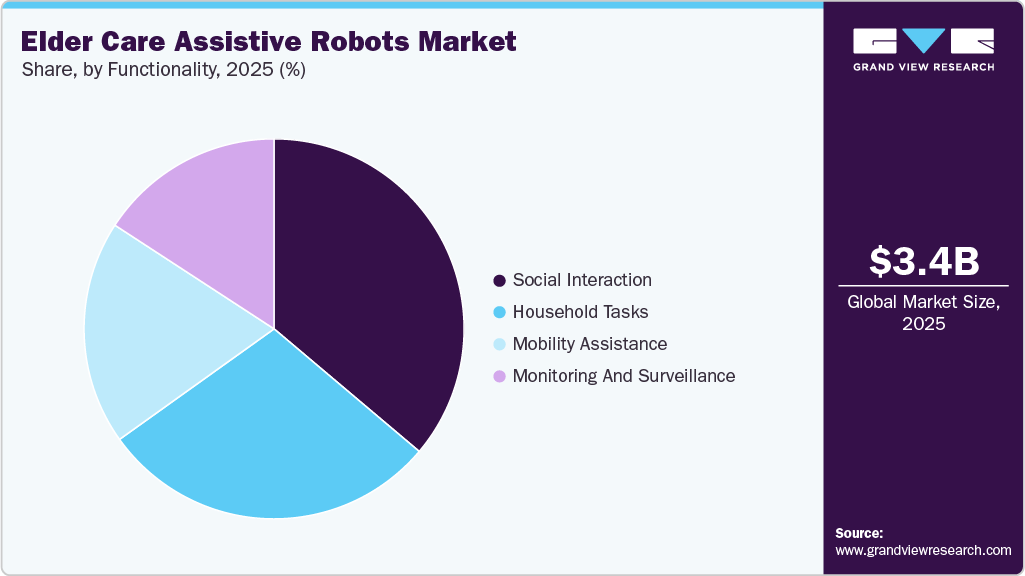
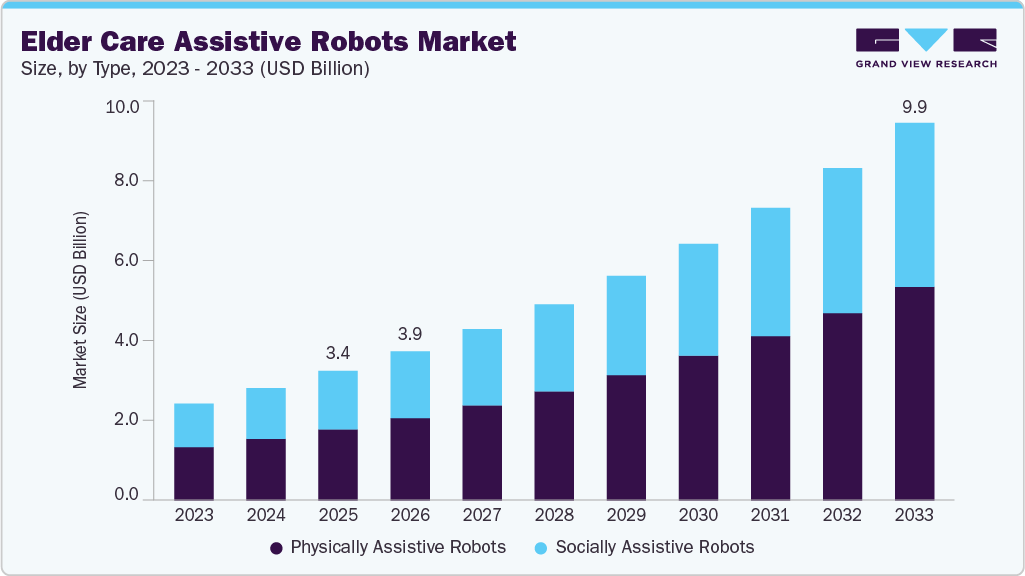
世界の高齢者介護支援ロボット市場規模は、2025年には33億8,000万米ドルと推定され、2033年には98億5,000万米ドルに達すると予測されています。2026年から2033年にかけての年平均成長率(CAGR)は14.20%です。高齢者人口の増加、投資の拡大、そして介護者の不足が、高齢者介護支援ロボットの需要を牽引しています。
世界中で人口の高齢化がかつてない速さで進む中、高齢者介護サービスの需要は急増しています。医療の進歩により平均寿命が延びたことで、多くの国、特にOECD加盟国は、増加する高齢者人口への適切な介護と支援を提供するという大きなプレッシャーに直面しています。この人口構造の変化は、社会経済構造を再構築し、医療制度における深刻なギャップを露呈させています。例えば、2021年のグローバル高齢化連合の報告書によると、OECD諸国だけでも2040年までに1350万人の介護労働者が不足すると予測されており、これは現在の介護者対患者比率を維持するために、現在の労働力を60%増加させる必要があることを意味します。この拡大するギャップは、高齢者を支援するための革新的なソリューションの必要性を高め、市場の成長を促進しています。
世界的な高齢者人口の増加が、市場成長の原動力となっています。国連人口基金の「インド高齢化レポート2023」によると、60歳以上の人口は、2022年7月1日時点の10.5%(1億4900万人)から2050年までに20.8%(3億4700万人)へと倍増すると予測されています。また、世界保健機関(WHO)は2025年に、60歳以上の人口は2023年の11億人から2030年までに14億人に増加すると予測しています。こうした人口動態の変化は、医療システムが継続的かつ効率的なケアを提供するようますます強い圧力を受ける中で、高齢者介護支援ロボット市場の需要を大きく押し上げています。
ロボット工学における研究開発活動の活発化は、市場の成長をさらに促進しています。例えば、2024年1月、コーネル大学のEmPRISE Labの研究者らは、RGBとサーマルイメージングを用いて皮膚の状態を識別するロボット支援型ベッド入浴ソリューションであるRABBITシステムを発表しました。このシステムは、柔軟なエンドエフェクタ「Scrubby」を採用し、優しくケアすることで、パーソナルケア作業における快適性と安全性を向上させています。重度の運動機能障害を持つ人を含む12人の参加者によるユーザー調査では、その有効性と快適性が実証されました。さらに、規制支援と政策イニシアチブも市場の成長を促進する上で重要な役割を果たしています。研究開発への資金提供、技術導入への補助金、安全性と有効性を保証する規制枠組みといった支援政策が、市場の成長を後押ししています。
Elder Care Assistive Robots Market Summary
The global elder care assistive robots market size was estimated at USD 3.38 billion in 2025 and is projected to reach USD 9.85 billion by 2033, growing at a CAGR of 14.20% from 2026 to 2033. The rising geriatric population, growing investments, and increasing shortage of care givers is driving the demand for elder care-assistive robots.
elder-care-assistive-robots-market-size
As populations across the globe continue to age at an unprecedented rate, the demand for elder care services is surging. With advancements in healthcare leading to increased life expectancy, many countries particularly those within the OECD are facing significant pressure to provide adequate care and support for their growing elderly populations. This demographic shift is reshaping social and economic structures and exposing critical gaps in healthcare systems. For instance, according to the Global Coalition on Aging Report in 2021, there will be a shortage of 13.5 million care workers by 2040 across OECD countries alone, which represents a 60% increase needed in the current workforce to maintain the present ratio of caregivers to patients. This growing gap is propelling the need for innovative solutions to support the elderly, thereby fostering market growth.
The growing investment by government and non-government bodies will boost market growth. In August 2023, Intuition Robotics, a company specializing in technology for seniors, raised USD 25 million to address the increasing interest in ElliQ, its conversational AI-powered robot designed for seniors. The device uses generative AI and large language models (LLMs) to facilitate ongoing conversational interactions between the robot and its user. Furthermore, increasing integration of artificial intelligence (AI) in the eldercare robots are enhancing their features, thereby fostering its adoptions. In March 2024, a South Korean company called Hyodol created a robot that utilizes AI to interact with elderly individuals living with dementia. This robot has advanced language-processing abilities, emotional recognition, and can talk and play music, providing companionship to lonely individuals.
Growing elderly population across the globe is driving the market growth. According to the United Nations Population Fund’s India Ageing Report 2023, the population of individuals aged 60 and above is projected to double from 10.5% or 14.9 crore (as of July 1, 2022) to 20.8% or 34.7 crore by 2050. In addition, the World Health Organization in 2025 cited that the number of people aged 60 and above is expected to grow from 1.1 billion in 2023 to 1.4 billion by 2030. This demographic trend significantly drives demand in the elder care assistive robots market, as healthcare systems face rising pressure to provide continuous and efficient care.
Rising research and development activities in robotics are further fueling market growth. For instance, in January 2024, researchers at Cornell University’s EmPRISE Lab introduced the RABBIT system, a robot-assisted bed bathing solution utilizing RGB and thermal imaging to identify skin conditions. It employs a compliant end-effector, “Scrubby,” for gentle care, enhancing comfort and safety in personal hygiene tasks. A user study with 12 participants, including one with severe mobility limitations, demonstrated its effectiveness and perceived comfort. In addition, regulatory support and policy initiatives play a crucial role in fostering market growth. Supportive policies, such as funding for research and development, subsidies for technology adoption, and regulatory frameworks that ensure safety and efficacy, are boosting market growth.
Elder Care Assistive Robots Market Report Scope
| Report Attribute | Details |
| Market size value in 2026 | USD 3.89 billion |
| Revenue forecast in 2033 | USD 9.85 billion |
| Growth rate | CAGR of 14.20% from 2026 to 2033 |
| Actual data | 2021 – 2025 |
| Forecast data | 2026 – 2033 |
| Quantitative units | Revenue in USD million/billion and CAGR from 2026 to 2033 |
| Report coverage | Revenue forecast, company ranking, competitive landscape, growth factors, and trends |
| Segments covered | Type, functionality, region |
| Regional scope | North America; Europe; Asia Pacific; Latin America; MEA |
| Country scope | U.S.; Canada; Mexico; Germany; UK; Spain; Italy; France; Norway; Denmark; Sweden; Japan; China; India; Australia; Thailand; South Korea; Brazil; Argentina; South Africa; Saudi Arabia; UAE; Kuwait |
| Key companies profiled | Intuition Robotics Inc; Toyota (GB) PLC.; SoftBank Robotics UK Ltd.; Blue Frog Robotics; KOMPAÏ robotics; Zorarobotics NV; YUJIN ROBOT Co., Ltd.; Panasonic Holdings Corporation; PARO Robots U.S., Inc. |
| Customization scope | Free report customization (equivalent up to 8 analysts working days) with purchase. Addition or alteration to country, regional & segment scope. |
Global Elder Care Assistive Robots Market Report Segmentation
This report forecasts revenue and volume growth at global, regional, and country level and provides an analysis on industry trends in each of the sub segments from 2021 to 2033. For the purpose of this study, Grand View Research, Inc. has segmented the global elder care assistive robots market report on the basis of type, functionality, and region:
- Type Outlook (Revenue USD Million, 2021 – 2033)
- Physically Assistive Robots
- Socially Assistive Robots
- Functionality Outlook (Revenue USD Million, 2021 – 2033)
- Monitoring and Surveillance
- Mobility Assistance
- Social Interaction
- Household Tasks
- Regional Outlook Revenue USD Million, 2021 – 2033)
- North America
o U.S.
o Canada
o Mexico
- Europe
o Germany
o UK
o Spain
o Italy
o France
o Denmark
o Norway
o Sweden
- Asia Pacific
o Japan
o China
o India
o Australia
o Thailand
o South Korea
- Latin America
o Brazil
o Argentina
- MEA
o South Africa
o Saudi Arabia
o UAE
o Kuwait
Table of Contents
Chapter 1. Methodology and Scope
1.1. Market Segmentation & Scope
1.1.1. Segment scope
1.1.2. Regional scope
1.1.3. Estimates and forecast timeline
1.2. Research Methodology
1.3. Information Procurement
1.3.1. Purchased database
1.3.2. GVR’s internal database
1.3.3. Secondary sources
1.3.4. Primary research
1.3.5. Details of primary research
1.4. Information or Data Analysis
1.4.1. Data analysis models
1.5. Market Formulation & Validation
1.6. Model Details
1.6.1. Commodity flow analysis (Model 1)
1.6.1.1. Approach 1: Commodity flow approach
1.7. Research Assumptions
1.8. List of Secondary Sources
1.9. List of Primary Sources
Chapter 2. Executive Summary
2.1. Market Outlook
2.2. Segment Outlook
2.2.1. Type outlook
2.2.2. Functionality outlook
2.2.3. Regional outlook
2.3. Competitive Insights
Chapter 3. Elder Care Assistive Robots Market Variables, Trends & Scope
3.1. Market Lineage Outlook
3.1.1. Parent market outlook
3.1.2. Ancillary market outlook
3.2. Market Dynamics
3.2.1. Market driver analysis
3.2.1.1. Rapidly Aging Population
3.2.1.2. Caregiver Shortage
3.2.1.3. Technological Advancements
3.2.2. Market restraint analysis
3.2.2.1. High Cost
3.3. Elder Care Assistive Robots: Market Analysis Tools
3.3.1. Industry Analysis – Porter’s
3.3.2. PESTLE Analysis
3.4. Regulatory Framework
Chapter 4. Elder Care Assistive Robots Market Segment Analysis, By Type, 2021-2033 (USD Million)
4.1. Definition and Scope
4.2. Type Market Share Analysis, 2021 & 2033
4.3. Segment Dashboard
4.4. Global Elder Care Assistive Robots Market, by Type, 2021 to 2033
4.5. Physically assistive robots
4.5.1. Physically assistive robots market estimates and forecasts, 2021 to 2033 (USD Million)
4.6. Socially assistive robots
4.6.1. Socially assistive robots market estimates and forecasts, 2021 to 2033 (USD Million)
Chapter 5. Elder Care Assistive Robots Market Segment Analysis, By Functionality, 2021-2033 (USD Million)
5.1. Definition and Scope
5.2. Functionality Market Share Analysis, 2021 & 2033
5.3. Segment Dashboard
5.4. Global Elder Care Assistive Robots Market, by Functionality, 2021 to 2033
5.5. Monitoring and surveillance
5.5.1. Monitoring and surveillance market estimates and forecasts, 2021 to 2033 (USD Million)
5.6. Mobility assistance
5.6.1. Mobility assistance market estimates and forecasts, 2021 to 2033 (USD Million)
5.7. Social interaction
5.7.1. Social interaction market estimates and forecasts, 2021 to 2033 (USD Million)
5.8. Household tasks
5.8.1. Household tasks market estimates and forecasts, 2021 to 2033 (USD Million)
Chapter 6. Elder Care Assistive Robots Market Segment Analysis, By Region, By Type, By Functionality, 2021- 2033 (USD Million)
6.1. Regional Market Share Analysis, 2021 & 2033
6.2. Regional Market Dashboard
6.3. Regional Market Snapshot
6.4. Elder Care Assistive Robots Market by Region, 2021 & 2033:
6.5. North America
6.5.1. North America elder care assistive robots market, 2021 – 2033 (USD Million)
6.5.2. U.S.
6.5.2.1. U.S. elder care assistive robots market, 2021 – 2033 (USD Million)
6.5.3. Canada
6.5.3.1. Canada elder care assistive robots market, 2021 – 2033 (USD Million)
6.5.4. Mexico
6.5.4.1. Mexico elder care assistive robots market, 2021 – 2033 (USD Million)
6.6. Europe
6.6.1. Europe elder care assistive robots market, 2021 – 2033 (USD Million)
6.6.2. UK
6.6.2.1. UK elder care assistive robots market, 2021 – 2033 (USD Million)
6.6.3. Germany
6.6.3.1. Germany elder care assistive robots market, 2021 – 2033 (USD Million)
6.6.4. France
6.6.4.1. France elder care assistive robots market, 2021 – 2033 (USD Million)
6.6.5. Italy
6.6.5.1. Italy elder care assistive robots market, 2021 – 2033 (USD Million)
6.6.6. Spain
6.6.6.1. Spain elder care assistive robots market, 2021 – 2033 (USD Million)
6.6.7. Norway
6.6.7.1. Norway elder care assistive robots market, 2021 – 2033 (USD Million)
6.6.8. Sweden
6.6.8.1. Sweden elder care assistive robots market, 2021 – 2033 (USD Million)
6.6.9. Denmark
6.6.9.1. Denmark elder care assistive robots market, 2021 – 2033 (USD Million)
6.7. Asia Pacific
6.7.1. Japan
6.7.1.1. Japan elder care assistive robots market, 2021 – 2033 (USD Million)
6.7.2. China
6.7.2.1. China elder care assistive robots market, 2021 – 2033 (USD Million)
6.7.3. India
6.7.3.1. India elder care assistive robots market, 2021 – 2033 (USD Million)
6.7.4. Australia
6.7.4.1. Australia elder care assistive robots market, 2021 – 2033 (USD Million)
6.7.5. South Korea
6.7.5.1. South Korea elder care assistive robots market, 2021 – 2033 (USD Million)
6.7.6. Thailand
6.7.6.1. Thailand elder care assistive robots market, 2021 – 2033 (USD Million)
6.8. Latin America
6.8.1. Brazil
6.8.1.1. Brazil elder care assistive robots market, 2021 – 2033 (USD Million)
6.8.2. Argentina
6.8.2.1. Argentina elder care assistive robots market, 2021 – 2033 (USD Million)
6.9. MEA
6.9.1. South Africa
6.9.1.1. South Africa elder care assistive robots market, 2021 – 2033 (USD Million)
6.9.2. Saudi Arabia
6.9.2.1. Saudi Arabia elder care assistive robots market, 2021 – 2033 (USD Million)
6.9.3. UAE
6.9.3.1. UAE elder care assistive robots market, 2021 – 2033 (USD Million)
6.9.4. Kuwait
6.9.4.1. Kuwait elder care assistive robots market, 2021 – 2033 (USD Million)
Chapter 7. Competitive Landscape
7.1. Recent Developments & Impact Analysis, By Key Market Participants
7.2. Company Categorization
7.3. Company Profiles
7.3.1. intuition robotics
7.3.1.1. Company overview
7.3.1.2. Financial performance
7.3.1.3. Product benchmarking
7.3.1.4. Strategic initiatives
7.3.2. Toyota (GB) PLC.
7.3.2.1. Company overview
7.3.2.2. Financial performance
7.3.2.3. Product benchmarking
7.3.2.4. Strategic initiatives
7.3.3. SoftBank Robotics UK Ltd.
7.3.3.1. Company overview
7.3.3.2. Financial performance
7.3.3.3. Product benchmarking
7.3.3.4. Strategic initiatives
7.3.4. Blue Frog Robotics
7.3.4.1. Company overview
7.3.4.2. Financial performance
7.3.4.3. Product benchmarking
7.3.4.4. Strategic initiatives
7.3.5. KOMPAÏ robotics
7.3.5.1. Company overview
7.3.5.2. Financial performance
7.3.5.3. Product benchmarking
7.3.5.4. Strategic initiatives
7.3.6. Zorarobotics NV
7.3.6.1. Company overview
7.3.6.2. Financial performance
7.3.6.3. Product benchmarking
7.3.6.4. Strategic initiatives
7.3.7. YUJIN ROBOT Co., Ltd.
7.3.7.1. Company overview
7.3.7.2. Financial performance
7.3.7.3. Product benchmarking
7.3.7.4. Strategic initiatives
7.3.8. Panasonic Holdings Corporation
7.3.8.1. Company overview
7.3.8.2. Financial performance
7.3.8.3. Product benchmarking
7.3.8.4. Strategic initiatives
7.3.9. PARO Robots U.S., Inc.
7.3.9.1. Company overview
7.3.9.2. Financial performance
7.3.9.3. Product benchmarking
7.3.9.4. Strategic initiatives
List of Tables
Table 1 List of Secondary Sources
Table 2 List of Abbreviations
Table 3 Global elder care assistive robots market, by region, 2021 – 2033 (USD Million)
Table 4 Global elder care assistive robots market, by type, 2021 – 2033 (USD Million)
Table 5 Global elder care assistive robots market, by functionality, 2021 – 2033 (USD Million)
Table 6 North America elder care assistive robots market, by region, 2021 – 2033 (USD Million)
Table 7 North America elder care assistive robots market, by type, 2021 – 2033 (USD Million)
Table 8 North America elder care assistive robots market, by functionality, 2021 – 2033 (USD Million)
Table 9 U.S. elder care assistive robots market, by type, 2021 – 2033 (USD Million)
Table 10 U.S. elder care assistive robots market, by functionality, 2021 – 2033 (USD Million)
Table 11 Canada elder care assistive robots market, by type, 2021 – 2033 (USD Million)
Table 12 Canada elder care assistive robots market, by functionality, 2021 – 2033 (USD Million)
Table 13 Mexico elder care assistive robots market, by type, 2021 – 2033 (USD Million)
Table 14 Mexico elder care assistive robots market, by functionality, 2021 – 2033 (USD Million)
Table 15 Europe elder care assistive robots market, by region, 2021 – 2033 (USD Million)
Table 16 Europe elder care assistive robots market, by type, 2021 – 2033 (USD Million)
Table 17 Europe elder care assistive robots market, by functionality, 2021 – 2033 (USD Million)
Table 18 Germany elder care assistive robots market, by type, 2021 – 2033 (USD Million)
Table 19 Germany elder care assistive robots market, by functionality, 2021 – 2033 (USD Million)
Table 20 UK elder care assistive robots market, by type, 2021 – 2033 (USD Million)
Table 21 UK elder care assistive robots market, by functionality, 2021 – 2033 (USD Million)
Table 22 France elder care assistive robots market, by type, 2021 – 2033 (USD Million)
Table 23 France elder care assistive robots market, by functionality, 2021 – 2033 (USD Million)
Table 24 Italy elder care assistive robots market, by type, 2021 – 2033 (USD Million)
Table 25 Italy elder care assistive robots market, by functionality, 2021 – 2033 (USD Million)
Table 26 Spain elder care assistive robots market, by type, 2021 – 2033 (USD Million)
Table 27 Spain elder care assistive robots market, by functionality, 2021 – 2033 (USD Million)
Table 28 Denmark elder care assistive robots market, by type, 2021 – 2033 (USD Million)
Table 29 Denmark elder care assistive robots market, by functionality, 2021 – 2033 (USD Million)
Table 30 Sweden elder care assistive robots market, by type, 2021 – 2033 (USD Million)
Table 31 Sweden elder care assistive robots market, by functionality, 2021 – 2033 (USD Million)
Table 32 Norway elder care assistive robots market, by type, 2021 – 2033 (USD Million)
Table 33 Norway elder care assistive robots market, by functionality, 2021 – 2033 (USD Million)
Table 34 Asia Pacific elder care assistive robots market, by region, 2021 – 2033 (USD Million)
Table 35 Asia Pacific elder care assistive robots market, by type, 2021 – 2033 (USD Million)
Table 36 Asia Pacific elder care assistive robots market, by functionality, 2021 – 2033 (USD Million)
Table 37 China elder care assistive robots market, by type, 2021 – 2033 (USD Million)
Table 38 China elder care assistive robots market, by functionality, 2021 – 2033 (USD Million)
Table 39 Japan elder care assistive robots market, by type, 2021 – 2033 (USD Million)
Table 40 Japan elder care assistive robots market, by functionality, 2021 – 2033 (USD Million)
Table 41 India elder care assistive robots market, by type, 2021 – 2033 (USD Million)
Table 42 India elder care assistive robots market, by functionality, 2021 – 2033 (USD Million)
Table 43 South Korea elder care assistive robots market, by type, 2021 – 2033 (USD Million)
Table 44 South Korea elder care assistive robots market, by functionality, 2021 – 2033 (USD Million)
Table 45 Australia elder care assistive robots market, by type, 2021 – 2033 (USD Million)
Table 46 Australia elder care assistive robots market, by functionality, 2021 – 2033 (USD Million)
Table 47 Thailand elder care assistive robots market, by type, 2021 – 2033 (USD Million)
Table 48 Thailand elder care assistive robots market, by functionality, 2021 – 2033 (USD Million)
Table 49 Latin America elder care assistive robots market, by region, 2021 – 2033 (USD Million)
Table 50 Latin America elder care assistive robots market, by type, 2021 – 2033 (USD Million)
Table 51 Latin America elder care assistive robots market, by functionality, 2021 – 2033 (USD Million)
Table 52 Brazil elder care assistive robots market, by type, 2021 – 2033 (USD Million)
Table 53 Brazil elder care assistive robots market, by functionality, 2021 – 2033 (USD Million)
Table 54 Argentina elder care assistive robots market, by type, 2021 – 2033 (USD Million)
Table 55 Argentina elder care assistive robots market, by functionality, 2021 – 2033 (USD Million)
Table 56 MEA elder care assistive robots market, by region, 2021 – 2033 (USD Million)
Table 57 MEA elder care assistive robots market, by type, 2021 – 2033 (USD Million)
Table 58 MEA elder care assistive robots market, by functionality, 2021 – 2033 (USD Million)
Table 59 South Africa elder care assistive robots market, by type, 2021 – 2033 (USD Million)
Table 60 South Africa elder care assistive robots market, by functionality, 2021 – 2033 (USD Million)
Table 61 Saudi Arabia elder care assistive robots market, by type, 2021 – 2033 (USD Million)
Table 62 Saudi Arabia elder care assistive robots market, by functionality, 2021 – 2033 (USD Million)
Table 63 UAE elder care assistive robots market, by type, 2021 – 2033 (USD Million)
Table 64 UAE elder care assistive robots market, by functionality, 2021 – 2033 (USD Million)
Table 65 Kuwait elder care assistive robots market, by type, 2021 – 2033 (USD Million)
Table 66 Kuwait elder care assistive robots market, by functionality, 2021 – 2033 (USD Million)
List of Figures
Fig. 1 Market research process
Fig. 2 Data triangulation techniques
Fig. 3 Primary research pattern
Fig. 4 Market research approaches
Fig. 5 Value-chain-based sizing & forecasting
Fig. 6 QFD modeling for market share assessment
Fig. 7 Market formulation & validation
Fig. 8 Elder care assistive robots market: outlook
Fig. 9 Elder care assistive robots competitive insights
Fig. 10 Ancillary market outlook
Fig. 11 Elder care assistive robots market driver impact
Fig. 12 Elder care assistive robots market restraint impact
Fig. 13 Porter’s Analysis
Fig. 14 PESTLE Analysis
Fig. 15 Elder care assistive robots market: Type movement analysis
Fig. 16 Elder care assistive robots market: Type outlook and key takeaways
Fig. 17 Physically assistive robots market estimates and forecast, 2021-2033
Fig. 18 Socially assistive robots estimates and forecast, 2021-2033
Fig. 19 Elder care assistive robots Market: Functionality movement Analysis
Fig. 20 Elder care assistive robots market: Functionality outlook and key takeaways
Fig. 21 Monitoring and surveillance market estimates and forecasts, 2021 – 2033
Fig. 22 Mobility assistance market estimates and forecasts,2021 – 2033
Fig. 23 Social interaction market estimates and forecasts,2021 – 2033
Fig. 24 Household tasks market estimates and forecasts,2021 – 2033
Fig. 25 Global elder care assistive robots market: Regional movement analysis
Fig. 26 Global elder care assistive robots market: Regional outlook and key takeaways
Fig. 27 North America elder care assistive robots market estimates and forecasts, 2021 – 2033 (USD Million)
Fig. 28 Key country dynamics
Fig. 29 U.S. elder care assistive robots market estimates and forecasts, 2021 – 2033 (USD Million)
Fig. 30 Key country dynamics
Fig. 31 Canada elder care assistive robots market estimates and forecasts, 2021 – 2033 (USD Million)
Fig. 32 Key country dynamics
Fig. 33 Mexico elder care assistive robots market estimates and forecasts, 2021 – 2033 (USD Million)
Fig. 34 Europe elder care assistive robots market estimates and forecasts, 2021 – 2033 (USD Million)
Fig. 35 Key country dynamics
Fig. 36 UK elder care assistive robots market estimates and forecasts, 2021 – 2033 (USD Million)
Fig. 37 Key country dynamics
Fig. 38 Germany elder care assistive robots market estimates and forecasts, 2021 – 2033 (USD Million)
Fig. 39 Key country dynamics
Fig. 40 Spain elder care assistive robots market estimates and forecasts, 2021 – 2033 (USD Million)
Fig. 41 Key country dynamics
Fig. 42 France elder care assistive robots market estimates and forecasts, 2021 – 2033 (USD Million)
Fig. 43 Key country dynamics
Fig. 44 Italy elder care assistive robots market estimates and forecasts, 2021 – 2033 (USD Million)
Fig. 45 Key country dynamics
Fig. 46 Norway elder care assistive robots market estimates and forecasts, 2021 – 2033 (USD Million)
Fig. 47 Key country dynamics
Fig. 48 Denmark elder care assistive robots market estimates and forecasts, 2021 – 2033 (USD Million)
Fig. 49 Key country dynamics
Fig. 50 Sweden elder care assistive robots market estimates and forecasts, 2021 – 2033 (USD Million)
Fig. 51 Asia Pacific elder care assistive robots market estimates and forecasts, 2021 – 2033 (USD Million)
Fig. 52 Key country dynamics
Fig. 53 Japan elder care assistive robots market estimates and forecasts, 2021 – 2033 (USD Million)
Fig. 54 Key country dynamics
Fig. 55 China elder care assistive robots market estimates and forecasts, 2021 – 2033 (USD Million)
Fig. 56 Key country dynamics
Fig. 57 India elder care assistive robots market estimates and forecasts, 2021 – 2033 (USD Million)
Fig. 58 Key country dynamics
Fig. 59 Australia elder care assistive robots market estimates and forecasts, 2021 – 2033 (USD Million)
Fig. 60 Key country dynamics
Fig. 61 South Korea elder care assistive robots market estimates and forecasts, 2021 – 2033 (USD Million)
Fig. 62 Key country dynamics
Fig. 63 Thailand elder care assistive robots market estimates and forecasts, 2021 – 2033 (USD Million)
Fig. 64 Latin America elder care assistive robots market estimates and forecasts, 2021 – 2033 (USD Million)
Fig. 65 Key country dynamics
Fig. 66 Brazil elder care assistive robots market estimates and forecasts, 2021 – 2033 (USD Million)
Fig. 67 Key country dynamics
Fig. 68 Argentina elder care assistive robots market estimates and forecasts, 2021 – 2033 (USD Million)
Fig. 69 MEA elder care assistive robots market estimates and forecasts, 2021 – 2033 (USD Million)
Fig. 70 Key country dynamics
Fig. 71 South Africa elder care assistive robots market estimates and forecasts, 2021 – 2033 (USD Million)
Fig. 72 Key country dynamics
Fig. 73 Saudi Arabia elder care assistive robots market estimates and forecasts, 2021 – 2033 (USD Million)
Fig. 74 Key country dynamics
Fig. 75 UAE elder care assistive robots market estimates and forecasts, 2021 – 2033 (USD Million)
Fig. 76 Key country dynamics
Fig. 77 Kuwait elder care assistive robots market estimates and forecasts, 2021 – 2033 (USD Million)
Fig. 78 Key company categorization
Fig. 79 Heat map analysis, 2022 – 2023