
Bioplastics Market Size, Share & Trends Analysis Report By Product (Biodegradable, Non-biodegradable), By Application (Packaging, Agriculture, Automotive & Transportation, Electronics, Textile), By Region, And Segment Forecasts, 2026 - 2033
バイオプラスチック市場 - 製品別(生分解性、非生分解性)、用途別(包装、農業、自動車・輸送、電子機器、繊維)、地域、セグメント別予測による市場規模、成長と動向分析レポート 2026-2033年
| 出版 | Grand View Research |
| 出版年月 | 2026年02月 |
| ページ数 | 145 |
| 価格 | 記載以外のライセンスについてはお問合せください |
| シングルユーザ | USD 4,950 |
| 種別 | 英文調査報告書 |
| 商品番号 | SMR-16768 |

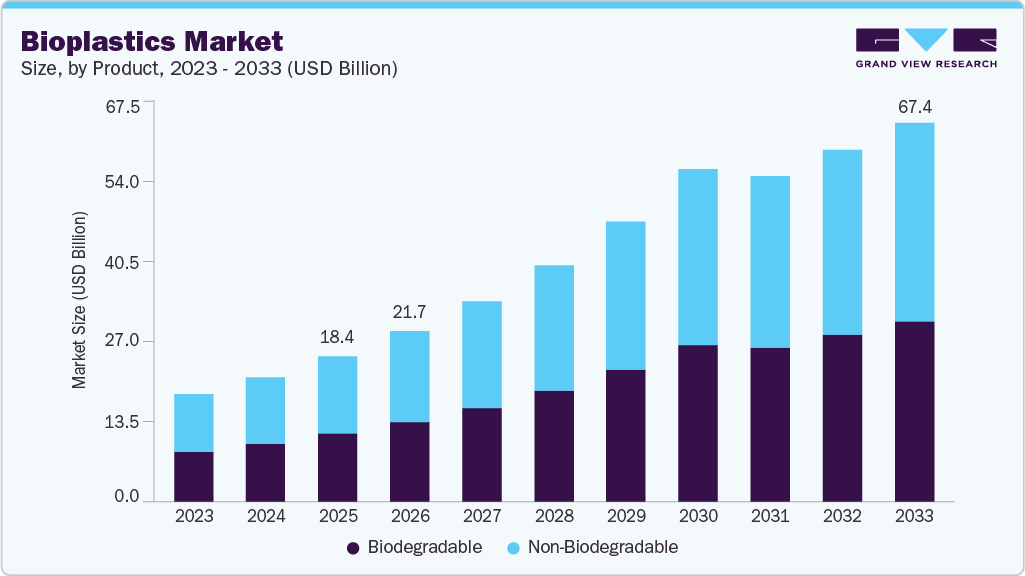
世界のバイオプラスチック市場規模は、2025年には184億1000万米ドルと推定され、2033年には674億2000万米ドルに達するとGrand View Researchでは予測しており、2026年から2033年にかけて年平均成長率(CAGR)17.6%で拡大すると見込まれています。包装業界におけるバイオプラスチックの利用拡大が、世界的な需要を牽引しています。
主要市場動向と洞察
- 欧州は2025年に43.18%という最大の収益シェアを獲得し、バイオプラスチック市場を牽引しました。
- ドイツのバイオプラスチック市場は、2026年から2033年にかけて年平均成長率(CAGR)17.2%という高い成長が見込まれています。
- 製品別に見ると、生分解性セグメントは、収益ベースで2026年から2033年にかけて17.8%という最も高いCAGRで成長すると予測されています。
- 用途別に見ると、自動車・輸送機器用途セグメントは、収益ベースで2026年から2033年にかけて18.6%という最も高いCAGRで成長すると予測されています。
市場は主に、北米やヨーロッパなどの先進地域、そしてアジア太平洋地域の新興国における、使い捨ての非生分解性プラスチックの使用に対する規制強化によって牽引されています。
バイオプラスチックは、包装箱、フィルム、袋などの製造に広く使用されています。持続可能な包装への消費者の関心の高まりと、世界的な埋立地問題の深刻化は、工業製品、食品・飲料製品、家庭用品の包装におけるバイオプラスチックの需要を押し上げ、ひいては予測期間中の市場成長を促進すると予想されます。さらに、消費者が環境に優しく、有害物質の少ない製品をますます求めるようになるにつれ、バイオプラスチックは従来のプラスチックの代替品として重要性を増しています。
Bioplastics Market Summary
The global bioplastics market size was estimated at USD 18.41 billion in 2025 and is expected to reach USD 67.42 billion by 2033, expanding at a CAGR of 17.6% from 2026 to 2033. Increased utilization of bioplastics in the packaging industry is driving their global demand.
Key Market Trends & Insights
- Europe dominated the bioplastics market with the largest revenue share of 43.18% in 2025.
- The bioplastics market in Germany is expected to grow at a substantial CAGR of 17.2% from 2026 to 2033.
- By product, the biodegradable segment is expected to grow at the fastest CAGR of 17.8% from 2026 to 2033 in terms of revenue.
- By application, the Automotive & Transportation application segment is expected to grow at the fastest CAGR of 18.6% from 2026 to 2033 in terms of revenue.
Market Size & Forecast
- 2025 Market Size: USD 18.41 Billion
- 2033 Projected Market Size: USD 67.42 Billion
- CAGR (2026-2033): 17.6%
- Europe: Largest market in 2025
- Asia Pacific: Fastest growing market
The market is primarily driven by increasing restrictions on the use of single-use non-biodegradable plastics in developed regions such as North America and Europe, as well as in emerging economies in the Asia Pacific.
Bioplastics are widely used for manufacturing packaging boxes, films, and bags. The inclination of consumers toward sustainable packaging and rising landfill issues worldwide are expected to boost demand for bioplastics in industrial, food & beverage, and household care packaging, which, in turn, is expected to drive the market over the forecast period. Moreover, bioplastics are gaining importance as an alternative to conventional plastics, as consumers increasingly seek products that are green and less hazardous to the environment.
Drivers, Opportunities & Restraints
Increasing concerns about the toxic effects of petrochemicals and the depletion of crude oil reserves have been driving the development of bio-based polymers. Government regulations restricting the use of petrochemicals in certain applications, such as food packaging and medical devices, are expected to further incentivize the adoption of bioplastics, including biodegradable plastics, in the industry.
An increase in demand for plastic alternatives has been observed in the market, driven by rising concerns about the use of plastics. This is expected to create opportunities for the market in the coming years. With the rapid pace of innovation and new product development, manufacturers in the market are shifting their focus to bioplastics. Companies are continuously developing product lines using biodegradable & non-biodegradable bioplastics and recycled materials to address the concerns regarding the toxic effects of plastic waste.
Bioplastics are gaining popularity worldwide; however, their higher cost compared to conventional plastics is a major factor restraining market growth. Furthermore, the low prices of conventional plastics make it difficult for bioplastics to compete. Moreover, the improper management of biodegradable plastic waste can release chemical substances into the environment if it is not stored, disposed of, or handled appropriately. Factors such as the lack of awareness regarding the health hazards caused by biopharma plastic waste, inadequate training for waste management personnel, and the absence of waste management & disposal systems are projected to restrain the growth of the biodegradable plastics market over the forecast period.
Market Concentration & Characteristics
The bioplastics industry exhibits a moderate-to-high level of innovation, driven by advances in bio-based raw materials, compostable polymer technologies, and performance improvements to compete with traditional plastics. Companies are increasingly investing in research and development to enhance heat resistance, mechanical durability, and scalability. Merger and acquisition activity has been steadily increasing as major chemical companies, packaging manufacturers, and specialty materials firms pursue acquisitions, collaborations, and joint ventures to gain access to technology, expand production capabilities, and reinforce their sustainable product offerings.
Strict environmental regulations, prohibitions on single-use plastics, and extended producer responsibility (EPR) initiatives are driving the increased use of bioplastics, especially in packaging and consumer products. Nonetheless, the market faces competition from alternatives such as recycled conventional plastics, paper-based materials, and new low-carbon polymers, which could limit the rate of substitution, depending on factors such as cost, performance, and the readiness of the infrastructure.
Demand from end users in the bioplastics sector is somewhat concentrated, particularly in packaging, food service, flexible packaging, and consumer goods. Additional industries, such as agriculture, textiles, automotive, and medical applications, are increasingly adopting bioplastics, but their consumption trends remain relatively fragmented and specific to certain applications.
Product Insights
Based on the product, the market has been segmented into biodegradable and non-biodegradable. The biodegradable segment accounted for the largest revenue share of 50.10% in 2025. The rising demand for bio-based plastics across a range of end-use sectors over the forecast period is expected to drive segment growth. The rise in demand for biodegradable plastics is driven by the surge in personal protective equipment (PPE) and the post-pandemic preference for packaged food.
The non-biodegradable segment is expected to grow at a significant CAGR during the forecast period. Non-biodegradable bioplastics are commonly used in a range of products, including automotive interiors, bottles, food packaging, shopping bags, films, carry bags, consumer goods, disposables, and electronics.
Application Insights
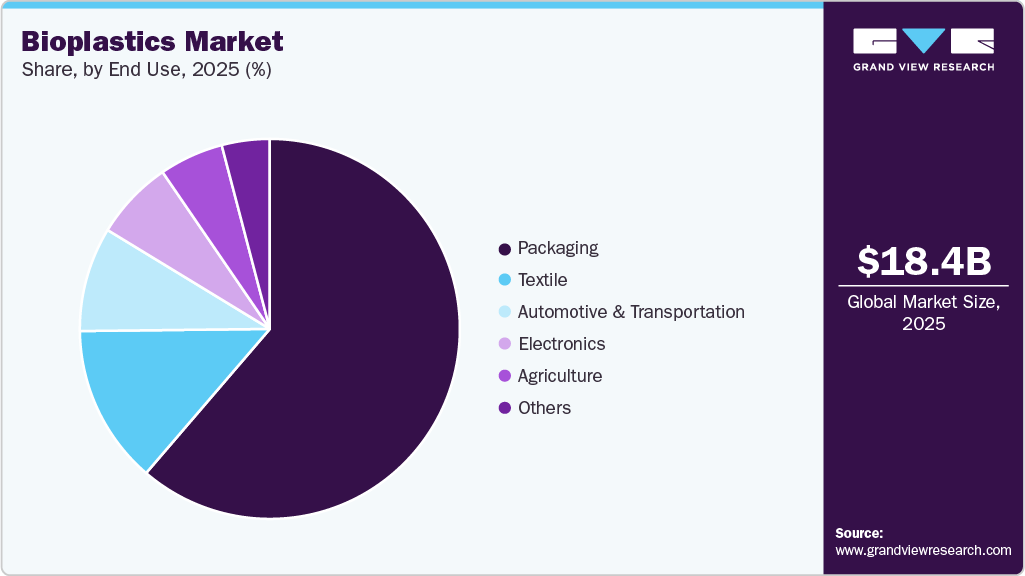
Based on application, the market has been segmented into packaging, agriculture, automotive & transportation, electronics, textile, and others. The packaging segment accounted for the largest revenue share of 61.29% in 2025 and is expected to grow at a considerable CAGR over the forecast period. Bioplastics are widely used in packaging applications, including films, sheets, household care items, food & beverage packaging, and personal care goods. The most popular bioplastics used for packaging are starch blends, PET, PLA, PBAT, PE, and PBS.
Automotive & Transportation is expected to grow at the fastest CAGR in the coming years. In the automotive industry, bioplastics are used in applications such as under-the-hood components and interior parts. Bioplastics are highly effective at reducing carbon footprints owing to their high biocontent.
bioplastics-market-share
The textile segment is also likely to present lucrative opportunities for these bioplastics. Bioplastics are used in the textile industry to manufacture bags, apparel, footwear, home textiles, and technical textiles. In the automotive sector, technical textiles are used in interiors, including seats, side panels, and other components, owing to their high strength and wear resistance. To lower their carbon footprint, major producers of technical textiles are transitioning from traditional polymers to bioplastics.
Key Bioplastics Market Company Insights
The bioplastics market is highly competitive, with several key players dominating the landscape. Major companies include TEIJIN LIMITED, TORAY INDUSTRIES, INC., Toyota Tsusho Corporation, Avantium, PTT MCC Biochem Co., Ltd., An Phat Holdings, NatureWorks LLC, SABIC, and BASF, among others. The Bioplastics Market is characterized by a competitive landscape with several key players driving innovation and market growth. Major companies in this sector are investing heavily in research and development to enhance the performance, cost-effectiveness, and sustainability of their products.
Key Bioplastics Market Companies:
The following key companies have been profiled for this study on the bioplastics market.
- TEIJIN LIMITED
- Toray Industries, Inc.
- Toyota Tsusho Corporation
- Avantium
- PTT MCC Biochem Co., Ltd.
- An Phat Holdings
- NatureWorks LLC
- SABIC
- BASF
- Futerro
- Trinseo
- Braskem S.A.
- TotalEnergies Corbion
- ECPlaza Network Inc.
- Solvay
Recent Developments
- In November 2025, Balrampur Chini Mills revealed its plan to establish India’s inaugural large-scale polylactic acid (PLA) bioplastics facility by October 2026, operating under the Bioyug brand. The initiative, estimated to cost around USD 340 million (₹2,850 crore), will use sugarcane-based feedstock to manufacture about 80,000 tons of compostable, low-emission bioplastics each year, contributing to the transition toward sustainable materials.
- In June 2025, Indian cleantech startup UKHI introduced EcoGran, a biodegradable biopolymer made from agricultural byproducts like hemp, flax, and crop stubble, at World Environment Day celebrations in New Delhi. This material aims to serve as a scalable alternative to traditional petroleum-based plastics, especially in packaging, consumer products, and industrial applications.
- In May 2025, Intec Bioplastics introduced the EarthPlus Hercules Bioflex stretch wrap, a sustainable packaging film made from plants that includes approximately 35% renewable materials, targeting a decrease in carbon emissions for pallet and food packaging uses.
Bioplastics Market Report Scope
| Report Attribute | Details |
| Market size value in 2026 | USD 21.71 billion |
| Revenue forecast in 2033 | USD 67.42 Billion |
| Growth rate | CAGR of 17.6% from 2026 to 2033 |
| Historical data | 2021 – 2024 |
| Base year | 2025 |
| Forecast period | 2026 – 2033 |
| Quantitative units | Revenue in USD million/billion, volume in kilotons, and CAGR from 2026 to 2033 |
| Report coverage | Revenue forecast, competitive landscape, growth factors, and trends |
| Segments covered | Product, application, region |
| Regional scope | North America; Europe; Asia Pacific; Latin America; Middle East & Africa |
| Country scope | U.S.; Canada; Mexico; Germany; France; UK; Italy; Spain; China; India; Japan; Australia; South Korea; Brazil |
| Key companies profiled | TEIJIN LIMITED; Toray Industries, Inc.; Toyota Tsusho Corporation; Avantium; PTT MCC Biochem Co., Ltd.; An Phat Holdings; NatureWorks LLC; SABIC; BASF; Futerro; Trinseo; Braskem S.A.; TotalEnergies Corbion; ECPlaza Network Inc.; Solvay |
| Customization scope | Free report customization (equivalent up to 8 analyst’s working days) with purchase. Addition or alteration to country, regional & segment scope |
Global Bioplastics Market Report Segmentation
This report forecasts revenue growth at the global, regional, and country levels and provides an analysis of the latest industry trends across sub-segments from 2021 to 2033. For this study, Grand View Research has segmented the bioplastics market report on the basis of product, application, and region:
- Product Outlook (Volume, Kilotons; Revenue, USD Million, 2021 – 2033)
- Biodegradable
- Polylactic Acid
- Starch Blends
- PBAT
- PBS
- Others
- Non-biodegradable
- Polyethylene
- Polyethylene Terephthalate
- Polyamide
- Polytrimethylene Terephthalate
- Others
- Biodegradable
- Application Outlook (Volume, Kilotons; Revenue, USD Million, 2021 – 2033)
- Packaging
- Agriculture
- Automotive & Transportation
- Electronics
- Textile
- Others
- Regional Outlook (Volume, Kilotons; Revenue, USD Million, 2021 – 2033)
- North America
- U.S.
- Canada
- Mexico
- Europe
- Germany
- France
- UK
- Italy
- Spain
- Asia Pacific
- China
- India
- Japan
- South Korea
- Australia
- Latin America
- Brazil
- Middle East & Africa
- North America
Table of Contents
Chapter 1 Methodology and Scope
1.1 Market Segmentation & Scope
1.2 Market Definitions
1.3 Information procurement
1.3.1 Information analysis
1.3.2 Market formulation & data visualization
1.3.3 Data validation & publishing
1.4 Research Scope and Assumptions
1.4.1 List to Data Sources
Chapter 2 Executive Summary
2.1 Market Snapshot 2023
2.2 Segment Snapshot (1/2)
2.3 Segment Snapshot (2/2)
2.4 Competitive Landscape Snapshot
Chapter 3 Bioplastics Market: Variables and Trends
3.1 Market Lineage Outlook
3.1.1 Global Plastics Market Outlook
3.2 Penetration & Growth Prospect Mapping
3.3 Industry Value Chain Analysis
3.3.1 Raw Material Trends
3.3.2 Raw Material Price Analysis
3.3.2.1 Sugarcane by-products Price Index
3.3.2.2 Corn Seeds Price Analysis
3.3.2.3 Cassava/Tapioca Price Analysis
3.4 Technology Framework
3.4.1 Commercial Production Technology
3.5 Impact of Circular Economy on the Bioplastics Market
3.6 Average Bioplastics Price Trend Analysis, 2021 – 2033 (USD/Kilogram)
3.6.1 Key Factors Influencing Pricing
3.7 Regulatory Framework
3.7.1 Policies and Incentive Plans
3.7.2 Standards & Compliances
3.8 Market Dynamics
3.8.1 Market Driver Analysis
3.8.1.1 Growing use of renewable & bio-based products
3.8.1.2 shift in Consumer Preferences Toward Eco-Friendly Packaging and strict government regulations
3.8.2 Market Restraint Analysis
3.8.2.1 Price competitiveness of bioplastics over conventional plastics
3.8.3 Industry Challenge Analysis
3.9 Market Business Environment Analysis
3.9.1 Industry Analysis: Porter’s Five Forces Model
3.9.2 Macroeconomic Environment Analysis
3.10 Looming Inflation Concerns and Economic Slowdown & their Impact on the Market
3.11 Supply Chain Disruption in the Red Sea
Chapter 4 Bioplastics Market: Product Estimates & Trend Analysis
4.1 Product Movement Analysis & Market Share Volume, 2025 & 2033
4.2 Product Movement Analysis & Market Share Revenue, 2025 & 2033
4.3 Bioplastics Market Estimates & Forecasts, by Product (Kilotons) (USD Million)
4.3.1 Biodegradable
4.3.1.1 Biodegradable Bioplastics Market Estimates & Forecasts, 2021 – 2033 (Kilotons) (USD Million)
4.3.1.2 Polylactic Acid
4.3.1.2.1 Polylactic Acid Bioplastics Market Estimates & Forecasts, 2021 – 2033 (Kilotons) (USD Million)
4.3.1.3 Starch Blends
4.3.1.3.1 Starch Blends Bioplastics Market Estimates & Forecasts, 2021 – 2033 (Kilotons) (USD Million)
4.3.1.4 Polybutylene Adipate Terephthalate (PBAT)
4.3.1.4.1 Polybutylene Adipate Terephthalate (PBAT) Bioplastics Market Estimates & Forecasts, 2021 – 2033 (Kilotons) (USD Million)
4.3.1.5 Polybutylene Succinate (PBS)
4.3.1.5.1 Polybutylene Succinate (PBS) Bioplastics Market Estimates & Forecasts, 2021 – 2033 (Kilotons) (USD Million)
4.3.1.6 Others
4.3.1.6.1 Other Bioplastics Market Estimates & Forecasts, 2021 – 2033 (Kilotons) (USD Million)
4.3.2 Non-Biodegradable
4.3.2.1 Non-Biodegradable Bioplastics Market Estimates & Forecasts, 2021 – 2033 (Kilotons) (USD Million)
4.3.2.2 Polyethylene
4.3.2.2.1 Polyethylene Bioplastics Market Estimates & Forecasts, 2021 – 2033 (Kilotons) (USD Million)
4.3.2.3 Polyethylene Terephthalate
4.3.2.3.1 Polyethylene Terephthalate Bioplastics Market Estimates & Forecasts, 2021 – 2033 (Kilotons) (USD Million)
4.3.2.4 Polyamide
4.3.2.4.1 Polyamide Bioplastics Market Estimates & Forecasts, 2021 – 2033 (Kilotons) (USD Million)
4.3.2.5 Polytrimethylene Terephthalate
4.3.2.5.1 Polytrimethylene Terephthalate Bioplastics Market Estimates & Forecasts, 2021 – 2033 (Kilotons) (USD Million)
4.3.2.6 Others
4.3.2.6.1 Other Bioplastics Market Estimates & Forecasts, 2021 – 2033 (Kilotons) (USD Million)
Chapter 5 Bioplastics Market: Application Estimates & Trend Analysis
5.1 Application Movement Analysis & Market Share Volume, 2025 & 2033
5.2 Application Movement Analysis & Market Share Revenue, 2025 & 2033
5.3 Bioplastics Market Estimates & Forecasts, by Application (Kilotons) (USD Million)
5.3.1 Packaging
5.3.1.1 Bioplastics in Packaging Market Estimates & Forecasts, 2021 – 2033 (Kilotons) (USD Million)
5.3.2 Agriculture
5.3.2.1 Bioplastics in Agriculture Market Estimates & Forecasts, 2021 – 2033 (Kilotons) (USD Million)
5.3.3 Textiles
5.3.3.1 Bioplastics in Textiles Market Estimates & Forecasts, 2021 – 2033 (Kilotons) (USD Million)
5.3.4 Automotive & Transportation
5.3.4.1 Bioplastics in Automotive & Transportation Market Estimates & Forecasts, 2021 – 2033 (Kilotons) (USD Million)
5.3.5 Electronics
5.3.5.1 Bioplastics in Electronics Market Estimates & Forecasts, 2021 – 2033 (Kilotons) (USD Million)
5.3.6 Others
5.3.6.1 Bioplastics in Other Market Estimates & Forecasts, 2021 – 2033 (Kilotons) (USD Million)
Chapter 6 Bioplastics Market: Regional Estimates & Trend Analysis
6.1 Bioplastics Market: Regional Outlook
6.2 North America
6.2.1 North America Bioplastics Market estimates & Forecasts, 2021 – 2033 (Kilotons) (USD Million)
6.2.2 U.S.
6.2.2.1 U.S. Bioplastics Market estimates & Forecasts, 2021 – 2033 (Kilotons) (USD Million)
6.2.3 Canada
6.2.3.1 Canada Bioplastics Market estimates & Forecasts, 2021 – 2033 (Kilotons) (USD Million)
6.2.4 Mexico
6.2.4.1 Mexico Bioplastics Market estimates & Forecasts, 2021 – 2033 (Kilotons) (USD Million)
6.3 Europe
6.3.1 Europe Bioplastics Market estimates & Forecasts, 2021 – 2033 (Kilotons) (USD Million)
6.3.2 Germany
6.3.2.1 Germany Bioplastics Market estimates & Forecasts, 2021 – 2033 (Kilotons) (USD Million)
6.3.3 France
6.3.3.1 France Bioplastics Market estimates & Forecasts, 2021 – 2033 (Kilotons) (USD Million)
6.3.4 UK
6.3.4.1 UK Bioplastics Market estimates & Forecasts, 2021 – 2033 (Kilotons) (USD Million)
6.3.5 Italy
6.3.5.1 Italy Bioplastics Market estimates & Forecasts, 2021 – 2033 (Kilotons) (USD Million)
6.3.6 Spain
6.3.6.1 Spain Bioplastics Market estimates & Forecasts, 2021 – 2033 (Kilotons) (USD Million)
6.4 Asia Pacific
6.4.1 Asia Pacific Bioplastics Market estimates & Forecasts, 2021 – 2033 (Kilotons) (USD Million)
6.4.2 China
6.4.2.1 china Bioplastics Market estimates & Forecasts, 2021 – 2033 (Kilotons) (USD Million)
6.4.3 India
6.4.3.1 india Bioplastics Market estimates & Forecasts, 2021 – 2033 (Kilotons) (USD Million)
6.4.4 Japan
6.4.4.1 japan Bioplastics Market estimates & Forecasts, 2021 – 2033 (Kilotons) (USD Million)
6.4.5 South Korea
6.4.5.1 South Korea Bioplastics Market estimates & Forecasts, 2021 – 2033 (Kilotons) (USD Million)
6.4.6 Australia
6.4.6.1 Australia Bioplastics Market estimates & Forecasts, 2021 – 2033 (Kilotons) (USD Million)
6.5 Central & South America
6.5.1 Central & South America Bioplastics Market estimates & Forecasts, 2021 – 2033 (Kilotons) (USD Million)
6.5.2 Brazil
6.5.2.1 Brazil Bioplastics Market estimates & Forecasts, 2021 – 2033 (Kilotons) (USD Million)
6.6 Middle East & Africa
6.6.1 Middle East & Africa Bioplastics Market estimates & Forecasts, 2021 – 2033 (Kilotons) (USD Million)
Chapter 7 Global Bioplastics Market: Competitive Landscape
7.1 Recent Developments & Their Impact Analysis, by Key Market Participants
7.2 Company Categorization
7.3 Vendor Landscape
7.3.1 List of Key Distributors and Channel Partners
7.3.2 List of Potential Customers/Key End Users
7.4 Competitive Dynamics
7.4.1 Company Market Share Analysis & Market Positioning
7.4.2 Competitive Benchmarking
7.4.3 Strategy Mapping
7.4.3.1 Expansions
7.4.3.2 new facility/product launches
7.4.3.3 Partnerships/Collaborations
7.4.3.4 Mergers & Acquisitions
7.4.3.5 Research & Development
7.4.4 Company Heat Map Analysis
7.5 Company Outlines
7.5.1 Participant’s Overview
7.5.2 Financial Performance
7.5.3 Product Benchmarking
List of Tables
Table 1 List of Abbreviations
Table 2 Bioplastics Market Estimates and Forecasts, By Product, 2021 – 2033 (Kilotons)
Table 3 Bioplastics Market Estimates and Forecast, By Product, 2021 – 2033 (USD Million)
Table 4 Bioplastics Market Estimates and Forecasts, By Application, 2021 – 2033 (Kilotons)
Table 5 Bioplastics Market Estimates and Forecast, By Application, 2021 – 2033 (USD Million)
Table 6 Recent Developments & Their Impact Analysis, by Key Market Participants
Table 7 Key companies undergoing expansions
Table 8 Key companies involved in partnerships/collaborations
Table 9 Key companies involved in mergers & acquisitions
Table 10 Key Companies undertaking R&D activities
List of Figures
Fig. 1 Bioplastics Market Segmentation
Fig. 2 Information procurement
Fig. 3 Data analysis models
Fig. 4 Market formulation and validation
Fig. 5 Data validating & publishing
Fig. 6 Market snapshot, 2025
Fig. 7 Segment snapshot, 2025 (1/2)
Fig. 8 Segment snapshot, 2025 (2/2)
Fig. 9 Competitive Landscape Snapshot, 2025
Fig. 10 Plastics Market vs Bioplastics Market, 2025 (USD Million)
Fig. 11 Bioplastics Market-Penetration & Growth Prospect Mapping
Fig. 12 Bioplastics Market-Industry Value Chain Analysis
Fig. 13 Raw sugarcane and sugarcane by-products price index (2016 – 2023) [Index 2016 = 100]
Fig. 14 Corn Seeds Price Analysis (2018 – 2023), USD/Bushel
Fig. 15 Cassava/Tapioca Price Analysis (2018 – 2023), USD/Kg
Fig. 16 Bioplastics: Price Trend Analysis (USD/Kg), 2021 – 2033
Fig. 17 Bioplastics Market Dynamics
Fig. 18 Biodegradable Market, 2021 to 2033, USD Billion
Fig. 19 Bioplastics Market: PORTER’s Analysis
Fig. 20 Bioplastics Market: PESTEL Analysis
Fig. 21 Bioplastics Market, by Product: Key Takeaways
Fig. 22 Bioplastics Market, by Product: Market Share Volume, 2025 & 2033
Fig. 23 Bioplastics Market, by Product: Market Share Revenue, 2025 & 2033
Fig. 24 Biodegradable Bioplastics Market Estimates & Forecasts, 2021 – 2033 (Kilotons) (USD Million)
Fig. 25 Polylactic Acid Bioplastics Market Estimates & Forecasts, 2021 – 2033 (Kilotons) (USD Million)
Fig. 26 Starch Blends Bioplastics Market Estimates & Forecasts, 2021 – 2033 (Kilotons) (USD Million)
Fig. 27 Polybutylene Adipate Terephthalate (PBAT) Bioplastics Market Estimates & Forecasts, 2021 – 2033 (Kilotons) (USD Million)
Fig. 28 Polybutylene Succinate (PBS) Bioplastics Market Estimates & Forecasts, 2021 – 2033 (Kilotons) (USD Million)
Fig. 29 Other Bioplastics Market Estimates & Forecasts, 2021 – 2033 (Kilotons) (USD Million)
Fig. 30 Non-Biodegradable Bioplastics Market Estimates & Forecasts, 2021 – 2033 (Kilotons) (USD Million)
Fig. 31 Polyethylene Bioplastics Market Estimates & Forecasts, 2021 – 2033 (Kilotons) (USD Million)
Fig. 32 Polyethylene Terephthalate Bioplastics Market Estimates & Forecasts, 2021 – 2033 (Kilotons) (USD Million)
Fig. 33 Polyamide Bioplastics Market Estimates & Forecasts, 2021 – 2033 (Kilotons) (USD Million)
Fig. 34 Polytrimethylene Terephthalate Bioplastics Market Estimates & Forecasts, 2021 – 2033 (Kilotons) (USD Million)
Fig. 35 Other Bioplastics Market Estimates & Forecasts, 2021 – 2033 (Kilotons) (USD Million)
Fig. 36 Bioplastics Market, by Application: Key Takeaways
Fig. 37 Bioplastics Market, by Application: Market Share Volume, 2025 & 2033
Fig. 38 Bioplastics Market, by Application: Market Share Revenue, 2025 & 2033
Fig. 39 Bioplastics in Packaging Market Estimates & Forecasts, 2021 – 2033 (Kilotons) (USD Million)
Fig. 40 Bioplastics in Agriculture Market Estimates & Forecasts, 2021 – 2033 (Kilotons) (USD Million)
Fig. 41 Bioplastics in Textiles Market Estimates & Forecasts, 2021 – 2033 (Kilotons) (USD Million)
Fig. 42 Bioplastics in Automotive & Transportation Market Estimates & Forecasts, 2021 – 2033 (Kilotons) (USD Million)
Fig. 43 Bioplastics in Electronics Market Estimates & Forecasts, 2021 – 2033 (Kilotons) (USD Million)
Fig. 44 Bioplastics in Other Market Estimates & Forecasts, 2021 – 2033 (Kilotons) (USD Million)
Fig. 45 Bioplastics Market revenue, by region, 2025 & 2033 (USD Million)
Fig. 46 Regional marketplace: Key takeaways
Fig. 47 Regional marketplace: Key takeaways
Fig. 48 North America Bioplastics Market estimates & forecast, 2021 – 2033 (Kilotons) (USD Million)
Fig. 49 U.S. Bioplastics Market estimates & forecast, 2021 – 2033 (Kilotons) (USD Million)
Fig. 50 Canada Bioplastics Market estimates & forecast, 2021 – 2033 (Kilotons) (USD Million)
Fig. 51 Mexico Bioplastics Market estimates & forecast, 2021 – 2033 (Kilotons) (USD Million)
Fig. 52 Europe Bioplastics Market estimates & forecast, 2021 – 2033 (Kilotons) (USD Million)
Fig. 53 Germany Bioplastics Market estimates & forecast, 2021 – 2033 (Kilotons) (USD Million)
Fig. 54 France Bioplastics Market estimates & forecast, 2021 – 2033 (Kilotons) (USD Million)
Fig. 55 UK Bioplastics Market estimates & forecast, 2021 – 2033 (Kilotons) (USD Million)
Fig. 56 Italy Bioplastics Market estimates & forecast, 2021 – 2033 (Kilotons) (USD Million)
Fig. 57 Spain Bioplastics Market estimates & forecast, 2021 – 2033 (Kilotons) (USD Million)
Fig. 58 Asia Pacific Bioplastics Market estimates & forecast, 2021 – 2033 (Kilotons) (USD Million)
Fig. 59 China Bioplastics Market estimates & forecast, 2021 – 2033 (Kilotons) (USD Million)
Fig. 60 India Bioplastics Market estimates & forecast, 2021 – 2033 (Kilotons) (USD Million)
Fig. 61 Japan Bioplastics Market estimates & forecast, 2021 – 2033 (Kilotons) (USD Million)
Fig. 62 South Korea Bioplastics Market estimates & forecast, 2021 – 2033 (Kilotons) (USD Million)
Fig. 63 Australia Bioplastics Market estimates & forecast, 2021 – 2033 (Kilotons) (USD Million)
Fig. 64 Central & South America Bioplastics Market estimates & forecasts, 2021 – 2033 (Kilotons) (USD Million)
Fig. 65 Brazil Bioplastics Market estimates & forecasts, 2021 – 2033 (Kilotons) (USD Million)
Fig. 66 Middle East & Africa Bioplastics Market estimates & forecasts, 2021 – 2033 (Kilotons) (USD Million)
Fig. 67 Market snapshot, 2025
Fig. 68 Company Market Share Analysis & Market Positioning
Fig. 69 Competitive Benchmarking