
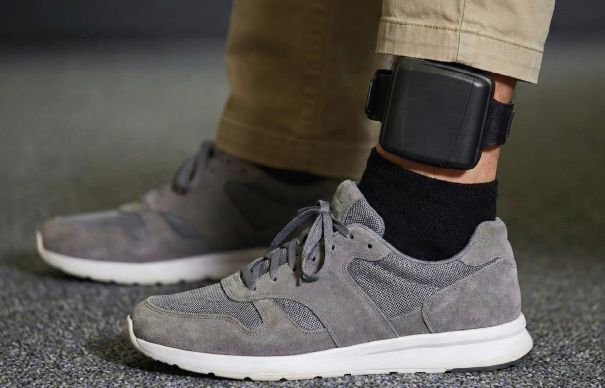
Electronic Offender Monitoring Solutions - 4th Edition
| 出版 | Berg Insight |
| 出版年月 | 2026年01月 |
| ページ数 | 90 |
| 図表数 | 40 |
| 価格 | 記載以外のライセンスについてはお問合せください |
| シングルユーザ | EUR 1,500 |
| 種別 | 英文調査報告書 |
| 商品番号 | SMR-14203 |

電子犯罪者監視ソリューションは、Berg Insightによる戦略レポートです。ヨーロッパ、北米、ラテンアメリカ、オセアニアの刑事司法制度におけるRFおよびGPS追跡ソリューションの最新動向を分析しています。このレポートは、5年間の業界予測や専門家の解説など、ビジネス上の意思決定の基盤となる90ページにわたる独自のビジネスインテリジェンスを提供します。
2025年におけるヨーロッパ、北米、ラテンアメリカ、オセアニアにおける監視対象者の1日平均件数は、それぞれ約9万2,000件、56万4,000件、16万2,000件、1万1,000件でした。Berg Insightは、2030年までに1日あたりの利用者数がヨーロッパで13万人、北米で70万人、ラテンアメリカで27万8,000人、オセアニアで1万6,000人に増加すると予測しています。Berg Insightによる90ページにわたる戦略レポートで、電子犯罪者監視ソリューションに関連するビジネスチャンスの詳細をご覧ください。ベンダー、製品、市場に関する最新情報をお届けします。
このレポートでは、以下のことが可能になります。
- 市場をリードする企業への多数のエグゼクティブインタビューからメリットを享受できます。
- 欧州、北米、中南米、オセアニアの新興市場における主要プレーヤーを特定できます。
- 最新の市場動向と主要な動向を把握できます。
- 新興市場における機会と課題を理解できます。
- 新興市場における機器およびサービスの普及を促進する将来の動向と推進要因を予測できます。
- 2030年までの最新の地域市場予測からメリットを享受できます。
Report Overview
Electronic Offender Monitoring Solutions is a strategy report from Berg Insight analysing the latest developments on the use of RF and GPS tracking solutions in the criminal justice systems in Europe, North America, Latin America and Oceania. This report provides you with 90 pages of unique business intelligence including 5-year industry forecasts and expert commentary on which to base your business decisions.
The average daily caseload of monitored individuals in Europe, North America, Latin America and Oceania amounted to about 92,000, 564,000, 162,000 and 11,000 respectively during 2025. Berg Insight estimates that the number of daily users will grow to 130,000 in Europe, 700,000 in North America, 278,000 in Latin America and 16,000 in Oceania by 2030. Learn more about the business opportunities associated with electronic offender monitoring solutions in this 90-page strategy report from Berg Insight. Get up to date with the latest information about vendors, products and markets.
This report will allow you to:
- Benefit from numerous executive interviews with market leading companies.
- Identify key players on the European, North American, Latin American and Oceanian EM market.
- Learn about the latest market trends and key developments.
- Understand the opportunities and challenges in the EM market.
- Predict future trends and drivers for uptake of EM equipment and services.
- Profit from updated regional market forecasts lasting until 2030.
Recent developments in the electronic offender monitoring industry
Electronic monitoring (EM) programmes were first introduced in the US in the early 1980s. Today, EM is an established alternative to detention across Europe and North America and in some Latin American and Oceanian countries. EM can be used in various stages of the criminal justice system, including at pre-trial, at sentencing and following a period of incarceration. There are two dominant technologies used for electronic monitoring – Radio Frequency (RF) and GPS. RF technology was the first technology to be used, enabling agencies to remotely monitor if offenders sentenced to home curfew complied with the rules of the programme. RF-based systems are today the most common type of solution in most European countries. In the US, Australia and New Zealand in Oceania, and Brazil and other countries in Latin America, GPS-based solutions are more common.
A number of private companies are involved in the provisioning of EM, including developing, supplying and installing equipment, providing monitoring services as well as delivering other supporting services. In North America, Latin America and in some European jurisdictions, private sector companies are responsible for most parts of the EM programme. In the majority of the European countries as well as in Australia and New Zealand, private companies mainly supply equipment and software while public authorities are responsible for installation, field services, monitoring and enforcement. Leading providers of EM equipment and services include US-based BI Inc. (GEO Group), Allied Universal Electronic Monitoring, Sentinel Offender Services, SCRAM Systems, Securus Technologies, Shadowtrack, Corrisoft, Talitrix and Track Group; UK-based Buddi; Israel-based SuperCom; Poland-based Enigma (COMP Group); Switzerland-based Geosatis; and Brazil-based Spacecom, Synergye and UE Brasil Tecnologia.
The average daily caseload of monitored individuals in Europe, North America, Latin America and Oceania amounted to about 92,000, 564,000, 162,000 and 11,000 respectively during 2025. Berg Insight estimates that the number of daily users will grow to 130,000 in Europe, 700,000 in North America, 278,000 in Latin America and 16,000 in Oceania by 2030. The market value in 2025 reached US$ 365 million in Europe, US$ 1.1 billion in North America, US$ 97 million in Latin America and US$ 31 million in Oceania. The total market value in the four regions combined is forecasted to grow at a CAGR of 5.9 percent from US$ 1.6 billion in 2025 to US$ 2.2 billion in 2030.
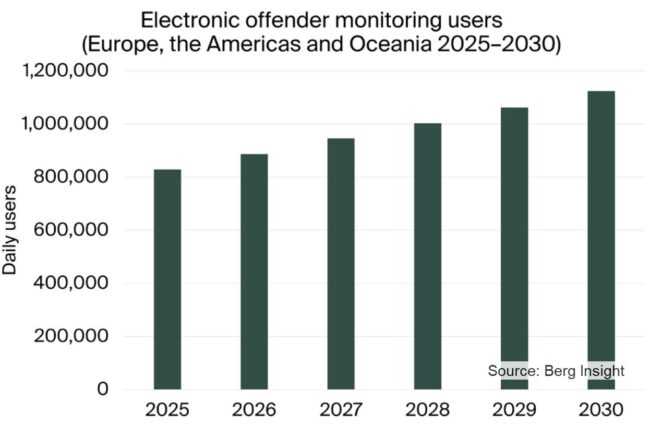
Table of Contents
Executive Summary
1 Electronic Offender Monitoring
1.1 The criminal justice system
1.1.1 Correctional population
1.2 Electronic offender monitoring programmes
1.2.1 North America
1.2.2 Europe
1.2.3 Latin America
1.2.4 Oceania
1.2.5 EM programme costs
1.3 Electronic offender monitoring infrastructure
1.3.1 Device segment
1.3.2 Positioning segment
1.3.3 Network segment
1.3.4 Platform segment
2 Market Forecasts and Trends
2.1 Market landscape
2.1.1 EM equipment and service vendor market shares
2.1.2 Mergers and acquisitions in the electronic offender monitoring industry
2.2 Market forecasts
2.3 Market drivers and trends
2.3.1 The COVID-19 pandemic created a greater awareness of EM solutions
2.3.2 Domestic violence and victim protection cases are important EM applications
2.3.3 Stronger focus on software and analytics within offender monitoring
2.3.4 App-based and wrist-worn solutions extend EM beyond traditional devices
2.3.5 Further consolidation of the EM market is expected
2.3.6 Electronic monitoring gains traction in the immigration control use case
2.3.7 Increasing integration of AI in EM solutions
2.3.8 Price erosion puts pressure on the EM market value
3 Company Profiles and Strategies
3.1 Allied Universal Electronic Monitoring
3.2 BI Incorporated (GEO Group)
3.3 Buddi (Big Technologies)
3.4 Corrisoft
3.5 Enigma (COMP Group)
3.6 Geosatis
3.7 Laipac Technology
3.8 SCRAM Systems
3.9 Securus Technologies
3.10 Sentinel Offender Services
3.11 Shadowtrack Technologies
3.12 Spacecom
3.13 SuperCom
3.14 Synergye
3.15 Talitrix
3.16 Track Group
3.17 UE Brasil Tecnologia
Glossary
List of Figures
Figure 1.1: Prison populations and occupancy levels in Europe (EU27+3 2025) ….. 6
Figure 1.2: Prison populations and occupancy levels in North America (2025) ….. 7
Figure 1.3: Prison populations and occupancy levels in Latin America (2025) ……. 8
Figure 1.4: Prison populations and occupancy levels in Oceania (2025) …… 9
Figure 1.5: Pre-trial, parole and probation statistics (2025) ……….. 10
Figure 1.6: Electronic monitoring programmes in North America (2025) …….. 11
Figure 1.7: Electronic monitoring programmes in Europe (2025) ………. 15
Figure 1.8: Daily EM programme participants in England and Wales (2020–2025) …. 17
Figure 1.9: Daily EM programme participants in Italy (2021–2025) …….. 20
Figure 1.10: Yearly EM programme participants in Sweden (2015–2024) …… 22
Figure 1.11: Daily EM programme participants in Argentina (2019–2024) …… 25
Figure 1.12: Daily EM programme participants in Brazil (2020–2025) ……… 25
Figure 1.13: Electronic monitoring programmes in Oceania (2025) ……… 26
Figure 1.14: Daily EM programme participants in New Zealand (2022–2025) …… 27
Figure 1.15: Electronic monitoring infrastructure ………… 31
Figure 1.16: Different EM device form factors ………….. 32
Figure 1.17: Electronic monitoring application ………… 38
Figure 2.1: EM hardware and software providers ………….. 40
Figure 2.2: Leading EM solution providers in Europe, Oceania and the Americas (2025) .. 42
Figure 2.3: Acquisitions in the electronic offender monitoring industry (2007–2025) …. 46
Figure 2.4: Offender monitoring systems and revenues (North America 2025–2030) … 48
Figure 2.5: Offender monitoring systems and revenues (Europe 2025–2030) …… 49
Figure 2.6: Offender monitoring systems and revenues (Latin America 2025–2030) …. 50
Figure 2.7: Offender monitoring systems and revenues (Oceania 2025–2030) …. 50
Figure 2.8: The use of EM technologies for the immigration cohort (USA 2022–2025) …. 56
Figure 3.1: BI LOC8 XT GPS ankle tag and BI VeriWatch wrist-worn GPS device …… 63
Figure 3.2: Buddi Smart Tag ………………. 65
Figure 3.3: The Corrisoft AIR product suite …………… 67
Figure 3.4: Monitoring devices from Enigma …………… 70
Figure 3.5: Geosatis electronic ankle bracelet …………. 71
Figure 3.6: S911 Enforcer wrist-worn GPS device …………. 72
Figure 3.7: SCRAM product portfolio …………… 74
Figure 3.8: BLUtag GPS device …………….. 76
Figure 3.9: OM500 GPS ankle tag ……………. 79
Figure 3.10: The ShadowCuff device from Shadowtrack Technologies …… 80
Figure 3.11: Spacecom offender monitoring solution …………. 82
Figure 3.12: PureOne GPS bracelet and PureCom home unit with PureTag RF bracelet … 84
Figure 3.13: Synergye Phoenix GPS ankle tag ………… 86
Figure 3.14: Talitrix T-Band wrist-worn GPS device ………….. 87
Figure 3.15: ReliAlert XC5 GPS device and BACtrack alcohol monitoring system ….. 89