
| 出版社 | MarketsandMarkets |
| 出版年月 | 2025年10月 |
Semiconductor Cleanroom Market – Global Forecast to 2030

半導体クリーンルーム市場 – HVACシステム、ファンフィルターユニット、ラミナーフローユニット、HEPA&ULPAフィルター、エアシャワー、パーティクルカウンター、オーバーヘッドホイスト搬送システム、クリーンルームロボット、無人搬送車(AGV) – 2030年までの世界予測
世界の半導体クリーンルーム市場は、2025年には80億8,000万米ドル、2030年には118億8,000万米ドルに達すると予測されており、2025年から2030年にかけて年平均成長率(CAGR)8.0%で成長します。デバイス形状の微細化が進み、EUVリソグラフィーや3D NANDなどのプロセスでは超クリーンな環境が求められるため、高度な汚染制御に対するニーズが高まっており、市場を牽引しています。さらに、環境規制の厳格化と、エネルギー効率が高く持続可能なクリーンルーム運用への要求が高まっていることから、製造工場では次世代のろ過技術とモニタリング技術の導入が進んでいます。これらの要因により、クリーンルームは半導体製造における歩留まり、コンプライアンス、そして信頼性の向上に不可欠な要素となっています。
本調査レポートは、半導体クリーンルーム市場を、提供内容(機器、消耗品)、機器の種類(クリーンルームインフラ・システム、監視・制御システム、クリーンルームロボット・オートメーション、その他機器)、エンドユーザー(IDM企業、OSAT企業、ファウンドリ)、地域(北米、欧州、アジア太平洋地域、その他の地域)に基づいて分類しています。本レポートでは、半導体クリーンルーム市場の主要な推進要因、制約要因、課題、機会を解説し、2030年までの市場予測を示しています。さらに、本レポートには、半導体クリーンルームエコシステムに含まれるすべての企業のリーダーシップマッピングと分析も含まれています。
本レポートは、半導体クリーンルーム市場全体および各サブセグメントの収益数値の近似値に関する情報を提供することで、市場リーダー企業および新規参入企業にとって有益な情報となります。また、本レポートは、ステークホルダーが競争環境を理解し、事業のポジショニングを改善し、適切な市場開拓戦略を策定するための洞察を深めるのに役立ちます。さらに、本レポートは、ステークホルダーが市場の動向を把握し、主要な市場牽引要因、制約要因、課題、そして機会に関する情報を提供する上でも役立ちます。
このレポートでは、以下の点について洞察を提供します。
- 半導体クリーンルーム市場の成長に影響を与える主要な推進要因(先進半導体の需要増加、半導体生産促進のための政府による取り組みと投資の増加、クリーンルーム設計における技術進歩、規制遵守要件)、制約要因(高額な資本コストと運用コスト、クリーンルーム設計と運用の複雑さ)、機会(環境に優しい材料の導入、クリーンルームにおけるロボット工学と自動化の統合)、課題(厳格な規制遵守、半導体クリーンルームにおける汚染管理の課題)の分析
- 製品開発/イノベーション:半導体クリーンルーム市場における今後の技術、研究開発活動、新製品発売に関する詳細な洞察
- 市場開発:収益性の高い市場に関する包括的な情報 – 本レポートでは、さまざまな地域における半導体クリーンルーム市場を分析しています
- 市場の多様化:半導体クリーンルーム市場における新製品、未開拓地域、最近の動向、投資に関する包括的な情報
The global semiconductor cleanroom market is expected to reach USD 8.08 billion in 2025 and USD 11.88 billion by 2030, growing at a CAGR of 8.0% from 2025 to 2030. The market is driven by the growing need for advanced contamination control as device geometries continue to shrink and processes such as EUV lithography and 3D NAND demand ultra-clean environments. Additionally, stricter environmental regulations and the push for energy-efficient, sustainable cleanroom operations encourage fabs to adopt next-generation filtration and monitoring technologies. These factors position cleanrooms as a critical enabler for higher yields, compliance, and reliability in semiconductor manufacturing.
Daifuku Co., Ltd. (Japan), MURATA MACHINERY, LTD. (Japan), Exyte Group (Germany), DuPont (US), and Thermo Fisher Scientific Inc. (US) are some key players in the semiconductor cleanroom market.
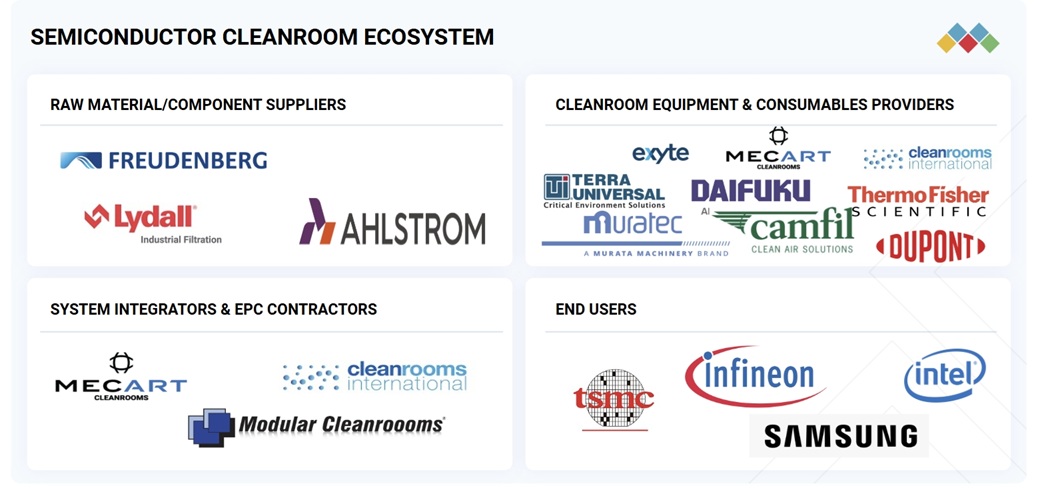
Semiconductor Cleanroom Market – Global Forecast to 2030 – ecosystem
Research Coverage:
This research report categorizes the semiconductor cleanroom market based on offering (equipment, consumables), equipment type (cleanroom infrastructure & systems, monitoring & control systems, cleanroom robotics & automation, and other equipment types), end user (IDM firms, OSAT companies, foundries), and region (North America, Europe, Asia Pacific, and RoW). The report describes the major drivers, restraints, challenges, and opportunities pertaining to the semiconductor cleanroom market and forecasts the same till 2030. Apart from this, the report also consists of leadership mapping and analysis of all the companies included in the semiconductor cleanroom ecosystem.
Key Benefits of Buying the Report
The report will help the market leaders/new entrants in this market by providing information on the closest approximations of the revenue numbers for the overall semiconductor cleanroom market and the subsegments. This report will help stakeholders to understand the competitive landscape and gain more insights to position their businesses better and plan suitable go-to-market strategies. The report also helps stakeholders understand the pulse of the market and provides them with information on key market drivers, restraints, challenges, and opportunities.
The report provides insights into the following pointers:
- Analysis of key drivers (rising demand for advanced semiconductors; increasing government initiatives and investments to boost semiconductor production; technological advancements in cleanroom design; regulatory compliance requirements), restraints (high capital and operational costs; complexity in cleanroom design and operation), opportunities (adoption of eco-friendly materials; integration of robotics and automation in cleanrooms), and challenges (stringent regulatory compliance; contamination control challenges in semiconductor cleanrooms) influencing the growth of the semiconductor cleanroom market
- Product Development/Innovation: Detailed insights on upcoming technologies, research & development activities, and new product launches in the semiconductor cleanroom market
- Market Development: Comprehensive information about lucrative markets–the report analyzes the semiconductor cleanroom market across varied regions
- Market Diversification: Exhaustive information about new products, untapped geographies, recent developments, and investments in the semiconductor cleanroom market
- Competitive Assessment: In-depth assessment of market shares, growth strategies, and product offerings of leading players, including Daifuku Co., Ltd. (Japan), MURATA MACHINERY, LTD. (Japan), Exyte Group (Germany), DuPont (US), Thermo Fisher Scientific Inc. (US), Kawasaki Heavy Industries, Ltd. (Japan), Camfil (Sweden), Clean Rooms International Inc. (US), Horton Automatics (US), and MECART Inc. (Canada), in the semiconductor cleanroom market