
| 出版社 | Mordor Intelligence |
| 出版年月 | 2025年6月 |
Self-Service – Market Share Analysis, Industry Trends & Statistics, Growth Forecasts (2025 – 2030)

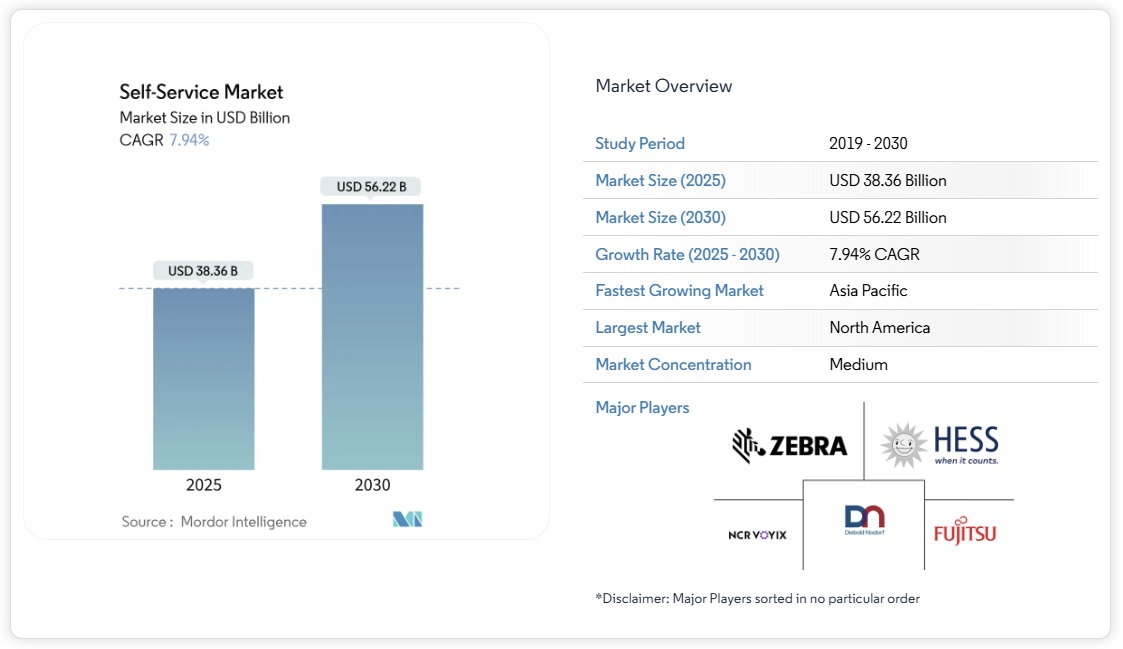
セルフサービス市場は2025年に383億6,000万米ドル規模となり、対象期間に年平均成長率(CAGR)7.9%で成長し、2030年には562億2,000万米ドルに達するとMordor Intelligenceでは予測しています。パンデミック後に導入が増加した非接触型決済、企業におけるデジタル化の強化、そしてデジタルウォレットの普及が市場成長の促進要因として挙げられます。
Mordor Intelligence(モルドーインテリジェンス)「セルフサービス市場規模、シェア分析 – 成長動向と予測 2025-2030年 – Self-Service – Market Share Analysis, Industry Trends & Statistics, Growth Forecasts (2025 – 2030)」はセルフサービスの世界市場を調査し、主要セグメント別に分析・予測を行っています。
調査対象セグメント
- 製品タイプ
- キオスク
- ATM
- 自動販売機
- セルフチェックアウトシステム
- スマートロッカー(宅配便ロッカー)/パーセルステーション
- 構成要素
- ハードウェア
- ソフトウェア
- サービス
- エンドユース産業
- BFSI
- 小売業&クイックサービスレストラン
- ホスピタリティ
- 医療
- 輸送&観光拠点
- 政府&公共部門
- 技術
- 生体認証対応
- 近距離無線通信(NFC)/非接触
- AI駆動型&コンピュータビジョン
- クラウド接続
- 導入場所
- 屋内
- 屋外
- 地域
- 北米
- 米国
- カナダ
- メキシコ
- 欧州
- ドイツ
- 英国
- フランス
- イタリア
- スペイン
- ロシア
- その他の欧州
- アジア太平洋地域
- 中国
- 日本
- インド
- 韓国
- ASEAN
- オーストラリア&ニュージーランド
- その他のアジア太平洋地域
- 南米
- ブラジル
- アルゼンチン
- その他の南米
- 中東&アフリカ
- 中東
- サウジアラビア
- アラブ首長国連邦(UAE)
- トルコ
- その他の中東
- アフリカ
- 南アフリカ
- ナイジェリア
- その他のアフリカ
- 中東
- 北米
ハードウェアおよびソフトウェアサプライヤーは、AI、コンピュータービジョン、生体認証モジュールを組み込むことで対応し、待ち時間を短縮し、セキュリティを強化し、銀行、小売、医療、公共施設などにおける新たなユースケースを開拓しています。QRコードやNFCを基盤とした決済エコシステムは、現在多くの都市中心部で主流となっており、ユーザーが好むあらゆる認証情報に対応できるセルフサービス端末への安定した需要を支えています。ベンダーはサービス契約やプラットフォーム料金にも重点を置いており、かつては1回限りのハードウェア販売だったものを、キャッシュフローを安定させる継続的な収益源に変えています。しかし、破壊行為、屋外の異常気象、電子商取引の代替に対する耐性は、収益性の高い展開の前提条件のままです。
キオスクは2024年にセルフサービス市場の36.2%のシェアを占め、チェックイン、発券、請求書支払いにおける柔軟性を際立たせました。キオスクに関連するセルフサービス市場は、言語パック、AIアバター、支払いオプションを追加する継続的なソフトウェア更新の恩恵を受けています。食料品店や量販店が人件費を削減し、レジのスピードアップを図っているため、セルフチェックアウトレーンは年平均8.3%の成長率で成長しています。ATMは依然として現金エコシステムの基盤となっていますが、モバイル送金が多くの低価値ニーズを満たすようになったため、年間設置数は横ばい状態にあります。自動販売機はスナック菓子だけでなく、市販薬、個人用保護具、時間的制約のあるワクチンにも販売を拡大しており、その社会的影響範囲は拡大しています。スマートロッカーは、ラストワンマイルのコスト削減と営業時間外の荷物受け取りの実現を迫られている物流会社からの注文が急増しました。ヘルスケアキオスクは、2024年の8億ドルから2028年には18億1000万ドルに増加すると予測されており、診断、遠隔医療、処方箋の更新がコンパクトなスペースに統合できることを示しています。小売業者はコンピュータービジョンを導入し、カメラによる自動計量によって農産物の重量を測定し、ミスや買い物客のストレスを最小限に抑えています。製品ミックスは、耐久性とクラウドフックを融合させ、リアルタイムのインサイトとリモートサービスを実現するベンダーに引き続き利益をもたらすでしょう。
Self-Service Market Analysis
The self-service market size stood at USD 38.36 billion in 2025 and is forecast to advance to USD 56.22 billion by 2030, reflecting a 7.9% CAGR over the period. This growth links directly to the shift toward contactless engagement that gathered pace after the pandemic, tighter corporate mandates for digitization, and broad public familiarity with digital wallets. Hardware and software suppliers are responding by embedding AI, computer vision, and biometric modules that cut wait times, strengthen security, and open new use-cases across banking, retail, healthcare, and public venues. Payment ecosystems built on QR and NFC are now mainstream in many urban centers, and they underpin steady demand for self-service terminals able to accept any credential the user prefers. Vendors also highlight service contracts and platform fees, turning what was once a one-off hardware sale into a recurring revenue stream that smooths cash flow. However, resilience against vandalism, outdoor weather extremes, and e-commerce substitution remains a prerequisite for profitable roll-outs.
Global Self-Service Market Trends and Insights
Ubiquity of Contact-Free Transactions Post-COVID
Global digital payment participation jumped from 44% in 2014 to two-thirds of adults in 2022, confirming a permanent tilt toward cashless behaviors. European research shows sustained intentions to avoid cash because of hygiene concerns, and operators of micro-markets report higher revenues after installing cashless modules. Countries like Sweden, where cash use halved in the past decade, underscore how rapidly policy, merchants, and consumers converge on digital rails. This preference extends to biometric taps and voice prompts, driving every corner of the self-service market to support no-touch authentication.
Self-Service – Market Share Analysis, Industry Trends & Statistics, Growth Forecasts (2025 – 2030)
List of Companies Covered in this Report:
- NCR Corporation
- Diebold Nixdorf
- Crane Payment Innovations
- Fujitsu Ltd.
- Glory Global Solutions
- Zebra Technologies
- Advantech Co. Ltd.
- Frank Mayer and Associates Inc.
- HESS Cash Systems GmbH
- Azkoyen Group
- Embross
- SEDCO
- IER Group
- Maas International B.V.
- RedyRef Interactive
- Olea Kiosks Inc.
- Posiflex Technology Inc.
- SlabbKiosks
- KIOSK Information Systems
Geography Analysis
North America held 39.4% of revenue in 2024, reflecting long-standing adoption of automated teller technology, wide retail deployment, and supportive privacy regulations. Payment card penetration is nearly universal, and digital wallets are mainstream, so merchants prioritize terminals that handle chip, tap, and mobile credentials. Federal agencies devote stimulus budgets to broadband and digital government portals, fostering a consistent user experience in public service kiosks. Corporate appetite for AI, cloud, and cybersecurity rises each budget cycle, reinforcing demand for software-centric upgrades that sit atop existing hardware.
Europe balances sustainability and inclusion. The European Commission urges eco-design and transparent supply chains, pushing manufacturers to lengthen device lifespans and publish carbon footprints. Accessibility law compels tactile keypads, audio prompts, and adjustable font sizes, which influence BOM and firmware design. Germany’s EHI initiative demonstrates commercial appetite by counting thousands of self-checkout lanes, while the region debates best formats for a digital euro that could seamlessly link to kiosks and ATMs. Operators retrofit remote telemetry to trim service van miles, aligning with climate targets.
Asia-Pacific, advancing at an 8.5% CAGR, benefits from pro-digitization edicts and an explosion of smartphone-linked QR payments. India stages billions of UPI transfers each month, normalizing QR taps even in rural kiosks. China pilots a central bank digital currency that will likely integrate into transit and vending networks, placing pressure on operators to update firmware fast. Governments in ASEAN fund e-government lobbies inside post offices, reducing red tape while ensuring remote citizens receive equal service. South America and the Middle East trail but accelerate as telcos push mobile money and as tourism revives interest in multi-language ticketing stations.