
| 出版社 | Kaleido Intelligence |
| 出版年月 | 2025年7月 |
Cellular-Satellite Communications: Opportunities & Outlook 2025

Kaleido Intelligenceの最新のフォーカスリサーチは、セルラー・衛星接続におけるDirect-to-Device(D2D)市場の将来について包括的な分析を提供し、業界の様々なステークホルダーにとってのこの技術の開発機会とビジネスモデルを評価しています。本レポートでは、様々なプレーヤーがD2D接続戦略をどのように展開しているかを考察するとともに、技術の強化とインフラの改善という観点から市場がどのように発展しているかを検証しています。さらに、8 ページのエグゼクティブ サマリーが用意されており、読者に主要な調査結果と戦略的洞察の簡潔な概要を提供します。
D2Dは現在、携帯電話接続において最も話題となっている分野の一つです。これは、改造されていない携帯電話端末が、かつてないほど大幅に低コストで衛星ネットワークに接続できるためです。特に通信目的のペイロードの軌道上への打ち上げは、打ち上げコストの大幅な低下により、過去10年間で飛躍的に増加しました。しかしながら、既存のビジネスモデル、パートナーシップ戦略、そして将来のユースケースに関する期待という点で、依然として大きな障壁が存在します。
Research Highlights:
- Direct-to-device IoT connections and revenue
- Direct-to-device smartphone connections and revenue
- Analysis of 15 satellite network operator players’ position and strategy
- Risk assessment of large-scale constellations and core players
- Monetisation strategies for direct-to-device connectivity
- Use case analysis across smartphones and IoT devices today and future outlook
The latest focus research from Kaleido Intelligence provides a comprehensive analysis of the future of the Direct-to-Device (D2D) market for cellular-satellite connectivity, assessing the development opportunities and business models for this technology for a number of industry stakeholders. The report considers how various players are developing strategies for D2D connectivity, while examining how the market is developing in terms of technology enhancements and infrastructure improvements.
Additionally, an 8-page executive summary is available, offering readers a concise overview of key findings and strategic insights.
D2D currently represents one of the most talked-about areas for cellular connectivity, due to the ability for unmodified cellular devices to connect to satellite networks at considerably lower costs than ever before. Payload launches into orbit, particularly for communications purposes, have exponentially risen over the past decade due to massive decreases in launch costs. Nevertheless, key barriers exist in terms of extant business models, partnership strategies and expectations surrounding future use cases.
Readers will receive the following insights:
- How use cases for smartphones and IoT will develop from today into the future, in consideration of satellite technology development and airtime economics
- Key strategic opportunities that MNOs and connectivity service providers can leverage to generate market traction
- An assessment of 15 key satellite network operators, in terms of their infrastructure capabilities, future strategy and long-term viability
- An understanding of how lack of sustainable practices in space represent a systemic risk to the industry in terms of financial viability for players
[PRESS RELEASE]
Direct-to-Device IoT Connections Reach 30 Million in 2030
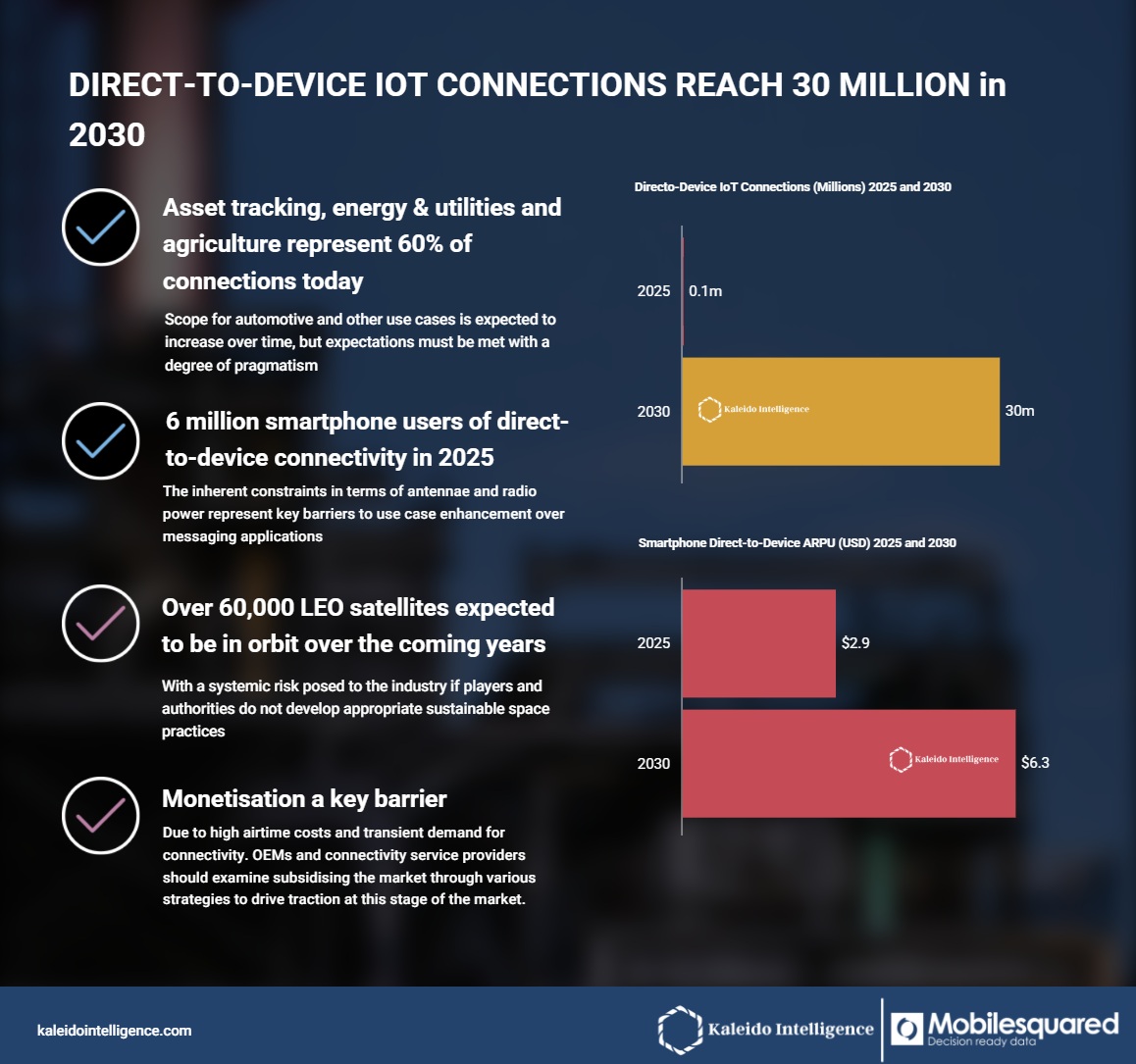
17th July 2025, London, UK: A new report from connectivity specialist research house Kaleido Intelligence has found that satellite direct-to-device IoT connections will reach 30 million in 2030, up from less than half a million at the end of 2025. Direct-to-device (D2D) technology allows commodity cellular hardware to connect to satellite networks using either licenced operator terrestrial spectrum or via NTN (Non-Terrestrial Network) chipsets and associated spectrum.
2025年7月17日、英国ロンドン: コネクティビティ専門調査会社Kaleido Intelligenceの新しいレポートによると、衛星直接デバイスIoT接続は、2025年末の50万未満から2030年には3,000万に達すると予測されています。直接デバイス(D2D)技術により、市販のセルラーハードウェアは、ライセンスを受けたオペレータの地上スペクトルを使用するか、NTN(非地上ネットワーク)チップセットと関連スペクトルを介して衛星ネットワークに接続できます。
Business Model Innovation Required
The new research, Cellular-Satellite Communications: Opportunities & Outlook 2025, highlighted that today, the market for D2D communications for IoT use cases remains nascent, with Skylo leading within the NTN space. Key use cases for D2D currently focus around low-bandwidth, non-critical applications with asset tracking, energy and utilities (including oil and gas) in addition to agriculture accounting for around 60% of connections today.
Nevertheless, while IoT represents a potentially high addressable market for uptake, with 51% of IoT enterprises and OEMS viewing it as a viable solution for WAN connectivity, economics in terms of airtime pricing pose significant barriers, which will continue to slow market adoption for the foreseeable future.
“In similar fashion to how OEM subsidies for satellite connectivity can drive traction in the smartphone market, the same principles can be applied to IoT”, remarked research author Steffen Sorrell. “Here, margins achieved through consumer data breakage can be leveraged to drive IoT airtime pricing down, and present a more attractive offer for volume.”
Cellular-Satellite Communications