
| 出版社 | MarketsandMarkets |
| 出版年月 | 2025年9月 |
Network API Market – Global Forecast to 2030

本市場調査は、ネットワークAPI市場の規模と、APIタイプ(デバイスステータス、エッジ、アイデンティティ、ロケーション、ネットワークパフォーマンス、その他のAPIタイプ)、アプリケーション(IoT、優先通信、自律走行車、不正防止、エンターテイメント&コンテンツ配信、エンタープライズIT、その他のアプリケーション)、業種(BFSI、IT&ITeS、通信、政府機関&公共部門、製造業、ヘルスケア&ライフサイエンス、小売&Eコマース、メディア&エンターテイメント、その他の業種)、地域など、様々なセグメントにおける成長の可能性を網羅しています。本調査には、主要市場プレーヤーの詳細な競合分析、企業プロフィール、製品および事業内容に関する主要な考察、最近の動向、市場戦略が含まれています。
本レポートは、市場リーダーと新規参入企業にとって、世界のネットワークAPI市場の収益数値とサブセグメントに関する近似値に関する情報を提供するのに役立ちます。また、ステークホルダーが競争環境を理解し、自社のポジショニングを改善し、適切な市場開拓戦略を策定するための洞察を深めるのに役立ちます。さらに、本レポートは、ステークホルダーが市場の動向を把握し、主要な市場牽引要因、制約要因、課題、そして機会に関する情報を提供するための洞察を提供します。
ネットワークAPI市場は、2025年には19億6,000万米ドルに達すると推定され、2030年には61億3,000万米ドルに達し、2025年から2030年にかけて25.7%のCAGRで成長すると予測されています。業界全体でプログラマブルでオンデマンドの接続性が求められる中、市場は実験段階から商用化へと急速に移行しています。従来の統合モデルとは異なり、ネットワークAPIは、デバイスの状態、場所、エッジコンピューティング、ポリシー制御などのリアルタイム機能を、標準化された開発者フレンドリーな形式で公開します。この変化により、企業はクラウドインフラストラクチャと同じくらい簡単にネットワークサービスを利用できるようになり、複雑さが軽減されるとともに、IoT、自律移動、拡張現実、安全なデジタルトランザクションなどの新しいアプリケーションが利用可能になります。CAMARAやOpen Gatewayなどのイニシアチブの台頭により、オペレータ間の相互運用性が確保され、企業はサイロ化された展開ではなく、グローバル規模のプログラマビリティを実現できます。ネットワークのソフトウェア定義化が進むにつれて、APIはオプションのアドオンから不可欠なビジネスイネーブラーへと進化しています。今後 5 年間は、企業の俊敏性に対する需要、通信事業者向けの新しい収益化モデル、AI 主導の自動化とネットワーク プログラマビリティの融合によって成長が促進されるでしょう。
ネットワークAPI市場は、高い成長ポテンシャルを秘めているものの、統合の複雑さ、事業者間の標準化の限界、そして高い実装コストといった制約に直面しています。企業は、APIを容易に利用できないレガシーシステムに苦慮することが多く、APIのセキュリティ、レイテンシ保証、収益化モデルに関する懸念が、大規模な導入を遅らせています。
The network API market is estimated to be USD 1.96 billion in 2025 and is projected to reach USD 6.13 billion by 2030, at a CAGR of 25.7% from 2025 to 2030. The market is rapidly moving from experimentation to commercialization, driven by the push for programmable, on-demand connectivity across industries. Unlike traditional integration models, network APIs expose real-time capabilities such as device status, location, edge computing, and policy control in a standardized, developer-friendly format. This shift is enabling enterprises to consume network services as easily as cloud infrastructure, reducing complexity while unlocking new applications in IoT, autonomous mobility, extended reality, and secure digital transactions. The rise of initiatives like CAMARA and Open Gateway is ensuring interoperability across operators, giving enterprises global-scale programmability instead of siloed deployments. As networks become increasingly software-defined, APIs are evolving from optional add-ons to essential business enablers. Over the next five years, growth will be fueled by enterprise demand for agility, new monetization models for operators, and the convergence of AI-driven automation with network programmability.
Despite strong growth potential, the network API market faces constraints such as integration complexity, limited standardization across operators, and high implementation costs. Enterprises often struggle with legacy systems that cannot easily consume APIs, while concerns around API security, latency guarantees, and monetization models slow adoption at scale.
network-api-market-ecosystem
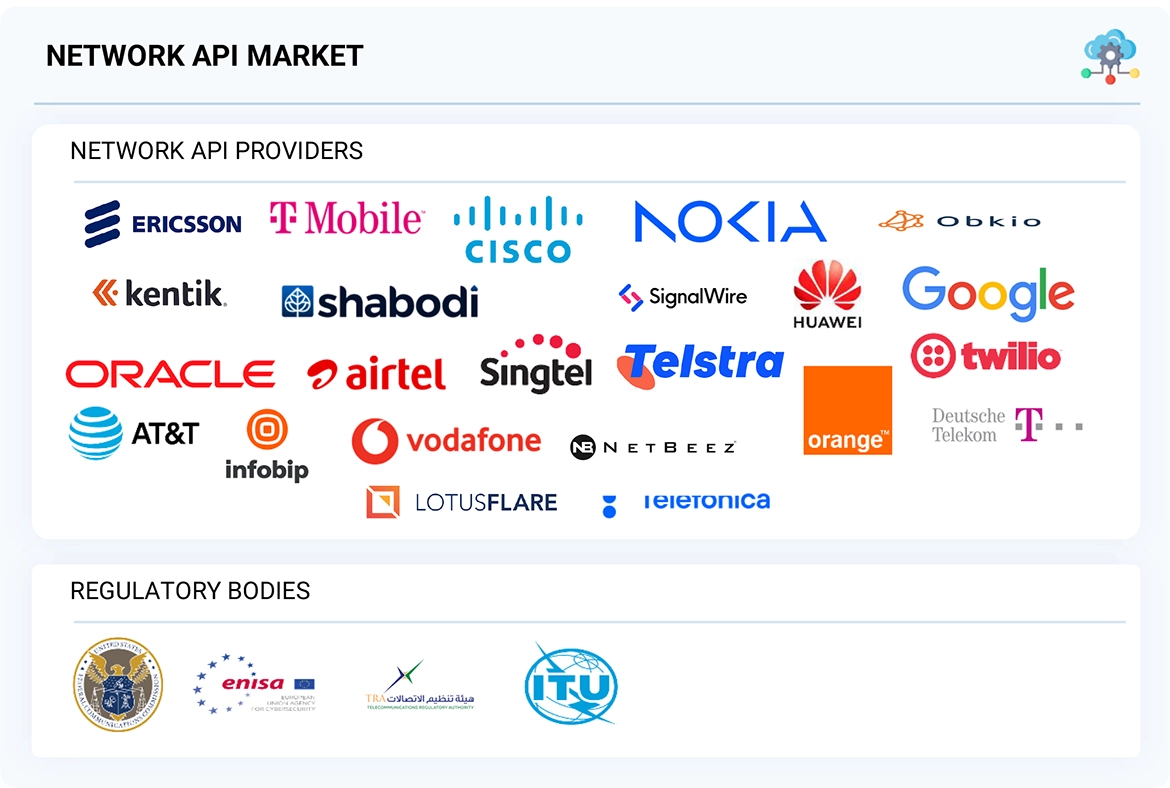
The major players in the network API market are Ericsson (Sweden), Nokia (Finland), Cisco (US), Microsoft (US), T-Mobile (US), AT&T (US), Orange (France), Deutsche Telekom (Germany), Vodafone (UK), Telefonica (Spain), Singtel (Singapore), Telstra (Australia), Huawei (China), Oracle (US), Bharti Airtel (India), and Infobip (Croatia). These players have adopted various growth strategies, such as partnerships, agreements, collaborations, product launches, product enhancements, and acquisitions, to expand their footprint in the network API market.
Key Benefits of Buying the Report
The report will help market leaders and new entrants with information on the closest approximations of the global network API market’s revenue numbers and subsegments. It will also help stakeholders understand the competitive landscape and gain more insights to position their businesses better and plan suitable go-to-market strategies. Moreover, the report will provide insights for stakeholders to understand the market’s pulse and provide them with information on key market drivers, restraints, challenges, and opportunities.
The report provides insights into the following points:
- Analysis of key drivers (increasing shift toward cloud and digital transformation, 5G and IoT expansion, rise of SDN/NFV technologies), restraints (stringent privacy and compliance regulations, integration complexity and cost barriers), opportunities (growing demand for real-time data and services, monetization of network-as-a-service), challenges (scalability and SLA assurance, rising complexity of API security and cyber threats).
- Product Development/Innovation: Detailed insights into upcoming technologies, research & development activities, and product & service launches in the network API market
- Market Development: Comprehensive information about lucrative markets – analyzing the network API market across various regions
- Market Diversification: Exhaustive information about new products & services, untapped geographies, recent developments, and investments in the network API market
- Competitive Assessment: In-depth assessment of market shares, growth strategies, and service offerings of leading players such as Ericsson (Sweden), Nokia (Finland), Cisco (US), Microsoft (US), T-Mobile (US), AT&T (US), Orange (France), Deutsche Telekom (Germany), Vodafone (UK), Telefonica (Spain), Singtel (Singapore), Telstra (Australia), Huawei (China), Oracle (US), Bharti Airtel (India), and Infobip (Croatia).