
| 出版社 | Grand View Research |
| 出版年月 | 2025年6月 |
Space Debris Monitoring And Removal Market Size, Share & Trends Analysis Report

世界のスペースデブリ(宇宙ゴミ)監視・除去市場規模は、2024年に10億5,000万米ドルと推定され、2025年から2033年にかけて年平均成長率7.8%で成長し、2033年までに20億5,000万米ドルに達すると予測されています。市場の成長は、主に宇宙の持続可能性と衛星保護に対するニーズの高まりによって推進されており、衛星の配備の増加と高度なデブリ軽減技術の需要により、市場は勢いを増しています。
Space Debris Monitoring And Removal Market Summary
The global space debris monitoring and removal market size was estimated at USD 1.05 billion in 2024 and is projected to reach USD 2.05 billion by 2033, growing at a CAGR of 7.8% from 2025 to 2033. The market growth is primarily driven by the rising need for space sustainability and satellite protection; the market is gaining traction due to increasing satellite deployments and demand for advanced debris mitigation technologies.
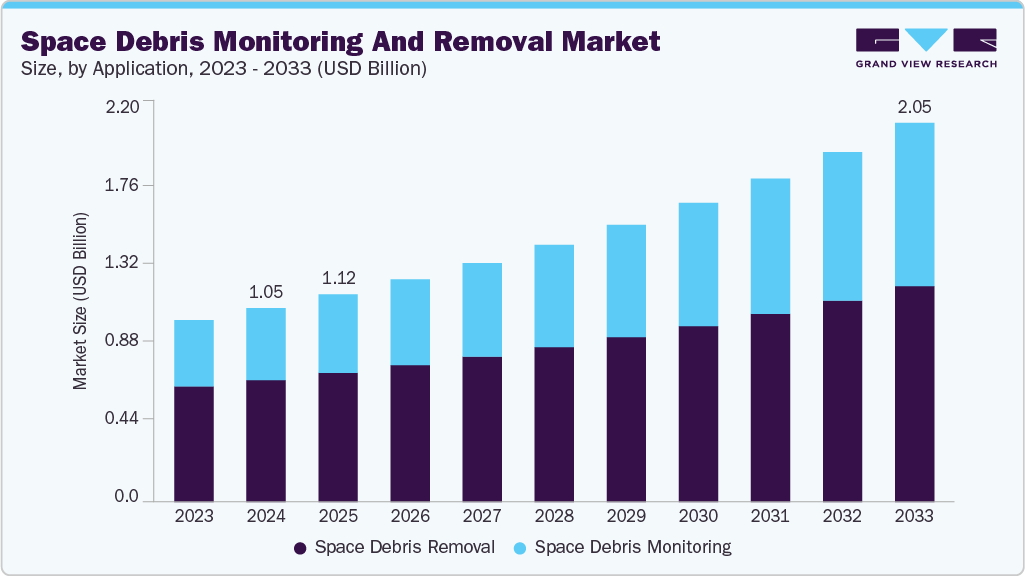
space-debris-monitoring-removal-market-size
The increasing demand for orbital safety and sustainability is accelerating the demand for space debris monitoring and removal solutions. Traditional passive monitoring systems are no longer sufficient, prompting governments and private players to invest in advanced technologies that actively track, predict, and eliminate space debris. This shift is further fueled by the growing number of satellite launches, particularly in Low Earth Orbit (LEO), which heightens collision risks and regulatory pressures. As a result, organizations are increasingly turning to innovative debris mitigation services, including AI-enabled tracking systems and active debris removal (ADR) missions, to ensure the long-term viability of space operations and protect critical assets.
軌道上の安全性と持続可能性に対する需要の高まりにより、スペースデブリ(宇宙ゴミ)監視・除去ソリューションの需要が加速しています。従来の受動的な監視システムではもはや十分ではなく、政府機関や民間企業は、宇宙デブリを能動的に追跡、予測、除去する高度な技術への投資を促しています。この変化は、特に低軌道(LEO)における衛星打ち上げの増加によってさらに加速しており、衝突リスクと規制圧力が高まっています。その結果、宇宙運用の長期的な実行可能性を確保し、重要な資産を保護するために、AIを活用した追跡システムや能動的なデブリ除去(ADR)ミッションなどの革新的なデブリ軽減サービスへの関心が高まっています。
The rising demand for satellite insurance coverage is accelerating the adoption of space debris monitoring and removal solutions. Insurers are placing more emphasis on collision avoidance measures and risk mitigation protocols as part of coverage terms. This shift is encouraging satellite operators to incorporate advanced debris tracking and alert systems into their operational workflows. Consequently, space debris mitigation has become not only a regulatory priority but also a critical factor in securing favorable insurance terms and managing operational risk.
衛星保険の需要の高まりは、スペースデブリ(宇宙ゴミ)監視・除去ソリューションの導入を加速させています。保険会社は、保険契約条件において、衝突回避策とリスク軽減プロトコルをより重視するようになっています。この変化は、衛星運用事業者が高度なデブリ追跡・警報システムを運用ワークフローに組み込むことを促しています。その結果、宇宙デブリの軽減は、規制上の優先事項であるだけでなく、有利な保険条件を確保し、運用リスクを管理する上で重要な要素となっています。
The rapid miniaturization of satellite technology and the growing number of CubeSat and small satellite deployments are heightening concerns over vulnerability to orbital debris. These smaller assets are more susceptible to damage from even sub-centimeter particles, driving demand for real-time micro-debris tracking systems. Companies are investing in scalable and cost-efficient debris monitoring platforms that can serve small satellite fleets without heavy infrastructure. This trend is reshaping market offerings, pushing vendors to develop lightweight, low-cost monitoring solutions tailored for emerging space startups and academic missions.
衛星技術の急速な小型化とキューブサットをはじめとする小型衛星の配備数の増加により、軌道上デブリに対する脆弱性への懸念が高まっています。これらの小型資産は、1センチメートル未満の粒子による損傷を受けやすく、リアルタイムの微小デブリ追跡システムの需要が高まっています。企業は、大規模なインフラを必要とせずに小型衛星群に対応できる、拡張性とコスト効率に優れたデブリ監視プラットフォームへの投資を進めています。この傾向は市場の提供内容に変化をもたらし、ベンダーは新興の宇宙スタートアップ企業や学術ミッション向けにカスタマイズされた軽量で低コストの監視ソリューションの開発を迫られています。
Commercial space companies are increasingly prioritizing the development of autonomous, AI-powered debris removal spacecraft to improve mission resilience. These technologies utilize machine vision, autonomous navigation, and robotic capture mechanisms to safely deorbit inactive satellites and debris. The shift toward automation decreases reliance on expensive ground control operations and allows for scalable debris mitigation. As space becomes more commercialized, the adoption of these self-operating systems is expected to grow significantly, establishing a new standard for orbital maintenance.
商業宇宙企業は、ミッションのレジリエンス向上のため、自律型AI搭載のデブリ除去宇宙船の開発をますます重視しています。これらの技術は、マシンビジョン、自律航法、ロボット捕捉メカニズムを活用し、休止中の衛星やデブリを安全に軌道離脱させます。自動化への移行により、高額な地上管制業務への依存度が低減し、スケーラブルなデブリ軽減が可能になります。宇宙の商業化が進むにつれて、これらの自律運用システムの採用は大幅に増加し、軌道維持の新たな基準を確立すると予想されます。
Space Debris Monitoring And Removal Market Report Scope
| Report Attribute | Details |
| Market size value in 2025 | USD 1.12 billion |
| Revenue forecast in 2033 | USD 2.05 billion |
| Growth rate | CAGR of 7.8% from 2025 to 2033 |
| Base year of estimation | 2024 |
| Actual data | 2021 – 2023 |
| Forecast period | 2025 – 2033 |
| Quantitative units | Revenue in USD million/billion and CAGR from 2025 to 2033 |
| Report coverage | Revenue forecast, company ranking, competitive landscape, growth factors, and trends |
| Segments covered | Application, debris size, end use, orbit type, region |
| Regional scope | North America; Europe; Asia Pacific; Latin America; Middle East and Africa |
| Country scope | U.S.; Canada; Mexico; Germany; UK; France; China; Japan; India; South Korea; Australia; Brazil; UAE; Saudi Arabia; South Africa |
| Key companies profiled | Astroscale; ClearSpace; LeoLabs; Northrop Grumman; Lockheed Martin; Airbus; SpaceX; Rocket Lab; Surrey Satellite Technology; Momentus |
| Customization scope | Free report customization (equivalent up to 8 analysts working days) with purchase. Addition or alteration to country, regional & segment scope. |