
Compound Semiconductor Market Size, Share, Trends and Forecast by Type, Product, Deposition Technology, Application, and Region, 2026-2034
化合物半導体市場の規模、シェア、動向、予測 : 種類別、製品別、成膜技術別、用途別、地域別、2026-2034年
| 出版 | IMARC Group |
| 出版年月 | 2026年04月 |
| ページ数 | 143 |
| 価格 | 記載以外のライセンスについてはお問合せください |
| シングルユーザ | USD 3,999 |
| 種別 | 英文調査報告書 |
| 商品番号 | SMR-17649 |

世界の化合物半導体市場規模は、2025年には1,279億米ドルと評価されました。IMARC Groupは、今後の見通しとして、市場規模は2034年までに1,811億米ドルに達し、2026年から2034年にかけて年平均成長率(CAGR)3.82%で成長すると予測しています。現在、アジア太平洋地域が市場を牽引しており、2025年には61.2%を超える市場シェアを占めています。高速電子機器、5G通信、電力効率の高いデバイス、自動車技術の進歩、LED照明の採用、IoTや再生可能エネルギー技術などの新たな用途へのニーズが、アジア太平洋地域における市場成長を牽引しています。
世界の化合物半導体市場は、高速電子機器、5G通信、IoTデバイスに対する需要の高まりに支えられた高出力・高周波アプリケーションにおけるイノベーションを主な要因として、著しい拡大を見せています。再生可能エネルギーソリューションや電気自動車(EV)への急速な傾倒は、炭化ケイ素(SiC)や窒化ガリウム(GaN)などの省エネルギー半導体の需要をさらに高めています。例えば、国際エネルギー機関(IEA)によると、主要なEVハブ以外の市場における電気自動車の販売台数は2024年には100万台を超えると予測されており、2023年の販売台数と比較して40%以上の大幅な成長が見込まれています。さらに、自動車産業、特にADASシステムやEVの拡大も市場の成長に大きく影響しています。加えて、多くの主要セクターにおけるLED技術の広範な利用や光電子デバイスの進歩も、世界的な市場拡大をさらに後押ししています。
IMARC Groupは、世界の化合物半導体市場の各セグメントにおける主要なトレンド分析に加え、2026年から2034年までの世界、地域、国レベルでの予測を提供しています。市場は、タイプ、製品、成膜技術、および用途に基づいて分類されています。
Report Overview
The global compound semiconductor market size was valued at USD 127.9 Billion in 2025. Looking forward, IMARC Group estimates the market to reach USD 181.1 Billion by 2034, exhibiting a CAGR of 3.82% from 2026-2034. Asia pacific currently dominates the market, holding a market share of over 61.2% in 2025. The need for high-speed electronics, 5G communication, and power-efficient devices, automotive advancements, LED lighting adoption, and emerging applications, including IoT and renewable energy technologies, are propelling the market growth in Asia Pacific.

compound semiconductor market
The global compound semiconductor market is witnessing notable expansion primarily due to innovations in high-power and high-frequency applications, fostered by magnifying requirement for exceptional-speed electronics, 5G communication, and IoT devices. The rapid inclination toward renewable energy solutions and electric vehicles (EVs) has further magnified the demand for energy-saving semiconductors, including silicon carbide (SiC) and gallium nitride (GaN). For instance, according to the International Energy Agency, electric vehicle sales in markets outside the primary EV hubs are projected to surpass 1 million units in 2024, reflecting a substantial growth of over 40% compared to the sales figures recorded in 2023. Furthermore, expansion in the automotive industry, especially in ADAS systems and EVs, is also impacting the market growth substantially. In addition, the extensive utilization of LED technology in numerous key sectors and advancements in optoelectronic devices are further boosting the market expansion globally.
The United States holds a significant position in the global compound semiconductor market, driven by advancements in defense technologies, telecommunications, and the automotive industry. The adoption of 5G networks and increasing demand for high-speed, power-efficient electronics are accelerating the use of compound semiconductors in various applications. In addition, key sectors, such as aerospace and renewable energy, also contribute to the market’s growth, leveraging these materials for their superior performance and reliability. For instance, in November 2024, the U.S. Commerce Department finalized approximately USD 60 million in government subsidies, allocating funds to BAE Systems (BAESF) for the production of chips utilized in jets and satellites, and to Rocket Lab (RKLB) for the development of compound semiconductors designed for satellites and spacecraft. Moreover, with substantial investments in research and development, the U.S. continues to innovate, fostering a competitive edge in the global landscape of compound semiconductors.
Compound Semiconductor Market Trends:
High-frequency Communication and 5G Networks
The National Library of Medicine reports of 2021 shows that the 5G network is projected to reach 40 percent population coverage and 1.9 Billion subscriptions by the end of 2024. The rise of high-speed, high-capacity communication systems is a crucial step in the establishment of compound semiconductors. Due to the establishment of 5G infrastructure around the world, these semiconductors operate at high frequencies and offer a substantial imperial value addition possibility for the supplier. According to Ericsson Mobility Report, the build-out of 5G continues, with around 320 networks launched worldwide. Global 5G population coverage is expected to reach 55 percent by 2024. Outside mainland China it is projected to increase from 45 percent in 2024 to about 85 percent in 2030. Additionally, the growth of the market is supported by compound semiconductors like gallium nitride (GaN) and gallium arsenide (GaAs), which are displacing elemental semiconductors such as silicon that are unstable at significant frequencies due to their elemental characteristics. Furthermore, the rising employment of GaN in 5G base stations, radar systems, and satellite communication equipment due to its high electron mobility and robust power handling capabilities is strengthening the compound semiconductor market growth.
Power Electronics and Energy Efficiency
As per the International Energy Agency, the global investment in energy efficiency reached USD 560 Billion in 2022, an increase of 16% on 2021. The heightening emphasis on energy saving and the notable inclination towards renewable energy sources are some of the crucial factors bolstering the need for compound semiconductors. For high-voltage and extreme temperature applications, materials including silicon-based semiconductors have certain drawbacks. However, silicon carbide with exceptional thermal conductivity and improved breakdown voltage aid in fostering more effective energy conversion and reducing power losses, which, in turn, is anticipated to fuel the market expansion. Furthermore, SiC is rapidly being employed in both fuel-cell and electric vehicles, as well as in industrial motor and solar inverters to significantly reduce energy consumption and boost sustainability, thereby accelerating the expansion of the compound semiconductor market globally.
Growing Demand for LiDAR
The IMARC Group’s report shows that the global LiDAR market size reached USD 2.6 Billion in 2023. LiDAR technology, which typically utilizes laser light sources to measure distances with high accuracy, is gaining momentum in numerous high-resolution applications, including environmental assessment, autonomous vehicles, and industrial automation. Compound semiconductors, which are mainly integrated with materials such as indium phosphide (InP) and gallium nitride (GaN), are critical components in the manufacturing of optimum-performance and effective laser diodes leveraged in LiDAR systems. In addition, as LiDAR systems are advancing to be useful in major sectors, there is an elevation in the requirement for cutting-edge semiconductor materials that have a better power output, can function at extreme temperatures and are more dependable. Compound semiconductors exhibit all these characteristics, resulting in rising adoption of this technology in the upcoming generation of LiDAR systems.
Compound Semiconductor Industry Segmentation:
IMARC Group provides an analysis of the key trends in each segment of the global compound semiconductor market, along with forecast at the global, regional, and country levels from 2026-2034. The market has been categorized based on type, product, deposition technology, and application.
Analysis by Type:
- III-V Compound Semiconductor
o Gallium Nitride
o Gallium Phosphide
o Gallium Arsenide
o Indium Phosphide
o Indium Antimonide
- II-VI Compound Semiconductor
o Cadmium Selenide
o Cadmium Telluride
o Zinc Selenide
- Sapphire
- IV-IV Compound Semiconductor
- Others
III-V compound semiconductor stand as the largest component in 2025, holding around 26.4% of the market. III-V compound semiconductors, such as gallium nitride, gallium phosphide, gallium arsenide, indium phosphide, and indium antimonide, are in high demand. They are required because of the unique material characteristics that allow breakthroughs in niche markets. GaN’s exceptional power handling capabilities are driving innovations in high-power electronics, RF amplifiers, and 5G infrastructure. GaAs’ high electron mobility supports high-speed devices for wireless communication and aerospace applications, thereby impelling the market growth. Similarly, InP is a fundamental material for high-speed optical communication systems since InSb is used in infrared detectors for thermal imaging. The exclusive performance of these specialized applications relies on III-V compound semiconductors.
Analysis by Product:
- Power Semiconductor
- Transistor
- Integrated Circuits
- Diodes and Rectifiers
- Others
Power semiconductor leads the market with around 25.2% of market share in 2025. As per IMARC Group’s report the global power semiconductor market reached USD 43.1 Billion in 2023. The surging demand for power compound semiconductors, such as silicon carbide (SiC) and gallium nitride (GaN), due to their transformative impact on energy efficiency and power electronics is one of the main drivers of the market. Additionally, SiC’s high thermal conductivity and breakdown voltage enhance energy conversion in EVs, renewable energy systems, and industrial equipment. GaN’s high electron mobility enables compact and efficient power supplies, contributing to smaller form factors in consumer electronics and EV charging systems. As industries seek enhanced performance, reduced energy losses, and greater power density, power compound semiconductors are emerging as crucial enablers, propelling their adoption across a spectrum of applications, aiding in market expansion.
Analysis by Deposition Technology:
- Chemical Vapor Deposition
- Molecular Beam Epitaxy
- Hydride Vapor Phase Epitaxy
- Ammonothermal
- Atomic Layer Deposition
- Others
Chemical vapor deposition leads the market with around 23.7% of market share in 2025. According to IMARC Group’s report, the global chemical vapor deposition (CVD) market is anticipated to reach USD 58.3 Billion by 2032. CVD provides superior uniformity and accuracy in depositing thin film materials, requisite for premium compound semiconductors, which, in turn, is bolstering the market expansion. Moreover, it aids a comprehensive range of materials and is compatible with several substrates, establishing it as a highly adaptable method. In addition to this, CVD’s excellent effectiveness and scalability in mass production position it as an ideal option for manufacturers, fulfilling the demand for compound semiconductors in various applications such as electronics, optoelectronics, and photovoltaics.
Analysis by Application:
- IT and Telecom
- Aerospace and Defense
- Automotive
- Consumer Electronics
- Healthcare
- Industrial and Energy and Power
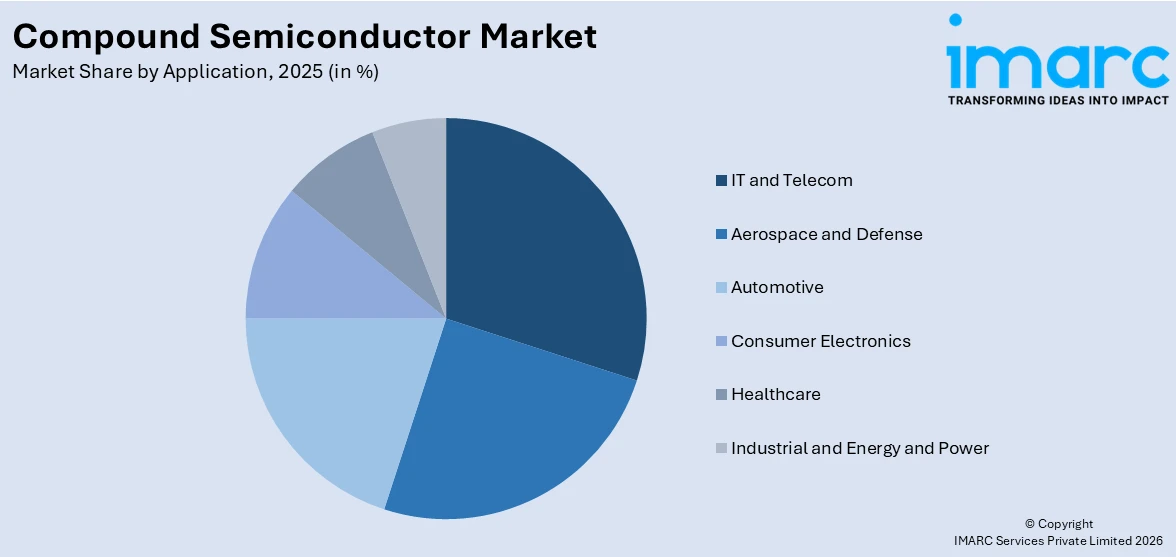
IT and telecom lead the market with around 22.2% of market share in 2025. The utilization of compound semiconductors in the IT and telecom sector is propelled by their capacity to meet the escalating demand for high-speed data transmission, networking, and wireless communication. These materials, such as gallium nitride (GaN) and indium phosphide (InP), enable the creation of high-frequency, high-efficiency devices critical for 5G infrastructure, satellite communication, and broadband expansion, fueling their adoption across various applications in the IT and telecom industry. GaN’s superior power handling characteristics enhance the performance of RF amplifiers and base stations, while InP’s exceptional optical properties drive advancements in optical communication systems. As the sector continues to seek faster and more reliable connectivity, compound semiconductors play an integral role in enabling the next era of information exchange and digital transformation.
Regional Analysis:
- North America
o United States
o Canada
- Asia Pacific
o China
o Japan
o India
o South Korea
o Australia
o Indonesia
o Others
- Europe
o Germany
o France
o United Kingdom
o Italy
o Spain
o Russia
o Others
- Latin America
o Brazil
o Mexico
o Others
- Middle East and Africa
In 2025, Asia Pacific accounted for the largest market share of over 61.2%. Asia-Pacific is a dominant player in the compound semiconductor market, driven by its robust electronics manufacturing sector and government-backed initiatives to develop renewable energy and 5G networks. According to IRENA, the solar photovoltaic energy capability in the South Asian country of India peaked at over 62.8 gigawatts in 2022, up 21.5% from the previous year. China, Japan, South Korea, and Taiwan lead the region in compound semiconductor production and innovation, with their expanding 5G networks and EV adoption contributing to market growth. China, in particular, is heavily investing in semiconductor localization and renewable energy projects, such as solar and wind power plants. Meanwhile, Japan and South Korea are advancing their EV and 5G infrastructure, while India is emerging as a hub for semiconductor production under its “Make in India” initiative. The increasing deployment of renewable energy systems and the growing focus on smart cities across the region are expected to further boost the market. According to the GSMA’s Mobile Economy Asia Pacific 2024 report, countries such as Australia, Japan, New Zealand, Singapore, and South Korea are expected to have 5G accounting for a substantial portion of their total mobile connections. Notably, South Korea is anticipated to achieve a 5G adoption rate exceeding 60%, underscoring the region’s rapid embrace of advanced mobile technologies.
Key Regional Takeaways:
United States Compound Semiconductor Market Analysis
The United States accounts for 87% of the market share in North America. The compound semiconductor market in the United States is experiencing rapid growth, fueled by advancements in renewable energy, 5G technology, and electric vehicle (EV) adoption. The U.S. government and private sectors are heavily investing in clean energy projects, with compound semiconductors being integral in energy management and smart grid integration. The U.S. is also leading the global 5G rollout, with a focus on mid-band and millimeter-wave spectrum, which is expected to significantly boost the semiconductor industry. According to the CTIA’s 2023 Annual Survey, nearly 40% of all wireless devices including phones, smartwatches, and IoT devices now have a 5G connection, marking a 34% increase over 2022. The increasing adoption of EVs, supported by federal incentives and initiatives to expand charging infrastructure, is further driving demand for compound semiconductors. Additionally, domestic manufacturing and the localization of chip production under programs like the CHIPS Act are set to create significant growth opportunities for the compound semiconductor market in the U.S.
Europe Compound Semiconductor Market Analysis
One of the key drivers for the compound semiconductor market in Europe is the European Commission’s strategic investment initiatives, including the allocation of up to EUR 1.75 Billion for industry research and innovation, expected to attract an additional EUR 6 Billion in private investments. This significant funding is aimed at accelerating technological advancements and fostering market adoption of compound semiconductors. Moreover, Europe’s ambition to increase its global semiconductor market share from 9% to 30% by 2030 underscores the region’s commitment to becoming a global leader in semiconductor manufacturing. The establishment of the European alliance on microelectronics, involving major chipmakers, automotive manufacturers, and telecom companies, further bolsters the region’s semiconductor ecosystem. Additionally, the goal to produce at least one-fifth of the world’s chips and microprocessors by value is driving substantial innovation and market growth opportunities, positioning Europe as a hub for cutting-edge compound semiconductor technologies.
Latin America Compound Semiconductor Market Analysis
The Latin American compound semiconductor market is driven by the region’s increasing integration into the global microelectronics industry and the localization of manufacturing capabilities within its growing electronics markets. The demand for microcomponents has seen steady growth, fueled by the rising need for cloud storage and data centers, as well as the expanding penetration of internet and communication devices. Additionally, industries in Latin America are adopting advanced technologies, including compound semiconductors, to develop green technology products such as LEDs and solar cells, aligning with sustainability goals. The emergence of IoT applications and the growth of autonomous products further support market expansion, creating significant opportunities for innovation and investment in the region.
Middle East and Africa Compound Semiconductor Market Analysis
The compound semiconductor market in the Middle East and Africa (MEA) region is witnessing substantial growth, driven by advancements in renewable energy, telecommunications, and electric vehicle (EV) infrastructure. Key countries like Saudi Arabia, Egypt, and the UAE are implementing extensive renewable energy programs, with compound semiconductors playing a pivotal role in managing energy generation and network integration. Initiatives like Saudi Arabia’s Semiconductor Program, launched by KACST in 2022, underscore the region’s focus on fostering research, development, and local manufacturing capabilities in electronic chip design. Furthermore, the rapid deployment of 5G across the region, led by Gulf nations, is supported by government-backed spectrum access, with mid-band 5G projected to contribute $16 Billion to the MENA region’s GDP by 2030, according to GSMA. In South Africa, MTN’s $42.25 Million investment in 5G expansion highlights similar progress. Meanwhile, Dubai’s ambitious “Smart Dubai” initiative aims to expand EV infrastructure and achieve a clean energy target of 75% by 2050. Projects like the world’s largest concentrated solar plant and incentives for EV adoption further bolster demand for compound semiconductors, creating a favorable outlook for the market.
Competitive Landscape:
The global compound semiconductor market features a competitive landscape characterized by the presence of key players focusing on innovation, technological advancements, and strategic collaborations. Companies are investing heavily in research and development to enhance product performance and cater to diverse applications in telecommunications, automotive, aerospace, and consumer electronics. Moreover, market leaders are leveraging partnerships and acquisitions to expand their portfolios and strengthen their market position. Furthermore, the rise of emerging players is intensifying competition through cost-effective manufacturing and innovative product offerings. Additionally, strategic geographic expansions and targeted marketing efforts are enabling companies to tap into high-growth regions, ensuring sustained competitiveness in a dynamic and evolving market. For instance, in September 2024, India and U.S. entered into a strategic partnership for the development of a multi-material semiconductor fabrication unit in Uttar Pradesh, India. The upcoming firm will manufacture chips for cutting-edge warfare technologies, including space sensors, electric vehicles, drones, night vision devices, and many more.
The report provides a comprehensive analysis of the competitive landscape in the compound semiconductor market with detailed profiles of all major companies, including:
- Infineon Technologies AG
- Microchip Technology Inc.
- Mitsubishi Electric Corporation
- Nexperia
- NXP Semiconductors
- Onsemi (Semiconductor Components Industries, LLC)
- Qorvo Inc.
- STMicroelectronics
- Texas Instruments Incorporated
- Wolfspeed Inc.
Compound Semiconductor Market Report Scope:
| Report Features | Details |
|---|---|
| Base Year of the Analysis | 2025 |
| Historical Period | 2020-2025 |
| Forecast Period | 2026-2034 |
| Units | Billion USD |
| Scope of the Report | Exploration of Historical Trends and Market Outlook, Industry Catalysts and Challenges, Segment-Wise Historical and Future Market Assessment:
|
| Types Covered |
|
| Products Covered | Power Semiconductor, Transistor, Integrated Circuits, Diodes and Rectifiers, Others |
| Deposition Technologies Covered | Chemical Vapor Deposition, Molecular Beam Epitaxy, Hydride Vapor Phase Epitaxy, Ammonothermal, Atomic Layer Deposition, Others |
| Applications Covered | IT And Telecom, Aerospace and Defense, Automotive, Consumer Electronics, Healthcare, Industrial and Energy, and Power |
| Regions Covered | Asia Pacific, Europe, North America, Latin America, Middle East and Africa |
| Countries Covered | United States, Canada, Germany, France, United Kingdom, Italy, Spain, Russia, China, Japan, India, South Korea, Australia, Indonesia, Brazil, Mexico |
| Companies Covered | Infineon Technologies AG, Microchip Technology Inc., Mitsubishi Electric Corporation, Nexperia, NXP Semiconductors, Onsemi (Semiconductor Components Industries, LLC), Qorvo Inc., STMicroelectronics, Texas Instruments Incorporated, Wolfspeed Inc., etc. |
| Customization Scope | 10% Free Customization |
| Post-Sale Analyst Support | 10-12 Weeks |
| Delivery Format | PDF and Excel through Email (We can also provide the editable version of the report in PPT/Word format on special request) |
Key Questions Answered in This Report
- What is compound semiconductor?
- How big is the global compound semiconductor market?
- What is the expected growth rate of the global compound semiconductor market during 2026-2034?
- What are the key factors driving the global compound semiconductor market?
- What is the leading segment of the global compound semiconductor market based on type?
- What is the leading segment of the global compound semiconductor market based on product?
- What is the leading segment of the global compound semiconductor market based on deposition technology?
- What is the leading segment of the global compound semiconductor market based on application?
- What are the key regions in the global compound semiconductor market?
- Who are the key players/companies in the global compound semiconductor market?
Table of Contents
1 Preface
2 Scope and Methodology
2.1 Objectives of the Study
2.2 Stakeholders
2.3 Data Sources
2.3.1 Primary Sources
2.3.2 Secondary Sources
2.4 Market Estimation
2.4.1 Bottom-Up Approach
2.4.2 Top-Down Approach
2.5 Forecasting Methodology
3 Executive Summary
4 Introduction
4.1 Overview
4.2 Key Industry Trends
5 Global Compound Semiconductor Market
5.1 Market Overview
5.2 Market Performance
5.3 Impact of COVID-19
5.4 Market Forecast
6 Market Breakup by Type
6.1 III-V Compound Semiconductor
6.1.1 Market Trends
6.1.2 Key Segments
6.1.2.1 Gallium Nitride
6.1.2.2 Gallium Phosphide
6.1.2.3 Gallium Arsenide
6.1.2.4 Indium Phosphide
6.1.2.5 Indium Antimonide
6.1.3 Market Forecast
6.2 II-VI Compound Semiconductor
6.2.1 Market Trends
6.2.2 Key Segments
6.2.2.1 Cadmium Selenide
6.2.2.2 Cadmium Telluride
6.2.2.3 Zinc Selenide
6.2.3 Market Forecast
6.3 Sapphire
6.3.1 Market Trends
6.3.2 Market Forecast
6.4 IV-IV Compound Semiconductor
6.4.1 Market Trends
6.4.2 Market Forecast
6.5 Others
6.5.1 Market Trends
6.5.2 Market Forecast
7 Market Breakup by Product
7.1 Power Semiconductor
7.1.1 Market Trends
7.1.2 Market Forecast
7.2 Transistor
7.2.1 Market Trends
7.2.2 Market Forecast
7.3 Integrated Circuits
7.3.1 Market Trends
7.3.2 Market Forecast
7.4 Diodes and Rectifiers
7.4.1 Market Trends
7.4.2 Market Forecast
7.5 Others
7.5.1 Market Trends
7.5.2 Market Forecast
8 Market Breakup by Deposition Technology
8.1 Chemical Vapor Deposition
8.1.1 Market Trends
8.1.2 Market Forecast
8.2 Molecular Beam Epitaxy
8.2.1 Market Trends
8.2.2 Market Forecast
8.3 Hydride Vapor Phase Epitaxy
8.3.1 Market Trends
8.3.2 Market Forecast
8.4 Ammonothermal
8.4.1 Market Trends
8.4.2 Market Forecast
8.5 Atomic Layer Deposition
8.5.1 Market Trends
8.5.2 Market Forecast
8.6 Others
8.6.1 Market Trends
8.6.2 Market Forecast
9 Market Breakup by Application
9.1 IT and Telecom
9.1.1 Market Trends
9.1.2 Market Forecast
9.2 Aerospace and Defense
9.2.1 Market Trends
9.2.2 Market Forecast
9.3 Automotive
9.3.1 Market Trends
9.3.2 Market Forecast
9.4 Consumer Electronics
9.4.1 Market Trends
9.4.2 Market Forecast
9.5 Healthcare
9.5.1 Market Trends
9.5.2 Market Forecast
9.6 Industrial and Energy and Power
9.6.1 Market Trends
9.6.2 Market Forecast
10 Market Breakup by Region
10.1 North America
10.1.1 United States
10.1.1.1 Market Trends
10.1.1.2 Market Forecast
10.1.2 Canada
10.1.2.1 Market Trends
10.1.2.2 Market Forecast
10.2 Asia-Pacific
10.2.1 China
10.2.1.1 Market Trends
10.2.1.2 Market Forecast
10.2.2 Japan
10.2.2.1 Market Trends
10.2.2.2 Market Forecast
10.2.3 India
10.2.3.1 Market Trends
10.2.3.2 Market Forecast
10.2.4 South Korea
10.2.4.1 Market Trends
10.2.4.2 Market Forecast
10.2.5 Australia
10.2.5.1 Market Trends
10.2.5.2 Market Forecast
10.2.6 Indonesia
10.2.6.1 Market Trends
10.2.6.2 Market Forecast
10.2.7 Others
10.2.7.1 Market Trends
10.2.7.2 Market Forecast
10.3 Europe
10.3.1 Germany
10.3.1.1 Market Trends
10.3.1.2 Market Forecast
10.3.2 France
10.3.2.1 Market Trends
10.3.2.2 Market Forecast
10.3.3 United Kingdom
10.3.3.1 Market Trends
10.3.3.2 Market Forecast
10.3.4 Italy
10.3.4.1 Market Trends
10.3.4.2 Market Forecast
10.3.5 Spain
10.3.5.1 Market Trends
10.3.5.2 Market Forecast
10.3.6 Russia
10.3.6.1 Market Trends
10.3.6.2 Market Forecast
10.3.7 Others
10.3.7.1 Market Trends
10.3.7.2 Market Forecast
10.4 Latin America
10.4.1 Brazil
10.4.1.1 Market Trends
10.4.1.2 Market Forecast
10.4.2 Mexico
10.4.2.1 Market Trends
10.4.2.2 Market Forecast
10.4.3 Others
10.4.3.1 Market Trends
10.4.3.2 Market Forecast
10.5 Middle East and Africa
10.5.1 Market Trends
10.5.2 Market Breakup by Country
10.5.3 Market Forecast
11 SWOT Analysis
11.1 Overview
11.2 Strengths
11.3 Weaknesses
11.4 Opportunities
11.5 Threats
12 Value Chain Analysis
13 Porters Five Forces Analysis
13.1 Overview
13.2 Bargaining Power of Buyers
13.3 Bargaining Power of Suppliers
13.4 Degree of Competition
13.5 Threat of New Entrants
13.6 Threat of Substitutes
14 Price Analysis
15 Competitive Landscape
15.1 Market Structure
15.2 Key Players
15.3 Profiles of Key Players
15.3.1 Infineon Technologies AG
15.3.1.1 Company Overview
15.3.1.2 Product Portfolio
15.3.1.3 Financials
15.3.1.4 SWOT Analysis
15.3.2 Microchip Technology Inc.
15.3.2.1 Company Overview
15.3.2.2 Product Portfolio
15.3.2.3 Financials
15.3.2.4 SWOT Analysis
15.3.3 Mitsubishi Electric Corporation
15.3.3.1 Company Overview
15.3.3.2 Product Portfolio
15.3.3.3 Financials
15.3.3.4 SWOT Analysis
15.3.4 Nexperia
15.3.4.1 Company Overview
15.3.4.2 Product Portfolio
15.3.4.3 Financials
15.3.4.4 SWOT Analysis
15.3.5 NXP Semiconductors
15.3.5.1 Company Overview
15.3.5.2 Product Portfolio
15.3.5.3 Financials
15.3.5.4 SWOT Analysis
15.3.6 Onsemi (Semiconductor Components Industries, LLC)
15.3.6.1 Company Overview
15.3.6.2 Product Portfolio
15.3.6.3 Financials
15.3.6.4 SWOT Analysis
15.3.7 Qorvo Inc.
15.3.7.1 Company Overview
15.3.7.2 Product Portfolio
15.3.7.3 Financials
15.3.7.4 SWOT Analysis
15.3.8 STMicroelectronics
15.3.8.1 Company Overview
15.3.8.2 Product Portfolio
15.3.8.3 Financials
15.3.8.4 SWOT Analysis
15.3.9 Texas Instruments Incorporated
15.3.9.1 Company Overview
15.3.9.2 Product Portfolio
15.3.9.3 Financials
15.3.9.4 SWOT Analysis
15.3.10 Wolfspeed Inc.
15.3.10.1 Company Overview
15.3.10.2 Product Portfolio
15.3.10.3 Financials
15.3.10.4 SWOT Analysis
List of Tables
Table 1: Global: Compound Semiconductor Market: Key Industry Highlights, 2025 and 2034
Table 2: Global: Compound Semiconductor Market Forecast: Breakup by Type (in Million USD), 2026-2034
Table 3: Global: Compound Semiconductor Market Forecast: Breakup by Product (in Million USD), 2026-2034
Table 4: Global: Compound Semiconductor Market Forecast: Breakup by Deposition Technology (in Million USD), 2026-2034
Table 5: Global: Compound Semiconductor Market Forecast: Breakup by Application (in Million USD), 2026-2034
Table 6: Global: Compound Semiconductor Market Forecast: Breakup by Region (in Million USD), 2026-2034
Table 7: Global: Compound Semiconductor Market: Competitive Structure
Table 8: Global: Compound Semiconductor Market: Key Players
List of Figures
Figure 1: Global: Compound Semiconductor Market: Major Drivers and Challenges
Figure 2: Global: Compound Semiconductor Market: Sales Value (in Billion USD), 2020-2025
Figure 3: Global: Compound Semiconductor Market Forecast: Sales Value (in Billion USD), 2026-2034
Figure 4: Global: Compound Semiconductor Market: Breakup by Type (in %), 2025
Figure 5: Global: Compound Semiconductor Market: Breakup by Product (in %), 2025
Figure 6: Global: Compound Semiconductor Market: Breakup by Deposition Technology (in %), 2025
Figure 7: Global: Compound Semiconductor Market: Breakup by Application (in %), 2025
Figure 8: Global: Compound Semiconductor Market: Breakup by Region (in %), 2025
Figure 9: Global: Compound Semiconductor (III-V Compound Semiconductor) Market: Sales Value (in Million USD), 2020 & 2025
Figure 10: Global: Compound Semiconductor (III-V Compound Semiconductor) Market Forecast: Sales Value (in Million USD), 2026-2034
Figure 11: Global: Compound Semiconductor (II-VI Compound Semiconductor) Market: Sales Value (in Million USD), 2020 & 2025
Figure 12: Global: Compound Semiconductor (II-VI Compound Semiconductor) Market Forecast: Sales Value (in Million USD), 2026-2034
Figure 13: Global: Compound Semiconductor (Sapphire) Market: Sales Value (in Million USD), 2020 & 2025
Figure 14: Global: Compound Semiconductor (Sapphire) Market Forecast: Sales Value (in Million USD), 2026-2034
Figure 15: Global: Compound Semiconductor (IV-IV Compound Semiconductor) Market: Sales Value (in Million USD), 2020 & 2025
Figure 16: Global: Compound Semiconductor (IV-IV Compound Semiconductor) Market Forecast: Sales Value (in Million USD), 2026-2034
Figure 17: Global: Compound Semiconductor (Other Types) Market: Sales Value (in Million USD), 2020 & 2025
Figure 18: Global: Compound Semiconductor (Other Types) Market Forecast: Sales Value (in Million USD), 2026-2034
Figure 19: Global: Compound Semiconductor (Power Semiconductor) Market: Sales Value (in Million USD), 2020 & 2025
Figure 20: Global: Compound Semiconductor (Power Semiconductor) Market Forecast: Sales Value (in Million USD), 2026-2034
Figure 21: Global: Compound Semiconductor (Transistor) Market: Sales Value (in Million USD), 2020 & 2025
Figure 22: Global: Compound Semiconductor (Transistor) Market Forecast: Sales Value (in Million USD), 2026-2034
Figure 23: Global: Compound Semiconductor (Integrated Circuits) Market: Sales Value (in Million USD), 2020 & 2025
Figure 24: Global: Compound Semiconductor (Integrated Circuits) Market Forecast: Sales Value (in Million USD), 2026-2034
Figure 25: Global: Compound Semiconductor (Diodes and Rectifiers) Market: Sales Value (in Million USD), 2020 & 2025
Figure 26: Global: Compound Semiconductor (Diodes and Rectifiers) Market Forecast: Sales Value (in Million USD), 2026-2034
Figure 27: Global: Compound Semiconductor (Other Products) Market: Sales Value (in Million USD), 2020 & 2025
Figure 28: Global: Compound Semiconductor (Other Products) Market Forecast: Sales Value (in Million USD), 2026-2034
Figure 29: Global: Compound Semiconductor (Chemical Vapor Deposition) Market: Sales Value (in Million USD), 2020 & 2025
Figure 30: Global: Compound Semiconductor (Chemical Vapor Deposition) Market Forecast: Sales Value (in Million USD), 2026-2034
Figure 31: Global: Compound Semiconductor (Molecular Beam Epitaxy) Market: Sales Value (in Million USD), 2020 & 2025
Figure 32: Global: Compound Semiconductor (Molecular Beam Epitaxy) Market Forecast: Sales Value (in Million USD), 2026-2034
Figure 33: Global: Compound Semiconductor (Hydride Vapor Phase Epitaxy) Market: Sales Value (in Million USD), 2020 & 2025
Figure 34: Global: Compound Semiconductor (Hydride Vapor Phase Epitaxy) Market Forecast: Sales Value (in Million USD), 2026-2034
Figure 35: Global: Compound Semiconductor (Ammonothermal) Market: Sales Value (in Million USD), 2020 & 2025
Figure 36: Global: Compound Semiconductor (Ammonothermal) Market Forecast: Sales Value (in Million USD), 2026-2034
Figure 37: Global: Compound Semiconductor (Atomic Layer Deposition) Market: Sales Value (in Million USD), 2020 & 2025
Figure 38: Global: Compound Semiconductor (Atomic Layer Deposition) Market Forecast: Sales Value (in Million USD), 2026-2034
Figure 39: Global: Compound Semiconductor (Other Deposition Technologies) Market: Sales Value (in Million USD), 2020 & 2025
Figure 40: Global: Compound Semiconductor (Other Deposition Technologies) Market Forecast: Sales Value (in Million USD), 2026-2034
Figure 41: Global: Compound Semiconductor (IT and Telecom) Market: Sales Value (in Million USD), 2020 & 2025
Figure 42: Global: Compound Semiconductor (IT and Telecom) Market Forecast: Sales Value (in Million USD), 2026-2034
Figure 43: Global: Compound Semiconductor (Aerospace and Defense) Market: Sales Value (in Million USD), 2020 & 2025
Figure 44: Global: Compound Semiconductor (Aerospace and Defense) Market Forecast: Sales Value (in Million USD), 2026-2034
Figure 45: Global: Compound Semiconductor (Automotive) Market: Sales Value (in Million USD), 2020 & 2025
Figure 46: Global: Compound Semiconductor (Automotive) Market Forecast: Sales Value (in Million USD), 2026-2034
Figure 47: Global: Compound Semiconductor (Consumer Electronics) Market: Sales Value (in Million USD), 2020 & 2025
Figure 48: Global: Compound Semiconductor (Consumer Electronics) Market Forecast: Sales Value (in Million USD), 2026-2034
Figure 49: Global: Compound Semiconductor (Healthcare) Market: Sales Value (in Million USD), 2020 & 2025
Figure 50: Global: Compound Semiconductor (Healthcare) Market Forecast: Sales Value (in Million USD), 2026-2034
Figure 51: Global: Compound Semiconductor (Industrial and Energy and Power) Market: Sales Value (in Million USD), 2020 & 2025
Figure 52: Global: Compound Semiconductor (Industrial and Energy and Power) Market Forecast: Sales Value (in Million USD), 2026-2034
Figure 53: North America: Compound Semiconductor Market: Sales Value (in Million USD), 2020 & 2025
Figure 54: North America: Compound Semiconductor Market Forecast: Sales Value (in Million USD), 2026-2034
Figure 55: United States: Compound Semiconductor Market: Sales Value (in Million USD), 2020 & 2025
Figure 56: United States: Compound Semiconductor Market Forecast: Sales Value (in Million USD), 2026-2034
Figure 57: Canada: Compound Semiconductor Market: Sales Value (in Million USD), 2020 & 2025
Figure 58: Canada: Compound Semiconductor Market Forecast: Sales Value (in Million USD), 2026-2034
Figure 59: Asia-Pacific: Compound Semiconductor Market: Sales Value (in Million USD), 2020 & 2025
Figure 60: Asia-Pacific: Compound Semiconductor Market Forecast: Sales Value (in Million USD), 2026-2034
Figure 61: China: Compound Semiconductor Market: Sales Value (in Million USD), 2020 & 2025
Figure 62: China: Compound Semiconductor Market Forecast: Sales Value (in Million USD), 2026-2034
Figure 63: Japan: Compound Semiconductor Market: Sales Value (in Million USD), 2020 & 2025
Figure 64: Japan: Compound Semiconductor Market Forecast: Sales Value (in Million USD), 2026-2034
Figure 65: India: Compound Semiconductor Market: Sales Value (in Million USD), 2020 & 2025
Figure 66: India: Compound Semiconductor Market Forecast: Sales Value (in Million USD), 2026-2034
Figure 67: South Korea: Compound Semiconductor Market: Sales Value (in Million USD), 2020 & 2025
Figure 68: South Korea: Compound Semiconductor Market Forecast: Sales Value (in Million USD), 2026-2034
Figure 69: Australia: Compound Semiconductor Market: Sales Value (in Million USD), 2020 & 2025
Figure 70: Australia: Compound Semiconductor Market Forecast: Sales Value (in Million USD), 2026-2034
Figure 71: Indonesia: Compound Semiconductor Market: Sales Value (in Million USD), 2020 & 2025
Figure 72: Indonesia: Compound Semiconductor Market Forecast: Sales Value (in Million USD), 2026-2034
Figure 73: Others: Compound Semiconductor Market: Sales Value (in Million USD), 2020 & 2025
Figure 74: Others: Compound Semiconductor Market Forecast: Sales Value (in Million USD), 2026-2034
Figure 75: Europe: Compound Semiconductor Market: Sales Value (in Million USD), 2020 & 2025
Figure 76: Europe: Compound Semiconductor Market Forecast: Sales Value (in Million USD), 2026-2034
Figure 77: Germany: Compound Semiconductor Market: Sales Value (in Million USD), 2020 & 2025
Figure 78: Germany: Compound Semiconductor Market Forecast: Sales Value (in Million USD), 2026-2034
Figure 79: France: Compound Semiconductor Market: Sales Value (in Million USD), 2020 & 2025
Figure 80: France: Compound Semiconductor Market Forecast: Sales Value (in Million USD), 2026-2034
Figure 81: United Kingdom: Compound Semiconductor Market: Sales Value (in Million USD), 2020 & 2025
Figure 82: United Kingdom: Compound Semiconductor Market Forecast: Sales Value (in Million USD), 2026-2034
Figure 83: Italy: Compound Semiconductor Market: Sales Value (in Million USD), 2020 & 2025
Figure 84: Italy: Compound Semiconductor Market Forecast: Sales Value (in Million USD), 2026-2034
Figure 85: Spain: Compound Semiconductor Market: Sales Value (in Million USD), 2020 & 2025
Figure 86: Spain: Compound Semiconductor Market Forecast: Sales Value (in Million USD), 2026-2034
Figure 87: Russia: Compound Semiconductor Market: Sales Value (in Million USD), 2020 & 2025
Figure 88: Russia: Compound Semiconductor Market Forecast: Sales Value (in Million USD), 2026-2034
Figure 89: Others: Compound Semiconductor Market: Sales Value (in Million USD), 2020 & 2025
Figure 90: Others: Compound Semiconductor Market Forecast: Sales Value (in Million USD), 2026-2034
Figure 91: Latin America: Compound Semiconductor Market: Sales Value (in Million USD), 2020 & 2025
Figure 92: Latin America: Compound Semiconductor Market Forecast: Sales Value (in Million USD), 2026-2034
Figure 93: Brazil: Compound Semiconductor Market: Sales Value (in Million USD), 2020 & 2025
Figure 94: Brazil: Compound Semiconductor Market Forecast: Sales Value (in Million USD), 2026-2034
Figure 95: Mexico: Compound Semiconductor Market: Sales Value (in Million USD), 2020 & 2025
Figure 96: Mexico: Compound Semiconductor Market Forecast: Sales Value (in Million USD), 2026-2034
Figure 97: Others: Compound Semiconductor Market: Sales Value (in Million USD), 2020 & 2025
Figure 98: Others: Compound Semiconductor Market Forecast: Sales Value (in Million USD), 2026-2034
Figure 99: Middle East and Africa: Compound Semiconductor Market: Sales Value (in Million USD), 2020 & 2025
Figure 100: Middle East and Africa: Compound Semiconductor Market: Breakup by Country (in %), 2025
Figure 101: Middle East and Africa: Compound Semiconductor Market Forecast: Sales Value (in Million USD), 2026-2034
Figure 102: Global: Compound Semiconductor Industry: SWOT Analysis
Figure 103: Global: Compound Semiconductor Industry: Value Chain Analysis
Figure 104: Global: Compound Semiconductor Industry: Porter’s Five Forces Analysis