
Solar PV Inverters - Market Share Analysis, Industry Trends & Statistics, Growth Forecasts (2026 - 2031)
The Solar PV Inverter Market Report is Segmented by Inverter Type (Central Inverters, String Inverters, Micro Inverters, and Hybrid/Battery-Ready Inverters), Phase (Single-Phase and Three-Phase), Connection Type (On-Grid and Off-Grid), Application (Residential, Commercial and Industrial, and Utility-Scale), and Geography (North America, Europe, Asia-Pacific, South America, and Middle East and Africa).
太陽光発電インバータ市場レポートは、インバータの種類(中央インバータ、ストリングインバータ、マイクロインバータ、ハイブリッド/バッテリー対応インバータ)、相(単相および三相)、接続タイプ(系統連系および系統外)、用途(住宅用、商業・産業用、公益事業規模)、および地域(北米、ヨーロッパ、アジア太平洋、南米、中東およびアフリカ)別に分類されています。
| 出版 | Mordor Intelligence |
| 出版年月 | 2026年02月 |
| ページ数 | 220 |
| 価格 | 記載以外のライセンスについてはお問合せください |
| シングルユーザ | USD 4,750 |
| 種別 | 英文調査報告書 |
| 商品番号 | SMR-16537 |

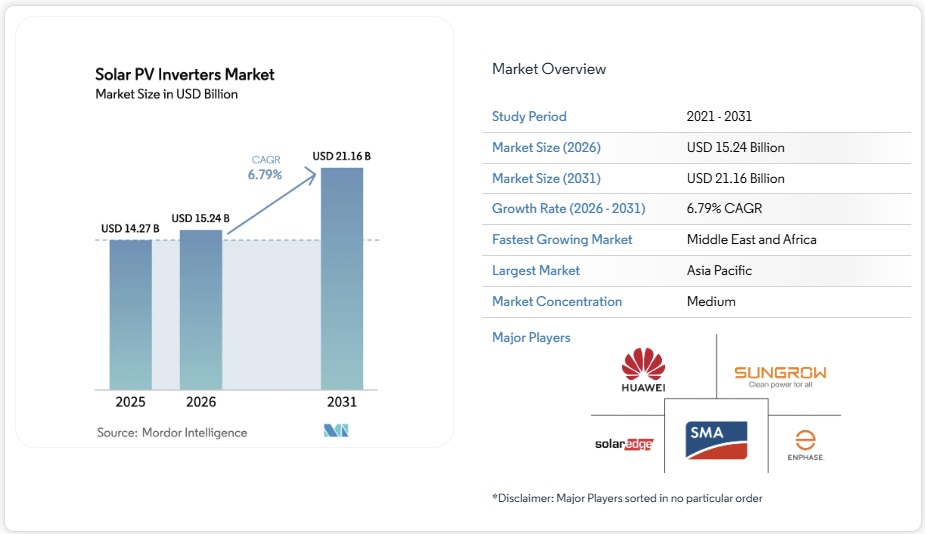
太陽光発電インバーター市場は、2025年の142億7,000万米ドルから2026年には152億4,000万米ドルに成長し、2031年には211億6,000万米ドルに達するとMordor Intelligenceでは予測しています。2026年から2031年にかけての年平均成長率(CAGR)は6.79%です。
市場の拡大は、単純な直流-交流変換から、電力品質の維持と所有者の新たな収益源の創出を可能にするスマートなグリッド形成ソリューションへの移行によって支えられています。アジア太平洋地域が世界の需要を牽引していますが、大規模な電力プロジェクトとグリッド近代化計画が重なり合う中東地域が現在最も急速に成長している地域となっています。日本における堅調な交換サイクル、インドにおける屋上設置義務化、米国と欧州における高電圧設計の普及が短期的な販売量を押し上げる一方、中国におけるSiC/IGBTの供給不足と出力抑制の増加が市場拡大のペースを抑制しています。こうした逆風にもかかわらず、高度な系統連系支援機能に対する高価格設定により、太陽光発電インバーター市場の総収益は上昇傾向を維持している。
セグメント分析
- 中央集中型インバータは2025年も売上高で54.30%のリードを維持すると予測されていますが、モジュールレベルの電子機器が初期導入段階のニッチ市場を超えつつあることから、マイクロインバータは年平均成長率(CAGR)7.96%で成長すると予測されています。Enphaseは2025年に国内で650万台以上のマイクロインバータを出荷し、米国の現地調達基準を満たし、このセグメントの商業規模を裏付けました。太陽光発電インバータ市場では、ASIC設計、無線データ通信、熱工学を小型化に統合した企業が優位に立っています。中央集中型アーキテクチャは、中国では出力抑制の影響で需要が横ばい状態ですが、他の地域では電力会社プロジェクト、特にプラントレベルの制御と競争力のある設備投資が重視される分野で依然として重要な役割を担っています。
- マイクロエレクトロニクス分野では競争が激化しており、参入障壁はハードウェアのコストではなく、ファームウェアの高度化と安全認証にあります。そのため、低価格参入企業は、急速シャットダウンやバッテリーインターフェースモードといった機能の急速な展開に追いつくのに苦労しています。マイクロインバーターは堅調な販売量増加にもかかわらず、今後10年間はストリング型インバーターを凌駕する可能性は低く、太陽光発電インバーター市場は構造の多様性を維持するだろう。
- 2025年の出荷量の62.25%は電力会社向けで、これは長期電力購入契約(PPA)に基づく大規模プロジェクトのパイプラインを反映している。それでも、グリッドサービスとネットビリング制度が家計の経済性を向上させるため、住宅用システムは年間7.45%の成長が見込まれる。インドのプラダン・マントリ・スーリヤ・ガル・プログラムは、2027年3月までに屋上設置型太陽光発電アレイを30GWまで拡大することを目標としており、オーストラリアでは蓄電池の導入が普及率を押し上げている。商業施設の屋上設置はインドの屋上設置義務化の波に乗っているが、他の地域では慎重な融資条件に直面しており、投資回収期間が長期化している。
- プロシューマーは双方向通信機能と独立運転モードの耐障害性をますます重視しており、インバーターメーカーは蓄電池制御ロジックの統合を進めている。その結果、平均販売価格(ASP)が上昇し、マクロ設置の伸びの鈍化を補い、太陽光発電インバーター市場全体の収益成長を支えている。一方、電力会社の開発業者は、1,500Vおよび2,000Vプラットフォームに注力し、より厳格な系統連系基準への準拠を満たすために、STATCOMのような機能と組み合わせる。
- 太陽光発電インバータ市場レポートは、インバータタイプ(セントラルインバータ、ストリングインバータ、マイクロインバータ、ハイブリッド/バッテリー対応インバータ)、相数(単相、三相)、接続タイプ(系統連系、独立系統連系)、用途(住宅用、商業・産業用、大規模発電用)、地域(北米、欧州、アジア太平洋、南米、中東・アフリカ)別に分類されている。
Solar PV Inverters Market Analysis
The Solar PV Inverters market is expected to grow from USD 14.27 billion in 2025 to USD 15.24 billion in 2026 and is forecast to reach USD 21.16 billion by 2031 at 6.79% CAGR over 2026-2031.
The market’s expansion is underpinned by a move from simple DC-to-AC conversion toward smart, grid-forming solutions that safeguard power quality and unlock new revenue streams for owners. Asia-Pacific anchors global demand, yet the Middle East is now the fastest-growing territory as large utility projects intersect with grid-modernization agendas. Robust replacement cycles in Japan, rooftop mandates in India, and higher-voltage designs across the United States and Europe amplify near-term unit volumes, while persistent SiC/IGBT shortages and rising curtailment in China temper the pace of expansion. Despite those headwinds, premium pricing for advanced grid-support functions keeps aggregate revenue upward in the solar PV inverter market .
Global Solar PV Inverters Market Trends and Insights
Rapid adoption of high-voltage 1 500 V string inverters in utility-scale projects (US, Spain)
Utility developers increasingly specify 1,500 V—and pilot 2,000 V—DC architectures to lower balance-of-system costs and boost power density. GE Vernova’s 2,000 V platform showcases a 30% output gain that decreases levelized energy costs. This voltage migration renders 1,000 V arrays economically obsolete on new-build sites and spurs retrofit projects, especially where land and grid headroom allow bigger block sizes. Heightened semiconductor demand follows, tightening the supply of SiC devices and elevating the strategic importance of thermal design expertise among leading brands.
Mandatory rooftop-solar mandates in India’s commercial buildings boosting ≤100 kW inverter demand
India’s policy obliges new and existing commercial structures to install rooftop arrays, driving the sustained need for ≤100 kW inverters. Record additions of 4 GW in fiscal 2024 signal the scale of the opportunity . Domestic manufacturers benefit from import-substitution targets embedded in the country’s 110 GW cell-and-module build-out by 2026, reinforcing the local value chain. While implementation gaps remain across several states, standardized installation practices create a template for broader residential uptake.
Persistent shortages & price volatility of high-current SiC / IGBT power modules
SiC wafer supply tightness continues to constrain high-efficiency inverters and amplify bill-of-material costs. Wolfspeed’s financial distress heightens risk perceptions, whereas Infineon’s switch to cost-effective 200 mm SiC wafers signals relief from 2026 onward . European and North American producers, dependent on advanced semiconductors for grid-forming functionality, experience sharper margin compression than vertically integrated Chinese peers able to fall back on silicon alternatives.
Other drivers and restraints analyzed in the detailed report include:
- Aggressive replacement cycle of inverters installed during Japan’s 2012-2016 FIT boom
- Integration of advanced grid-support functions lifting ASPs in Europe
- Rising curtailment in China’s northwest dampening central-inverter orders
For complete list of drivers and restraints, kindly check the Table Of Contents.
Segment Analysis
Central units retained a 54.30% revenue lead in 2025, yet microinverters are forecast to grow at an 7.96% CAGR as module-level electronics move beyond the early-adopter niche. Enphase shipped more than 6.5 million domestic microinverters in 2025, satisfying US localization criteria and underlining the segment’s commercial scale . The solar PV inverter market rewards firms that combine ASIC design, wireless data, and thermal engineering in a miniature footprint. Central architectures now confront flattish demand in China due to curtailment but remain anchored in utility projects elsewhere, especially where plant-level controls and competitive capex remain priorities.
Competitive intensity is pronounced in microelectronics; barriers arise from firmware sophistication and safety certifications rather than raw hardware cost. Consequently, low-price entrants struggle to keep pace with rapid feature rollouts such as rapid shutdown and battery interface modes. Despite robust volume growth, microinverters are not likely to eclipse string platforms before the next decade, keeping the solar PV inverter market diversified by architecture.
Utility plants captured 62.25% of 2025 shipments, reflecting large project pipelines locked under long-term PPAs. Even so, residential systems should expand by 7.45% annually as grid services and net-billing frameworks enhance household economics. India’s Pradhan Mantri Surya Ghar program targets 30 GW of rooftop arrays by March 2027, while Australia’s battery add-on trend lifts attachment rates. Commercial rooftops ride India’s rooftop mandate wave but face cautious finance terms in other regions that stretch payback timelines.
Prosumers increasingly value bidirectional capability and island-mode resilience, prompting inverter OEMs to integrate battery control logic. The resulting ASP uplift compensates for slower macro installation growth, supporting aggregate revenue progression inside the solar PV inverter market. Utility developers, meanwhile, focus on 1,500 V and 2,000 V platforms, coupling them with STATCOM-like functionalities to meet stricter grid-code compliance.
The Solar PV Inverter Market Report is Segmented by Inverter Type (Central Inverters, String Inverters, Micro Inverters, and Hybrid/Battery-Ready Inverters), Phase (Single-Phase and Three-Phase), Connection Type (On-Grid and Off-Grid), Application (Residential, Commercial and Industrial, and Utility-Scale), and Geography (North America, Europe, Asia-Pacific, South America, and Middle East and Africa).
Geography Analysis
Asia-Pacific generated 54.40% of 2025 shipments, underpinned by China’s vertically integrated supply chain and India’s policy-driven rooftop push. While China’s new market-based tariff regime may slow greenfield installations, volume resilience stems from retrofits that embed storage and higher-voltage strings. India’s manufacturing capacity, set to reach 110 GW by 2026, tightens domestic procurement loops and shields the local solar PV inverter market from import volatility, although regional disparities in regulatory execution temper immediate gains.
The Middle East, clocking the quickest 9.31% CAGR through 2031, aligns gigawatt-scale projects with economic diversification blueprints. Harsh desert conditions drive demand for high-derating-temperature designs, opening niches for European OEMs specializing in sealed cubicle solutions. Grid-reinforcement efforts in Saudi Arabia and the United Arab Emirates elevate low-voltage ride-through and reactive-power management specifications, pressing vendors to certify products against stricter utility benchmarks. North America and Europe operate in a mature install base where replacement and retrofit cycles dominate incremental demand. The US Inflation Reduction Act’s domestic content credits accelerate localized production, with Texas, South Carolina, and Arizona facilities targeting annual output well above 30 GW by 2026. Europe’s renewable penetration surpassing 50% in markets such as Germany and Spain raises the value of grid-forming features, allowing vendors to pass through higher ASPs even as new-build volumes plateau.
List of Companies Covered in this Report:
- Huawei Technologies Co., Ltd.
- Sungrow Power Supply Co., Ltd.
- SMA Solar Technology AG
- SolarEdge Technologies Inc.
- Enphase Energy Inc.
- FIMER SpA
- Delta Electronics, Inc.
- Growatt New Energy Technology Co., Ltd.
- Ginlong (Solis) Technologies
- TMEIC Corporation
- Mitsubishi Electric Corporation
- Schneider Electric SE
- Siemens AG
- Eaton Corporation plc
- Hitachi Energy Ltd.
- Omron Corporation
- Power Electronics España S.L.
- Chint Power Systems Co., Ltd.
- GoodWe Technologies Co., Ltd.
- GE Vernova
- Canadian Solar Inc. (CSI Solar)
- Toshiba Mitsubishi-Electric Industrial Systems Corp. (TMEIC)
- Kepco KPS (South Korea)
Additional Benefits:
- The market estimate (ME) sheet in Excel format
- 3 months of analyst support
Table of Contents
1 Introduction
1.1 Study Assumptions & Market Definition
1.2 Scope of the Study
2 Research Methodology
3 Executive Summary
4 Market Landscape
4.1 Market Overview
4.2 Market Drivers
4.2.1 Rapid adoption of high-voltage 1 500 V string inverters in utility-scale projects (US, Spain)
4.2.2 Mandatory rooftop-solar mandates in India’s commercial buildings boosting ?100 kW inverter demand
4.2.3 Aggressive replacement cycle of inverters installed during Japan’s 2012-2016 FIT boom
4.2.4 Integration of advanced grid-support functions lifting ASPs in Europe
4.2.5 Growth of hybrid PV-storage solutions driving bidirectional inverters in Australia
4.2.6 Localization incentives in Brazil encouraging domestic manufacture of central inverters
4.3 Market Restraints
4.3.1 Persistent shortages & price volatility of high-current SiC / IGBT power modules
4.3.2 Rising curtailment in China’s northwest dampening central-inverter orders
4.3.3 Fragmented US interconnection codes inflating certification costs
4.3.4 Fire-safety concerns on rooftop DC circuits slowing microinverter uptake in Germany
4.4 Supply-Chain Analysis
4.5 Regulatory Outlook
4.6 Technological Outlook
4.7 Porter’s Five Forces
4.7.1 Bargaining Power of Suppliers
4.7.2 Bargaining Power of Consumers
4.7.3 Threat of New Entrants
4.7.4 Threat of Substitutes
4.7.5 Intensity of Competitive Rivalry
5 Market Size & Growth Forecasts
5.1 By Inverter Type
5.1.1 Central Inverters
5.1.2 String Inverters
5.1.3 Microinverters
5.1.4 Hybrid/Battery-Ready Inverters
5.2 By Phase
5.2.1 Single-Phase
5.2.2 Three-Phase
5.3 By Connection Type
5.3.1 On-Grid
5.3.2 Off-Grid
5.4 By Application
5.4.1 Residential
5.4.2 Commercial and Industrial
5.4.3 Utility-Scale
5.5 By Geography
5.5.1 North America
5.5.1.1 United States
5.5.1.2 Canada
5.5.1.3 Mexico
5.5.2 Europe
5.5.2.1 United Kingdom
5.5.2.2 Germany
5.5.2.3 France
5.5.2.4 Spain
5.5.2.5 Nordic Countries
5.5.2.6 Russia
5.5.2.7 Rest of Europe
5.5.3 Asia-Pacific
5.5.3.1 China
5.5.3.2 India
5.5.3.3 Japan
5.5.3.4 South Korea
5.5.3.5 Malaysia
5.5.3.6 Thailand
5.5.3.7 Indonesia
5.5.3.8 Vietnam
5.5.3.9 Australia
5.5.3.10 Rest of Asia-Pacific
5.5.4 South America
5.5.4.1 Brazil
5.5.4.2 Argentina
5.5.4.3 Colombia
5.5.4.4 Rest of South America
5.5.5 Middle East and Africa
5.5.5.1 United Arab Emirates
5.5.5.2 Saudi Arabia
5.5.5.3 South Africa
5.5.5.4 Egypt
5.5.5.5 Rest of Middle East and Africa
6 Competitive Landscape
6.1 Market Concentration
6.2 Strategic Moves (M&A, Partnerships, PPAs)
6.3 Market Share Analysis (Market Rank/Share for key companies)
6.4 Company Profiles (includes Global level Overview, Market level overview, Core Segments, Financials as available, Strategic Information, Products & Services, and Recent Developments)
6.4.1 Huawei Technologies Co., Ltd.
6.4.2 Sungrow Power Supply Co., Ltd.
6.4.3 SMA Solar Technology AG
6.4.4 SolarEdge Technologies Inc.
6.4.5 Enphase Energy Inc.
6.4.6 FIMER SpA
6.4.7 Delta Electronics, Inc.
6.4.8 Growatt New Energy Technology Co., Ltd.
6.4.9 Ginlong (Solis) Technologies
6.4.10 TMEIC Corporation
6.4.11 Mitsubishi Electric Corporation
6.4.12 Schneider Electric SE
6.4.13 Siemens AG
6.4.14 Eaton Corporation plc
6.4.15 Hitachi Energy Ltd.
6.4.16 Omron Corporation
6.4.17 Power Electronics España S.L.
6.4.18 Chint Power Systems Co., Ltd.
6.4.19 GoodWe Technologies Co., Ltd.
6.4.20 GE Vernova
6.4.21 Canadian Solar Inc. (CSI Solar)
6.4.22 Toshiba Mitsubishi-Electric Industrial Systems Corp. (TMEIC)
6.4.23 Kepco KPS (South Korea)
7 Market Opportunities & Future Outlook
7.1 White-Space & Unmet-Need Assessment